
In This Article
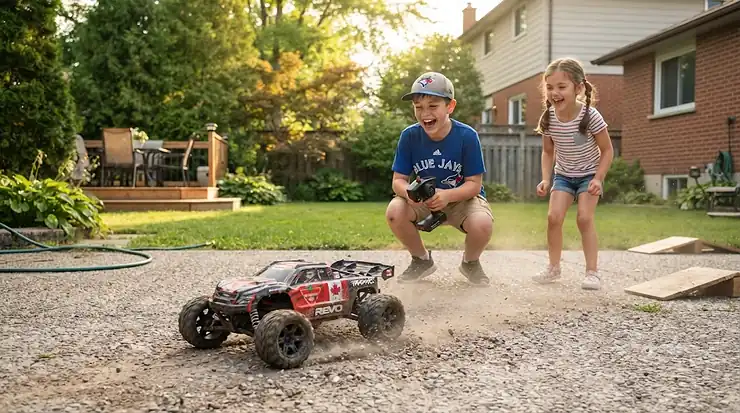
Somewhere in every Canadian garage, there’s a graveyard of dead-on-arrival toys — the kind that snap a wheel off on day two and get quietly binned before Grandma asks how they’re holding up. RC cars kids receive as gifts have a reputation for landing in that graveyard, and honestly, a lot of them earn it. But the good ones don’t just survive; they become the thing your kid begs to take to the cottage, the driveway, the school parking lot on a Saturday morning.

What is an RC car for kids? It’s a battery-powered, radio-controlled vehicle built with simplified controls, tougher plastics, and age-appropriate speed limits so children — typically ages 3 to 12 — can drive it independently with minimal supervision, unlike hobby-grade adult RC cars that demand assembly and tuning.
This guide skips the fluff you’d get from an Amazon listing and digs into what actually separates a toy that lasts a season from one that dies in the driveway. We’ve pulled together seven real, currently available models spanning toddler-friendly cartoon cruisers to near-hobby-grade trucks, with honest analysis of durability, battery life, and who each one genuinely suits — plus a full rundown on why these things are quietly excellent for a kid’s coordination and outdoor time. Before you scroll to the picks, it’s worth knowing that every toy on this list falls under Health Canada’s mandatory toy safety framework, which shapes a lot of what “durable” and “safe” really mean in this category — more on the safety specifics a bit further down.
Quick Comparison Table
| Product | Best For | Age Range | Top Speed | Price Range (CAD) |
|---|---|---|---|---|
| KULARIWORLD Mini RC Car | First-ever RC car, tight budgets | 5-9 | ~18 km/h | Under C$30 |
| Prextex Cartoon Police RC Car | Toddlers, sensory play | 3-6 | Slow crawl | C$40-C$55 |
| BIFYTON 1:18 RC Truck | Rough 6-year-old play | 5-9 | Moderate | C$45-C$65 |
| BEZGAR TB141 | All-weather backyard use | 8-12 | ~20 km/h | C$90-C$120 |
| HAIBOXING 18859E | Kids ready for real speed | 8-12 | Up to 36 km/h | C$130-C$170 |
| ARRMA Granite 4X2 Boost MEGA | Growing into the hobby | 10+ | 30+ mph (gear-dependent) | C$220-C$280 |
| RIAARIO Brushless RC Truck | Serious performance, older kids/teens | 12+ | High-speed, gyro-stabilized | C$280-C$350 |
Reading this table, the pattern is pretty clear: price climbs in step with motor power, chassis material, and how much abuse the thing can shrug off. Budget picks like the KULARIWORLD Mini RC Car and Prextex Cartoon Police RC Car win on accessibility and toddler-safe speeds, not toughness — while the RIAARIO Brushless RC Truck justifies its premium price with genuine hobby-grade engineering. If your kid is under 7, resist the urge to buy the fastest thing on this list; speed without supervision skill is just a fast way to lose a bumper.
💬 Just one click — help others make better buying decisions too! 😊
💬 Already have a favourite in mind? Jump down to see it in action — or keep reading for the full breakdown!
Top 7 RC Cars for Kids: Expert Analysis
1. KULARIWORLD Mini RC Car — best under-C$30 first ride
The KULARIWORLD Mini RC Car is proof that a low price tag doesn’t automatically mean a disappointing toy. Out of the box, it pulls a genuinely peppy 18 km/h on flat pavement, which for a first RC car is plenty to feel fast without feeling reckless. The built-in LED headlights aren’t just a gimmick — they turn a five-minute after-dinner driveway session into an actual event, and the roughly 100-foot control range means your kid can send it further than you’d expect from something this size.
Realistically, this is built for a first-timer between about 5 and 9, someone who wants to feel in control without a steep learning curve. Reviewers frequently mention that the rechargeable battery, while modest in capacity, charges fast enough that “dead battery” tantrums are short-lived rather than day-ruining. The plastic shell is light rather than armoured, so this isn’t the pick for a kid who treats every toy like a demolition derby entrant.
Pros:
- ✅ Genuinely fast for the price point
- ✅ LED headlights add real play value
- ✅ Simple, no-pairing 2.4GHz-style operation
Cons:
- ❌ Light plastic body dents on hard impacts
- ❌ Battery capacity is modest, so runtime is short
At under C$30, this sits firmly in “stocking stuffer that overdelivers” territory — a smart pick if you’re not ready to commit real money to a toy your kid might abandon in a month.
2. Prextex Cartoon Police RC Car — best toddler-proof starter
The Prextex Cartoon Police RC Car isn’t trying to be fast; it’s trying to be the first steering wheel your toddler ever holds, and on that front it delivers. The flashing lights, siren sound, and honking horn turn basic driving into a full sensory experience, which matters enormously for a 3-to-6-year-old whose attention span isn’t built for subtlety.
Each unit runs on its own radio frequency, meaning siblings can race two of these at once without one hijacking the other’s signal — a small design choice that saves a surprising number of meltdowns. The simple two-button or joystick control scheme means even a child who can’t yet manage complex hand movements can make it go forward, back, and turn. Reviewers describe it as an easy, low-frustration entry point precisely because there’s no speed to be afraid of and no complicated remote to decode.
Pros:
- ✅ Lights, siren, and horn create genuine toddler engagement
- ✅ Separate frequencies allow simultaneous multi-car play
- ✅ Extremely simple two-function control scheme
Cons:
- ❌ Runs on multiple AA batteries, so rechargeables are a must-buy
- ❌ Speed and durability aren’t built for anyone past about age 6
In the C$40-C$55 range, it’s a reasonable toddler gift, provided you budget an extra C$15-C$20 for a decent rechargeable AA battery set — the toy’s fun-per-dollar ratio depends heavily on not burning through disposables.
3. BIFYTON 1:18 RC Truck — most crash-proof for a 6 year old
If you’re specifically shopping for durable RC cars 6 year old kids can’t destroy in a weekend, the BIFYTON 1:18 RC Truck is the model built for exactly that fight. It’s a 2WD design, which sounds like a compromise on paper — and in thick grass, it is — but on pavement, gravel, porch steps, and garden beds, it’s shown remarkable resilience in real-world reports from parents of young, aggressive drivers.
The battery delivers a solid 30 minutes of runtime per charge, which for the toy-grade category is genuinely above average; most competitors in this price bracket cap out closer to 15-20 minutes. The 2.4GHz remote requires zero pairing ceremony — power on both units and go, which matters enormously when you’re trying to get a 6-year-old moving before their patience runs out. Aggregated parent feedback consistently frames this as the model that survives being driven into furniture repeatedly without cracking, which is precisely the abuse profile a 6-year-old subjects a toy to.
Pros:
- ✅ Genuinely tough against repeated hard impacts
- ✅ Above-average 30-minute runtime per charge
- ✅ Zero-hassle pairing and startup
Cons:
- ❌ 2WD struggles in thick grass or deep mud
- ❌ Top speed is modest compared to 4WD rivals
At roughly C$45-C$65, this is arguably the best value on this entire list for the specific job of “give a young, hard-charging kid something that won’t break by Sunday.”
4. BEZGAR TB141 — best all-weather backyard bruiser
The BEZGAR TB141 steps up the build quality noticeably, pairing an ABS plastic chassis with an aluminum alloy body frame — a combination that meaningfully improves collision resistance over pure-plastic competitors. Reaching around 20 km/h, it’s fast enough to be exciting for an 8-to-12-year-old without tipping into “needs a helmet” territory, and the 2.4GHz non-interference remote holds a genuine 50-metre range, which is plenty for most backyards and small parks.
What stands out here is the charging setup: two rechargeable batteries plus a USB charger, with built-in overcharge and short-circuit protection — a detail that matters more than most parents realize, since cheap RC batteries are a disproportionately common source of toy-related battery incidents. What most buyers overlook about this model is that the dual-battery system effectively doubles playtime without doubling the wait, since one battery can charge while the other’s in use.
Pros:
- ✅ Aluminum alloy frame handles real impacts well
- ✅ Dual rechargeable batteries with safety protections
- ✅ Stable performance on both grass and pavement
Cons:
- ❌ Requires a decent chunk of open space at full speed
- ❌ Not marketed with off-brand replacement parts readily available
In the C$90-C$120 range, the BEZGAR TB141 earns its price premium mainly through the battery safety engineering — for parents specifically nervous about battery incidents, that’s worth paying for.
5. HAIBOXING 18859E — best bridge to real hobby-grade
This is where the lineup crosses from “toy” into something closer to a genuine hobby-grade machine wearing a kid-friendly disguise. The HAIBOXING 18859E runs a 380 brushed motor through a proper 4WD drivetrain, hitting up to 36 km/h — noticeably faster than anything else on this list built for a similar age bracket. Ball bearings and a solid gear differential replace the bushings and plastic gears you’d find in cheaper trucks, which translates directly into less friction, less heat, and a longer working life.
The clever part for parents is the 70% throttle-limiting switch, which caps power output for a beginner without permanently locking out the fun — flip it off once your kid has earned some confidence, and the truck’s full speed becomes available. Based on the spec comparison against toy-grade competitors, the independent suspension here is the real differentiator: it’s what lets this thing handle bumpy, uneven yards without bottoming out or flipping.
Pros:
- ✅ 4WD and ball bearings deliver hobby-grade feel
- ✅ Beginner throttle limiter grows with the kid
- ✅ Independent suspension handles rough terrain well
Cons:
- ❌ Full speed is genuinely too fast for unsupervised younger kids
- ❌ LiPo battery handling requires a bit more parental oversight
At C$130-C$170, this is the pick for a kid who’s outgrown toy-grade cars and is ready for something with actual mechanical sophistication underneath the hood.
6. ARRMA Granite 4X2 Boost MEGA — best upgrade path for growing skills
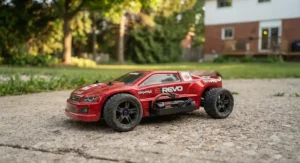
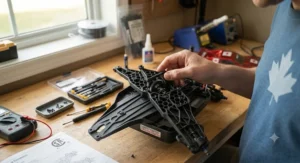
The ARRMA Granite 4X2 Boost MEGA arrives ready-to-run, but it’s built on a genuine hobby platform — meaning parts, upgrades, and a real community exist behind it, unlike disposable toy-grade trucks. The MEGA 550 12T brushed motor can push past 30 mph with optional gearing changes, and the modular design means power, differential, and electronics modules can be accessed and swapped without an engineering degree.
What the spec sheet won’t tell you, but the design clearly signals, is that ARRMA built this specifically as a stepping stone — the included Spektrum SLT2 transmitter offers 50/75/100% throttle modes, so a kid can genuinely grow into this truck’s full capability over a season rather than outgrowing it in a week. That kind of headroom is rare in a first “real” RC car and is precisely why hobbyist communities frequently recommend this line as the sensible jumping-off point.
Pros:
- ✅ True hobby-grade platform with real upgrade paths
- ✅ Modular design simplifies maintenance and repairs
- ✅ Multi-mode throttle limiter suits growing skill levels
Cons:
- ❌ Meaningfully pricier than toy-grade alternatives
- ❌ Requires some willingness to learn basic maintenance
At C$220-C$280, this isn’t an impulse buy — it’s for the kid who’s shown genuine, sustained interest in RC as a hobby rather than a passing phase.
7. RIAARIO Brushless RC Truck — best premium performance pick
At the top of this lineup sits the RIAARIO Brushless RC Truck, and the spec sheet reads like something you’d expect on a truck twice the price. A 3650 2650KV brushless motor with a metal heatsink and cooling fan delivers sustained high-speed performance without the overheating issues that plague cheaper brushed motors, while a built-in gyroscope adds genuine stability at speed — something toy-grade trucks simply don’t attempt.
The 2.5mm hardened aluminum alloy chassis, paired with a carbon fibre second floor plate and shock tower, is construction quality you’d normally see on trucks costing hundreds more. CNC-machined gears reduce slippage, a 7075 gear servo delivers 11kg of torque, and the 60A ESC paired with a 5-channel 2.4GHz transmitter — complete with a data screen and adjustable throttle limits from 0 to 100 percent — means this truck can be dialed all the way back for a nervous first-timer or opened all the way up for an experienced older kid or teen.
Pros:
- ✅ Brushless motor with genuine sustained performance
- ✅ Aluminum and carbon fibre construction is premium-grade
- ✅ Fully adjustable throttle limits suit any skill level
Cons:
- ❌ Overkill and overpriced for younger, casual users
- ❌ Higher top speed demands large, open spaces to use safely
At C$280-C$350, the RIAARIO Brushless RC Truck is the pick for a family that’s already decided RC is a genuine hobby, not just a toy — the value is real, but only if the speed will actually get used.
Getting Started: Your Beginner Remote Control Car Setup Guide
Buying a beginner remote control car is only step one; getting it set up right in the first 30 days is what determines whether it becomes a favourite or a forgotten drawer occupant. Start by fully charging the battery before the first run — most kids (and honestly, most parents) skip this and wonder why day-one performance feels sluggish. Pair the remote and vehicle in an open space, away from other 2.4GHz devices, and do a slow first lap to check steering trim before letting a kid open the throttle.
The most common early mistake is charging batteries overnight on a bare tabletop or bed — always charge on a hard, heat-resistant surface, and never leave a charging RC battery unattended in another room. For maintenance, wipe down wheels and the underside after any grass or dirt session; caked mud in the wheel wells is the number one cause of motor strain in the first month. Set a simple rule early: the remote gets turned off before the car gets picked up, which prevents the classic “surprise reverse into a shin” incident. Within the first week, most kids master forward-reverse-turn; the optimization trick from there is teaching gentle throttle control rather than full-send driving, which meaningfully extends both battery life and gear longevity.
Real-World Scenarios: Matching Kids to the Right RC Car
The cautious 4-year-old with an older sibling racing everything in sight needs something like the Prextex Cartoon Police RC Car — low stakes, high sensory payoff, and a separate frequency so the older kid’s faster truck doesn’t interfere with playtime. The fearless 6-year-old who treats every toy like a stress test is the exact customer for the BIFYTON 1:18 RC Truck — its documented resilience to hard impacts and furniture collisions matters more here than top speed ever could.
The 9-year-old who’s begged for “a real one” after watching RC videos online is ready for the HAIBOXING 18859E or BEZGAR TB141, depending on budget — both offer genuine speed with a beginner-friendly throttle ceiling that can be raised later. The 12-year-old who’s shown sustained interest over multiple birthdays — asking about upgrades, watching maintenance videos, wanting to understand how the motor works — has earned a look at the ARRMA Granite 4X2 Boost MEGA or, budget allowing, the RIAARIO Brushless RC Truck, both of which reward a kid who’s ready to treat this as an actual hobby rather than a toy.
How to Choose an RC Car for Kids
- Match top speed to age and supervision level — a 5-year-old doesn’t need 36 km/h; a 12-year-old with an open field might.
- Check battery type and charge time — rechargeable lithium batteries beat disposable AAs on cost and convenience over time.
- Confirm terrain compatibility — 2WD toy-grade trucks handle pavement fine but bog down in grass; 4WD is worth the upgrade for yards.
- Look for a throttle limiter switch — this single feature extends a car’s useful lifespan by years, since it grows with the kid.
- Verify parts availability — hobby-grade trucks with real community support are repairable; disposable toy-grade ones usually aren’t.
- Read aggregated review themes, not star ratings alone — recurring complaints about cracked bodies or dead motors matter more than a 4.5-star average.
- Budget for accessories — extra batteries, a spare body shell, and rechargeable AAs often cost more over a year than the toy itself.
Durable RC Cars for a 6 Year Old: What Actually Survives Backyard Chaos
Six-year-olds are, functionally, a stress test on legs. They drive toys into walls, down stairs, and through puddles with an enthusiasm that no engineer fully anticipates, which is exactly why durable RC cars 6 year old parents search for tend to share a few specific traits rather than a single brand. Reinforced wheel wells, a slightly heavier chassis (paradoxically, more weight often means more impact absorption rather than more fragility), and simple mechanical designs with fewer exposed small parts all correlate with longer real-world lifespans.
The BIFYTON 1:18 RC Truck exemplifies this — its 2WD simplicity means fewer components that can jam or crack under stress, and its documented survival of stair-drops and furniture collisions isn’t marketing spin, it’s the recurring theme across aggregated parent feedback. Reviewers consistently note that the biggest durability killer at this age isn’t the crashes themselves but water exposure from puddle-driving without a sealed electronics housing, so checking for at least basic splash resistance is worth the extra few dollars.
Rechargeable RC Vehicles: Battery Types, Runtime, and True Cost
Rechargeable RC vehicles fall into two camps: simple NiMH battery packs, common in toy-grade cars, and lithium-based packs (LiPo or Li-ion), which power most mid-range and hobby-grade trucks. NiMH is forgiving, cheap to replace, and nearly impossible to damage through normal misuse — ideal for younger kids. Lithium packs deliver more power and faster charging but demand a bit more care: never leave them charging unattended, and store them at partial charge if the toy goes unused for weeks.
On total cost of ownership, the math favours rechargeables decisively over disposables within about two to three months of regular play — a single quality rechargeable pack replaces what would otherwise be a steady stream of AA batteries. Runtime varies enormously across this list, from roughly 10-15 minutes on entry-level models to 30-plus minutes on the BIFYTON 1:18 RC Truck and dual-battery setups like the BEZGAR TB141. If your household plans on frequent, longer play sessions, budgeting for a second battery pack from day one — rather than after the first “but it’s already dead!” complaint — is the smarter long-term move.
✨ Ready to stop guessing and start racing? Check current prices on today’s top picks before they shift!
Hand-Eye Coordination Toys: The Real Developmental Case for RC Cars
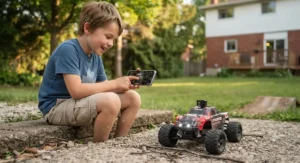
RC cars belong solidly in the category of hand-eye coordination toys, and the mechanism is straightforward: a child watches the vehicle’s position and speed in real time, then translates that visual information into small, continuous thumb and finger adjustments on the controller. That closed loop — see, judge, adjust, see again — is precisely the kind of repeated practice that builds fine motor precision and visual tracking, skills that also transfer to activities like handwriting, sports, and even screen-based tasks that require sustained visual attention.
Unlike a lot of “educational toy” marketing claims, this one holds up simply through repetition and consequence: steer too late and the car hits the curb, steer too early and it clips the flower bed, and the child adjusts their timing accordingly without anyone lecturing them about physics. It’s coordination practice disguised entirely as fun, which is arguably the best kind.
Outdoor Remote Play: Turning a Backyard Into a Racetrack
Canadian kids spend a notably limited amount of time outdoors on an average day, according to national active-play research from a Canadian public health network — and outdoor remote play with an RC car is a remarkably low-friction way to nudge that number up. There’s no team to organize, no equipment to haul beyond the car itself, and the built-in novelty of “driving” something tends to hold attention far longer than a plain ball or bike might on a lazy Tuesday evening.
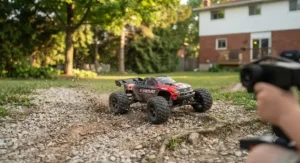
Driveways and cul-de-sacs work fine for beginner models, but a proper backyard or local park opens up terrain variety — grass, gravel, gentle slopes — that meaningfully improves the play value of 4WD trucks like the HAIBOXING 18859E or ARRMA Granite 4X2 Boost MEGA. A simple trick worth trying: set up cone or stick “checkpoints” and time laps, turning a solo backyard session into a genuine challenge that keeps a kid engaged well past the ten-minute mark most toys manage before boredom sets in.
Vehicular Control Skills: What Steering a Toy Car Actually Teaches
There’s a genuine argument that early exposure to vehicular control skills through RC cars builds intuitions kids will actually use later — understanding that a vehicle continues moving after you stop steering, that speed changes how sharply you can turn, and that overcorrecting a skid usually makes things worse, not better. None of this is formally “taught,” but repeated hands-on experience with a small, low-stakes vehicle builds an intuitive feel for momentum and control that a video game’s simplified physics genuinely can’t replicate.
This matters more with 4WD, higher-speed models like the BEZGAR TB141 or RIAARIO Brushless RC Truck, where the consequences of misjudging a turn are immediate and visible, rather than abstracted behind a screen. It’s a low-stakes way for a kid to build genuine spatial and control judgment years before they’ll ever sit behind a real steering wheel.
RC Cars vs Traditional Push Toys and Video Games
Compared with traditional push-and-pull toy cars, RC cars trade some of the raw physical activity of running alongside a toy for a different kind of engagement: sustained attention, remote-based fine motor practice, and the payoff of controlling something from a distance rather than by direct contact. Push toys still win for pure gross-motor exercise with toddlers, but RC cars pull ahead the moment a child is old enough to want independence and mastery over a “real” driving experience rather than simple pushing.
Against video games — often the RC car’s real competitor for attention — the case is arguably stronger. Both demand hand-eye coordination and reward practice, but an RC car happens outdoors, involves actual physical objects with real consequences (a crash is a crash, not a respawn), and according to research compiled by a Canadian physical and health education organization, outdoor active play is linked to measurable gains in concentration and attention span that purely screen-based play doesn’t replicate. An RC car essentially offers the engagement of a driving game with none of the screen time.
Common Mistakes Parents Make When Buying RC Cars for Kids
The single most common mistake is buying for the child’s dream rather than their actual skill level — a 5-year-old begging for the fastest truck on the shelf usually ends up frustrated, not thrilled, once they can’t keep it out of the flowerbed. A close second is skipping the battery math entirely: buying a car that runs on disposable AAs without budgeting for rechargeables turns a “cheap” toy into a recurring expense within weeks.
Parents also frequently underestimate terrain mismatch — a sleek pavement-only 2WD car bought for a family with a grass-only backyard is set up to disappoint on day one. Finally, skipping the first-run supervision step (checking trim, confirming battery charge, doing a slow test lap) leads to avoidable early damage that colours a kid’s entire first impression of the toy, sometimes unfairly.
Safety, Batteries, and Canadian Toy Regulations
Every children’s toy sold in Canada — RC cars included — falls under the Canada Consumer Product Safety Act and its Toys Regulations, which set mandatory limits on mechanical, electrical, and thermal hazards. Battery-specific risks deserve particular attention: Health Canada’s own battery safety guidance stresses that only adults should install or handle battery installation for young children, given the real risk of swallowing hazards and chemical exposure from damaged cells.
For toys marketed to children under three, the same regulations require the absence of small, detachable parts that could present a choking hazard — worth double-checking on any toddler-oriented pick like the Prextex Cartoon Police RC Car, since accessories like antennas or small trim pieces sometimes slip through less rigorous manufacturing. Practical safety habits matter as much as the regulations themselves: charge batteries in a supervised, ventilated space, never puncture or expose a battery pack to water, and retire any battery that shows swelling or damage immediately rather than “getting one more charge out of it.”
Features That Actually Matter (And Those That Don’t)
Genuinely worth paying for: a throttle-limiting switch, sealed or water-resistant electronics, rechargeable battery systems, and independent suspension on anything used off pavement — all four directly affect how long a car survives real play and how safely a beginner can use it. Largely marketing noise: exaggerated top-speed claims measured under ideal conditions no backyard replicates, “scale accuracy” claims that matter to adult collectors but mean nothing to a 7-year-old, and flashy body kits that add cost without adding durability or performance.
Here’s what to weigh when a listing leads with “professional-grade”: that language often signals genuine engineering (as with the RIAARIO Brushless RC Truck‘s gyroscope and brushless motor) but sometimes just signals a higher price tag with no functional difference from the toy-grade model beside it — cross-reference against the actual spec sheet, not the headline, before paying the premium.
✨ Don’t Miss These Exclusive Deals!
🔍 Take your search for the perfect RC car to the next level with these carefully vetted picks. Click through to check current pricing and availability — and get your kid outside making some genuinely great memories this season!
Frequently Asked Questions
❓ How fast can an RC car for kids go?
❓ Are RC cars safe for a 6 year old?
❓ How long do rechargeable RC car batteries last per charge?
❓ What is the best RC car for a beginner kid?
❓ Do RC cars actually help with coordination?
Conclusion
There’s no single “best” RC car for kids — there’s only the best one for your specific kid, their age, their patience level, and how much backyard chaos you’re willing to tolerate on a Saturday afternoon. What matters more than any spec sheet is matching realistic expectations to the right model: a toddler doesn’t need speed, a rough-and-tumble 6-year-old needs toughness over everything else, and a kid who’s shown real staying power deserves room to grow into a proper hobby-grade truck.
Across all seven picks here, the throughline is honesty about trade-offs — nothing on this list is perfect, but each earns its spot for a specific kid and situation. Whichever one ends up in your cart, the real win isn’t the toy itself; it’s the hours of outdoor, screen-free, coordination-building play it buys back for your family, one backyard lap at a time.
✨ Ready to pick the right one for your kid? Check current prices and availability on today’s top picks before you decide!
Recommended for You
- Street Hockey Equipment: 7 Best Picks for Driveway Play (2026)
- beginner hockey equipment kids: 7 Picks Canadian Parents Trust (2026)
- Kids Sports Equipment: 7 Top Picks Parents Love in 2026
Disclaimer: This article contains affiliate links. As an Amazon Associate, I earn from qualifying purchases. If you purchase products through these links, we may earn a small commission at no additional cost to you.
✨ Found this helpful? Share it with your friends! 💬🤗
