
In This Article
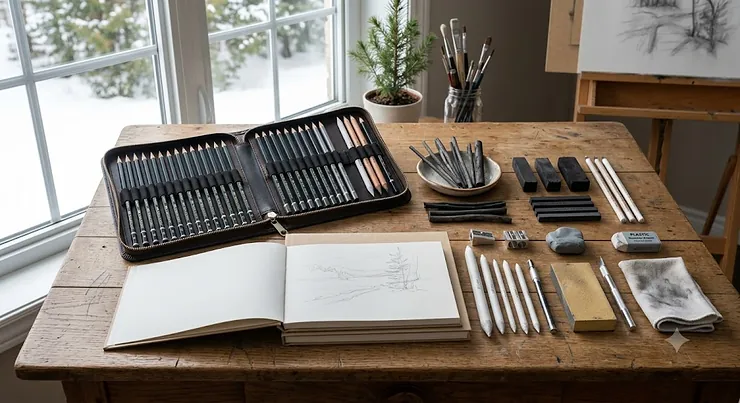
Standing in front of a wall of pencil tins and paint tubes, wondering which professional drawing set will actually get you drawing instead of just collecting dust, is a very specific kind of Canadian art-supply paralysis. Prices climb every year, shipping from the U.S. adds duty and exchange-rate sting, and half the “professional” labels on Amazon mean almost nothing. So what is a professional drawing set, really? In plain terms, it is a curated collection of graphite, charcoal, or coloured pencils — sometimes paired with blending tools, erasers, and a sketchbook — built with artist-grade pigments and break-resistant cores rather than the softer, chalkier leads found in kids’ craft kits.
This guide cuts through the marketing fog with real product research: actual model numbers, aggregated review sentiment pulled from verified sources, and honest analysis of who each option suits. We looked at everything from entry-level all-in-one kits to specialist graphite tins, alongside the gear that naturally follows once drawing turns into painting — an oil painting starter kit, a proper artist easel studio setup, and the fine arts materials that carry a sketchbook habit into portfolio-ready work. Whether you’re a hobbyist rebuilding a home studio, a parent shopping for a teenager applying to art school, or someone circling back to professional art education after years away, you’ll find a fit here.
We’ll walk through seven real, currently available products across budget, mid-range, and premium tiers; break down what the specs actually mean once pencil meets paper; and cover the practical stuff Amazon listings skip — setup routines, common first-month mistakes, and how a habit of daily sketching eventually feeds into serious portfolio development. Let’s get into it.
Quick Comparison Table
For readers short on time, here’s the condensed rundown before we go deep on each pick.
| Product | Type | Price Range (CAD) | Best For |
|---|---|---|---|
| Castle Art Supplies 40-Piece Set | All-in-one kit | C$30–C$45 | Beginners wanting one complete box |
| Faber-Castell 9000 Graphite Set (12pc) | Graphite pencils | C$25–C$35 | Realistic shading and portraiture |
| Derwent Graphic Pencils (24-Count Tin) | Graphite pencils | C$35–C$50 | Full tonal range, architectural sketching |
| Prismacolor Premier Soft Core (72-Count) | Coloured pencils | C$60–C$110 | Layered, painterly colour work |
| Winsor & Newton Winton Oil Colour Set | Oil paint | C$60–C$85 | First-time oil painters |
| MEEDEN Basic Studio Easel | Easel | C$90–C$140 | Home studio setups |
| Strathmore 400 Series Sketch Pad | Sketchbook paper | C$15–C$25 | Practice pages and portfolio drafts |
Looking at the spread above, notice that a genuinely complete studio setup rarely comes from one purchase — the Castle Art Supplies 40-Piece Set covers your first few months of sketching, but pairing it with dedicated graphite like the Faber-Castell 9000 or a colour set like the Prismacolor Premier is where technique actually sharpens. Budget-conscious readers should note the Strathmore 400 Series Sketch Pad at under C$25 delivers outsized value since paper quality affects every other tool on this list. Meanwhile, anyone eyeing oil painting should budget separately for the MEEDEN Basic Studio Easel, since a wobbly work surface undermines even the best paint.
💬 Just one click — help others make better buying decisions too!😊
Top 7 Professional Drawing Sets: Expert Analysis
Coverage below spans budget all-in-ones through premium specialist tools, with real specs interpreted for what they mean once you’re actually drawing.
1. Castle Art Supplies 40-Piece Drawing, Sketching and Charcoal Set — best all-in-one starter for serious beginners
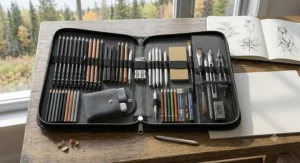
The zippered case here is the whole point: everything unfolds into standing organized sections, so nothing rolls off the desk mid-sketch. Inside, the 40-piece breakdown mixes graphite pencils across multiple hardness grades with charcoal and pastel pencils, plus blending stumps and erasers — essentially a compressed toolkit that would otherwise mean buying four separate products. In practice, that hardness range means you can rough in a composition with a soft 6B, then tighten details with a harder 2H, without leaving the box. This set is built for someone who has outgrown a dollar-store pencil pack but isn’t ready to commit hundreds of dollars to single-brand specialist tins yet — art students, hobbyists returning after a long break, and anyone testing whether drawing is a habit worth investing further in. Reviewers consistently note the case organization as the standout feature, with the mixed-media range getting praised for letting beginners experiment across charcoal and graphite before settling on a preferred medium; a recurring theme in feedback is that the individual pencils, while solid, aren’t quite up to the standard of single-brand professional lines once your technique outpaces the kit.
Pros:
- ✅ Zippered case keeps 40 pieces organized and portable
- ✅ Mixes graphite, charcoal, and pastel for medium experimentation
- ✅ Strong value entry point before committing to premium brands
Cons:
- ❌ Individual pencil quality trails single-brand specialist sets
- ❌ Fewer total pieces than some 73- to 126-piece competitor kits
At around C$30–C$45, this is one of the more approachable ways to build a real professional drawing set foundation without overcommitting on your first purchase.
2. Faber-Castell 9000 Graphite Sketch Pencil Set (12-Piece) — the graphite benchmark since 1905
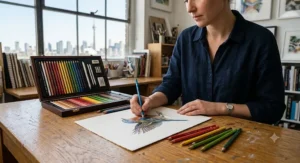
Faber-Castell’s SV bonding process — where the lead is fully fused to the wood casing along its entire length — is the detail that separates this tin from cheaper graphite sets, and it’s the reason these pencils resist snapping when dropped or sharpened aggressively. The 12 pencils span 8B through 2H, giving you deep, velvety blacks at one end and crisp, controllable lines at the other, which in practice means one tin covers both loose gestural sketching and tight technical rendering. Faber-Castell’s graphite has been the reference point for illustrators and architects for over a century, and what most buyers overlook is that the “Castell 9000” naming itself signals the professional tier within Faber-Castell’s own catalogue, distinct from their student-grade lines. Reviewers frequently mention the smooth, non-scratchy laydown even at the softer 8B end, where cheaper graphite tends to feel gritty; the main aggregated complaint is the absence of an eraser or sharpener in the box, meaning first-time buyers often need a second purchase to get started immediately.
Pros:
- ✅ SV-bonded leads resist breakage during sharpening or drops
- ✅ 8B–2H range covers deep shading through fine detail
- ✅ Century-long reputation among illustrators and architects
Cons:
- ❌ No eraser or sharpener included in the tin
- ❌ Graphite only — no colour or charcoal options
Priced around C$25–C$35, this is arguably the smartest single upgrade for anyone whose current professional drawing set is heavy on tools but thin on genuinely good graphite.
3. Derwent Graphic Drawing Pencils (24-Count Metal Tin) — widest hardness range for tonal control
Derwent’s hexagonal barrel design is a small ergonomic detail with outsized impact: the flat facets stop the pencil from rolling off an inclined drawing board, and the extra grip surface reduces hand fatigue during long shading sessions. The 24-count tin spans the full 9B to 9H spectrum — twenty-four distinct hardness grades in one case — which is roughly double the range most sets offer, meaning you can render a single object from paper-white highlight to near-black shadow using nothing but this tin. Derwent has manufactured graphite pencils in the UK’s Lake District since the company’s founding in 1832, and the hard (H) grades use a narrower 2.2mm core for precision linework while black (B) grades widen to 3.5mm for expressive, smudgeable tone. This is the set for architectural sketching, detailed portraiture, or anyone teaching themselves formal tonal-value theory, since having every grade on hand removes the guesswork of which pencil to reach for next. Aggregated reviewer sentiment praises the tin’s durability as a travel case and the noticeably smoother core compared to budget 12-piece alternatives; a common critique is that casual sketchers rarely use the extreme ends of the range, making the 24-piece set feel like overkill next to a tighter 12-piece selection.
Pros:
- ✅ Full 9B–9H range covers every tonal value needed
- ✅ Hexagonal barrel improves grip and prevents rolling
- ✅ Nearly 200-year manufacturing heritage in the UK
Cons:
- ❌ Higher price point than smaller 12-piece graphite sets
- ❌ Extreme hardness grades go unused by casual sketchers
Expect to pay in the C$35–C$50 range, which is reasonable given you’re effectively buying two overlapping 12-piece sets’ worth of range in a single tin.
4. Prismacolor Premier Soft Core Colored Pencils (72-Count) — the layering pencil illustrators reach for first
The defining feature of Prismacolor Premier pencils is their soft, thick wax-based core, which lays down colour in a smooth, almost creamy stroke that blends into neighbouring layers rather than sitting as a hard line on top. Practically, that means you can build up five or six layers of colour on a single area — a technique called burnishing — to achieve the kind of painterly depth that harder coloured pencils simply can’t replicate. This 72-count tin gives you enough range to handle skin tones, foliage, and skies without constant colour-mixing workarounds, and it’s the set most frequently recommended when people search Prismacolor pencils Canada looking for the same tier professional illustrators use. Based on the spec comparison with rival brands, Prismacolor’s core sits softer than Faber-Castell’s Polychromos line but delivers comparable pigment saturation at a lower price per pencil. Reviewers consistently highlight the blending capability as the standout strength, while a recurring aggregated complaint is that the soft cores wear down and need re-sharpening more often than harder competitor pencils — a fair trade-off for the blend quality, but worth knowing going in. It’s also worth flagging that Canadian retail pricing on this particular set tends to run noticeably higher than U.S. listings, so comparison shopping between Canadian retailers pays off here.
Pros:
- ✅ Soft, creamy cores blend and layer smoothly for realism
- ✅ 72-colour range covers skin tones, foliage, and skies
- ✅ Tin case keeps the full set organized and travel-ready
Cons:
- ❌ Soft cores wear down and need frequent sharpening
- ❌ Canadian pricing runs notably higher than U.S. listings
Budget C$60–C$110 depending on retailer, and treat this as the set that turns a graphite-only professional drawing set into a full-colour studio kit.
5. Winsor & Newton Winton Oil Colour Paint Set (20 x 12ml Tubes) — the classic gateway into oil painting
Winsor & Newton has formulated oil paint since 1832, and the Winton line specifically targets students and amateur painters who want genuine oil-painting characteristics without artist-tier pricing. The 20-tube set covers essential starter hues, and the higher-than-expected pigment load — Winsor & Newton notes Winton’s pigmentation exceeds many competing “student” ranges — means colours stay vibrant rather than washing out when thinned. In practice, that pigment strength translates to fewer tubes needed per painting session, which offsets the initial cost over time. This is the natural next step for anyone whose current professional drawing set has them itching to move from pencil into paint, and it pairs directly with the oil painting starter kit search intent driving a lot of interest in this category. What most buyers overlook is that oil paint’s slow drying time — often days rather than hours — is a feature, not a flaw, since it allows blending directly on the canvas that acrylic and watercolour simply can’t match. Aggregated reviews consistently praise the stiff, buttery consistency for holding brushstroke texture, while a common theme in feedback is that beginners are surprised by the need to separately purchase solvents, mediums, and proper ventilation, since none of that comes bundled with the paint itself.
Pros:
- ✅ 20 essential colours cover most beginner palette needs
- ✅ Higher pigment load than typical student-grade oil paint
- ✅ Stiff consistency holds brushstrokes and knife texture well
Cons:
- ❌ Solvents and mediums must be purchased separately
- ❌ Slow drying time demands patience and good ventilation
Priced around C$60–C$85, this oil painting starter kit is the honest, unglamorous way into a medium that intimidates a lot of otherwise confident pencil artists.
6. MEEDEN Basic Studio Easel (Solid Beech Wood) — sturdy beech-wood studio easel for serious setups
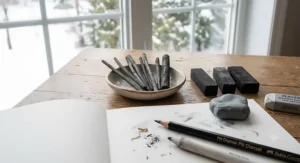
Solid beech construction is the headline spec here, and it matters more than it sounds: cheaper easels built from softwood or MDF tend to wobble under the weight of a loaded canvas or flex when you lean into detailed brushwork, while beech resists both. This easel adjusts in height and angle, and its forward-tilt function — up to roughly 10 degrees — lets pastel or charcoal dust fall away from the surface naturally instead of settling into your last hour of work, a detail dedicated pastel artists specifically look for. Holding canvases up to 50 inches, it comfortably handles anything from small studies through moderately large studio pieces, positioning it as a genuine artist easel studio centrepiece rather than a display-only stand. Based on the spec sheet, the adjustable mast height accommodates both seated and standing painting positions, which matters over long sessions where posture fatigue is a real, if under-discussed, occupational hazard for visual artists. Reviewers consistently flag the stability as the standout quality once assembled, with the forward-tilt feature getting specific praise from pastel and charcoal users; the most common critique in aggregated feedback is that assembly takes real effort and floor space, making it a poor fit for cramped apartment corners.
Pros:
- ✅ Solid beech wood resists wobble under load and pressure
- ✅ Forward-tilt function suits pastel and charcoal work
- ✅ Holds canvases up to 50 inches for varied project sizes
Cons:
- ❌ Assembly requires real time and a few extra hands
- ❌ Needs dedicated floor space, limiting small-apartment use
At roughly C$90–C$140, this easel anchors an artist easel studio setup that will genuinely outlast several rounds of paint and canvas purchases.
7. Strathmore 400 Series Sketch Pad (9×12″, 100 Sheets) — the sketchbook paper professionals actually use
Strathmore has supplied fine art paper since 1899, and the 400 Series specifically targets the “general purpose, heavyweight” category — meaning it’s built to survive graphite, charcoal, and pastel without the tearing or ghosting that thinner practice paper suffers under repeated erasing. The micro-perforated binding is the detail that elevates this from a disposable sketchbook to genuine fine arts materials: pages tear away clean and true-to-size, so a strong practice sketch can go straight into a portfolio without visible ragged edges. At 100 sheets per pad, that’s enough working surface for months of daily practice, and the heavier tooth grips pigment more assertively than lightweight printer-style sketch paper, giving pencil and charcoal work more visible texture and depth. What the spec sheet won’t tell you, but reviewers note repeatedly, is that this paper’s forgiveness under repeated erasing makes it especially good for beginners still developing confident line weight, since mistakes don’t shred the surface. The main aggregated critique is straightforward: this is dry-media paper, and anyone hoping to layer in watercolour washes will need a dedicated watercolour block instead.
Pros:
- ✅ Heavyweight tooth resists tearing under repeated erasing
- ✅ Micro-perforated sheets remove cleanly for portfolio use
- ✅ Works across graphite, charcoal, pastel, and marker
Cons:
- ❌ Not suited to wet media like watercolour washes
- ❌ 100 sheets go quickly under a daily practice habit
At C$15–C$25, this pad is arguably the highest-value item on this list — every other tool here performs better on paper built to actually hold it.
Setting Up Your Professional Drawing Set: A Practical Usage Guide
Unboxing day matters more than most guides admit. Start by sharpening every pencil in a new set before your first session — factory points are often inconsistent, and a dull 8B behaves nothing like a properly sharpened one. Store graphite and coloured pencils flat rather than upright in a cup; standing storage puts constant pressure on the tip, which can cause hairline core fractures that only show up as frustrating breakage weeks later. For the first 30 days, resist the urge to buy more supplies before you’ve genuinely tested what’s in your current professional drawing set — a common mistake is chasing new pencils to solve what’s actually a technique gap, like heavy-handed pressure or inconsistent stroke direction.
If your kit includes charcoal or pastel alongside graphite, keep them physically separated in your case; charcoal dust migrates and dulls the crisp edges graphite pencils need for fine linework. A kneaded eraser, if not included, is worth adding immediately — it lifts graphite without abrading the paper tooth the way a standard rubber eraser does, which matters enormously on textured Strathmore-style paper. For oil painters starting with a set like the Winton kit above, establish a ventilated workspace before your first session, not after; solvent fumes build up faster than beginners expect in a closed room. Finally, build a five-minute cleanup habit — wiping graphite dust and eraser crumbs off your easel or desk after every session — since accumulated dust is the single most common cause of accidental smudging on otherwise finished work.
Real-World Scenarios: Matching the Right Set to Your Situation
If you’re a university student commuting to studio classes three times a week with limited storage in a dorm room, the Castle Art Supplies 40-Piece Set paired with a Strathmore 400 Series Sketch Pad covers coursework without the bulk of a full easel setup — everything fits in one bag. If you’re a parent of a teenager preparing a portfolio for art school applications, budget around C$150–C$200 combined for the Faber-Castell 9000 Graphite Set, a Prismacolor colour set, and several Strathmore pads, since admissions committees consistently want to see range across media and sustained practice volume, not just polished final pieces. If you’re a hobbyist rebuilding a home studio after years away from painting, prioritize the MEEDEN Basic Studio Easel first — a stable, properly angled work surface improves every subsequent painting session more than any single paint or brush purchase will. And if you’re specifically chasing realism and detail work, layering the Derwent Graphic 24-Count Tin with the Prismacolor Premier 72-Count gives you both graphite underdrawing precision and full-colour rendering capability in one combined toolkit, which is roughly the setup working illustrators describe using for client work.
Your Buyer’s Decision Framework
If your budget is under C$50 and you’re still figuring out which medium you enjoy, choose the Castle Art Supplies 40-Piece Set because it lets you sample graphite, charcoal, and pastel before committing further. If you already know graphite realism is your focus, choose between the Faber-Castell 9000 and Derwent Graphic tins based on range needed — 12 pieces for most projects, 24 for serious tonal-value work. If colour and illustration-style layering is the goal, choose the Prismacolor Premier 72-Count and expect to budget for Canadian retail pricing running above U.S. listings. If you’re ready to move into paint, choose the Winsor & Newton Winton set paired with a stable surface — don’t buy paint before you’ve solved where you’ll actually stand or sit while using it. And if storage space is your binding constraint rather than budget, prioritize the Strathmore 400 Series pad and a compact pencil tin over a full easel setup until your space situation changes.
How to Choose a Professional Drawing Set
Choosing well comes down to seven practical checkpoints, each worth weighing before you buy:
- Identify your primary medium first. Graphite, charcoal, coloured pencil, and oil paint each demand different tools — buying broadly before narrowing your interest wastes money on gear you won’t reuse.
- Check the hardness or colour range. A 12-piece graphite set covers most needs; a 24-piece set only pays off once you’re doing detailed tonal-value work.
- Match paper to medium. Heavyweight, toothy paper like Strathmore’s 400 Series suits dry media; wet media needs dedicated watercolour or oil-primed surfaces.
- Weigh core hardness against your hand pressure. Heavy-handed artists wear through soft cores fast, favouring harder, more durable pencils.
- Consider portability versus studio permanence. A zippered kit suits commuting students; a full easel setup suits a dedicated home studio corner.
- Read aggregated review themes, not star ratings alone. Ratings hide detail — recurring complaints about sharpening frequency or price tell you more than a number out of five.
- Budget for consumables beyond the initial set. Solvents, extra paper, and replacement erasers are ongoing costs that first-time buyers consistently underestimate.
Common Mistakes When Buying a Professional Drawing Set
The most frequent misstep is buying range before buying quality — a 150-piece set with unnamed, unbranded pencils often performs worse than a focused 12-piece set from an established manufacturer like Faber-Castell or Derwent. A second common error is ignoring paper entirely; even excellent pencils look mediocre on thin, low-tooth paper that can’t hold pigment properly. Third, many beginners skip a kneaded eraser, not realizing standard rubber erasers abrade textured paper and leave visible damage rather than a clean lift. Fourth, oil painting beginners frequently buy paint without budgeting for solvents, mediums, and ventilation, leading to an unusable first session. Finally, a subtler mistake — buying an artist easel studio setup that’s too small for future growth, only to replace it within a year once canvases get larger, when a slightly larger easel would have cost little more upfront.
Professional Drawing Set vs Beginner Art Kits
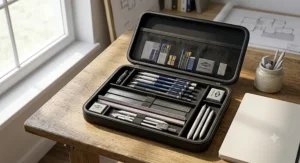
The gap between a genuine professional drawing set and a beginner art kit isn’t always obvious from packaging alone, but it shows up fast once pencil meets paper.
| Feature | Beginner Art Kits | Professional Drawing Sets |
|---|---|---|
| Core material | Softer, chalkier graphite/wax | Break-resistant, pigment-dense cores |
| Hardness range | Often limited to 4–6 grades | Spans 12–24+ grades |
| Paper compatibility | Basic printer-style paper | Heavyweight, toothy fine art paper |
| Blending capability | Muddy, limited layering | Smooth, multi-layer blending |
| Typical price (CAD) | C$10–C$25 | C$25–C$110+ |
The core material difference is the biggest practical gap: beginner-tier graphite and wax pigments tend to smear and dull quickly, while sets like the Faber-Castell 9000 or Prismacolor Premier hold a point and colour saturation through extended sessions. That said, beginner kits aren’t a waste — they’re the right call for testing interest before investing further, and several products on this list, like the Castle Art Supplies 40-Piece Set, sit deliberately in the middle ground to ease that transition without a steep price jump.
Prismacolor Pencils in Canada: What Makes Them a Staple
Searching for Prismacolor pencils Canada usually turns up the same core question: are they worth the price gap compared to buying in the U.S.? The honest answer is nuanced. Prismacolor Premier pencils remain a genuine professional-tier product — soft, richly pigmented cores that blend better than most competing coloured pencil lines at a similar price point — but Canadian retail pricing on sets like the 72-count tin runs meaningfully higher than equivalent U.S. Amazon listings, partly due to import costs and currency conversion. For Canadian buyers, comparison shopping across Amazon.ca, Staples.ca, and Michaels Canada before purchasing is worth the ten extra minutes, since sale pricing fluctuates independently across each retailer. What doesn’t change regardless of retailer is the core quality: the soft, waxy pigment that makes burnishing and layering possible is consistent across authorized sellers, so the shopping decision here is really about price-matching rather than product-quality risk.
Building Your First Oil Painting Starter Kit
An oil painting starter kit needs to cover four things beyond paint itself: brushes suited to oil’s thicker body, a palette for mixing, a solvent or water-mixable alternative for thinning and cleanup, and rags or paper towel for the inevitable mess. The Winsor & Newton Winton set covers the paint itself with 20 essential colours, but budgeting an additional C$40–C$60 for a basic brush set, palette, and Sansodor-style low-odour solvent rounds out a genuinely usable starting kit. Here’s what to weigh: water-mixable oils, like Winsor & Newton’s Artisan line, trade a small amount of traditional handling feel for dramatically easier cleanup, which matters if you’re painting in a shared space or apartment without a dedicated studio. Traditional oils, like the Winton set featured above, offer the classic buttery consistency oil painters describe as unmatched, at the cost of needing proper solvents and ventilation from day one.
Choosing the Right Artist Easel Studio Setup
An artist easel studio setup starts with a simple question: how large will your work realistically get? The MEEDEN Basic Studio Easel comfortably holds canvases up to 50 inches, which suits most home studio painters, but anyone planning larger gallery-scale work should look at MEEDEN’s larger H-frame options instead. Beyond size, adjustability matters more than most buyers initially weigh it — an easel that tilts forward accommodates pastel and charcoal dust management, while a fixed-angle easel works fine for oil and acrylic where dust isn’t a factor. Floor space is the constraint people underestimate most: a stable studio easel needs roughly a 3-by-3-foot working footprint once you account for stepping back to assess a piece, which rules out plenty of apartment corners that look spacious until the easel actually arrives.
Fine Arts Materials Worth Investing In Beyond the Basics
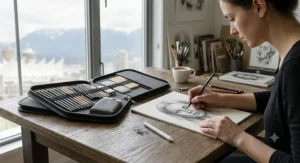
Once your core professional drawing set is settled, a short list of fine arts materials consistently improves output more than additional pencils would. A proper blending stump or tortillon smooths graphite transitions far better than a fingertip, which also avoids transferring skin oils onto the paper. A metal pencil sharpener with a replaceable blade outperforms cheap plastic sharpeners, which tend to crush soft cores like Prismacolor’s rather than cutting them cleanly. A drafting or utility knife, used carefully, sharpens pencils to a longer, more controllable point than any rotary sharpener manages, which matters for detailed shading work. And a fixative spray, applied to finished charcoal or pastel pieces, prevents smudging during storage or transport — a detail that’s saved more than one portfolio piece from ruin between the studio and a submission deadline.
Professional Art Education and Portfolio Development in Canada
For anyone pursuing professional art education formally, Canadian institutions like OCAD University are explicit about what strengthens an admissions portfolio: sustained sketchbook practice, observational drawing from life, and process documentation alongside finished pieces — not just polished final work. That guidance maps directly onto the tools covered here. A dedicated professional drawing set used consistently over months produces exactly the kind of visible skill progression admissions committees look for, while a habit of tearing clean sheets from a Strathmore 400 Series pad means your strongest practice work can go straight into a submission without a messy spiral-bound edge undermining the presentation. Portfolio development, in practice, isn’t really about buying better materials right before a deadline — it’s about accumulating a body of dated, varied work over time, which is exactly what a well-chosen kit used daily makes possible. Reviewers of portfolio-prep programs and instructors alike tend to agree that range across media — graphite, colour, and at least some painting experience — reads as stronger than deep skill in only one medium.
Safety, Regulations & Long-Term Value in Canada
Canadian buyers should know that art materials sold here fall under Health Canada’s consumer product safety guidance, and Health Canada’s own advice on using arts and crafts materials safely specifically recommends keeping non-child-labelled materials out of reach of young children, working in ventilated spaces with solvents, and retaining original packaging so label instructions stay accessible in case of accidental exposure. This matters directly for oil painting starter kits, where solvents and mediums carry genuine ventilation requirements that a lot of first-time buyers skip reading. On long-term value, higher upfront cost generally pays off: a Faber-Castell 9000 tin, properly stored, lasts years longer than budget graphite that dulls and crumbles within months, and the graphite hardness scale itself — standardized internationally from 9H through 9B — is described in more technical depth on Wikipedia’s graphite pencil grading overview if you want to understand exactly what each letter and number combination controls before buying.
✨ Don’t Miss These Exclusive Deals!
🔍 Take your drawing practice to the next level with these carefully selected products. Click on any highlighted item to check current pricing and availability. These tools will help you create authentic, portfolio-ready work you’ll be proud to share.
Frequently Asked Questions
❓ What is included in a typical professional drawing set?
❓ How many pencils does a beginner actually need?
❓ Are Prismacolor pencils worth the Canadian price premium?
❓ What's the difference between water-mixable and traditional oil paint?
❓ Do I need an easel to start painting seriously?
Conclusion
Building a real professional drawing set in Canada doesn’t require buying everything on this list at once — it requires buying the right thing first. Someone still discovering their preferred medium is better served by the Castle Art Supplies 40-Piece Set than by committing to a specialist tin they might not stick with. Someone already deep into graphite realism gets more from the Derwent Graphic 24-Count Tin‘s extended range than from a beginner kit’s basic assortment. And someone chasing full-colour illustration work needs the Prismacolor Premier 72-Count far more than another set of graphite pencils they’ll rarely reach for.
What ties every recommendation together is honest fit: matching the tool to where you actually are in your practice, not where marketing copy suggests you should aspire to be. Pair your chosen pencils or paint with proper paper — the Strathmore 400 Series consistently punches above its price — and if painting is on the horizon, don’t underestimate how much a stable MEEDEN easel setup improves every session that follows. Whether you’re rebuilding a home studio, prepping a portfolio for professional art education, or just rediscovering the habit of daily sketching, the right starting kit makes the difference between supplies that sit in a drawer and ones that actually get used.
Recommended for You
- Telescope Astronomy Teens: 7 Real Picks to Ignite Stargazing (2026)
- Advanced STEM Kits for Teens: 7 Brilliant Picks for 2026
- Action Camera Youth Guide: 7 Rugged Picks Worth Buying in 2026
Disclaimer: This article contains affiliate links. As an Amazon Associate, I earn from qualifying purchases. If you purchase products through these links, we may earn a small commission at no additional cost to you.
✨ Found this helpful? Share it with your friends! 💬🤗
