
In This Article
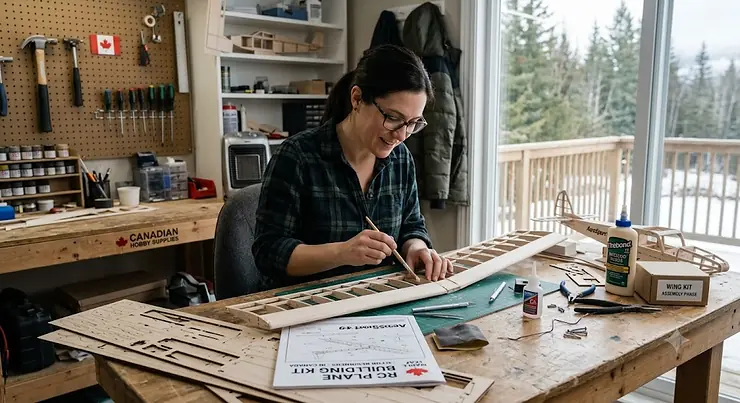
There’s a particular kind of quiet that settles over a workbench covered in balsa dust, glue clamps, and a half-finished wing rib. If you’ve ever felt the pull toward that quiet, you already understand why an RC plane building kit is such a different animal from the ready-to-fly boxes stacked at the big-box toy aisle. Building one is slower, occasionally frustrating, and completely addictive — you’re not just buying a toy, you’re assembling an actual flying machine from sticks of wood, sheets of foam, or laser-cut plywood, one joint at a time.
This guide exists because most “best RC plane” roundups on the Canadian internet quietly swap in ready-to-fly drones and call it a day. That’s not what we’re doing here. Every product below genuinely requires assembly — gluing, covering, wiring, or all three — and every one of them is a real, currently sold model, not a placeholder. We’ve pulled specs from manufacturer documentation, cross-referenced pricing patterns, and leaned on aggregated review sentiment from hobby forums and retailer feedback rather than inventing a single quote.
We’ll cover seven kits spanning roughly C$25 up to the C$600 range, from a rubber-powered balsa Cub a ten-year-old can finish in an afternoon to a foam warbird with retractable gear that will test an experienced builder’s patience. Along the way we’ll dig into aerodynamic modeling basics, Canadian flying regulations, and the honest trade-offs between building your own radio-controlled aircraft and just buying one pre-assembled. By the end, you should know exactly which kit matches your skill level, your budget, and your patience.
Quick Comparison Table
| RC Plane Building Kit | Wingspan | Build Type | Skill Level | Price Range (CAD) | Best For |
|---|---|---|---|---|---|
| Guillow’s Piper Super Cub 95 | 61 cm (24 in) | Balsa, rubber-powered, RC-convertible | Beginner | Under C$35 | First-ever balsa build, kids |
| Guillow’s P-51 Mustang | 70 cm (27.75 in) | Balsa, laser-cut, static/free-flight | Beginner | Under C$45 | Display-quality scale modelling |
| VilogaRC Vogee-08 Trainer | 81 cm (32 in) | Balsa + electric RC bundle | Beginner-Intermediate | C$90-C$130 | First real RC flight, no parts hunting |
| Viloga Piper Cub J3 | 117 cm (46 in) | Balsa, laser-cut, kit-only | Intermediate | C$120-C$170 | Builders with a spare-electronics bin |
| FMS 800mm P-51D Mustang V2 | 80 cm (31.5 in) | Foam, PNP warbird | Intermediate | C$180-C$240 | Scale speed after a trainer |
| Dynam Supermarine Spitfire V3 | 120 cm (47 in) | Foam, PNP warbird, retracts/flaps | Intermediate-Advanced | C$550-C$680 | Experienced pilots wanting realism |
| Great Planes PT-40 MkII | 152 cm (60 in) | Balsa short kit, glow/gas trainer | Advanced | C$180-C$260 (airframe only) | Traditional from-scratch builders |
Reading this table left to right, the pattern is pretty clear: price climbs with pre-installed electronics and airframe complexity, not with build difficulty alone. The Guillow’s Piper Super Cub 95 and Guillow’s P-51 Mustang are genuinely beginner-safe because a warped wing costs you a wasted evening, not a cracked LiPo battery. Meanwhile the Dynam Supermarine Spitfire V3 commands premium pricing largely because of its pre-installed brushless motor, electronic retracts, and flap servos — the airframe itself isn’t dramatically harder to assemble than the FMS 800mm P-51D Mustang V2, but the hardware inside it is.
💬 Just one click — help others make better buying decisions too!😊
What Is an RC Plane Building Kit?
An RC plane building kit is a set of unassembled aircraft parts — typically balsa wood, laser-cut plywood, or moulded foam — that a hobbyist glues, covers, and wires together into a flyable radio-controlled model. Kits range from “airframe only” versions requiring a separately purchased motor, servos, and radio, to bundled kits that include most electronics, needing only a battery and transmitter to fly.
Some hobbyists know this pursuit under different names — remote flight construction, RC aircraft assembly, or simply “building your own plane” — but the underlying process is identical no matter what you call it. That definition covers a huge amount of ground, which is exactly why this hobby has three distinct tiers worth understanding before you spend a dollar. At the bottom, you’ve got true balsa kits like the ones Guillow’s has made since the 1920s — precision-cut wood sticks and sheets, a printed plan, and glue joints you make yourself. In the middle sit hybrid kits, like the VilogaRC Vogee-08 Trainer, that hand you a balsa airframe alongside a motor, ESC, and servos so you’re not sourcing electronics from six different suppliers. At the top are foam PNP (“plug-and-play”) warbirds like the FMS 800mm P-51D Mustang V2 and Dynam Supermarine Spitfire V3, which arrive with motors, ESCs, and servos already installed in a foam shell you still have to assemble panel by panel, plumb the control linkages on, and bind to a radio.
Top 7 RC Plane Building Kits: Expert Analysis
We picked these seven to cover the realistic range of what a Canadian hobbyist will actually encounter searching Amazon.ca: two pure balsa starter kits, two balsa-based trainers with more serious electronics, two foam warbirds, and one old-school glow-power short kit for builders who want the full traditional experience. Budget, mid-range, and premium options are all represented, and — full disclosure — none of these are “the best in the world,” because that phrase doesn’t mean much in a hobby this personal. They’re simply seven legitimately good, verifiable options, each suited to a different kind of builder.
1. Guillow’s Piper Super Cub 95 — the classic entry point every builder starts with
There’s a reason this kit has stuck around for decades: it’s genuinely the easiest way to find out if you enjoy this hobby before committing real money. The 61 cm (24 in) laser-cut balsa airframe ships with a rubber motor for classic free-flight power, plus hardware and partial provisions for converting to electric or small gas power down the road — meaning the same box can take you from a weekend project to an actual radio-controlled build once you’re hooked. The laser-cut parts pop out of their sheets cleanly rather than needing an X-Acto knife to free every rib, which matters enormously if this is your first time handling balsa.
Based on the spec comparison against older die-cut Guillow’s kits, the laser-cut Guillow’s Piper Super Cub 95 represents a genuine manufacturing upgrade — older forum threads document warping and brittle stock in pre-2015 stamped kits, while more recent laser-cut runs get consistently better marks for fit and consistency. This is best for absolute first-timers, parents building alongside a curious kid, or anyone testing the waters before buying anything with a lithium battery in it. Reviewers consistently note the plans and decals are a nice touch for a kit this size, though a common complaint is that the included rubber motor doesn’t last through more than a dozen or so flights before it needs replacing.
Pros:
- ✅ Laser-cut parts remove cleanly without damaging ribs
- ✅ Genuinely beginner-safe — mistakes cost minutes, not dollars
- ✅ Convertible toward small electric or gas power later
Cons:
- ❌ Rubber motor wears out and needs periodic replacement
- ❌ Not RC-capable out of the box without extra parts
At around C$25-C$35 depending on retailer promotions, this is one of the cheapest legitimate entries into scale model airplanes, and the value case is straightforward: even if you never touch a radio transmitter, you get a real, finished model out of the deal.
2. Guillow’s P-51 Mustang — the most rewarding first “real” scale build
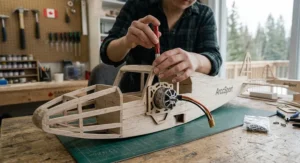
Where the Piper Cub is forgiving, the 70 cm (27.75 in) Mustang asks a little more of you — more ribs to align, more complex fuselage formers, and a shape that actually looks like the WWII fighter it represents once you’re done. The laser-cut balsa and plywood components come with authentic decals, which is a small detail that makes a surprising difference to how proud you’ll be displaying the finished model.
What most first-time builders overlook about this kit is that the extra 30-40 minutes of careful dry-fitting before you commit any glue pays off enormously on a fuselage this curved; rushing the alignment is the single most common way these builds end up crooked. Aggregated reviewer sentiment describes the instructions as clear enough for a patient beginner but recommends having a hobby knife and pin board on hand, since the kit assumes some basic modelling tools you may not already own. This is best suited to hobbyists who’ve built at least one simpler kit already, or adults with model-building experience from other crafts looking to move into scale model airplanes specifically.
Pros:
- ✅ High level of surface and cockpit detail for the price
- ✅ Laser-cut precision keeps panel lines crisp
- ✅ Iconic WWII design with genuine display appeal
Cons:
- ❌ More demanding fuselage alignment than the Piper Cub
- ❌ Free-flight only unless you source your own RC conversion parts
Expect a price in the C$35-C$45 range. As a value proposition, it’s hard to beat for a display-quality scale model that also teaches real balsa-building fundamentals.
3. VilogaRC Vogee-08 Trainer — the bridge from balsa hobbyist to actual RC pilot
This is where the hobby gets serious without getting expensive. The 81 cm (32 in) Vogee-08 bundles a laser-cut balsa airframe with a motor, ESC, servos, propeller, and covering film in one box, which solves the single biggest headache new builders face: sourcing compatible electronics from scratch. You still glue every joint and cover every surface by hand — this is not a shortcut kit — but you’re not left guessing whether a random motor you bought separately will actually fit the firewall.
The trainer-class wing design (long span, generous dihedral, forgiving stall characteristics) is a textbook example of practical aerodynamic modeling: the airframe is intentionally engineered to be self-righting and slow-flying rather than aerobatic, because that’s exactly what a first-time RC pilot needs while learning stick coordination. Based on the spec sheet, the bundled motor and ESC combination is sized conservatively for the airframe weight, which trades outright speed for a much wider margin of error on your first flights. This is best for builders who’ve already finished a balsa static kit and are ready to actually fly something, or anyone who wants one supplier handling the whole parts list.
Pros:
- ✅ Motor, ESC, and servos included — no separate electronics sourcing
- ✅ Forgiving trainer wing geometry for first-time RC pilots
- ✅ Full building experience, not a pre-assembled shortcut
Cons:
- ❌ Covering film application has a real learning curve
- ❌ Smaller buyer base means fewer third-party spare parts
Pricing typically sits in the C$90-C$130 range depending on the exact bundle configuration. For what amounts to an entire electric RC trainer’s worth of parts in one box, that’s a genuinely strong value.
4. Viloga Piper Cub J3 — for builders who want to choose their own electronics
At 117 cm (46 in), the Piper Cub J3 is a noticeably bigger, more serious balsa build than anything else on this list at a comparable price, and it’s sold as a kit-only airframe — no motor, ESC, or servos included. That’s a deliberate trade-off: builders who already own spare electronics from a previous project, or who have strong opinions about which brand of servo they trust, get a blank canvas instead of paying for parts they’d swap out anyway.
The tab-lock construction method used throughout this kit is a genuine engineering precision upgrade over traditional slot-and-glue balsa building — ribs and formers key into pre-cut tabs, which keeps the airframe square during assembly without needing quite as many alignment jigs. What the spec sheet won’t tell you, but aggregated builder feedback suggests, is that the sheer part count at this wingspan means realistic build time runs well past a weekend, closer to 15-25 hours spread over a few weeks for someone building their first kit this size. This is best for intermediate builders moving up from a Guillow’s-scale kit, or anyone who already has an electronics parts bin and just needs a well-designed airframe.
Pros:
- ✅ Tab-lock construction keeps the airframe square while building
- ✅ Larger 117 cm wingspan flies more stably in Canadian wind
- ✅ Freedom to select your own motor, ESC, and radio gear
Cons:
- ❌ No electronics included — budget separately for a full RC setup
- ❌ Significantly longer build time than smaller kits on this list
Expect the kit-only box to run C$120-C$170, with a further C$80-C$150 in electronics depending on what you already own. Builders who already have spare gear get real value here; those starting from zero should compare the total cost against option 3.
5. FMS 800mm P-51D Mustang V2 — the foam warbird that still teaches you to build
This is the point on the list where “kit” starts to mean something a little different. The 80 cm (31.5 in) foam FMS 800mm P-51D Mustang V2 arrives as a PNP (“plug-and-play”) airframe — motor, ESC, and servos pre-installed at the factory — but you’re still assembling separate wing, fuselage, and tail sections, running and securing control linkages, and gluing structural joints before it’s flightworthy. It’s not a balsa build, but it’s genuinely not a “charge the battery and go” experience either.
Based on the spec comparison with the balsa kits above it in this list, the moulded EPO foam construction sacrifices some of the tactile, from-scratch building satisfaction in exchange for a much more forgiving, crash-resistant airframe — a real consideration if you’re flying somewhere without a dedicated smooth runway. Reviewers consistently point out that the scale panel lines and retractable-look landing gear give this warbird real display presence for the price, though a recurring complaint across foam warbirds this size is that a hard landing on grass can crack the foam around the wing root if you’re not careful. This is best for pilots who’ve already soloed on a slower trainer like the Vogee-08 and are ready to step up to a faster, scale-shaped airframe.
Pros:
- ✅ Pre-installed motor and ESC reduce wiring guesswork
- ✅ Crash-resistant EPO foam forgives rough landings
- ✅ Authentic WWII scale panel lines and markings
Cons:
- ❌ No radio, battery, or charger included
- ❌ Foam wing root is vulnerable to hard grass landings
Pricing generally lands in the C$180-C$240 range before you add a battery and receiver-compatible transmitter. For an intermediate step up in speed and scale realism, it earns its price.

6. Dynam Supermarine Spitfire V3 — the premium warbird for builders ready to level up
At 120 cm (47 in) with a flying weight around 1,150 g, the Dynam Supermarine Spitfire V3 is the most technically ambitious airframe on this list — electronic retractable landing gear, functioning flaps, and a four-blade scale propeller give it a level of realism you simply don’t get from the smaller foam warbirds. Manufacturer documentation lists roughly an hour of assembly time for the PNP version, which sounds quick until you’re actually wiring six separate 9-gram servos and confirming your retract sequencing before the first flight.
The pre-installed brushless outrunner motor and 40A ESC are sized specifically for this airframe’s wing loading, and the retract and flap linkages reflect the same engineering precision found in the balsa kits earlier on this list, just executed in foam and metal gear rather than wood — that’s a meaningful piece of honest engineering: wing loading around 40.5 g/dm² puts this firmly in intermediate-to-advanced territory, meaning it lands faster and punishes clumsy approaches more than the trainer-class kits earlier on this list. Aggregated feedback on Dynam’s warbird line generally praises the fit and finish of the pre-painted foam relative to the price point, while noting that the flap and retract wiring harness takes real patience to route cleanly on first build. This is best for pilots with genuine trainer-plane experience under their belt, not a first RC build under any circumstances.
Pros:
- ✅ Functional flaps and electronic retracts for real scale realism
- ✅ Pre-installed brushless power system matched to airframe weight
- ✅ Strong fit and finish relative to comparable warbird kits
Cons:
- ❌ Not suitable as a first build — genuinely advanced
- ❌ Requires a 3S LiPo and compatible radio gear, sold separately
At roughly C$550-C$680 depending on the PNP, BNF, or full radio-included configuration you choose, this sits at the top of the list — a legitimate premium purchase for a hobbyist who already knows this is a long-term interest, not a maybe.
7. Great Planes PT-40 MkII Perfect Trainer Kit — the traditional balsa build for serious hobbyists
We’re closing the list with the kit that represents the opposite philosophy from the foam warbirds above: the 152 cm (60 in) Great Planes PT-40 MkII Perfect Trainer Kit is a true short kit — laser-cut balsa and plywood parts, a full-size plan, and absolutely nothing else. No motor. No radio. No covering. You’re sourcing a glow or small gas engine, a complete radio system, fuel tank hardware, and covering material separately, then building this thing essentially from first principles, the way modelers have for decades.
This design has been a trusted trainer airframe for a genuinely long time, and that reputation is earned rather than marketed: the high-wing, flat-bottom airfoil and generous dihedral are a masterclass in aerodynamic modeling built for stability over speed, deliberately engineered so a shaky first solo doesn’t end in a tumbling crash. What the spec sheet won’t tell you, but decades of builder consensus suggest, is that assembling this kit properly — squaring the fuselage, setting correct incidence on the stabilizer, balancing the finished airframe at the right centre of gravity — teaches you more about how an airplane actually works than any foam PNP ever will. This is best for builders who genuinely want the traditional experience: gas or glow power, full electronics selection, and total control over the finished result.
Pros:
- ✅ Decades-proven trainer geometry with forgiving flight characteristics
- ✅ Full creative control over engine, radio, and covering choices
- ✅ Genuine hands-on engineering education in every joint
Cons:
- ❌ Requires substantial additional purchases (engine, radio, fuel system)
- ❌ Multi-week build time even for experienced modelers
The airframe-only kit typically runs C$180-C$260, but budget realistically for C$400-C$600 all-in once engine, radio, and covering are added. This is a long-term investment in the traditional side of the hobby, not a weekend impulse buy.
✨ Don’t Miss These Exclusive Deals!
🔍 Take your RC plane building kit search to the next level with these carefully selected picks. Click on any highlighted kit above to check current pricing and availability on Amazon.ca. These builds will help you create an authentic scale-flying experience your whole family will love!
RC Plane Building Kits vs Ready-to-Fly Models
| Factor | RC Plane Building Kit | Ready-to-Fly (RTF) Model |
|---|---|---|
| Time to first flight | Hours to weeks | Same day |
| Skill development | Significant — construction, wiring, trimming | Minimal |
| Repairability after a crash | High — you understand the structure | Often low — sealed assemblies |
| Customization | Full control over electronics and finish | Limited or none |
| Best For | Hobbyists who value the build as much as the flight | First-time flyers who just want to fly today |
The honest analysis here isn’t “kits are better” — it’s that they solve different problems. A Dynam Supermarine Spitfire V3 or a Great Planes PT-40 MkII will teach you exactly why your plane behaves the way it does in the air, because you set every control throw and glued every joint yourself, and that knowledge translates directly into faster, cheaper field repairs when (not if) something eventually cracks. An RTF model gets you airborne in an afternoon, but when it breaks, you’re often mailing it back to the manufacturer rather than fixing it on your kitchen table.
Aerodynamic Modeling 101: What Actually Makes These Kits Fly
Every kit on this list, from the tiny Guillow’s Piper Super Cub 95 to the 152 cm Great Planes PT-40 MkII, is a physical exercise in aerodynamic modeling whether the box says so or not. Wing dihedral (the upward angle of the wings from the fuselage) is the single biggest factor in how self-righting a trainer feels — more dihedral means the plane naturally rolls back level after a gust, which is exactly why trainer-class kits like the VilogaRC Vogee-08 Trainer are built with noticeably more of it than a scale warbird like the FMS 800mm P-51D Mustang V2.
Wing loading — the aircraft’s flying weight divided by wing area — is the second variable worth understanding before you buy, because it predicts stall speed and landing difficulty better than wingspan alone does. The Dynam Supermarine Spitfire V3‘s wing loading of roughly 40.5 g/dm² is a genuinely useful benchmark: anything meaningfully above that number in a similarly sized airframe will land faster and forgive less. For a deeper technical grounding in how these principles scale from a model plane to a full-size aircraft, the University of Toronto Institute for Aerospace Studies publishes research that, while aimed at full-scale and academic aerospace work, shares the exact same fundamental lift and stability equations hobbyists are applying by hand when they set dihedral and incidence on a balsa wing.
The Hobbyist Crossover: Scale Model Airplanes, Architectural Models, and Complex 3D Wooden Puzzles
If you’ve ever caught yourself enjoying architectural models — the kind that recreate a building down to individually scored window mullions — or found genuine satisfaction in 3D wooden puzzles complex enough to eat an entire rainy Saturday, you already have the exact skill set an RC plane building kit demands. Both hobbies reward the same things: patience with small, fiddly pieces, comfort reading a plan or diagram, and the willingness to dry-fit twice before committing glue once.
The overlap runs deeper than shared patience, too. Laser-cut precision — the same manufacturing leap that made modern Guillow’s kits so much more consistent than their 1990s-era die-cut ancestors — is the identical technology behind high-end architectural model kits and premium 3D wooden puzzles complex enough to include working hinges or gears. If you already own a hobby knife, a pin board, and a bottle of wood glue from either of those pursuits, you’re not starting from zero when you open your first balsa airplane kit; you’re applying skills you’ve already built, just pointed at something that eventually flies.
Your First Build: Tools, Setup, and the 30-Day Learning Curve
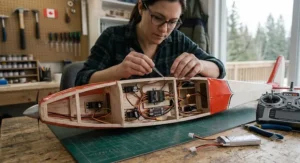
Before your kit even arrives, get the basics sorted: a self-healing cutting mat, a sharp hobby knife with spare blades, a pin board or foam building board, medium and thin cyanoacrylate glue, and a set of T-pins. For any kit with electronics — like the VilogaRC Vogee-08 Trainer or either foam warbird — add a basic multimeter and a LiPo-safe charging bag to that list; skipping the charging bag is the single most common regret among first-time electric RC builders.
Your first 30 days will typically break down into three phases. Week one is structure — gluing the fuselage, wings, and tail surfaces, and this is where rushing costs you the most, because a slightly warped fuselage is nearly impossible to fully correct later. Weeks two and three are covering and finishing for balsa builds, or panel assembly and control linkage setup for foam kits like the FMS 800mm P-51D Mustang V2 — this is also when you’ll do your first centre-of-gravity check, which every single kit on this list requires before its maiden flight regardless of price point. Week four, assuming you’re flying an RC-capable build, is range-checking your radio, setting conservative control throws, and finding an open field — ideally a sanctioned club field booked through an organization like the Model Aeronautics Association of Canada rather than an empty parking lot, for reasons we’ll get into shortly.

Which RC Plane Kit Fits Your Life? Three Builder Profiles
The curious parent with a rainy weekend. If you’re building alongside a nine- or ten-year-old who’s never touched balsa, start with the Guillow’s Piper Super Cub 95. It’s cheap enough that a mistake doesn’t sting, forgiving enough that a wobbly glue joint still looks like an airplane, and the finished rubber-powered flight is genuinely magical for a kid who helped build it.
The returning hobbyist with a bit of a budget. If you built kits decades ago and want back in without dropping serious money upfront, the VilogaRC Vogee-08 Trainer or Viloga Piper Cub J3 hit the right note — real balsa building with modern laser-cut precision, at a price where a mistake is annoying rather than financially painful.
The experienced builder chasing realism. If you’ve already got flight hours on a trainer and want a genuine step up, the Dynam Supermarine Spitfire V3 or the from-scratch Great Planes PT-40 MkII deliver real engineering depth — retracts and flaps on one end, total build control on the other — for hobbyists who see the construction process itself as half the reward.
Common Mistakes When Buying and Building an RC Plane Kit
Overbuying wingspan for your first build is the single most frequent mistake — a 152 cm trainer sounds impressive, but it’s genuinely harder to transport, store, and repair than something like the 81 cm VilogaRC Vogee-08 Trainer, with no meaningful learning benefit for a true beginner. A close second is skipping the centre-of-gravity check before the first flight because “it looks about right” — every kit on this list, foam or balsa, will fly nose-heavy and unrecoverable if the CG is meaningfully off, and eyeballing it is not a substitute for a proper balancing stand.
Buying electronics piecemeal without checking compatibility is another classic error, particularly on kit-only builds like the Viloga Piper Cub J3 — mismatched motor KV rating and propeller pitch is a common cause of overheating ESCs on a first electric build. Finally, plenty of first-timers skip a proper range check on their radio before the maiden flight; it takes five minutes and catches a meaningful percentage of pre-flight failures before they turn into a lost or crashed airplane.
Long-Term Cost & Maintenance: What a Kit Really Costs Over Time
| Cost Category | Balsa Kits (Guillow’s, Viloga) | Foam PNP Warbirds (FMS, Dynam) |
|---|---|---|
| Upfront kit price | C$25-C$170 | C$180-C$680 |
| Additional electronics needed | Often, C$80-C$150+ | Usually just battery + radio |
| Typical crash repair cost | Low — glue and patch materials | Moderate — foam sections, servo replacement |
| Covering/finish refresh | C$15-C$30 in film every few years | Rarely needed |
| Best For | Long-term tinkerers who enjoy repair as part of the hobby | Pilots who want to fly more than they build after the first assembly |
The real total-cost-of-ownership story favours balsa kits for hobbyists who stick with the sport, because glue, covering film, and replacement balsa stock cost a fraction of a replacement foam wing panel. That said, the Dynam Supermarine Spitfire V3 and similar foam warbirds hold their value differently — a cracked wing root is a genuine repair project, but the pre-installed electronics rarely need touching again once they’re dialled in, which some pilots consider a worthwhile trade for less ongoing maintenance.
Features That Actually Matter (And Those That Don’t)
Laser-cut accuracy matters enormously — it’s the difference between an afternoon of clean assembly and a weekend fighting warped parts, and it’s the main reason we favoured kits built with genuine engineering precision, like the Guillow’s P-51 Mustang and Viloga Piper Cub J3, throughout this list. Wing loading and dihedral genuinely matter too, because they predict real flight behaviour far more reliably than wingspan or price alone. Pre-installed electronics on kits like the FMS 800mm P-51D Mustang V2 matter if you value your time, since sourcing and testing a compatible motor-ESC-servo combination from scratch is a real skill gap for many first-timers.
What matters less than the marketing suggests: scale accuracy down to individual rivets rarely affects how a model actually flies, and it’s mostly a display consideration. Similarly, top-line motor power numbers on a foam warbird matter far less than wing loading and control throw setup — an overpowered plane with poorly set throws is more dangerous to a new pilot than a modestly powered one that’s properly trimmed. And if you’re weighing this hobby against something like architectural models purely on “which looks more impressive finished,” that’s the wrong question — the RC version has to survive actual flight loads, not just sit on a shelf.
Safety, Regulations, and Flying Legally in Canada
Even a fully hand-built RC plane is subject to Canadian airspace rules, and this is genuinely worth understanding before your maiden flight, not after a call from a neighbour. Transport Canada splits model aircraft into weight classes: anything under 250 g faces only minimal restrictions, but the 250 g-to-25 kg “small RPAS” category — which covers every powered kit on this list except the very lightest free-flight balsa builds, including the roughly 1,150 g Dynam Supermarine Spitfire V3 — must be registered through Transport Canada’s Drone Management Portal for a modest C$5 fee, with the registration number affixed somewhere durable and legible. Flying one also requires a Basic Pilot Certificate (minimum age 14) for flights below 400 feet (about 122 metres), more than 3 nautical miles from an airport, and within visual line of sight; getting closer to controlled airspace, airports, or bystanders means you need an Advanced Pilot Certificate and additional manufacturer safety approvals.
This genuinely surprises a lot of returning hobbyists: the exemption that once let Model Aeronautics Association of Canada (MAAC) members fly traditional model aircraft without federal certification was formally cancelled by Transport Canada in 2023, so a MAAC card alone no longer satisfies registration or pilot-certificate requirements. That said, MAAC membership is still one of the most practical safety decisions a new builder can make: it includes liability insurance coverage for flying activities, access to sanctioned club fields, and the Wings program, which pairs new flyers with experienced instructors for exactly the kind of guided first flights that prevent a beautifully built kit from ending its life in a tree on flight one. Flying from a sanctioned club field also sidesteps a lot of the grey area around private property and bystander proximity that comes with flying from an open field or park on your own.
FAQ
❓ How much does an RC plane building kit cost in Canada?
❓ Do I need a licence to fly an RC plane in Canada?
❓ What is the best RC plane building kit for beginners?
❓ Can kids build RC plane kits, or are these for adults only?
❓ Do RC plane building kits come with a remote control?
Conclusion
Whether you think of this hobby as scale-model building or simply remote flight construction, picking the right RC plane building kit really comes down to being honest with yourself about two things: how much building you actually want to do, and how much a mistake should cost you while you’re still learning. The Guillow’s Piper Super Cub 95 and Guillow’s P-51 Mustang exist for exactly the reason we put them first — cheap, forgiving, genuinely satisfying scale model airplanes that teach real fundamentals without real financial risk. The VilogaRC Vogee-08 Trainer and Viloga Piper Cub J3 bridge you into actual radio-controlled flight without demanding warbird-level money or experience.
Once you’re past that bridge, the FMS 800mm P-51D Mustang V2 and Dynam Supermarine Spitfire V3 reward pilots ready for scale realism and faster flight characteristics, while the Great Planes PT-40 MkII stands apart entirely — a genuine, traditional, from-scratch build for hobbyists who want the deepest possible engineering education this hobby offers. Wherever you land on that spectrum, buy based on your actual skill level today, not the pilot you hope to become in six months; every kit on this list rewards patience far more than it rewards ambition.
Recommended for You
- Advanced Model Kits: 7 Best Picks for Serious Builders in 2026
- Wacom Tablet Canada: 7 Best Picks Ranked for Artists in 2026
- 7 Best Professional Drawing Set Picks for Canadian Artists (2026)
Disclaimer: This article contains affiliate links. As an Amazon Associate, I earn from qualifying purchases. If you purchase products through these links, we may earn a small commission at no additional cost to you.
✨ Found this helpful? Share it with your friends! 💬🤗
