
In This Article
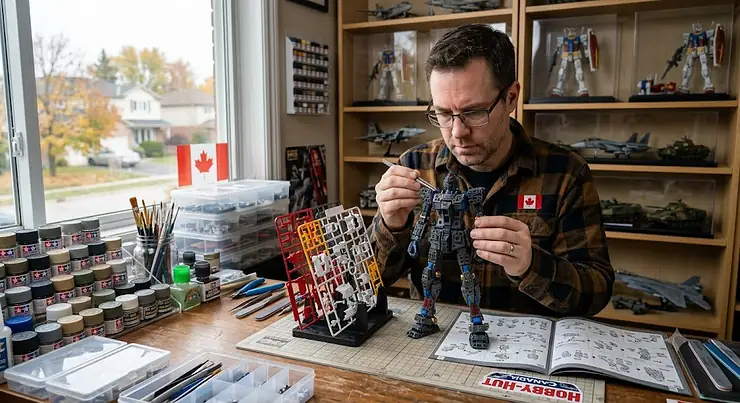
Somewhere between “harmless hobby” and “genuine obsession” sits a strange little category of consumer goods: the advanced model kit. You know the type. Hundreds of tiny grey sprues. Instructions that read like assembly manuals for a small aircraft. A finished piece that, if you did it right, looks nothing like a toy and everything like a museum display.

Advanced model kits are scale or display-model kits engineered for experienced builders — think higher part counts, separately moulded small components, photo-etched metal details, and assembly sequences that assume you already know your way around a hobby knife. They reward patience with a level of realism that beginner kits simply cannot match, and the plastic model kit itself has a surprisingly long, well-documented history worth a quick look on Wikipedia if you want the full backstory.
Here’s the thing nobody tells you before you graduate from snap-fit kits: the jump in difficulty is real, and so is the jump in price. A beginner Gunpla kit might run you under C$30. An advanced model kit can climb well past C$500 once you’re talking Perfect Grade Gundam or a 1/32 scale warbird with photo-etched brass. That gap matters for Canadian buyers trying to figure out where their money is best spent, and it’s exactly what this guide sorts out.
We researched seven real, currently available advanced model kits spanning metal puzzle sculptures, Gunpla, military armour, and a premium aircraft kit, plus one tool set every serious bench needs. Each one gets an honest breakdown: what the spec sheet actually means for your build, who it suits, and what reviewers consistently flag as the catch. No fabricated hands-on stories here — just research-backed analysis so you can pick with your eyes open.
Quick Comparison Table
| Category | Pick | Price Range (CAD) | Best For |
|---|---|---|---|
| Best Overall | MENG TS-027 Leopard 2A7 | C$100-C$140 range | Balanced detail and buildability |
| Best Premium Splurge | PG Unleashed RX-78-2 Gundam | C$550-C$650 range | Collectors chasing the ultimate build |
| Best Budget Entry | Metal Earth ICONX Notre-Dame | C$25-C$35 range | Testing your patience before going bigger |
| Best for Gundam Fans | MG Wing Gundam Zero EW Ver.Ka | C$100-C$140 range | Posability and screen-accurate detail |
Looking at this table, the pattern is clear: you don’t need to spend C$500+ to get a genuinely advanced build experience — the MENG TS-027 Leopard 2A7 and MG Wing Gundam Zero EW Ver.Ka both deliver serious part counts and finishing challenges well under C$150. The premium end exists for a reason, though; if display presence and engineering novelty matter more to you than value-per-dollar, the PG Unleashed RX-78-2 Gundam is in a category of its own. Budget-conscious builders shouldn’t feel shut out either, since a well-chosen Metal Earth ICONX kit tests the same tweezer-and-patience skills at a fraction of the cost.
💬 Just one click — help others make better buying decisions too!😊
Top 7 Advanced Model Kits: Expert Analysis
Before diving into individual builds, here’s how all seven stack up side by side.
| Product | Type | Parts / Difficulty | Price Range (CAD) | Best For |
|---|---|---|---|---|
| Tamiya 1/32 F4U-1D Corsair | Aircraft | High / photo-etch included | C$220-C$260 range | Detail-obsessed aircraft collectors |
| PG Unleashed RX-78-2 Gundam | Gunpla | 90+ articulation points | C$550-C$650 range | Ultimate Gundam collectors |
| MG Wing Gundam Zero EW Ver.Ka | Gunpla | Master Grade, multi-part frame | C$100-C$140 range | Intermediate-to-expert Gundam fans |
| Metal Earth ICONX Millennium Falcon | Metal puzzle | Advanced skill rating | C$30-C$40 range | Small-desk display seekers |
| Metal Earth ICONX Notre-Dame | Metal puzzle | Advanced skill rating | C$25-C$35 range | Architecture and history fans |
| MENG TS-027 Leopard 2A7 | Armour | 500+ parts, photo-etch | C$100-C$140 range | Modern military modellers |
| Tamiya Basic Tool Set | Tool kit | 6-piece essentials | C$35-C$50 range | Any advanced-kit builder’s bench |
This table alone tells a useful story: price does not track cleanly with difficulty. The MENG TS-027 Leopard 2A7 demands more sustained assembly time than the far pricier PG Unleashed RX-78-2 Gundam, simply because tank kits pack hundreds of small suspension and track links into a single build. Meanwhile, both Metal Earth ICONX kits punch well above their price in frustration-per-dollar, since steel sheet metal doesn’t forgive a shaky hand the way plastic sprues do.
1. Tamiya 1/32 F4U-1D Corsair — best all-round premium warbird for detail purists
The 1/32 scale immediately sets this kit apart — most Corsair kits top out at 1/48, so this one is roughly eight times the volume, and every rivet line shows it. Tamiya’s F4U-1D includes photo-etched parts for cockpit and engine detail, dual marking options for both Navy and Marine Corps aircraft, and parts to build the model either parked with folded gull wings or airborne. Based on the spec comparison with smaller-scale competitors, the extra real estate means paint and weathering techniques that would look clumsy at 1/48 actually read as convincing texture here.
This is squarely an experienced-modeller’s kit — Tamiya’s own kit-difficulty guidance and third-party retailers rate it for advanced builders, not because the fit is poor (Tamiya’s engineering tolerances are famously tight) but because the sheer number of small assemblies, decal work, and painting stages demands real bench time. A hobbyist who’s completed a dozen simpler 1/48 aircraft kits is the right audience; a first-timer will likely stall out on the cockpit sub-assembly alone.
Aggregated reviewer sentiment across hobby forums is strongly positive on fit and detail, with one recurring critique: the stock decals are noticeably thicker than aftermarket options like Cartograf, and some builders replace them entirely for a cleaner finish. That’s a minor knock on an otherwise top-tier kit, and it’s the kind of detail an Amazon listing won’t tell you.
Pros:
- ✅ 1/32 scale allows exceptional surface and cockpit detail
- ✅ Photo-etched parts included for realism straight from the box
- ✅ Both parked and airborne assembly options included
Cons:
- ❌ Decals run thicker than premium aftermarket alternatives
- ❌ Large part count extends build time significantly
At a price point in the C$220-C$260 range at the time of research, this kit sits firmly in “centrepiece” territory. For a collector building a shelf of 1/32 warbirds, the value is easy to justify; for someone dabbling casually, it’s a serious commitment. Check current price and availability before ordering, since premium Tamiya kits can fluctuate with import demand.
2. PG Unleashed RX-78-2 Gundam — most advanced Gunpla ever engineered
Bandai didn’t just reissue the original Perfect Grade RX-78-2 — they rebuilt it from the ground up, and the numbers back that up. The internal frame alone stands about 18 cm tall, the largest inner skeleton in Gunpla history, and the finished kit reportedly offers more than 90 points of articulation, the most of any mass-produced Gunpla release. What most buyers overlook about this kit is that the “Gunpla Evolution Link System” isn’t marketing fluff — it’s a genuinely different build order that assembles the skeleton first, so you experience the mobile suit’s internal structure before a single armour panel goes on.
That structural ambition comes with real complexity. Multiple metallic finishes across the truss frame, magnet-based joint mechanisms, and an LED-compatible beam saber jig mean this is not a kit to rush. Reviewers and specialist retailers consistently frame it as an expert-tier build, appropriate for builders who’ve already worked through Master Grade or Real Grade kits and understand basic panel-line and nub-removal technique.
Based on aggregated customer sentiment from retailers carrying the kit, satisfaction runs high — the vast majority of reviews land in the top rating tier — but a recurring theme is that the sheer number of small metallic and magnetic components makes this a poor choice for a first “big” Gunpla purchase. It rewards modellers who already know their tools.
Pros:
- ✅ Largest, most detailed internal frame in Perfect Grade history
- ✅ Over 90 articulation points for dynamic display poses
- ✅ Multiple metallic finishes create genuine collector-shelf presence
Cons:
- ❌ Premium price puts it out of reach for casual buyers
- ❌ Small magnetic and metal parts demand careful handling
Priced in the C$550-C$650 range at the time of research, this is the splurge pick on this list. If you’re chasing gundam model kits Canada shoppers rate as true showpieces, this is the one collectors save up for.
3. MG Wing Gundam Zero EW Ver.Ka — best mid-grade for posability and lore
Where the PG Unleashed model is about raw engineering scale, the MG Wing Gundam Zero EW Ver.Ka is about refinement. Designed under the supervision of veteran mecha artist Hajime Katoki, this 1/100 Master Grade kit reworks every joint from the original release, with particular attention to the mobile suit’s signature white wings and their unfolding, interlocking mechanism. A newly engineered gimmick lets the Twin Buster Rifle store directly inside the wings, and the whole model transforms into “Neo Bird Mode” for an alternate display configuration.
Here’s what the spec sheet won’t tell you outright: the wing mechanism is also the hardest part of the build. Getting the interlocking joints to move smoothly without snapping a connector point takes deliberate, unhurried assembly — this is not a kit you build while distracted. Reviewers consistently describe the payoff as worth it, citing the dramatic wingspan and clean panel lines as reasons the Ver.Ka re-release outshines the original Endless Waltz-era kit.
This is a strong pick for intermediate builders stepping up toward expert-level modeling, since Master Grade kits generally use snap-fit assembly with minimal glue, but reward careful nub removal, panel-lining, and decal placement the way a true advanced kit does.
Pros:
- ✅ Katoki-supervised redesign improves proportions and panel lines
- ✅ Twin Buster Rifle storage and Neo Bird transformation gimmick
- ✅ Snap-fit assembly with advanced posing depth
Cons:
- ❌ Wing joint assembly requires patience to avoid breakage
- ❌ Stickers can show wear faster than water-slide decals
In the C$100-C$140 range at the time of research, it’s an accessible way to explore gundam model kits Canada fans consider display-worthy without the premium-tier price tag.
4. Metal Earth ICONX Millennium Falcon — toughest small-format metal build
Don’t let the size fool you. The ICONX line is Metal Earth’s “premium” tier, and the Millennium Falcon kit is officially rated Advanced — the same difficulty tier as kits many times its physical footprint. Two laser-cut steel sheets fold into a model measuring roughly 10.5 cm long once assembled, using no glue or solder; instead, tiny tabs thread through matching slots and get bent into place with tweezers or fine-nosed pliers.
Here’s what most buyers overlook about metal earth models generally: the challenge isn’t complexity of design so much as tolerance for error. Steel doesn’t flex forgivingly the way plastic sprues do, so a bent tab in the wrong spot can mean re-forming a piece multiple times, and repeated bending fatigues the metal. Reviewers frequently mention that magnification and strong desk lighting turn a frustrating evening into a genuinely relaxing one — a detail rarely mentioned on the product listing itself.
Because it’s a licensed Star Wars piece with recognizable silhouette and a display stand included, it also holds strong resale and gift appeal, which matters if you’re weighing this as a collector-quality build rather than a one-off project.
Pros:
- ✅ Officially rated Advanced despite compact finished size
- ✅ No glue or solder needed — pure precision-folding challenge
- ✅ Includes display stand for shelf-ready presentation
Cons:
- ❌ Sharp cut edges demand careful handling throughout
- ❌ Bent tabs are difficult to reposition without weakening metal
Typically priced in the C$30-C$40 range at the time of research, this is one of the most accessible entry points into serious metal-model building without sacrificing genuine difficulty.
5. Metal Earth ICONX Notre-Dame — best architectural metal puzzle
Where the Falcon leans on licensed pop-culture appeal, the ICONX Notre-Dame Cathedral model leans on pure structural complexity. Recreating gothic arches, rose windows, and twin bell towers in laser-cut steel means dozens of small, curved pieces that need to align at precise angles — architecture has none of the forgiving symmetry of a spaceship hull, so builders can’t rely on intuition to guess how a bent piece should sit.
Based on the spec comparison with other ICONX releases, this kit consistently ranks among the more time-intensive builds in the line, often requiring five or more hours for careful assembly. That places it firmly in “collector quality builds” territory rather than a casual weekend project. What most buyers overlook is that curved architectural details are actually harder to shape cleanly than the flat panels found on vehicle-themed kits, since a slightly off curve is immediately visible on a cathedral facade in a way it wouldn’t be on, say, a tank hull.
Reviewers note that good lighting and a magnifying lamp are close to mandatory here, echoing the general Metal Earth ICONX consensus, and that the finished piece photographs remarkably well thanks to the intricate silhouette against light.
Pros:
- ✅ Intricate gothic detailing tests precision folding skills
- ✅ Distinctive architectural subject stands out from vehicle kits
- ✅ No paint or glue required for a clean finished look
Cons:
- ❌ Curved sections are unforgiving of assembly errors
- ❌ Longer build time than most single-sheet metal kits
At a price in the C$25-C$35 range at the time of research, it’s an inexpensive way to build genuine intricate assembly skills that transfer directly to pricier Gunpla and armour kits.
6. MENG TS-027 Leopard 2A7 — most authentic modern armour build
Military modellers looking for intricate assembly at a fair price should have this one on their radar. The MENG TS-027 depicts the Leopard 2A7, one of the most heavily upgraded main battle tanks currently in NATO service, and the kit reflects that complexity with a parts count regularly cited above 500, including photo-etched grille and stowage details that plastic-only kits skip entirely.
What the spec sheet won’t tell you is how that part count is distributed: individual track links, separate road wheel components, and a detailed turret basket mean this build unfolds in distinct phases rather than one continuous session. Based on the spec comparison with older Leopard 2 tooling from other manufacturers, MENG’s newer engineering generally fits with less filler and sanding required, which matters enormously on a kit this dense — sloppy fit at 500+ parts compounds fast.
Reviewers consistently highlight the photo-etched parts as a standout feature for the price bracket, since etched metal grilles and mesh are usually reserved for aftermarket add-ons on competing kits. The trade-off is build time: this is not a weekend project, and rushing the running gear stage is the single most common way builders report frustration with track alignment later.
Pros:
- ✅ Photo-etched detail parts included at this price point
- ✅ Accurately represents a current NATO main battle tank
- ✅ Engineering reduces filler and sanding compared to older tooling
Cons:
- ❌ 500+ parts mean a genuinely long build timeline
- ❌ Track and road-wheel assembly rewards careful sequencing
Priced in the C$100-C$140 range at the time of research, this is arguably the best value-per-hour-of-engagement kit on this list for anyone drawn to expert level modeling in military armour.
7. Tamiya Basic Tool Set — the professional model tools every bench needs
Every kit above assumes you already own decent tools, and that’s where this six-piece set earns its spot. The Tamiya Basic Tool Set bundles a side cutter for clean sprue separation, angled tweezers for small parts and decal placement, a craft knife with snap-off blades, a basic file, and small Phillips and flat screwdrivers — everything a hobbyist genuinely needs before touching an advanced kit, packed into a compact case.
Here’s what most buyers overlook: cheap side cutters leave a visible nub stump on sprue-attachment points, and on a kit like the Corsair or the Leopard 2A7 with hundreds of small parts, that adds up to hours of extra cleanup. A proper flush cutter — like the one included here — pays for itself on the very first advanced kit you build. Reviewers rate this set highly and consistently, with hundreds of ratings clustering solidly above 4.5 out of 5 stars on major retail platforms, an unusually strong consensus for a basic accessory.
This isn’t a glamorous pick, but professional model tools are the difference between a frustrating build and an enjoyable one, and this set is the most commonly recommended starting point across hobby communities.
Pros:
- ✅ Six essential tools covers 90% of assembly needs
- ✅ Compact case keeps tools organized at the bench
- ✅ Consistently rated near the top of its category
Cons:
- ❌ Doesn’t include an airbrush or paint-related tools
- ❌ Basic file wears down faster than premium alternatives
At a price in the C$35-C$50 range at the time of research, it’s one of the smartest add-on purchases alongside any kit on this list.
Practical Usage Guide: Setting Up Your Advanced Modelling Bench
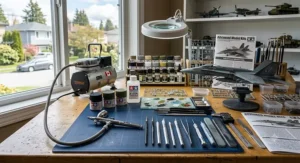
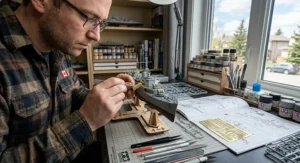
Getting an advanced kit home is only step one. Before you crack open the box, set up a dedicated, well-lit workspace — ideally near a window or with a small desk fan, since plastic cement and certain adhesives release volatile organic compounds that build up quickly in an unventilated room. A self-healing cutting mat protects both your table and your blades, and a small parts tray (even a muffin tin works) keeps sprue-separated pieces from rolling away mid-build.
First-use tips that save real frustration: dry-fit every sub-assembly before applying glue or bending metal tabs, since advanced kits rarely forgive an out-of-sequence step the way beginner kits do. For Gunpla specifically, remove parts from the runner with a proper side cutter rather than twisting them off — twisting creates visible stress marks that no amount of paint fully hides. For Metal Earth kits, always bend tabs slowly through their full range rather than snapping them into place, since repeated aggressive bending fatigues and eventually snaps the steel.
Common first-30-days mistakes include rushing decal application before the surface is fully cured, applying too much liquid cement (which causes visible seam distortion on aircraft canopies), and skipping a test-fit on tank track links before committing glue. Building the habit of “dry-fit, then commit” from your very first advanced kit will save you from a shelf of half-salvaged projects.
Real-World Scenarios: Matching the Kit to the Builder
Consider three common profiles. First, the returning hobbyist who built plastic kits as a teenager and is picking the hobby back up in their 30s or 40s with more disposable income and less free time. For this person, the MG Wing Gundam Zero EW Ver.Ka makes sense: snap-fit assembly means no glue fumes to manage around a family home, but the wing mechanism still delivers a genuine sense of accomplishment across a handful of focused evening sessions.
Second, the budget-conscious student or young professional testing whether advanced modelling is worth the investment before committing serious money. Here, a Metal Earth ICONX kit is the obvious entry point — under C$40, no specialized tools beyond tweezers required, and a finished piece attractive enough to display in a small apartment or dorm room.
Third, the dedicated collector with bench space, ventilation, and years of build experience looking for a genuine centrepiece project. This is where the PG Unleashed RX-78-2 Gundam or the Tamiya 1/32 F4U-1D Corsair earn their premium price tags — both demand and reward the kind of sustained attention a casual builder simply won’t give a C$600 kit.
How to Choose Advanced Model Kits
Picking the right advanced kit comes down to a handful of honest questions.
- Assess your true skill level first. Be honest about how many intermediate kits you’ve actually finished, not started — half-finished advanced kits gathering dust are the most common hobby regret reported in community forums.
- Match scale to available display space. A 1/32 Corsair or a Perfect Grade Gundam needs real shelf depth; a Metal Earth kit fits almost anywhere.
- Factor in tool requirements before price. A cheap kit paired with poor tools often costs more in frustration than a pricier kit built with the right side cutters and files.
- Consider ventilation needs honestly. Plastic cement kits need airflow; snap-fit Gunpla and metal puzzle kits don’t, which matters if you’re building in a shared space.
- Check photo-etch and decal quality in reviews. These details separate genuinely advanced kits from kits that are simply large.
- Set a realistic build timeline. A 500-part armour kit or an 18 cm Perfect Grade frame is a multi-week project, not a weekend one.
- Buy from established retailers. For gundam model kits Canada shoppers specifically should watch for grey-market imports with missing instructions in English or French.
Local chapters of organisations like IPMS Canada are a genuinely useful resource here — meeting fellow builders in person remains one of the best ways to gauge whether a specific advanced kit matches your actual skill level before you buy.
Metal Earth Models for Collectors: What Makes Them Different
Metal earth models occupy an unusual niche in the advanced kit world: no paint, no glue, and yet a difficulty ceiling that rivals plastic kits many times their price. The entire ICONX “premium” tier — which includes both the Millennium Falcon and Notre-Dame kits reviewed above — is built from laser-cut steel sheets roughly 10 cm square, with parts popped out by hand and folded into shape using nothing but tweezers and pliers.
What most buyers overlook is that this format actually demands more spatial reasoning than plastic kits, not less. There’s no adhesive to correct a slightly misaligned joint after the fact — once a metal tab is bent and threaded through its slot, repositioning it risks metal fatigue and breakage. That single constraint is why Metal Earth’s own skill-level system rates its Advanced and Challenging tiers as requiring five or more hours of focused work, on par with mid-range plastic kits despite the tiny finished footprint.
For collectors specifically, metal earth models offer something plastic rarely does: a genuinely different display texture. A shelf mixing painted plastic Gundam kits with unpainted brushed-steel Metal Earth pieces creates visual contrast that a single-material collection can’t. It’s a detail worth considering if you’re building out a display case rather than a single centrepiece.
✨ Don’t Miss These Exclusive Deals!
🔍 Take your advanced model kits to the next level with these carefully selected picks. Click on any highlighted item to check current pricing and availability. These builds will help you create authentic collector-quality results your shelf deserves!
Gundam Model Kits in Canada: Grades, Pricing & Availability
For anyone new to gundam model kits Canada availability, the grading system is the single most important thing to understand before buying. Entry Grade and High Grade kits sit at the beginner end, typically under C$40, with simplified snap-fit construction. Real Grade steps up detail while staying in a manageable 1/144 scale. Master Grade — like the Wing Gundam Zero reviewed above — introduces internal frames and more refined articulation at 1/100 scale. Perfect Grade sits at the top, with the PG Unleashed RX-78-2 representing the current pinnacle of that line.
Canadian buyers face a specific wrinkle: many high-demand Gunpla releases sell out at Japanese retail before reaching North American distribution, which drives up prices on secondary marketplaces. Reviewers and Canadian hobby retailers alike consistently advise checking established Canadian hobby shops and their online storefronts before resorting to import listings, both for accurate customs handling and for authentic, non-counterfeit parts. Community events like the Gunpla Builders World Cup, which has run Canadian regional heats for several years, are also a good barometer of which kits Canadian builders are gravitating toward each season.
Price ranges vary enormously by grade: expect roughly C$15-C$40 for High Grade, C$50-C$70 for Real Grade, C$100-C$180 for most Master Grade releases, and C$400 and up for Perfect Grade kits like the one featured in this guide.
Advanced Model Kits vs Beginner Kits: What Really Changes
The gap between an advanced kit and a beginner kit isn’t just part count — it’s a shift in what the manufacturer assumes you already know how to do.
| Factor | Beginner Kits | Advanced Model Kits |
|---|---|---|
| Typical part count | Under 100 | 200-500+ |
| Assembly method | Snap-fit, minimal tools | Cement, photo-etch, precision folding |
| Paint requirement | Often pre-coloured | Usually required for realism |
| Build time | 2-5 hours | 8-40+ hours |
| Best For | First-time builders | Experienced modellers seeking realism |
The practical upshot of this table is that advanced model kits aren’t simply “bigger” — they introduce entirely new failure points. A beginner kit’s snap-fit joints are engineered to be nearly foolproof, while an advanced kit’s photo-etched brass fret or cement-glued canopy can be permanently damaged by a single rushed step. That’s precisely why skipping straight from a first kit to a Perfect Grade Gundam or a 500-part tank often ends in a half-finished shelf project rather than a display piece.
Common Mistakes When Buying Advanced Model Kits
Even experienced hobbyists trip over a few recurring pitfalls. The first is buying based on box art alone without checking the stated skill level or parts count — a stunning render doesn’t guarantee a stunning finished product if the build itself is beyond your current comfort zone. The second is underestimating tool costs; a C$100 kit paired with a C$5 hardware-store hobby knife often produces worse results than the same kit built with proper craft tools.
A third mistake is ignoring scale compatibility when building a themed collection — mixing 1/32 and 1/48 aircraft, or 1/35 and 1/72 armour, on the same shelf creates a jarring size mismatch that undermines an otherwise excellent build. Finally, many buyers underestimate how much decal and paint work separates a “technically finished” kit from a genuinely collector-quality one; the assembly itself is often less than half the total time investment on premium kits.
Long-Term Cost & Maintenance
Advanced model kits carry costs beyond the sticker price. Cement, paint, spare blades, and replacement tweezers add up over a year of active building — budget roughly an additional 20-30% on top of kit price for consumables if you’re building regularly. Photo-etched brass parts also require specific adhesives (cyanoacrylate rather than standard plastic cement), which is an added line item many first-time advanced builders don’t anticipate.
On the maintenance side, finished models need occasional dusting with a soft brush rather than compressed air, which can dislodge small antenna or gun-barrel parts on Gunpla and armour kits. Metal Earth pieces are essentially maintenance-free once assembled, since there’s no paint to chip, which is a genuine long-term value advantage worth weighing against their lower upfront cost. Total cost of ownership, in other words, favours simpler kits for anyone building a large display collection on a fixed budget.
Intricate Assembly: What to Expect at the Workbench
“Intricate assembly” sounds abstract until you’re twelve hours into a 500-part tank kit at 11 p.m. wondering why a single road wheel won’t sit flush. In practice, intricate assembly means working in short, well-lit sessions rather than marathon sittings — fatigue causes far more visible mistakes than lack of skill does. It also means accepting that sub-assemblies (a cockpit, an engine, a turret basket) get built and painted separately before final assembly, rather than gluing everything together sequentially from the instruction sheet’s first page to its last.
Reviewers across every product category in this guide echo the same practical advice: dry-fit obsessively, work in batches, and don’t be afraid to set a kit aside for a day if a particular stage feels rushed. That patience is exactly what separates a kit that looks assembled from one that looks genuinely built.
Safety, Materials & Regulations for Canadian Hobbyists
Ventilation deserves real attention, not an afterthought. Plastic cements and certain paints release volatile organic compounds, and Health Canada’s own guidance on indoor air contaminants notes that VOC exposure indoors can affect health depending on concentration and duration of exposure — a good reason to crack a window or run a small fan whenever cement or spray paint is involved, even for a “quick” ten-minute gluing session.
Most advanced kits carry age recommendations of 14 or 15 years and up due to small-parts choking hazards and sharp photo-etched metal edges, both worth taking seriously if kits will be stored anywhere children might access them. Metal Earth’s laser-cut sheets in particular can leave sharp burrs at cut points, so keeping a small first-aid kit nearby is a sensible, low-effort precaution for any serious modelling bench.
Building Collector-Quality Results: Finishing & Display Tips
The line between “assembled” and collector quality builds almost always comes down to finishing steps most instruction manuals treat as optional. Panel-lining — running a fine dark wash into moulded surface detail — adds dramatic depth to both Gunpla and armour kits for minimal cost and effort. A simple matte or semi-gloss topcoat evens out sheen inconsistencies between different plastic parts, which is one of the fastest ways to make a kit look professionally finished rather than merely completed.
Display matters too: UV exposure fades paint and yellows clear canopy parts over time, so a shelf out of direct sunlight preserves both plastic and metal kits far longer. Members of clubs affiliated with institutions like the Canadian War Museum, which regularly hosts scale-modelling demonstrations, often cite proper storage and light control as the most underrated factor in keeping a collection looking sharp for decades rather than years.
Frequently Asked Questions
❓ Are advanced model kits worth it for beginners?
❓ What is the hardest type of advanced model kit to build?
❓ Do Metal Earth kits count as advanced model kits?
❓ How much should I budget for tools alongside a kit?
❓ Where can I buy gundam model kits in Canada safely?
Conclusion
Advanced model kits reward exactly the kind of patience that makes the hobby satisfying in the first place — there’s no shortcut to a genuinely collector-quality finished piece, and honestly, that’s part of the appeal. Whether you’re drawn to the engineering ambition of the PG Unleashed RX-78-2 Gundam, the accessible challenge of a Metal Earth ICONX kit, or the quiet satisfaction of a well-built MENG TS-027 Leopard 2A7, the right pick comes down to matching your actual skill level and available bench time to the kit’s real demands, not just its box art.
Start with honest self-assessment, invest in decent tools like the Tamiya Basic Tool Set from day one, and build up through grades and scales rather than jumping straight to the top shelf. Do that, and the jump from beginner hobbyist to genuinely advanced modeller happens naturally, one carefully finished kit at a time.
✨ Ready to start your next build? Check current prices on the kits above and find the one that matches where you’re at right now! 🛠️
Recommended for You
- Wacom Tablet Canada: 7 Best Picks Ranked for Artists in 2026
- 7 Best Professional Drawing Set Picks for Canadian Artists (2026)
- Telescope Astronomy Teens: 7 Real Picks to Ignite Stargazing (2026)
Disclaimer: This article contains affiliate links. As an Amazon Associate, I earn from qualifying purchases. If you purchase products through these links, we may earn a small commission at no additional cost to you.
✨ Found this helpful? Share it with your friends! 💬🤗
