
In This Article
Somewhere between the family group chat and the fortieth blurry selfie, a lot of Canadian teens hit a wall with their phone camera. It does everything, technically, and yet nothing feels like theirs. That’s usually the moment a parent starts typing “beginner DSLR camera teens” into a search bar at eleven at night, hoping there’s a straightforward answer buried somewhere in the noise. There sort of is, and sort of isn’t — it depends entirely on what your teenager actually wants to do with a camera.

A beginner DSLR camera for teens is essentially a camera with a bigger sensor, interchangeable lenses, and manual controls that a smartphone can’t match, built to be simple enough for a first-timer while leaving room to grow into “real” photography. That’s the short version. The longer version involves weighing sensor size against price, guide modes against manual dials, and — since this is written for a Canadian audience — actual availability and pricing on amazon.ca rather than U.S. listings that don’t ship north of the border.
We dug through real product specs, aggregated review sentiment from photography publications and verified retailers, and put together seven genuinely available options spanning budget, mid-range, and premium territory, plus a couple of mirrorless alternatives for teens who might outgrow a DSLR faster than expected. Nothing here is invented — where we couldn’t verify something (say, an exact review count), we say so rather than making it up. What follows is commentary and comparison you won’t find on a product listing page, plus a Canada-specific take on lighting kits, starter bundles, and what actually matters when you’re buying for a teenager rather than yourself.
Quick Comparison Table
| Camera | Type | Sensor | Price Range (CAD) | Best For |
|---|---|---|---|---|
| Canon EOS Rebel T7 | DSLR | 24.1MP APS-C | Around C$600-C$700 (kit) | Tightest budgets, guide-mode learners |
| Nikon D3500 | DSLR | 24.2MP APS-C | Around C$550-C$680 (kit) | All-day battery life, simplicity |
| Canon EOS Rebel SL3 | DSLR | 24.1MP APS-C | C$800-C$950 range | Small hands, flip-screen selfies |
| Nikon D5600 | DSLR | 24.2MP APS-C | C$900-C$1,050 range | Growing into manual mode |
| Canon EOS Rebel T8i | DSLR | 24.1MP APS-C | C$1,100-C$1,300 range | Fast-moving subjects, sports |
| Nikon Z50 II | Mirrorless | 20.9MP APS-C | C$1,250-C$1,600 range | Content creators, video-first teens |
| Canon EOS R100 | Mirrorless | 24.1MP APS-C | Under C$800 (kit) | Smallest mirrorless entry point |
Prices reflect approximate Canadian retail ranges at the time of research and change constantly — always check current price before buying.
Looking at this lineup, the split isn’t really “cheap versus expensive,” it’s “how much hand-holding does your teen need versus how much room do they want to grow.” The Canon EOS Rebel T7 and Nikon D3500 sit at the accessible end and are built to be forgiving of mistakes, while the Nikon Z50 II trades some of that simplicity for genuinely modern autofocus that a teenager serious about video will actually notice. The middle ground — Canon EOS Rebel SL3, Nikon D5600, and Canon EOS Rebel T8i — is where most families should probably be looking, because it gives a teen enough manual control to keep learning for two or three years without immediately feeling like a hand-me-down.
💬 One click below could save another parent the same 11 p.m. research spiral — thanks for sharing!
Top 7 Beginner DSLR Cameras for Teens: Expert Analysis
1. Canon EOS Rebel T7 — best value beginner DSLR overall
The Canon EOS Rebel T7 (sold internationally as the EOS 2000D) earns its spot mostly by refusing to overcomplicate things. It pairs a 24.1-megapixel APS-C CMOS sensor with Canon’s older but reliable DIGIC 4+ processor, a 9-point autofocus system, and built-in Wi-Fi with NFC for pulling images onto a phone. In practice, that sensor resolution is plenty for school yearbook submissions, Instagram, and even reasonably large prints, though the 3fps continuous shooting speed and non-articulating screen show their age the moment you try to shoot anything fast-moving. Based on the spec comparison against newer entry DSLRs, the T7’s real strength is Canon’s Guide Mode, which walks a first-time user through exposure concepts in plain language instead of burying them in menu jargon — something reviewers repeatedly single out as the reason a beginner “gets it” within the first afternoon. What the spec sheet won’t tell you, but aggregated reviews consistently note, is that this is the camera most often recommended specifically because it survives a teenager’s first year of dropped bags and forgotten settings without complaint. Reviewers consistently mention strong battery life (rated around 500 shots per charge) and warm, natural skin tones in portraits, while the most common criticism is the sluggish autofocus and burst rate compared to anything mirrorless.
Pros:
- ✅ Genuinely beginner-friendly Guide Mode explains settings in real time
- ✅ Solid 24.1MP sensor produces detail smartphones can’t match
- ✅ Wide, inexpensive lens ecosystem thanks to Canon’s EF-S mount
Cons:
- ❌ 3fps burst rate struggles with sports or fast pets
- ❌ Fixed screen with no touchscreen feels dated next to mirrorless rivals
At around C$600-C$700 for the kit lens bundle, the Canon EOS Rebel T7 remains one of the easiest recommendations for a first camera when budget is the deciding factor.
2. Nikon D3500 — longest battery life for all-day shoots
The Nikon D3500 takes a different approach to the same problem: instead of leaning on software hand-holding, it leans on sheer reliability. Its 24.2MP DX-format sensor has no optical low-pass filter, which — based on the spec comparison with the Canon T7 — means slightly crisper detail straight out of camera, particularly noticeable in landscape and texture-heavy shots. The standout number here is battery life: a CIPA-rated 1,550 shots per charge, roughly three times what many entry mirrorless cameras manage, which for a teenager who forgets to charge things is arguably more valuable than any single spec on this list. Here’s what to weigh, though — Nikon dropped Wi-Fi in favour of Bluetooth-only connectivity through the SnapBridge app, and aggregated user reviews describe that pairing process as slower and occasionally finicky compared to a direct Wi-Fi transfer. The 11-point autofocus system and 5fps burst rate are both modest improvements over the Canon T7, useful for casual action shots but not built for serious sports photography. Reviewers largely agree the D3500’s Guide Mode is nearly as approachable as Canon’s, and its lighter, more compact body (roughly 365 grams without lens) is genuinely easier for a smaller teenager to hold comfortably for a full afternoon.
Pros:
- ✅ Outstanding 1,550-shot battery life beats nearly every rival
- ✅ Sharp, detailed images thanks to the filter-free 24.2MP sensor
- ✅ Lighter and more compact than most entry-level DSLRs
Cons:
- ❌ Bluetooth-only SnapBridge transfers are slower than Wi-Fi rivals
- ❌ No touchscreen makes menu navigation feel old-fashioned
Priced around C$550-C$680 for the kit, the Nikon D3500 is the pick for a teen who’d rather not think about charging a battery every other day.
3. Canon EOS Rebel SL3 — lightest DSLR with a flip touchscreen
If the goal is something that doesn’t feel like carrying a brick around a school hallway, the Canon EOS Rebel SL3 (EOS 250D internationally) is worth the jump in price. At roughly 449-453 grams with battery and card, Canon markets it as the world’s lightest DSLR with a fully articulating screen, and based on the spec comparison, that vari-angle 3-inch touchscreen is the single biggest usability upgrade over the T7 and D3500 on this list. What most buyers overlook about this model is its Dual Pixel CMOS autofocus in Live View mode, which uses phase-detection across up to 3,975 selectable points — a system so fast that reviewers routinely compare the Live View shooting experience to using a mirrorless camera rather than a traditional DSLR. That’s a meaningful distinction for a teen who composes shots by staring at the screen rather than through an optical viewfinder, which, let’s be honest, is most of them. The trade-off is that the 9-point autofocus system used through the optical viewfinder is unchanged from older, cheaper Rebel models, so the SL3’s real advantage only shows up in Live View or video. Aggregated reviews are consistently positive about ease of use and image quality, with the most common complaint being underwhelming video autofocus performance in 4K mode, where Dual Pixel AF is disabled entirely.
Pros:
- ✅ Lightest DSLR body with a fully articulating touchscreen
- ✅ Dual Pixel AF in Live View rivals mirrorless autofocus speed
- ✅ Eye-detection AF helps beginners nail focus on portraits
Cons:
- ❌ Optical viewfinder still limited to a basic 9-point AF system
- ❌ 4K video loses Dual Pixel AF, forcing slower contrast-detect focus
In the C$800-C$950 range for the kit, the Canon EOS Rebel SL3 suits a teen who’ll mostly shoot using the screen rather than the viewfinder — which, again, is nearly everyone under twenty.
4. Nikon D5600 — most room to grow into manual mode
The Nikon D5600 sits a rung above the entry-level Rebel and D3500 tier, and it shows in the details that matter for a teenager who’s actually sticking with photography past the first month. Its 24.2MP DX sensor pairs with a 39-point autofocus system (nine of them cross-type, meaning more accurate focus tracking), a genuine step up from the 9- or 11-point systems on cheaper models. The 3.2-inch fully articulating touchscreen — larger than the SL3’s — combined with SnapBridge Bluetooth connectivity makes this Nikon’s most content-creator-friendly DSLR, something aggregated reviews from vlogging-focused outlets note specifically. Based on the spec comparison, the real value here isn’t raw image quality (which is close to the cheaper D3500) but rather the added creative control: a proper 5fps burst rate, a wider ISO range up to 25,600, and physical dials that reward a teen who’s ready to leave Auto mode behind. What the spec sheet won’t tell you is that Nikon’s own connectivity software has a reputation, echoed across multiple review sites, for being “temperamental” — expect occasional dropped connections rather than a seamless experience. Battery life at roughly 820 shots is solid, if noticeably behind the D3500 in the same lineup.
Pros:
- ✅ 39-point AF with cross-type sensors improves focus accuracy
- ✅ Large 3.2-inch vari-angle touchscreen ideal for vlogging angles
- ✅ Genuine manual-mode headroom for a teen who wants to advance
Cons:
- ❌ SnapBridge connectivity is inconsistent according to user reports
- ❌ Meaningfully pricier than the D3500 for a similar core sensor
Sitting around C$900-C$1,050, the Nikon D5600 is the mid-range pick for a teenager who has already outgrown “point and shoot” thinking.
5. Canon EOS Rebel T8i — fastest autofocus and burst speed
Canon’s most advanced entry-level DSLR, the Canon EOS Rebel T8i (EOS 850D internationally), is aimed squarely at “ambitious beginners” rather than absolute first-timers, and the spec sheet backs that framing up. A 45-point all cross-type autofocus system through the viewfinder — five times the coverage of the base T7 — combined with a DIGIC 8 processor pushes continuous shooting to 7fps, a genuinely useful number for a teen shooting school sports, dance, or anything else that doesn’t sit still. Reviewers consistently point to the eye-detection autofocus in Live View and 4K video recording (with the caveat that Dual Pixel AF is unavailable in 4K, forcing a switch to slower contrast-detect focus) as the camera’s headline upgrades over the rest of Canon’s Rebel lineup. Based on the spec comparison, what most buyers overlook is that the T8i and its predecessor, the T7i, are nearly identical apart from the processor and burst speed bump — so you’re paying largely for speed and video capability rather than a fundamentally new sensor. The vari-angle 3-inch touchscreen and vertical video support also make it a sensible pick for a teen splitting time between stills and short-form video content. Its heavier body (around 515 grams) is the one real ergonomic downside for a smaller teenager.
Pros:
- ✅ 45-point all cross-type AF is the fastest viewfinder AF on this list
- ✅ 7fps burst rate handles sports and fast action confidently
- ✅ 4K video with vertical recording support suits content creators
Cons:
- ❌ Heavier body than the SL3 or D3500, less comfortable for smaller hands
- ❌ 4K video disables Canon’s excellent Dual Pixel autofocus
At C$1,100-C$1,300, the Canon EOS Rebel T8i is the ceiling of the DSLR side of this list — a genuine two-to-three-year camera rather than a one-summer purchase.

6. Nikon Z50 II — best mirrorless upgrade path for style-conscious teens
For a teenager who cares more about content creation than optical viewfinders, the Nikon Z50 II is the strongest mirrorless argument here, and it directly answers the “mirrorless camera youth” question a lot of parents are quietly asking. It borrows its 209-point autofocus system, subject detection (people, animals, birds, and vehicles), and EXPEED 7 processor from Nikon’s professional Z8 and Z9 bodies — a genuinely unusual amount of trickle-down technology at this price tier. What most buyers overlook about this model is how much that autofocus inheritance actually matters in daily use: reviewers across multiple outlets describe subject tracking that performs on par with cameras costing two to three times as much, which is a meaningful claim for a mirrorless camera aimed at younger, less experienced shooters. Based on the spec comparison, the trade-offs are real: battery life drops to roughly 230-250 shots per charge (a fraction of the D3500’s), and there’s no in-body image stabilization, so a shaky-handed beginner will need a stabilized lens to compensate. Burst shooting up to 11fps mechanically (and 30fps electronically for JPEGs) plus 4K/60p video puts this squarely ahead of every DSLR on this list for anyone prioritizing motion and video over stills-only shooting.
Pros:
- ✅ Flagship-grade autofocus and subject detection at a mid-range price
- ✅ 4K/60p video and 11fps burst outperform every DSLR here
- ✅ Compact 495-gram body is easy to carry all day
Cons:
- ❌ Battery life (roughly 230-250 shots) trails DSLRs significantly
- ❌ No in-body stabilization, so shaky footage needs a stabilized lens
Around C$1,250-C$1,600 depending on kit configuration, the Nikon Z50 II suits a teen who’s already thinking about YouTube, TikTok, or simply wants the newest autofocus technology available at this price.
7. Canon EOS R100 — smallest mirrorless entry point on a tight budget
The Canon EOS R100 functions as Canon’s mirrorless answer to the Rebel T7 — similarly dated internals, similarly aimed at first-time buyers who want the smallest possible footprint. Its 24.1MP APS-C sensor and Dual Pixel CMOS autofocus (with 3,975 selectable points across 143 zones) sit inside a body Canon markets as the smallest and lightest in the entire EOS R lineup, weighing around 356 grams. Based on the spec comparison with the more expensive EOS R50, the R100 cuts several corners to hit its price point: there’s no touchscreen, the fixed rear display forces navigation through a four-way directional pad instead of tapping to focus, and continuous shooting tops out at a modest 6.5fps in single-AF mode. Reviewers are fairly consistent in framing this as “acceptable, not exciting” — a reasonable entry into Canon’s RF lens ecosystem for a teen on a tight budget, but a camera most will want to upgrade from within a year or two once they notice the lack of animal or vehicle detection autofocus (both reserved for the pricier R50). Where it genuinely earns its keep is portability: for a teen who wants an interchangeable-lens camera that fits in a school bag pocket without a second thought, the R100’s size is difficult to beat.
Pros:
- ✅ Smallest, lightest body in Canon’s entire mirrorless lineup
- ✅ Dual Pixel AF with eye detection handles portraits reliably
- ✅ Access to Canon’s growing RF and RF-S lens ecosystem
Cons:
- ❌ No touchscreen, so menu and focus-point navigation is slower
- ❌ Lacks animal and vehicle autofocus modes found on the pricier R50
At under C$800 for the kit, the Canon EOS R100 is the budget mirrorless option worth cross-shopping against the T7 before deciding between DSLR and mirrorless entirely.
Practical Usage Guide: Setting Up Your Teen’s First Camera Right
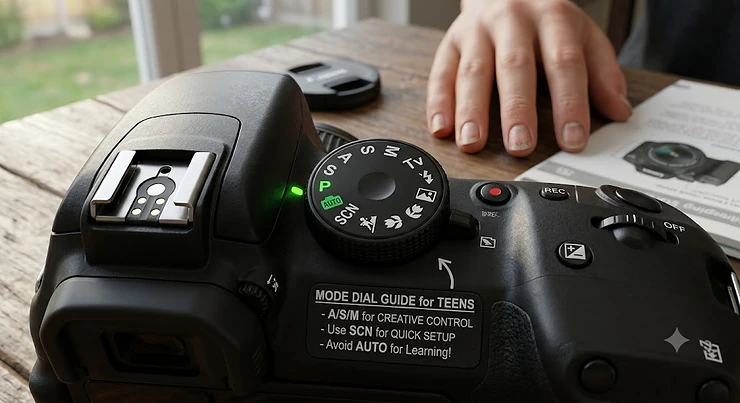
Handing over a new camera is the easy part — the first thirty days determine whether it becomes a genuine hobby or a drawer decoration. Start by resisting the urge to explain every setting on day one. Every camera on this list, from the Canon EOS Rebel T7 to the Nikon Z50 II, ships with a fully automatic mode specifically designed to produce good results with zero configuration; let your teen shoot in Auto for the first week just to get comfortable holding the camera, framing shots, and pressing the shutter without hesitation.
The single most common first-month mistake, according to aggregated advice from photography educators, is skipping straight to full Manual mode out of a sense that “real photographers” don’t use Auto. That backfires almost every time — a teenager fighting with exposure triangle math while also learning composition tends to get frustrated and quit within a week. Instead, move to Aperture Priority mode around week two or three; it lets a beginner control depth of field (the blurry background look everyone loves) while the camera still handles shutter speed automatically.
A quick maintenance routine matters more than most first-time buyers expect. Teach your teen to turn the camera off before changing lenses to avoid a dust-covered sensor, to store the body with a lens cap on and the battery removed if it won’t be used for more than a week, and to keep a microfibre cloth in the bag rather than a sleeve or shirt for cleaning the lens. Memory cards fail more often from being yanked out while the camera is writing data than from age — a five-second pause after taking a photo before ejecting the card avoids most corrupted-file headaches entirely.
Real-World Scenarios: Matching the Camera to the Teen
The casual hobbyist. A 14-year-old who wants to document friends, pets, and weekend outings without a steep learning curve is best served by the Canon EOS Rebel T7 or Nikon D3500. Both offer Guide Modes that teach fundamentals passively, and neither represents a devastating loss if it gets left in a backpack pocket for a rainy soccer practice.
The content creator. A 16-year-old already posting videos to social platforms needs flip screens, decent autofocus for talking-head shots, and reasonable video quality more than raw megapixels. The Canon EOS Rebel SL3, with its vari-angle touchscreen and Dual Pixel Live View AF, or the Nikon Z50 II, with genuinely modern subject tracking and 4K/60p, both fit this profile — budget is really the deciding factor between them.
The aspiring sports or wildlife shooter. A teen chasing fast-moving subjects — soccer, hockey, birds in the backyard — needs autofocus speed and burst rate above almost everything else. The Canon EOS Rebel T8i, with its 45-point AF and 7fps shooting, or the Nikon Z50 II, with 11-30fps depending on shutter mode, both outperform the entry-level options here by a wide margin, and the difference is genuinely noticeable the first time a subject actually moves quickly.
How to Choose a Beginner DSLR Camera for Teens
- Decide DSLR versus mirrorless first. DSLRs on this list generally offer longer battery life and cheaper used lenses; mirrorless options like the Nikon Z50 II and Canon EOS R100 offer better video and more modern autofocus but shorter battery life.
- Match autofocus points to intended use. A teen shooting mostly still subjects (portraits, landscapes) doesn’t need the Canon EOS Rebel T8i‘s 45-point system; a teen shooting sports absolutely does.
- Weigh screen type honestly. If your teen composes by looking at the rear screen rather than an optical viewfinder — and most do — a touchscreen model like the Canon EOS Rebel SL3 or Nikon D5600 will feel dramatically easier to use day-to-day.
- Check lens ecosystem cost, not just body price. Canon’s EF-S mount (used by the T7, SL3, and T8i) has a deep, inexpensive used lens market; Nikon’s F-mount (D3500, D5600) is similar, while newer mirrorless mounts have fewer budget third-party options for now.
- Consider battery anxiety realistically. If your teen is forgetful about charging devices, the Nikon D3500‘s 1,550-shot rating solves a real, recurring problem that other cameras on this list don’t.
- Set a total budget including a lighting kit and extra memory card, not just the camera body — a camera that costs C$700 with no accessories often ends up costing closer to C$850-C$900 once basics are added.
- Read the return policy before buying, particularly for a first camera; a teen’s interest sometimes shifts within the first month, and Amazon.ca’s standard return window gives some flexibility if that happens.
Common Mistakes When Buying a Camera for a Teen
The most expensive mistake families make is overbuying — jumping straight to something like the Canon EOS Rebel T8i or Nikon Z50 II assuming “better specs equals better first experience.” In practice, a beginner rarely notices the difference between a 9-point and 45-point autofocus system in the first few months, but they absolutely notice if the camera feels intimidating or overly heavy. A second common error is ignoring lens cost entirely; a camera body on sale for C$500 can easily balloon past C$1,000 once a telephoto lens, a memory card, and a case get added, so it pays to price the full kit before committing. Third, many parents assume any camera “will just work” for video content creation, without checking whether Dual Pixel autofocus is disabled in 4K mode (as it is on the Canon EOS Rebel SL3 and T8i) — a dealbreaker for a teen focused specifically on smooth video. Finally, skipping the return-window check is a quiet but real risk: interests shift, and buying through a retailer with a workable return policy protects against a camera that ends up unused after the novelty wears off.

Beginner DSLR Camera vs Mirrorless Camera Youth Options
This is genuinely the biggest fork in the road for anyone shopping this category in 2026, and it’s worth settling before falling in love with a specific model. A DSLR like the Canon EOS Rebel T7 or Nikon D5600 uses a mirror and optical viewfinder, which means what you see through the eyepiece is a direct, lag-free view of the scene — reassuring for a beginner who finds electronic viewfinders disorienting. DSLRs in this price bracket also tend to have noticeably better battery life, since they aren’t powering an electronic viewfinder or rear screen continuously; the Nikon D3500‘s 1,550-shot rating dwarfs the Nikon Z50 II‘s roughly 230-250 shots on a single charge.
Mirrorless cameras aimed at a younger audience, like the Nikon Z50 II and Canon EOS R100, flip that trade-off. They’re generally lighter, offer faster and more accurate autofocus (particularly for video and subject tracking), and their electronic viewfinders — where present — show a live preview of exposure and colour before you even take the shot, which shortens the learning curve for understanding how settings affect the final image. The catch, based on the spec comparison, is cost and battery anxiety: mirrorless bodies with modern autofocus systems like the Z50 II’s tend to sit at a higher price point than comparable DSLRs, and their batteries need more frequent charging. For a teen who mostly shoots outdoors during the day and doesn’t mind an optical viewfinder, a DSLR remains the more forgiving and often cheaper starting point; for a teen focused on video-first content creation, the mirrorless side of this list is worth the trade-offs.
Photography Lighting Kit: Does a Beginner Actually Need One?
A photography lighting kit isn’t essential for a teen’s first six months with any of these cameras — natural window light and a reflector (even a piece of white foam board) will teach composition and exposure fundamentals just as effectively as a purchased kit. That said, once a teenager moves into portrait work, product photography for a small side hustle, or indoor content creation, a basic two-softbox lighting kit becomes genuinely useful rather than a nice-to-have. Look for a continuous LED kit over a flash-based strobe kit for a beginner: continuous lighting lets you see the exact effect in real time on cameras like the Canon EOS Rebel SL3 or Nikon D5600, both of which have articulating screens that make positioning lights while checking the live preview much easier. A basic two-light continuous kit with stands and diffusers typically runs in the C$100-C$200 range in Canada, which is a reasonable add-on once the camera itself has proven the interest is sticking. One practical note specific to Canadian buyers: LED lighting kits sold through amazon.ca vary in whether they include a CSA or cUL safety certification mark, and it’s worth checking for one before leaving continuous lights running unattended, particularly around younger siblings or pets.
Building a Photography Starter Kit in Canada
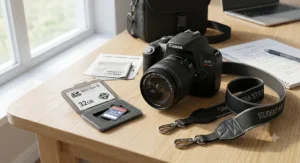
A camera body alone rarely covers the full first-purchase list, and building a sensible photography starter kit in Canada means budgeting for accessories alongside the body itself. At minimum, plan for a second battery (particularly important for the Nikon Z50 II given its shorter battery life), a 64GB or larger SD card rated UHS-I or faster, a padded camera bag or sling, and a basic tripod for anyone experimenting with longer exposures or self-portraits. A lens cleaning cloth and a UV or clear protective filter for the front element round out the essentials without meaningfully inflating the budget. For Canadian buyers specifically, it’s worth pricing accessories through amazon.ca directly rather than assuming U.S. listings will ship or price the same way — cross-border shipping and duties can quietly add 15-20% to a bundle that looked cheaper on a U.S. site. A realistic starter kit budget on top of any camera body in this guide sits around C$150-C$250 for batteries, a card, and a bag, which is worth factoring into the overall decision between, say, the budget-friendly Canon EOS Rebel T7 and the pricier Nikon Z50 II.
✨ Don’t Miss These Exclusive Deals! 🔍
Take your teen’s photography hobby to the next level — click on any highlighted camera above to check current pricing and availability on amazon.ca.
Long-Term Cost & Maintenance in Digital Photography
The sticker price of any camera on this list is only the opening cost in digital photography, and understanding the full picture helps set realistic expectations. Sensor cleaning, needed roughly once a year for a camera that gets regular lens changes, typically costs C$40-C$80 at a local camera shop if you’d rather not attempt it yourself. Batteries for DSLRs like the Canon EOS Rebel T7 or Nikon D3500 tend to last several years of regular use before needing replacement, generally in the C$30-C$60 range when they do; mirrorless batteries for the Nikon Z50 II run similarly but need replacing or supplementing sooner given the lower per-charge shot count. Lenses hold their value unusually well compared to camera bodies — a well-maintained kit lens or telephoto purchased used can often be resold for 60-70% of its original price years later, which meaningfully lowers the effective cost of ownership if a teen eventually upgrades to a more advanced body within the same lens mount. Cloud photo storage is worth budgeting for too, since a serious hobbyist can accumulate hundreds of gigabytes of RAW files within a year; a modest C$3-C$5 monthly subscription for extra cloud storage is often cheaper than repeatedly buying new memory cards.

Creative Imaging and Photographic Technique for Teens
Learning creative imaging goes beyond understanding a camera’s buttons — it’s about developing an eye for composition, light, and timing that no spec sheet teaches directly. The rule of thirds, where a subject is placed off-centre along an imaginary grid rather than dead centre, is the single fastest photographic technique to teach a beginner, and every camera on this list can display a grid overlay in its menu to practise it in real time. Encouraging a teen to shoot the same subject at different times of day — the harsh light of noon versus the warm, low-angle light of golden hour — builds an intuitive understanding of how light shapes a photo far faster than reading about it. For teens using cameras with strong Live View autofocus, like the Canon EOS Rebel SL3 or Canon EOS R100, experimenting with a wide-open aperture to blur backgrounds (often called “background blur” in Canon’s beginner-friendly Creative Assist mode) is an easy, visually rewarding way to grasp depth of field. Photography programs at Canadian institutions, including Toronto Metropolitan University’s Photography Media Arts program, build entire foundational curricula around exactly these fundamentals before ever touching advanced editing — proof that composition and light, not gear, are what actually separate a good photo from a forgettable one.
Safety, Privacy & Canadian Rules Every Teen Photographer Should Know
Before a teenager starts sharing photos widely, it’s worth having a short conversation about copyright and privacy rather than assuming social platforms cover it. Under Canada’s Copyright Act, the fair dealing provisions allow limited use of others’ copyrighted images for research, private study, and similar purposes — but taking and posting photos of other people, particularly identifiable classmates or strangers, involves separate privacy considerations that copyright law alone doesn’t resolve. A simple household rule — ask before posting photos that clearly identify someone else — avoids most real-world friction. It’s also worth revisiting how much time your teen spends on a screen versus behind a viewfinder; interestingly, a hands-on hobby like photography is one of the few screen-adjacent activities that Canadian health guidance treats favourably, since Canada’s updated screen time guidance increasingly emphasizes the quality and intentionality of screen use over rigid time limits, and composing a deliberate photograph is a fairly different mental activity than passively scrolling. On the equipment side, always store spare lithium-ion batteries away from metal objects and extreme heat, and never leave a battery charging unattended overnight — standard advice that applies to every camera on this list.

Frequently Asked Questions
❓ What is the best beginner DSLR camera for a teenager?
❓ Is a mirrorless camera better than a DSLR for a teen?
❓ How much should I spend on a first camera for a teenager?
❓ Do teens need a lighting kit for photography?
❓ Can a beginner DSLR camera shoot good video for content creation?
Conclusion
There isn’t a single “best” answer buried in this list, and that’s honestly the point — a beginner DSLR camera for teens needs to match the specific teenager, not a spec sheet ranking. The Canon EOS Rebel T7 and Nikon D3500 remain the sensible, low-risk starting points for a teen who just wants to try photography without a big financial commitment. The Canon EOS Rebel SL3 and Nikon D5600 earn their higher price with touchscreens and autofocus systems that make daily use noticeably easier, while the Canon EOS Rebel T8i rewards a teen who’s already shooting sports or fast action and needs the speed to match. For anyone leaning mirrorless, the Nikon Z50 II brings genuinely modern autofocus technology within reach, and the Canon EOS R100 offers the smallest, lightest entry point into that ecosystem for a tighter budget. Whichever one fits, remember that the accessories — a spare battery, a decent memory card, a proper bag — matter almost as much as the body itself, and building those into the initial budget avoids a frustrating surprise a few weeks in. Above all, the camera that actually gets used and enjoyed will always outperform the one with the better spec sheet sitting untouched in a drawer.
✨ Ready to help your teen start their photography journey? Check current prices on the picks above and see which one fits your family’s budget and their creative goals best! 📸
Recommended for You
- Arduino Advanced Kit: 7 Top Picks Tested for Canada in 2026
- RC Plane Building Kit: 7 Best Canadian Picks for 2026
- Advanced Model Kits: 7 Best Picks for Serious Builders in 2026
Disclaimer: This article contains affiliate links. As an Amazon Associate, I earn from qualifying purchases. If you purchase products through these links, we may earn a small commission at no additional cost to you.
✨ Found this helpful? Share it with your friends! 💬🤗
