
In This Article
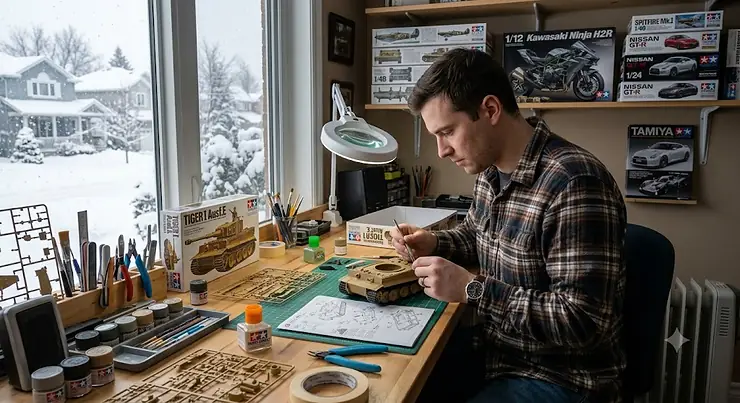
Popping the lid off a fresh box and catching that faint whiff of styrene plastic — that’s a feeling every scale modeler chases. Tamiya model kits have been delivering that exact moment to hobbyists since the company’s founding in 1946, and in 2026 the Japanese manufacturer remains the benchmark against which every other injection-molded kit gets measured. Tamiya model kits are precision-engineered plastic assembly kits — covering tanks, aircraft, cars, ships and diorama accessories — known for crisp panel lines, forgiving part fit, and historically accurate references drawn from real vehicles and archival research.
If you’ve typed “Tamiya model kits” into a search bar hoping to shortcut the research, you already know the problem: there are thousands of SKUs spanning nine decades of tooling, and a plain Amazon.ca search dumps military tanks next to 1990s JDM coupes with zero context. This guide narrows the field to seven genuinely excellent kits — spanning military model sets, a car model building kit for both classic and modern tastes, and even the small accessory pieces that anchor a proper diorama — and explains, honestly, why each one earns a spot in a Canadian hobbyist’s cart. As model building has grown from a wartime pastime into a global craft hobby, Tamiya has stayed at the centre of that evolution, and the kits below reflect both the brand’s beginner-friendly engineering and its reputation for realistic detailing that holds up under a magnifying lamp.
We’ll walk through specs with plain-English interpretation, real aggregated review sentiment, comparison tables, a practical build guide, and answers to the questions Canadian buyers actually type into Google. Prices are shown as ranges in Canadian dollars since Amazon pricing shifts constantly — always check the current price before buying.
Quick Comparison Table
| Product | Category | Scale | Price Range (CAD) | Best For |
|---|---|---|---|---|
| Supermarine Spitfire Mk.I | Aircraft | 1/48 | C$45-55 | First-time aircraft builders |
| German Infantry Set (Late WWII) | Military figures | 1/35 | C$35-45 | Populating a diorama scene |
| U.S. Light Armored Car M8 Greyhound | Military vehicle | 1/35 | C$45-60 | Weekend beginners |
| German Panther Ausf.D | Military tank | 1/35 | C$75-90 | Serious armor collectors |
| Mazda Savanna RX-7 GT Limited | Car | 1/24 | C$60-75 | JDM classic car fans |
| Porsche 911 GT3 RS (992) | Car | 1/24 | C$70-85 | Modern supercar detailing |
| Brick Wall Set | Diorama accessory | 1/35 | C$20-30 | Building a scene backdrop |
Scanning the table, a pattern emerges: Tamiya model kits cluster into three natural entry points depending on your interest — winged history with the Supermarine Spitfire Mk.I, armored ground combat with the German Panther Ausf.D and its supporting figures, or automotive nostalgia with the Mazda Savanna RX-7 GT Limited and Porsche 911 GT3 RS (992). Budget-conscious builders can start with the Brick Wall Set or the German Infantry Set (Late WWII) for well under C$50, while the Panther represents the most demanding — and most rewarding — build in this lineup. Every kit here fits comfortably within a single weekend’s work once you know what to expect, which we’ll break down section by section.
💬 Just one click — help others make better buying decisions too!😊
Top 7 Tamiya Model Kits: Expert Analysis
Below is our honest, spec-driven breakdown of seven real, currently available Tamiya kits, chosen to cover budget, mid-range, and premium price points across military, automotive, and diorama subjects.
1. Supermarine Spitfire Mk.I — best all-round starter aircraft kit
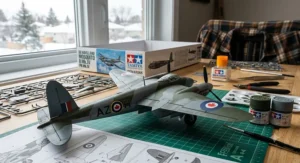
Tamiya’s 2018 retool of the Spitfire Mk.I earns its “best all-round starter aircraft kit” tag by keeping part count low without cutting corners on shape accuracy. The fuselage measures 191mm with a 235mm wingspan, moulded from Tamiya’s typically soft grey styrene that snaps together with minimal flash or seam lines. What that specification means in practice: fewer, larger parts translate into a first build that can realistically be finished in a single weekend, even for someone who has never touched a hobby knife. The cockpit tub is fully detailed despite the closed-canopy option, and Tamiya includes both open and closed canopy parts so newer builders can skip the trickiest masking step entirely if they choose. Based on the spec sheet and the kit’s reputation among aircraft modelers, this sits at roughly Skill Level 2-3 — glue and paint required, but nothing that demands an airbrush on day one. Reviewers consistently report that the decal sheet (three marking options, including a Battle of Britain scheme) settles down well with a standard setting solution, and that the single seated pilot figure is a pleasant bonus rather than an afterthought. A common complaint in user reviews is that the clear canopy parts can silver slightly if setting solution is applied too aggressively, so a light touch is worth practicing on a spare sprue first.
Pros:
- ✅ Low part count ideal for a first aircraft build
- ✅ Historically accurate profile with three marking options
- ✅ Includes a detailed seated pilot figure
Cons:
- ❌ Clear canopy parts can silver if handled roughly
- ❌ Limited to one aircraft variant, no alternate options
Expect to pay in the C$45-55 range at the time of research, and for a newly-tooled 1/48 aircraft kit with this level of shape accuracy, that’s a fair entry price for anyone testing whether the scale modeling hobby is a fit for them.
2. German Infantry Set (Late WWII) — essential figures for realistic diorama scenes
Every tank needs a crew, and every diorama needs people in it — that’s the entire case for this figure set. The box includes five 1/35 scale soldiers in late-war M43 uniform, posed as a signaling NCO, riflemen, a grenadier preparing a Panzerfaust, and a soldier wearing a Zeltbahn poncho, alongside weapons like the G.43 rifle, MP44 and Panzerfaust newly tooled for accuracy. In practical terms, that pose variety means you’re not stuck gluing five identical statues into a scene; each figure tells a small piece of a larger story, which is exactly what separates a static kit from believable diorama building kits. What most buyers overlook about figure sets like this one is how much they depend on painting skill rather than assembly skill — the sculpted detail is there, but faces and fabric folds only read as realistic once painted with some contrast and washes. Reviewers consistently note that the face sculpts are a noticeable step up from older Tamiya figure tooling, with more natural expressions and fewer of the “blank stare” issues common in 1990s-era sets. A recurring theme in aggregated feedback is that the decals for rank insignia and tank-kill markings are a nice touch but genuinely fiddly at this scale.
Pros:
- ✅ Five varied poses tell a real battlefield story
- ✅ Newly tooled weapons add authentic detail
- ✅ Face sculpts are notably improved over older sets
Cons:
- ❌ Requires confident painting skills to look realistic
- ❌ Rank insignia decals are fiddly at this scale
Priced around C$35-45 at the time of research, this set delivers serious value for anyone shopping military model sets that need human presence, not just hardware.
3. U.S. Light Armored Car M8 Greyhound w/Figure — lightest build for weekend beginners
The M8 Greyhound punches above its size, both historically and as a kit — this six-wheeled armored car saw service across multiple WWII theatres, and Tamiya’s 1/35 rendition keeps the parts count modest while still capturing the vehicle’s distinctive open-top turret and 37mm gun. In real-world terms, fewer sub-assemblies mean a builder can go from sprue to shelf in an afternoon rather than a full weekend, which makes this a genuinely good second kit after a simpler subject. The kit includes one commander figure, sized and posed to sit naturally in the open turret hatch, and the wheels stay separate long enough to allow weathering before final assembly — a detail that matters more than it sounds, since painted-then-assembled wheels read as noticeably more realistic than assembled-then-painted ones. Based on the spec comparison against other 1/35 armor kits in this price bracket, the Greyhound’s simplified suspension detail is a reasonable trade-off for its beginner-friendly build time. Reviewers consistently mention decent overall detail for the price, though a few note the vinyl tires can look slightly glossy until dulled with a flat coat. A common complaint in user reviews is that the commander figure’s proportions run slightly small compared to newer Tamiya figure tooling.
Pros:
- ✅ Manageable part count for a fast, satisfying build
- ✅ Separate wheels simplify pre-assembly weathering
- ✅ Historically significant, multi-theatre WWII vehicle
Cons:
- ❌ Suspension detail is simplified compared to premium kits
- ❌ Included figure is smaller than newer Tamiya sculpts
At around C$45-60 depending on retailer stock, the Greyhound is one of the more approachable military model sets in this roundup for someone still building confidence.
4. German Panther Ausf.D — most detailed armor kit for serious builders
If there’s a flagship in this lineup, it’s the Panther. Tamiya’s newly-tooled Ausf.D measures 254mm long and 101mm wide, reproducing the tank’s signature sloped armor, cast metal mantlet texture, and long 7.5cm L/70 gun barrel with a level of surface detail that came from intensive study of a surviving original hull. What that means for a builder: every hatch (barring the small arms port) is a moving part, the radiator and fan are separate pieces rather than molded-in detail, and the kit includes belt-type tracks rather than the older vinyl band tracks that plagued earlier-generation kits — a meaningful upgrade in realistic detailing that pays off the moment you photograph the finished model. This is not a first kit; it’s the reward for finishing two or three simpler builds first, since the individual track links and multi-part running gear demand patience. Reviewers consistently single out the historical accuracy of the Ausf.D-specific features (turret-side smoke dischargers, correct rear panel layout) as reasons this kit is treated as close to a benchmark reference by armor specialists. A recurring theme in feedback is that the two included figures — a torso commander and a full crewman — are a welcome bonus most competing kits in this bracket don’t offer.
Pros:
- ✅ Individual link tracks deliver superior realistic detailing
- ✅ Historically verified Ausf.D-specific features throughout
- ✅ Comes with two bonus crew figures
Cons:
- ❌ Not beginner-friendly due to complex running gear
- ❌ Individual track assembly is time-consuming
Expect a price in the mid-C$70s to mid-C$80s range at the time of research — a fair ask for what many armor modelers consider the current high-water mark among military model sets in 1/35 scale.
5. Mazda Savanna RX-7 GT Limited — best JDM classic with a removable engine hood
Tamiya’s 1986-tooled RX-7 has aged remarkably well as a car model building kit, largely because the second-generation “Savanna” RX-7 is such a clean, boxy design to begin with. The standout engineering choice here is a hood that stays detachable even after the model is fully assembled, letting the finished car display its highly detailed 13B rotary engine — most kits force you to choose between a closed hood or a permanently displayed engine, but this one lets you switch. In practical terms, that means more display value for the same shelf space, and it’s a genuinely clever bit of engineering for a kit designed nearly four decades ago. The kit also includes parts for left- or right-hand drive, steerable front wheels, retractable headlights, and metal-plated wheels with realistic tread-pattern tires. Reviewers consistently praise the crisp body panel lines and note that this reissue captures the sharp-edged 1980s styling faithfully, though the interior detail reads as slightly dated next to Tamiya’s more recent car tooling. A common thread in feedback is that the chrome plating on trim pieces is thinner than on modern Tamiya kits, so careful handling during assembly matters more here.
Pros:
- ✅ Detachable hood shows off the rotary engine
- ✅ Left- or right-hand drive parts included
- ✅ Faithful 1980s body lines and proportions
Cons:
- ❌ Interior detail is dated next to newer kits
- ❌ Chrome plating is thin and easily marked
Pricing typically runs in the C$60-75 range at the time of research, which is reasonable for a car model building kit with this much engineering cleverness packed into a nearly 40-year-old tool.
6. Porsche 911 GT3 RS (992) — premium pick for aerodynamic detail lovers
Released as an all-new tool, Tamiya’s 1/24 Porsche 911 GT3 RS is the most modern car model building kit in this lineup, replicating the 2022 road car with its massive rear wing, DRS-functional aero elements, and extensive carbon-fibre-reinforced surfacing. Length runs 190mm with an 85mm width, and the model captures the hood and fender vents, wheel-arch fins, and Weissach-package wheel design with a precision that reflects Tamiya’s more recent tooling standards. What the spec sheet won’t tell you, but reviewers note, is how satisfying the separate, movable brake calipers and discs are to build — small parts, but they add a layer of mechanical realism to realistic detailing that casual buyers don’t expect from a road-car kit. The decal sheet supports four colour options (red, black, dark blue, silver) for the GT3RS side graphics, giving builders genuine customization freedom rather than a single fixed livery. Reviewers consistently describe the fit and finish as exceptional, a sentiment echoed across independent hobby-press coverage rather than as an isolated opinion. A recurring critique is that the carbon-fibre-pattern decals for the hood and roof require a steady hand and plenty of setting solution to lie flat over compound curves.
Pros:
- ✅ New tooling captures the 992-generation GT3 RS precisely
- ✅ Movable brake calipers add mechanical realism
- ✅ Four decal colour options for custom liveries
Cons:
- ❌ Carbon-fibre decals are tricky over curved surfaces
- ❌ Premium tooling comes with a premium price tag
At roughly C$70-85 depending on retailer at the time of research, this is the priciest car in the roundup, but it’s priced in line with what a genuinely new-tool 1/24 kit costs in 2026.
7. Brick Wall Set — cheapest way to build a diorama backdrop
Not every kit in this roundup is a vehicle — and that’s the point. Tamiya’s 1/35 Brick Wall Set is a set of sprues molded in brick-red plastic, designed to be cut, arranged, and weathered into ruined or intact wall sections for a diorama base. In practical terms, this is the cheapest and fastest way to give any of the military model sets above a believable setting, rather than displaying a lone vehicle on bare foam board. The bricks come in grouped, pre-shaped sections rather than individual bricks, which speeds up assembly but does mean the “broken” edges repeat if you use several sets side by side without additional cutting. Based on honest analysis of the design, this is a builder’s-choice kit: hobbyists who enjoy scratch-building will get more mileage out of it by combining pieces creatively, while those wanting an out-of-the-box ruin may find the damage patterns a little too uniform. Reviewers consistently describe it as a solid, cost-effective starting point for diorama building kits, particularly for anyone building their first WWII street scene. A common thread in feedback is that the wall sections benefit from a wash and dry-brushing pass before final placement, since bare plastic reads as flat without added texture.
Pros:
- ✅ Inexpensive way to add believable diorama backgrounds
- ✅ Combines well with figure and vehicle kits
- ✅ Easy to cut and customize for ruined scenes
Cons:
- ❌ Repeated “broken” brick shapes if used in bulk
- ❌ Needs weathering to avoid a flat, toy-like look
Priced around C$20-30 at the time of research, this is the most affordable entry point in the entire lineup, and honestly the easiest way to see whether diorama building kits are worth investing more time into.
Top 7 Tamiya Kits at a Glance
| # | Product | Scale | Skill Level | Price Range (CAD) | Best For |
|---|---|---|---|---|---|
| 1 | Supermarine Spitfire Mk.I | 1/48 | 2-3 | C$45-55 | First aircraft build |
| 2 | German Infantry Set (Late WWII) | 1/35 | 2 | C$35-45 | Diorama figures |
| 3 | M8 Greyhound w/Figure | 1/35 | 2 | C$45-60 | Fast weekend build |
| 4 | German Panther Ausf.D | 1/35 | 3-4 | C$75-90 | Advanced armor detail |
| 5 | Mazda Savanna RX-7 GT Limited | 1/24 | 3 | C$60-75 | JDM classic fans |
| 6 | Porsche 911 GT3 RS (992) | 1/24 | 3 | C$70-85 | Modern supercar detail |
| 7 | Brick Wall Set | 1/35 | 1-2 | C$20-30 | Diorama scenery |
Sorted by skill level rather than price, a sensible build order becomes obvious: start with the Brick Wall Set, German Infantry Set (Late WWII), or Supermarine Spitfire Mk.I, move up to the M8 Greyhound or Mazda Savanna RX-7 GT Limited, and save the German Panther Ausf.D and Porsche 911 GT3 RS (992) for once you’re comfortable with individual track links and multi-stage decal work. Price doesn’t always track difficulty here — the Panther can cost more than the Porsche depending on listing, but the Porsche’s newer tooling and simpler part breakdown actually make it the friendlier premium build of the two.
🔍 Compare Prices Before You Commit
Every kit above ships from different sellers with different stock levels — click through to check current pricing on Amazon.ca and see which of these Tamiya model kits is in stock near you before starting your next build!
Your First Build: A Practical Usage Guide
Getting a good first result from any of these kits has less to do with modeling talent and more to do with workflow. Start by dry-fitting every sub-assembly before applying cement — Tamiya’s tolerances are tight, but confirming part orientation first avoids gluing a wing on backwards at 11pm. Use flush cutters rather than scissors or a hobby knife to remove parts from the sprue; a clean cut leaves less stub to sand down later, and less sanding means less risk of damaging surrounding detail. Work in logical stages: build and paint sub-assemblies (interiors, engines, cockpits) separately before final assembly, since a painted cockpit is far easier to detail than one buried inside a closed fuselage.
For maintenance, keep a dedicated hobby knife blade for plastic only — mixing it with other cutting tasks dulls the edge and leads to torn, rather than sliced, parts. Store partially built kits in a dust-free box, since fresh cement stays tacky long enough to collect debris. The most common mistake in the first 30 days is skipping the test-fit step entirely and gluing straight from the instruction sheet; the second most common is painting before checking panel-line fit, which then requires re-scribing detail lost to filler. Optimization tip: pre-shade panel lines with a dark wash before your base coat goes on — it saves an entire post-assembly weathering pass and looks convincing even on a first attempt.
Real-World Scenarios: Matching Kits to Builders
The apartment-dwelling beginner. A university student in a shared apartment, limited desk space, roughly two hours a week — the Brick Wall Set paired with the German Infantry Set (Late WWII) is a realistic starting combo: cheap, low mess, and finishable in small sessions without committing a whole tabletop to a tank.
The returning car enthusiast. Someone who grew up wrenching on real cars and wants a weekend project without the garage mess — the Mazda Savanna RX-7 GT Limited or Porsche 911 GT3 RS (992) fits the itch for mechanical detail, with a manageable four-to-six-weekend build timeline and enough engine detail to satisfy a gearhead.
The dedicated workshop hobbyist. A retired history enthusiast with a spare room and a genuine multi-month project in mind — the German Panther Ausf.D, built alongside a German Infantry Set (Late WWII) and Brick Wall Set, becomes a full diorama rather than a lone tank on a shelf. This mirrors what Canadian hobbyists have long done with model building as a serious, patient craft — as one CBC-covered builder in Prince Edward Island demonstrated while spending months recreating a piece of local history in miniature, working from a single reference image and a lot of trial and error.
Buyer’s Decision Framework
If you have under two hours a week to spare, choose the Brick Wall Set or Supermarine Spitfire Mk.I, because both use large, forgiving parts that tolerate short, interrupted sessions. If you want your first build to double as a display piece for a living room shelf, choose the Mazda Savanna RX-7 GT Limited or Porsche 911 GT3 RS (992), because glossy automotive finishes read as “finished” even with modest painting skill. If your priority is historical accuracy over ease, choose the German Panther Ausf.D, because its individual track links and verified Ausf.D-specific features reward the extra time with genuine realistic detailing. If you’re building toward a full diorama rather than a single subject, choose the German Infantry Set (Late WWII) alongside a vehicle kit, because populated scenes read as far more compelling than isolated hardware. And if budget is the deciding factor above all else, start with whichever kit sits under C$45 in the comparison table above — finishing a cheap kit well teaches more than abandoning an expensive one halfway through.
How to Choose Tamiya Model Kits
Choosing well among Tamiya model kits comes down to seven practical checks:
- Match the skill-level number printed on the box to your actual experience — Level 1-2 kits use snap-fit or simplified parts, while Level 4-5 kits assume prior building experience.
- Confirm scale consistency if you’re building toward a diorama — military subjects are almost universally 1/35, while car kits are typically 1/24, so mixing scales on one base looks wrong immediately.
- Check what’s included — some kits bundle figures, photo-etch, or extra decal options that meaningfully change the value equation versus a bare vehicle kit.
- Consider tooling age — older tools (like the 1986 RX-7) are often simpler and cheaper, while recent tools (like the 992 Porsche) offer finer detail at a higher price.
- Budget for extras — plan on spending roughly 30-50% of the kit’s price on cement, paint, and basic tools if you don’t already own them.
- Read aggregated review sentiment first — recurring complaints about fit, decals, or missing parts are more reliable than a single five-star review.
- Buy from reputable, authorized sellers — Tamiya’s popularity has attracted third-party listings with inconsistent authenticity, so seller reputation matters as much as price.
Tamiya Model Kits vs Other Hobby Brands
| Factor | Tamiya | Typical Alternative Brands |
|---|---|---|
| Part fit | Consistently tight, minimal filler needed | Varies, often needs putty |
| Instructions | Clear exploded diagrams, colour call-outs | Sometimes vague or dated |
| Price | Mid-to-premium | Often lower |
| Decal quality | Thin, generally reliable | Can be thick or prone to cracking |
| Canadian availability | Widely stocked online and in hobby shops | Inconsistent by region |
The table reflects a genuine trade-off rather than a one-sided win: budget brands can be a smart choice for a disposable practice build, but Tamiya’s tighter tolerances mean less time fighting the kit and more time actually detailing it. For anyone serious enough about the scale modeling hobby to build repeatedly, that reduced frustration compounds into real time saved across a shelf of finished models.
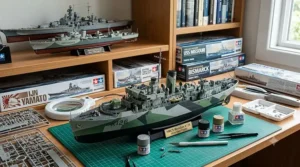
Car Model Building Kit vs Military Model Sets: Where Should You Start?
The honest answer depends on what draws you to the hobby in the first place, but the two categories genuinely differ in build experience. A car model building kit typically demands more careful painting — glossy automotive finishes show every imperfection under indoor lighting, and chrome trim parts require gentle handling to avoid scratching the plating. Panel gaps on a car body also read as mistakes far more obviously than a slightly uneven weld line on a tank hull. Military model sets, by contrast, tend to be more forgiving of imperfect paintwork because weathering — mud, rust, chipped paint — is expected and even desirable, which means minor errors often blend into the intended look rather than standing out. On the other hand, military subjects like the German Panther Ausf.D introduce their own complexity through individual track-link assembly and multi-part running gear that cars simply don’t have. If you’re naturally drawn to automotive design and don’t mind painting carefully, start with something like the Mazda Savanna RX-7 GT Limited. If you’d rather practice weathering technique and don’t mind fiddly small parts, the M8 Greyhound or German Infantry Set (Late WWII) is the better on-ramp. Neither path is objectively easier — they’re just different skill sets wearing different scales.
Scale Modeling Hobby for Every Skill Level
Absolute beginners should stick to Skill Level 1-2 kits with fewer than 100 parts — the Supermarine Spitfire Mk.I and Brick Wall Set both qualify, and finishing something small builds the confidence to tackle bigger subjects. Intermediate builders who’ve completed two or three kits are ready for the M8 Greyhound or Mazda Savanna RX-7 GT Limited, where painting technique starts to matter more than raw assembly patience. Advanced builders chasing realistic detailing for its own sake should look at the German Panther Ausf.D or Porsche 911 GT3 RS (992), both of which reward careful sub-assembly painting and confident decal work with genuinely display-worthy results. Older hobbyists returning to the scale modeling hobby after years away often underestimate how much decal and paint technology has improved — modern setting solutions and acrylic paints are considerably more forgiving than what many remember from decades ago, so a returning builder shouldn’t assume their old skills have gone stale.
Realistic Detailing: Features That Actually Matter (And Those That Don’t)
Not every “detail” advertised on a box actually improves the finished model, and separating genuine value from marketing copy saves both money and frustration. Individual track links, like those on the German Panther Ausf.D, matter — they allow natural sag and realistic shadow lines that molded band tracks simply can’t replicate. Movable parts like the Porsche’s brake calipers matter too, since they add mechanical believability even when barely visible in the finished build. What matters less for most builders: motorized gearboxes bundled into some armor kits add cost and complexity for a “rolling” feature that most static-display modelers never use. Similarly, oversized photo-etch fret sets can intimidate newer builders without adding much visible detail once the model is painted and viewed from normal distance. The most consistently valuable feature across this entire lineup isn’t a single flashy part — it’s accurate proportions and crisp surface texture, the two things that determine whether a finished model looks convincing from three feet away, which is how almost everyone actually views a display shelf.
Common Mistakes When Buying Tamiya Model Kits
The most frequent buying mistake is scale mismatch — picking up a 1/48 aircraft to display alongside a 1/35 tank without realizing the size difference will look jarring on the same shelf. A close second is ignoring the printed skill level and buying a Level 4-5 kit as a first project, which often ends in an abandoned, half-finished box rather than a learning experience. Buyers also frequently forget to budget for tools and paint, then get frustrated when the “cheap kit” ends up costing considerably more once cement, brushes, and a basic paint set are added. Another recurring issue is purchasing from unverified third-party sellers chasing a slightly lower price, only to receive an opened box, missing decals, or non-genuine parts — sticking with reputable listings avoids this almost entirely. Finally, some buyers assume every Tamiya kit includes paint; the vast majority do not, so checking the listing description before checkout prevents an unpleasant surprise on arrival.
Safety, Regulations & Compliance for Canadian Hobbyists
Plastic model cement and enamel or lacquer paints release fumes that genuinely warrant attention, not alarm. Health Canada’s guidance on using household chemical products safely applies directly to hobby cement and spray paints: work in a well-ventilated space, avoid mixing products, and follow label instructions for any recommended protective equipment. Most Tamiya kits list a recommended minimum age on the box — commonly 10 and up for simpler figure or accessory sets, and 15 and up for kits with very small parts — reflecting genuine choking-hazard concerns for younger builders rather than arbitrary marketing. Consumer products sold in Canada, including hobby adhesives and paints, fall under the Canada Consumer Product Safety Act, which regulates flammability and toxicity labelling requirements for anything sold at retail. Practical takeaways for a home hobby space: keep solvent-based cement and paint away from open flames, store partially used tubes and bottles out of reach of small children, and take a fresh-air break if you notice a headache or dizziness during a long painting session — all sensible precautions rather than reasons to avoid the hobby altogether.
Frequently Asked Questions
❓ What is the best Tamiya model kit for beginners?
❓ How much do Tamiya model kits cost in Canada?
❓ Are Tamiya model kits worth the price compared to cheaper brands?
❓ What glue and paint do I need for a Tamiya model kit?
❓ Where can I buy authentic Tamiya model kits in Canada?
Conclusion
Tamiya model kits earn their reputation the unglamorous way: through consistent part fit, clear instructions, and historically grounded reference work rather than flashy marketing. Whether your interest leans toward military model sets like the German Panther Ausf.D and German Infantry Set (Late WWII), a car model building kit like the Mazda Savanna RX-7 GT Limited or Porsche 911 GT3 RS (992), or the quieter craft of diorama building kits like the Brick Wall Set, there’s a genuinely well-engineered entry point in this lineup at nearly every price tier. The seven kits above aren’t the only good options in Tamiya’s catalogue, but they represent a fair, honest cross-section of what the brand does well in 2026 — approachable engineering for newcomers, and enough realistic detailing to satisfy builders who’ve been at this for decades. Start with whichever kit matches your available time and current skill level rather than the one with the flashiest box art, and the miniature construction process itself — cutting, test-fitting, painting, weathering — tends to become the real reward, regardless of which subject ends up on the shelf.
✨ Don’t Miss These Exclusive Deals!
🔍 Take your Tamiya model kits collection to the next level with these carefully selected picks. Click on any highlighted item to check current pricing and availability on Amazon.ca. These kits will help you build genuinely realistic, display-worthy models your friends and family will admire!
Recommended for You
- 7 Best Scale Model Kits Kids Will Actually Finish (2026)
- 7 Best Chess Set Tournament Picks for Canadian Players in 2026
- 7 Best Strategy Board Games Tweens Will Actually Love (2026)
Disclaimer: This article contains affiliate links. As an Amazon Associate, I earn from qualifying purchases. If you purchase products through these links, we may earn a small commission at no additional cost to you.
✨ Found this helpful? Share it with your friends! 💬🤗
