
In This Article
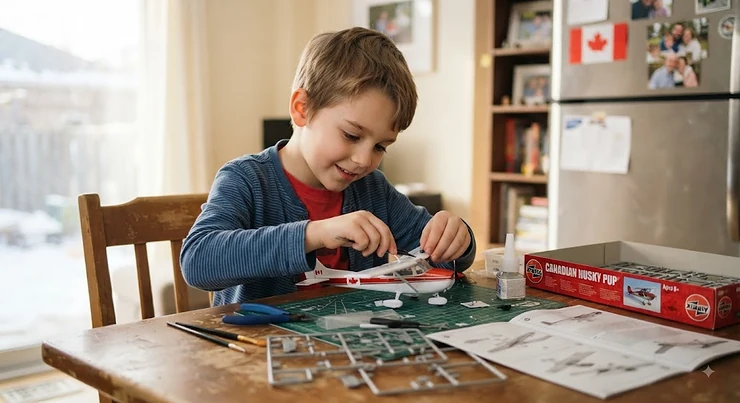
Somewhere in every parent’s memory is a half-built plastic something gathering dust under a bed — wings glued on crooked, decals curling at the corners, enthusiasm long gone. That’s usually not the kid’s fault. It’s a kit-matching problem. The right scale model kits kids can actually complete, at the right skill level, with the right glue-free (or glue-required) setup, turn into hours of quiet, screen-free focus instead of a frustrated abandonment. The wrong kit turns into exactly the opposite.
This guide skips the marketing fluff and gets into what actually matters: real products with real specifications, honestly summarized review sentiment, and straight answers about which kits suit a first-time seven-year-old versus a patient eleven-year-old who’s already outgrown snap-together toys. We looked at budget starter sets, mid-range historical replicas, and a couple of genuinely premium builds, all searchable on amazon.ca. Somewhere in the mix — cars, tanks, aircraft, a motorized racer, and yes, a proper paint kit — there’s a match for your household’s patience level and your kid’s actual interests.
Scale model kits kids gravitate toward tend to split cleanly by category: vehicles that snap together with zero tools, historically accurate aircraft that demand glue and a steady hand, and everything in between. We’ll walk through all of it, including the parts nobody puts on the box: how long a first build genuinely takes, what reviewers wish they’d known, and where the real value sits once you account for paint, glue, and the inevitable second kit six weeks later.
What Are Scale Model Kits for Kids?
Scale model kits for kids are simplified plastic (or snap-fit) replicas of real vehicles — cars, aircraft, ships, or tanks — built at a fixed ratio to the original, such as 1:72 or 1:24. Manufacturers rate difficulty using skill levels (often 1 through 5), with lower numbers meaning fewer parts, no glue, and pre-colored components suited to younger builders.
That skill-level number, printed right on the box, is the single most useful piece of information a parent can use before checkout — more useful, honestly, than the picture of the finished model on the front.
Quick Comparison Table
| Kit | Skill Level | Scale | Assembly Type | Price Range (CAD) |
|---|---|---|---|---|
| Revell Junior Fire Truck Model Kit | 0 / Beginner | 1:20 | Screw-together, no glue | Under C$30 |
| Airfix Supermarine Spitfire Mk.Ia Starter Set | 1 | 1:72 | Glue + included paint | C$30-C$45 range |
| Tamiya Mini 4WD JR Fun-Vroom Kit | 1-2 | 1:32 | Snap-fit, motorized | C$25-C$40 range |
| Revell Model Set T-34/85 | 3 | 1:72 | Glue + included paint | C$35-C$55 range |
| Airfix Supermarine Spitfire Mk.IXc Gift Set | 4 | 1:24 | Glue, separate paint | Mid-C$60s-C$80 range |
| Testors Acrylic Pods Paint Kit | N/A (accessory) | N/A | Brush-on | Under C$25 |
| Revell Model Set Airbus A320neo Lufthansa | 3-4 | 1:144 | Glue + included paint | C$35-C$60 range |
Looking at the spread, the gap between the Revell Junior Fire Truck Model Kit and the Airfix Supermarine Spitfire Mk.IXc Gift Set isn’t really about price — it’s about hours of build time and the amount of adult supervision required. Reviewers consistently note that jumping straight to a skill-4 kit with a child who’s never held a hobby knife is the single most common reason a first model ends up half-finished, so treat that skill-level column as a hard filter, not a suggestion. For most households, starting one or two rungs below what a child’s age “should” allow gets better long-term results than starting at the top.
💬 Just one click — help others make better buying decisions too!😊
Top 7 Scale Model Kits for Kids: Expert Analysis
1. Revell Junior Fire Truck Model Kit — easiest true starter, zero glue
The standout here is the ergonomic child-sized screwdriver included in the box, which turns assembly into something closer to a toy than a craft project. This 41-piece, 1:20 scale kit is rated for ages five and up, and every connection point is a screw rather than a glued joint, which matters enormously for households not ready to introduce plastic cement yet.
Doors, hood, and compartments open and close once assembled, and the whole build typically runs 40-60 minutes according to hands-on accounts from parents who built it alongside four- and five-year-olds. Based on the spec comparison with other entry kits, the screw-together system (rather than a straight snap-fit) gives slightly more durable joints than pure click-together designs, though it does mean smaller hands sometimes need a second set of hands nearby.
Reviewers consistently report that the model holds up well to actual play afterward — kids push it around like a toy fire truck — though a recurring complaint is that the wheels can work themselves loose with rough floor play, which is a fair trade-off for a kit this beginner-friendly. Aggregated feedback also flags that assembly with a younger sibling watching turns into a shared activity more often than not, since the pieces are large enough to hand off safely.
Pros:
- ✅ Screwdriver-based assembly needs zero glue or paint
- ✅ Large, chunky parts suit five- and six-year-old hands
- ✅ Doors and compartments open for imaginative play after
Cons:
- ❌ Wheels can loosen with heavy floor play afterward
- ❌ Limited challenge for kids who’ve built kits before
At under C$30, this sits at true entry-level pricing, and for a first-ever kit, that low buy-in makes it an easy yes — the real question is whether your child is ready to graduate to something with more steps within a few months.
2. Airfix Supermarine Spitfire Mk.Ia Starter Set — best true first aircraft build
The standout feature is that this Skill Level 1 starter set bundles the essentials — paint, brush, and poly cement — directly in the box, removing the most common first-purchase mistake: buying a kit and discovering at the kitchen table that nothing else was included. At 1:72 scale, the finished Spitfire comes in around 15 cm, small enough for a shelf but with real recessed panel lines and accurate proportions rather than the blocky simplification some junior kits use.
This is genuinely a historical aircraft, not a toy shape — the Mk.Ia variant flew in the Battle of Britain, and the box art and included information reflect real 1940s markings rather than invented liveries. The Spitfire’s real combat history is well documented and gives a young builder a genuine historical hook rather than a generic aircraft shape. Because it requires glue and enamel or acrylic paint application, plan for direct supervision through the whole build rather than drop-off independent play; Skill Level 1 in Airfix’s system still assumes some adult involvement for children under about ten.
Aggregated review sentiment describes the fit of parts as noticeably tighter and cleaner than budget alternatives, with fewer flash lines to trim, which matters because rough parts are what turn a 45-minute build into a frustrated two-hour one. A recurring theme in feedback is that the included paint set, while limited in color range, is genuinely enough to finish the model respectably without an immediate second purchase.
Pros:
- ✅ Paint, brush, and cement included — nothing extra to buy
- ✅ Accurate WW2 markings teach real aviation history
- ✅ Clean part fit reduces first-build frustration
Cons:
- ❌ Requires full adult supervision due to glue and paint
- ❌ Included paint palette is limited to a handful of colours
Priced in the C$30-C$45 range, this is the kit we’d point most parents toward if the goal is a genuine first “real” model rather than a snap-together toy — it’s the natural second step up from something like the Revell Junior Fire Truck Model Kit.
3. Tamiya Mini 4WD JR Fun-Vroom Snap Together Kit — best for kids who want it to actually move
The standout advantage is motorized speed with zero screws, zero cement, and zero paint required — this 1:32 scale buggy snaps together entirely by hand, with only side cutters needed to separate parts from the sprue. The EZ chassis is molded in tinted, semi-transparent plastic, so the internal gearing stays visible after assembly, which turns “how does this work” into a built-in lesson rather than a hidden mechanism.
A double-shaft type-130 motor runs on two AA batteries and powers all four wheels, so once built, this isn’t a static shelf piece — it’s a genuine little race car meant to run on Tamiya’s U-shaped tracks or just across a hardwood floor. What most buyers overlook about this line is that it’s a gateway into an entire ongoing hobby ecosystem: Mini 4WD racing has a decades-long history dating back to 1982, complete with organized communities and swappable upgrade parts, so a single kit can become a long-running interest rather than a one-off project.
Reviewers, including several who built it specifically with children, describe the assembly as genuinely fast — often well under an hour — while still teaching basic mechanical concepts like gear meshing and axle alignment. The trade-off reviewers flag most often is that the stock motor and tires are entry-level; kids who get hooked will likely want upgrade parts fairly quickly, which is a cost worth planning for rather than a flaw in the base kit.
Pros:
- ✅ No glue, paint, or screws — pure snap assembly
- ✅ Motorized and genuinely drivable once built
- ✅ Clear chassis shows the mechanics as it runs
Cons:
- ❌ Stock motor and tires are basic compared to upgrades
- ❌ Less of a “display piece” than static aircraft or tanks
In the C$25-C$40 range including the motor, this is the pick for kids who measure success by whether a toy does something, not just looks like something — a meaningfully different kind of reward than the static historical builds elsewhere on this list.
4. Revell Model Set T-34/85 — best mid-range historical military build
The standout here is that “Model Set” designation, which means Revell bundles the kit with Aqua Color paints, glue, and a brush, so there’s no guessing which paint numbers to hunt down separately — a real time-saver flagged repeatedly in aggregated feedback. At 1:72 scale, the T-34/85 is one of the most produced tanks in history, and the kit reflects real WWII-era Soviet armor design rather than a generic tank shape.
Skill Level 3 puts this solidly in “graduated from starter kits” territory: expect separately molded tracks, a rotating turret, and enough individual parts that a full build reasonably spans two or three sitting sessions rather than one afternoon. Based on the spec comparison with Skill 1 kits, the extra parts count buys genuinely improved detail — weld seams, hatch detail, and a more accurate hull shape — which matters if the build is destined for a display shelf rather than immediate play.
Reviewers describe the fit as solid for the price point, though a recurring theme is that the included Aqua Color paints run thinner than premium hobby paint lines, meaning two coats are often needed for full coverage — worth knowing before a frustrated kid wonders why the green looks patchy after one pass. On the whole, aggregated sentiment treats this as a strong value pick for a first serious armor build.
Pros:
- ✅ Includes paint, glue, and brush — nothing extra to buy
- ✅ Rotating turret and separate tracks add real detail
- ✅ Represents an accurate, historically significant tank
Cons:
- ❌ Included paint needs two coats for solid coverage
- ❌ Multi-session build may test younger attention spans
At C$35-C$55, this sits squarely in mid-range territory and works well as the “next step” gift for a kid who’s already finished a Skill 1 kit and wants something with real heft to it.
5. Airfix Supermarine Spitfire Mk.IXc Gift Set — premium pick for a serious young builder
The standout feature is scale itself: at 1:24, this Spitfire finishes at roughly 50 cm wingspan — nearly four times the linear size of the 1:72 starter kit above — with correspondingly dramatic increases in surface detail, cockpit interior parts, and engine components. Airfix rates this Skill Level 4, officially aimed at ages eight and up, though realistically it suits a patient older child or a parent-and-kid team project spread across multiple weekends.
This particular Spitfire variant, the Mk.IXc, was a wartime upgrade rushed into service specifically to counter a new German fighter threat, and the kit’s included reference material reflects that real history rather than glossing over it — a detail that rewards a kid who’s genuinely curious about the “why” behind the aircraft, not just the assembly. Here’s what to weigh: the jump from Skill 1 to Skill 4 isn’t linear, it’s steep — expect photo-etched-style small parts, a full engine bay option, and canopy glazing that demands a steady hand and a clean workspace.
Aggregated review sentiment is strongly positive on accuracy and finished-model presence, with reviewers repeatedly describing it as display-case worthy once painted properly — though several also flag that paint and cement are sold separately here, unlike the Model Set line, so factor that into the real total cost before buying. For a genuinely engaged pre-teen builder, though, this is frequently cited as a rewarding step up rather than an overreach.
Pros:
- ✅ Large 1:24 scale delivers museum-quality surface detail
- ✅ Historically accurate Mk.IXc variant and markings
- ✅ Genuine sense of achievement on completion
Cons:
- ❌ Paint and cement sold separately, adding to real cost
- ❌ Skill Level 4 demands real patience and steady hands
Priced in the mid-C$60s to C$80 range, this is a considered gift rather than an impulse buy — best reserved for a child who’s already shown genuine follow-through on two or three easier builds.
6. Testors Acrylic Pods Paint Kit — the painting-supplies pick that just works
The standout advantage is the spill-proof pod design: twelve individual 1/10 fl. oz. acrylic paints snap shut between sessions instead of drying out or tipping over on a craft table, which sounds minor until you’ve cleaned dried enamel off a carpet once. The set includes a mix of gloss and flat automotive-style colours, plus a brush and a mixing tray, purpose-built to complement car and general hobby kits rather than fine art painting.
Because these are water-based acrylics rather than enamels, cleanup happens with soap and water instead of solvent, which matters enormously for kid-supervised painting sessions — no need for mineral spirits anywhere near a nine-year-old’s workspace. What most buyers overlook about paint kits generally is that colour range matters less than a kit’s cleanup profile and dry time for keeping a young builder’s interest; a paint that’s still tacky forty minutes later loses a kid’s attention fast, and acrylics dry noticeably quicker than most enamel alternatives.
Reviewer sentiment describes the pigmentation as solid for the price and notes the pods make colour-mixing genuinely approachable for first-timers, since each snap-open compartment stays visually organized rather than becoming a jumble of loose bottles. A fair complaint that surfaces in aggregated feedback is that twelve colours, while a reasonable starting palette, will eventually need topping up with specific shades — olive drab or specific national aircraft greys, for instance — once a young builder starts chasing accuracy on historical replicas.
Pros:
- ✅ Spill-proof pods stay usable between painting sessions
- ✅ Water-based formula means simple soap-and-water cleanup
- ✅ Pre-organized palette suits complete beginners
Cons:
- ❌ Twelve colours won’t cover every specialty shade needed
- ❌ Acrylics dry fast, which can also mean less blending time
Under C$25, this is the accessory purchase we’d pair with almost any kit above that doesn’t already include its own paint — it consistently punches above its price for first-time painters.
7. Revell Model Set Airbus A320neo Lufthansa — best civil aviation pick for the non-military kid
The standout here is subject matter: not every kid is drawn to fighter planes and tanks, and this 1:144 scale commercial airliner model gives a different kind of aviation fan — the one who spots plane types at the airport — something to build that matches their actual interest. As a Model Set, it includes Revell’s Aqua Color paints, glue, and brush, following the same bundled-value approach as the T-34/85 above.
Reviewers and Revell’s own product literature note that large aircraft are deliberately kept in smaller scales like 1:144 for a practical reason: a commercial jet built at 1:24 simply wouldn’t fit through a bedroom door, so this scale strikes a workable balance between manageable size and enough surface detail — window lines, engine nacelles, tail livery — to look genuinely convincing once painted. Skill Level 3-4 puts this roughly alongside the T-34/85 in terms of complexity, with a fuselage that needs careful seam alignment and gluing to avoid a visible centerline once assembled.
Aggregated sentiment on Revell’s civil aviation line consistently praises decal accuracy for real-world airline liveries, which matters if a young builder cares about getting the Lufthansa colour scheme genuinely right rather than approximate. On the downside, several reviewers note that the small scale makes some panel details fiddly for younger hands, so this tends to suit an older child already comfortable with tweezers and a hobby knife.
Pros:
- ✅ Includes paint, glue, and brush in one set
- ✅ Accurate real-world airline decals and livery
- ✅ Different subject matter than the usual military kits
Cons:
- ❌ Small 1:144 scale makes some details fiddly
- ❌ Long, straight fuselage seam needs careful gluing
At C$35-C$60, it’s priced in line with the T-34/85 and makes a genuinely good alternative gift for the airport-loving kid who has zero interest in tanks or fighter jets.
Practical Usage Guide: Precision Hobby Crafting Setup and First-Build Success
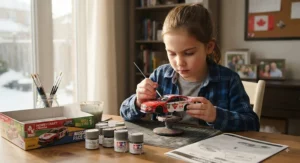
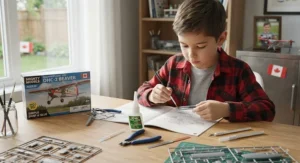
Precision hobby crafting doesn’t require a dedicated workshop — it requires a flat, well-lit surface, a covering that catches glue drips (wax paper works fine), and good ventilation if cement or enamel paint is involved. Before opening the box, lay out the instruction sheet fully and identify the sprues by letter, since most kits label parts trees to match numbered steps, and hunting for an unlabelled piece is the fastest way to lose a young builder’s patience.
For the first thirty days, resist the urge to rush toward paint. Dry-fitting parts — test-assembling without glue first — teaches how pieces actually align and catches mistakes before they’re permanent, and it’s a technique real modellers use regardless of age. A common first-timer mistake is applying too much cement, which causes visible glue smears on clear canopy parts or seeps into panel lines; a small dot at each contact point, applied with a toothpick rather than straight from the tube, avoids nearly all of it.
Maintenance after completion is minimal but worth mentioning: keep finished models out of direct sunlight, which fades paint over months, and store loose kits in their box until ready, since sprues left out collect dust that shows under paint later.
Real-World Scenarios: Matching Every Kid to the Right Kit
Consider a six-year-old who loves trucks but has never built anything more complex than large-block construction toys — the Revell Junior Fire Truck Model Kit is the obvious match, since the screw-together system removes glue entirely from the equation and the build finishes in under an hour, well within a first-timer’s attention span.
Now picture a nine-year-old obsessed with WWII history documentaries, asking real questions about aircraft and tanks. The Airfix Supermarine Spitfire Mk.Ia Starter Set or the Revell Model Set T-34/85 both fit, depending on whether planes or armor win out — both include everything needed in one box, so there’s no second trip to a hobby shop before the first weekend build.
Finally, think about an eleven-year-old who’s already built two or three kits independently and wants a real challenge. The Airfix Supermarine Spitfire Mk.IXc Gift Set, paired with a proper paint kit like the Testors Acrylic Pods Paint Kit, gives that child a multi-weekend project with genuine display value at the end — the kind of build that turns into a bedroom shelf centerpiece rather than a one-off activity.
Buyer’s Decision Framework
If your child has never built a kit before, choose a Skill Level 0 or 1 set like the Revell Junior Fire Truck Model Kit, because glue-free assembly removes the biggest failure point for absolute beginners. If your child wants movement, not just a static display, choose the Tamiya Mini 4WD JR Fun-Vroom Kit, because a motorized, drivable result rewards a shorter attention span better than a shelf piece does. If your child is drawn to real history and asks detailed questions, choose a Model Set like the Revell Model Set T-34/85 or Revell Model Set Airbus A320neo Lufthansa, because the included paint and glue turn a history interest directly into a finishable project. And if your child has already proven they’ll finish what they start, the Airfix Supermarine Spitfire Mk.IXc Gift Set is the reward that matches that follow-through.
How to Choose Scale Model Kits for Kids: 6 Expert Criteria
- Check the printed skill level first, not the age range on the box. Age recommendations are often broader marketing ranges; skill level reflects actual part count and technique required.
- Decide on glue tolerance before shopping. Snap-fit and screw-together kits remove an entire category of mess and risk for younger or more impulsive builders.
- Confirm whether paint and cement are included. A “Starter Set” or “Model Set” bundling these saves a frustrating first-weekend gap.
- Match subject matter to genuine interest, not assumed interest. A kid who loves commercial flights over fighter jets will finish the Revell Model Set Airbus A320neo Lufthansa far more happily than a tank.
- Consider scale relative to display space. Larger scales like 1:24 mean bigger, easier-to-handle parts, but also a bigger finished object needing shelf room.
- Budget for consumables, not just the kit price. Glue, extra paint, and a hobby knife often add C$15-C$25 to any kit that doesn’t already include them.
Common Mistakes When Buying Scale Model Kits for Kids
The single most common mistake, based on aggregated review patterns across brands, is buying strictly by age printed on packaging rather than checking the skill-level number — a “kids 8+” label can still mean a genuinely advanced Skill 3 or 4 kit. A close second is forgetting that many kits, including several on this list, don’t include paint or cement, leaving a family staring at an unfinishable box on build day.
Parents also frequently underestimate build time, expecting a one-sitting activity when a mid-range kit like the Revell Model Set T-34/85 realistically spans two or three sessions. Finally, skipping ventilation or workspace prep for glue-and-paint kits is a recurring regret in reviews — a five-minute setup with newspaper and an open window prevents most of the mess complaints altogether.
Scale Model Kits vs Ready-to-Play Toys and RC Kits
| Factor | Scale Model Kits | Ready-to-Play Toys | Pre-Built RC Kits |
|---|---|---|---|
| Skill development | High — assembly, painting, patience | Low — no build process | Low to moderate |
| Time investment | 1-6+ hours depending on skill level | None | Minutes for setup |
| Customization | High — paint and decals are yours | None | Limited |
| Best For | Patient builders, history-curious kids | Very young children, instant play | Kids wanting immediate play value |
The written comparison matters more than the table here: a ready-to-play toy delivers instant gratification but teaches essentially nothing about mechanics, patience, or history, while a scale model kit trades that instant reward for a slower payoff with real skill-building attached. Pre-built RC kits like some Tamiya lines split the difference — the Tamiya Mini 4WD JR Fun-Vroom Kit specifically requires hand assembly first, so it still delivers the building process before the play reward arrives. For a household deciding between screen time alternatives, the scale model route consistently wins on sustained engagement, simply because there’s more to actually do.
✨ Ready to pick one?
Compare the full lineup above and grab the kit that matches your kid’s patience level today.
Model Painting Supplies: What Actually Matters for Young Builders
For young builders specifically, model painting supplies matter less for colour range and more for three practical factors: cleanup method, dry time, and forgiveness of mistakes. Water-based acrylics, like those in the Testors Acrylic Pods Paint Kit, clean up with soap and water and dry fast enough to hold a kid’s attention across a single sitting — both major advantages over solvent-based enamels for anyone under about ten.
Brushes matter more than most parents assume going in. A single stiff, cheap brush leaves visible bristle marks and uneven coverage, which can genuinely discourage a young painter who did everything else right. A basic two-brush setup — one flat, one fine detail — covers the vast majority of a beginner’s needs without overcomplicating the shopping list. What most buyers overlook is that a simple mixing tray, included in the Testors pod set, prevents the single most common beginner error: dipping a wet brush straight into a shared paint pot and contaminating the whole supply with a different colour.
Historical Replicas and Detailed Assembly: Building Real-World Skills
Historical replicas offer something ready-made toys can’t: a direct, tangible link to real events, real engineering, and real people. Building a Supermarine Spitfire, the fighter that famously helped defend Britain’s skies during WWII, or a T-34/85, one of the most-produced tanks in history, turns an assembly project into a small history lesson that sticks far better than a textbook paragraph, simply because the kid built it with their own hands.
Detailed assembly at higher skill levels also teaches transferable precision skills — reading a numbered instruction sequence, dry-fitting before committing, and recognizing when a part needs trimming rather than forcing. These aren’t abstract “educational” claims; they’re the direct, practical steps any completed model actually requires, regardless of subject matter. For a family weighing whether the jump from a Skill 1 to a Skill 3 or 4 kit is worth it, the honest answer is that the payoff isn’t just a nicer-looking model — it’s a kid who’s noticeably more comfortable with fine motor precision and multi-step instructions by the end of it.
Airplane Model Building for Kids: A Closer Look
Airplane model building sits in a slightly different category from cars or tanks because scale choice matters more dramatically. A 1:72 Spitfire like the Airfix Supermarine Spitfire Mk.Ia Starter Set fits comfortably on a small shelf, while the same aircraft at 1:24 scale, as in the Airfix Supermarine Spitfire Mk.IXc Gift Set, becomes a genuine centerpiece requiring real display space — the size difference is roughly fourfold in linear dimension.
Aircraft kits also introduce specific technique challenges cars and tanks don’t: clear canopy parts that show every fingerprint and glue smear, and decal application across curved fuselage surfaces that can wrinkle if applied carelessly. Reviewers across both Airfix kits on this list consistently flag canopy handling as the trickiest single step for young builders — a tip worth passing along before build day is to handle canopy parts only by the edges, ideally with a cotton glove or clean tissue, to avoid smudges that show badly once painted around.
For a child specifically drawn to aviation over other vehicle types, starting at 1:72 scale and working up to 1:48 or 1:24 as skill improves mirrors how most real hobbyists actually progress, rather than jumping straight to the largest, most detailed kit available.
Revell Models Canada: Availability and What to Expect
Revell models Canada availability runs through both amazon.ca listings and dedicated Canadian hobby retailers, with the brand’s Junior, Starter Kit, and Model Set lines all commonly stocked. Because Revell has been a pioneer in scale modeling since 1943, Canadian retailers typically carry consistent, ongoing stock rather than limited runs, which matters if a family wants to replace a lost part or buy a matching second kit later.
One practical note for Canadian buyers: cross-border cost differences and shipping times can vary between amazon.ca listings and specialty hobby shops, so it’s worth comparing both before a purchase, particularly for the Model Set line where included paint adds shipping weight. Bricks-and-mortar Canadian hobby retailers, concentrated mostly in larger cities, remain a solid backup source when a specific Revell kit shows limited amazon.ca availability around peak gift-buying periods.
Long-Term Cost & Maintenance: What Scale Model Kits Really Cost Over Time
| Cost Factor | Starter Kits (Skill 0-1) | Mid-Range Kits (Skill 2-3) | Premium Kits (Skill 4+) |
|---|---|---|---|
| Base kit price | Under C$45 | C$35-C$60 | Mid-C$60s-C$80+ |
| Paint/glue needed separately | Rarely | Sometimes | Usually |
| Realistic annual hobby cost (2-3 kits) | C$60-C$100 | C$100-C$180 | C$180-C$300+ |
The real cost of this hobby isn’t the sticker price of any single box — it’s the ongoing supply chain of paint, glue, and eventually specialty tools that follows once a kid gets hooked. A family starting with the Revell Junior Fire Truck Model Kit and the Airfix Supermarine Spitfire Mk.Ia Starter Set spends relatively little in year one, since both bundle their own consumables, but a family whose kid graduates to premium kits like the Airfix Supermarine Spitfire Mk.IXc Gift Set should budget separately for paint sets like the Testors Acrylic Pods Paint Kit on an ongoing basis. Viewed as cost-per-hour of engaged, screen-free activity, even the premium end of this hobby compares favourably to many subscription-based kids’ activities once you tally up actual build hours.
Safety, Regulations & Age-Appropriate Compliance in Canada
Toy products sold in Canada must comply with SOR/2011-17, a regulation that came into effect in 2011 and replaced the earlier Hazardous Products (Toys) Regulations, covering everything from small-parts choking hazards to structural sturdiness. For scale model kits specifically, the relevant real-world takeaway is straightforward: small parts and loose accessories should be kept out of reach of children under three, which is exactly why every kit on this list carries a minimum age recommendation well above that threshold.
Beyond small parts, glue and paint introduce a second safety layer worth knowing before a first build. Choose water-based acrylics like those in the Testors Acrylic Pods Paint Kit over solvent-based enamels wherever possible for younger builders, since they eliminate strong fume exposure and simplify cleanup with just soap and water. For more detailed toy safety guidance for parents, Health Canada’s toy safety resource covers small parts, magnets, and general household precautions in more depth than any single product listing will.
🛠️ Build-day checklist ready? Pick your kit, grab the right paint, and get that first model started this weekend!
FAQ
❓ Are scale model kits good for kids who don't like sitting still?
❓ What age can a kid start building scale model kits?
❓ Do scale model kits need special glue?
❓ What's the difference between skill level and age recommendation on a kit box?
❓ Can scale model kits be repainted if a kid makes a mistake?
Conclusion
Matching scale model kits kids will actually finish comes down to reading one number on the box — the skill level — before anything else, and being honest about whether your household is ready for glue and paint or better served by a screw-together or snap-fit build first. The seven kits above cover that whole range: the Revell Junior Fire Truck Model Kit for a true first build, motorized fun with the Tamiya Mini 4WD JR Fun-Vroom Kit, historically rich mid-range options in the Revell Model Set T-34/85 and Revell Model Set Airbus A320neo Lufthansa, a genuine first aircraft with the Airfix Supermarine Spitfire Mk.Ia Starter Set, a real challenge in the Airfix Supermarine Spitfire Mk.IXc Gift Set, and the painting foundation for all of it in the Testors Acrylic Pods Paint Kit.
None of these require expert-level modelling knowledge to buy correctly — just an honest read of your kid’s patience level and a quick check of that skill-level number before checkout. Whichever kit ends up on the workbench this weekend, the payoff is the same: hours of hands-on focus, a finished model to be proud of, and very likely, a request for the next one within a month.
✨ Don’t Miss These Exclusive Deals!
🔍 Take your model-building weekend to the next level with the kits and paint sets covered above. Click through to check current pricing and availability before it changes — these picks make genuinely great gifts your kid will actually finish!
Recommended for You
- 7 Best Chess Set Tournament Picks for Canadian Players in 2026
- 7 Best Strategy Board Games Tweens Will Actually Love (2026)
- Digital Drawing Tablet Kids: 7 Brilliant Picks Parents Trust (2026)
Disclaimer: This article contains affiliate links. As an Amazon Associate, I earn from qualifying purchases. If you purchase products through these links, we may earn a small commission at no additional cost to you.
✨ Found this helpful? Share it with your friends! 💬🤗
