
In This Article
There’s a particular kind of quiet that falls over a house mid-January in most of Canada — the kind where the snow’s been down for weeks, the days are short, and everyone in the family is just a little tired of staring at a screen. That’s usually when our house rediscovers the games closet.
Family board games are one of the most reliable ways to fill that stretch of cold-weather evenings with something everyone actually wants to do together. They’re screen-free, they don’t need batteries (mostly), and unlike a lot of “family bonding activities” that sound nice in theory, an actual game on the table tends to get used. This guide focuses on games that work well for families with kids around 6 to 8 years old, with several cooperative games kids genuinely enjoy and a few that grow with the family as the kids get older.
We looked at what’s actually available to ship to Canadian addresses, not just what shows up first on a US search, and we’ve tried to flag where Amazon.ca pricing, availability, or shipping realities differ from what you might see referenced elsewhere. Prices below are in CAD and shown as ranges — Amazon pricing changes often, so treat these as a starting point rather than a quote.
Quick Comparison Table
| Game | Players | Age | Type | Playtime | Price Range (CAD) | Best For |
|---|---|---|---|---|---|---|
| Outfoxed! | 2–4 | 5+ | Cooperative | 20–30 min | $25–$32 | First cooperative game |
| Hoot Owl Hoot! | 2–4 | 4+ | Cooperative | 15–20 min | $25–$30 | Younger siblings (4–6) |
| Sleeping Queens | 2–5 | 6+ | Competitive | 15–20 min | $14–$20 | Quick card-game nights |
| Qwirkle | 2–4 | 6+ | Competitive | 30–45 min | $35–$45 | Multi-generational play |
| Ticket to Ride: First Journey | 2–4 | 6+ | Competitive | 15–30 min | $30–$38 | Building toward “real” strategy games |
| Catan Junior | 2–4 | 6+ | Competitive | 30–45 min | $35–$45 | Kids who love a bit of strategy |
| Sushi Go! | 2–5 | 7+ | Competitive | 15–20 min | $14–$20 | Travel and quick rounds |
Looking at the spread above, the two cooperative games — Outfoxed! and Hoot Owl Hoot! — sit at the gentlest end of the table, which matters if a 6-year-old in the house still gets upset about losing. The mid-range strategy games, Qwirkle, Catan Junior, and Ticket to Ride: First Journey, all land in a similar $30–$45 CAD band and are the ones most likely to still get played once the kids hit 9 or 10. The two quick card games are the cheapest entries and the easiest to justify as stocking-stuffer or “try it first” purchases.
💬 Just one click — help others make better buying decisions too!😊
Top 7 Family Board Games: Expert Analysis
1. Gamewright Outfoxed!
Outfoxed! is built around a single shared goal — catching the fox who stole Mrs. Plumpert’s pie — and that cooperative structure is the whole appeal. Everyone wins or loses together, which the box copy frames as a way to build social skills, sharing, and teamwork instead of competition, and in practice it does soften the usual sibling meltdown over losing.
What the listing doesn’t tell you: the “evidence scanner” gimmick is genuinely fun for 6 and 7-year-olds the first dozen times, but the deduction logic is shallow enough that an attentive adult can solve it almost immediately — so the trick is letting the kids lead and resisting the urge to call out the answer. It’s an easy choice for a Canadian household with a younger sibling who isn’t ready for competitive games yet, and it travels well for cottage weekends since the box is compact.
- ✅ Genuinely cooperative — no losers, no tears
- ✅ Quick rounds (20–30 min) suit short attention spans
- ✅ Compact box, good for travel and cabins
- ❌ Limited replay depth once kids master the logic
- ❌ Plastic scanner piece is a small-parts choking hazard for under-5s
Price & verdict: Around $25–$32 CAD on Amazon.ca. At that price, it’s one of the lower-risk first purchases for cooperative games kids — easy to recommend.
2. Peaceable Kingdom Hoot Owl Hoot!
If Outfoxed! is the cooperative game for a 6-year-old, Hoot Owl Hoot! is the one for the 4-year-old tagging along. Players move owl tokens around a colour-matching path, trying to get them all home before a sun token finishes its track — and the design explicitly builds color recognition and matching skills through simple, hands-on play.
The real value here is the two built-in difficulty levels. Basic mode needs no strategy at all, which is what makes it work for a preschooler; advanced mode adds enough decision-making that a 7 or 8-year-old sibling doesn’t get bored playing along. That range is what makes it a strong pick for mixed-age Canadian households — the kind where a 5-year-old and an 8-year-old are both expected to play nicely at the same table.
- ✅ Two difficulty modes grow with the child
- ✅ No reading required, ages 4+
- ✅ Strong for mixed-age sibling play
- ❌ Too simple to hold interest past about age 8
- ❌ Small tokens need supervision around younger toddlers
Price & verdict: Around $25–$30 CAD on Amazon.ca. Best value if you have a child under 6 in the mix.
3. Gamewright Sleeping Queens
Invented by a 6-year-old, Sleeping Queens has stayed popular for a reason: it’s a genuinely strategic card game wearing a fairy-tale costume. Players use knight, dragon, and potion cards to wake sleeping queens and steal them from opponents, which means there’s real tactical depth — bluffing about which queen to protect, timing a dragon card defensively — hiding inside rules simple enough for a 6-year-old to follow.
For Canadian families, this is the card game that survives the car ride and the cottage dock equally well, since it needs no table, no board, and packs into a glove compartment. It is competitive, though, and younger players can get frustrated when a sibling steals their favourite queen — worth knowing if your 6-year-old is still sensitive to losing.
- ✅ Real strategy in a simple, fast format (15–20 min)
- ✅ Highly portable — ideal for travel and waiting rooms
- ✅ Builds memory and basic arithmetic skills
- ❌ Competitive structure can spark sibling friction
- ❌ 79 small cards are easy to lose individual pieces of
Price & verdict: Around $14–$20 CAD on Amazon.ca, making it one of the most affordable entries on this list and an easy add to a bigger order to help clear the free-shipping threshold.
4. MindWare Qwirkle
Qwirkle is the rare game that genuinely works across three generations at the same table. The rules — match tiles by colour or shape, score lines, avoid duplicates — take about two minutes to explain, but the tile-bag mechanic means even an adult can’t fully plan ahead, which levels the field for younger players in a way a lot of strategy games don’t.
What most buyers overlook is how much the chunky wooden tiles matter in practice: they’re tactile enough that younger kids enjoy just sorting them, which keeps a 6-year-old engaged even on turns where the actual scoring logic goes over their head. It’s a solid choice for Canadian grandparent visits or extended-family game nights, since “easy to teach, hard to master” is exactly the combination that keeps mixed-skill tables happy.
- ✅ Two-minute rules, deep strategic ceiling
- ✅ Solid wooden tiles, built to last years of play
- ✅ Genuinely fun for adults, not just tolerated
- ❌ Longer playtime (30–45 min) can lose younger kids partway through
- ❌ Higher price point than the card-game options on this list
Price & verdict: Around $35–$45 CAD on Amazon.ca — worth the higher price tag given how long families tend to keep playing it.
5. Days of Wonder Ticket to Ride: First Journey
This is the simplified, kid-friendly entry point into the much-loved Ticket to Ride series, with a brand new map, simplified rules, and shorter routes, perfect for newcomers. Kids collect train cards and claim routes across a North American map, racing to complete six tickets before anyone else.
The practical upside for Canadian families is that this game scales up. A 6-year-old can play First Journey today, and in a year or two the household can graduate to the full Ticket to Ride game without anyone feeling lost — the core mechanic carries over directly. One real-world wrinkle: the rulebook is light on starting-hand details, so it’s worth a quick search before your first game to settle how many ticket and train cards each player begins with.
- ✅ Smooth on-ramp to “real” strategy board games
- ✅ Map theme (trains across the continent) appeals broadly
- ✅ Shorter routes keep games moving for younger players
- ❌ Rulebook is thin on setup specifics
- ❌ A 4-year-old will likely need an adult’s help throughout
Price & verdict: Around $30–$38 CAD on Amazon.ca. A strong pick if you want a game that will still be played in three years, not just three months.
6. CATAN Studio Catan Junior
Catan Junior takes the resource-trading bones of the original Catan and reframes them as a pirate-island adventure, where kids collect goats, wood, and “molasses” to build ships and pirate hideouts while dodging a Ghost Captain. It’s the most strategically demanding game on this list that’s still genuinely playable by a 6-year-old, since the resource-management decisions are simplified but not removed entirely.
What the spec sheet won’t tell you: the negotiation element of full Catan (trading resources with other players) is mostly absent here, which is the right call for this age group but means kids expecting to “deal” the way they might have seen older siblings do will be a little disappointed. For Canadian families building toward board-game-night culture, this is the title that tends to create the most “again, again!” requests.
- ✅ Real strategic decisions, scaled for 6-year-olds
- ✅ Strong gateway into the wider Catan ecosystem
- ✅ Charming pirate theme that holds attention
- ❌ Longer setup than most games on this list
- ❌ No trading mechanic, unlike the adult version
Price & verdict: Around $35–$45 CAD on Amazon.ca, similar to Qwirkle — both are worth treating as a longer-term investment rather than a one-season toy.
7. Gamewright Sushi Go!
Sushi Go! is the lightest game on this list and arguably the easiest to slot into an actual weeknight, since a full round takes about 15 minutes. Players draft cards from a passed hand, building sets of sushi dishes for points — simple enough for a 7-year-old, fast enough that even a reluctant teenager will play “just one round.”
The card-drafting mechanic is the same one used in heavier hobbyist games, just simplified into something a family table can pick up in one explanation. It doesn’t have huge replay depth on its own, but it’s the kind of game that’s genuinely improved by owning two or three quick card games and rotating between them — which is worth knowing before buying it as a standalone purchase.
- ✅ Fastest playtime on this list (15–20 min)
- ✅ Genuinely funny art and theme for kids
- ✅ Excellent for travel — no board needed
- ❌ Shallow on its own; best paired with another quick game
- ❌ Slightly fiddly card sorting for kids under 7
Price & verdict: Around $14–$20 CAD on Amazon.ca — an easy, low-cost addition that pairs naturally with Sleeping Queens for a two-game travel bag.
✨ Don’t Miss These Exclusive Deals!
🔍 Take your next game night to the next level with these carefully selected picks. Check current pricing and availability on Amazon.ca before you buy — these games are built to create the kind of screen-free entertainment your family will actually ask for again.
Practical Game Night Guide: Getting the Most From a New Game
A new board game’s first outing often decides whether it becomes a household favourite or a closet fixture. A few things help:
- Read the rules once, alone, before game night. Trying to learn a new game’s rules out loud while three kids wait is the single biggest reason first plays flop.
- Skip optional rules in round one. Almost every game on this list has an “advanced” variant — start with base rules and add complexity only after everyone’s comfortable.
- Store loose pieces immediately. Small cards and tokens (Sleeping Queens, Sushi Go!) scatter fast; a resealable bag inside the box saves a lot of frustration before the next play.
- Winter storage matters more than people expect. Cardboard boxes left in a cold garage or unheated cottage over a Canadian winter can warp; keep games in a closet at room temperature if you’re storing them between visits.
- Rotate, don’t stockpile. Keep two or three games in active rotation rather than a closet full of options — decision fatigue kills game nights as reliably as a bad rulebook.
Real Canadian Family Scenarios
The Toronto condo family with two kids, ages 5 and 8. Limited shelf space rules out anything bulky. Sleeping Queens and Sushi Go! both store flat and play on a coffee table, while Hoot Owl Hoot! keeps the 5-year-old engaged at her own level while her brother plays the advanced variant.
The Calgary family hosting weekly extended-family dinners. Qwirkle is the natural fit here — grandparents, parents, and a 7-year-old can genuinely compete on equal footing, and the two-minute rule explanation means new guests join in without holding up the table.
The rural Manitoba family an hour from the nearest toy store. Ordering ahead matters more here, since shipping to rural addresses can take longer than the standard estimate. Catan Junior and Ticket to Ride: First Journey are worth ordering together to clear the $35 CAD Amazon.ca free-shipping threshold in one trip, rather than ordering one game at a time.
How to Choose Family Board Games in Canada
- Match the game to your youngest regular player, not your oldest. A game that bores the 8-year-old can be adjusted with house rules; a game that frustrates the 5-year-old usually just stops getting played.
- Decide cooperative vs. competitive on purpose. If sibling rivalry is already a sore spot, Outfoxed! or Hoot Owl Hoot! remove that pressure entirely; if your kids handle losing fine, competitive games tend to have more long-term depth.
- Check real playtime, not just the box. A listed “15–30 minutes” often runs long with a first-time 6-year-old player — budget extra time for the first few rounds.
- Favour fewer, smaller pieces for travel and small spaces. Card games (Sleeping Queens, Sushi Go!) beat anything with a board if you’re short on table space or packing for a cottage.
- Buy for where your family is headed, not just where it is now. Catan Junior and Ticket to Ride: First Journey are worth the slightly higher price if you expect game nights to keep happening as the kids get older.
Common Mistakes When Buying Family Board Games
A few patterns show up again and again in Canadian buyer feedback:
- Buying for the parent’s nostalgia, not the kid’s age. A classic strategy game that an adult loved at 12 can badly miss the mark for a 6-year-old.
- Ignoring storage realities. Several of these games (Qwirkle especially) come with dozens of small wooden tiles — a drawstring bag or tin is worth the extra cost if you’re prone to losing pieces.
- Skipping the playtime check before a road trip. Catan Junior’s 30–45 minute games don’t suit a short car ride the way Sleeping Queens or Sushi Go! do.
- Forgetting bilingual labelling differences. Some editions sold in Canada include French rulebooks or packaging by default; if your household needs an English-only copy, check the listing details before ordering rather than assuming.
- Not checking seller shipping policies for remote postal codes. Some third-party Amazon.ca sellers exclude remote or northern addresses from free shipping even on orders over $35 CAD — worth confirming at checkout if you’re outside a major city.
Board Games vs. Screen Time: What Canadian Research Actually Shows
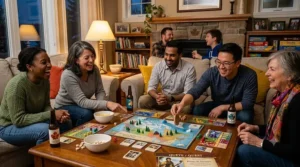
Canadian parents have good reason to look for screen-free entertainment options. The Canadian Paediatric Society’s guidelines recommend no screen time for children younger than 2, and one hour or less per day for children aged 2 to 5, while recommendations for children 5 to 17 cap recreational screen time at two hours a day. Statistics Canada’s longitudinal research found that only 44% of children followed the CPS guidelines consistently between 2019 and 2023, which suggests most Canadian households are looking for realistic ways to close that gap, not just willpower.
This is where board games earn their keep beyond simply being “screen-free.” A behavioural study of preschoolers found that board games are often marketed to caregivers as improving social development, despite relatively few developmental psychology studies focusing specifically on how board games shape social behaviour in typically developing children — in other words, the social-skill benefits are plausible and increasingly studied, but it’s fair to stay a little skeptical of marketing copy that states them as settled fact. What the research base does support more directly is that playing games supports children’s development of communication, cooperation, the ability to build relationships, and emotional regulation. The Canadian Paediatric Society’s own preschool screen-time guidance specifically recommends encouraging activities unrelated to screens, including shared reading, outdoor play, easy board games, and crafts as part of healthy family routines.Influencer marketing and the Competition Act
The honest takeaway: board games won’t replace every screen-time conversation in a household, but they’re one of the few activities pediatric guidance actively names as a constructive substitute — and unlike a lot of “developmental” toy marketing, that recommendation is coming from the people who write the screen-time limits in the first place.
Canadian Availability, Shipping & Buying Notes
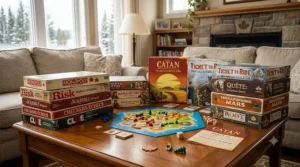
All seven games above were confirmed available through Amazon.ca listings at the time of research, sold either directly by Amazon.ca or by Amazon-fulfilled third-party sellers. A few Canada-specific notes worth knowing before you order:
- Free shipping threshold: Amazon.ca generally requires $35 CAD in eligible items for free standard shipping on non-Prime orders; Prime members get free shipping regardless of order size on eligible items.
- Remote and northern addresses: Free shipping offers typically exclude remote postal codes, and delivery windows run longer outside major centres — worth budgeting extra lead time if you’re ordering for a specific occasion like a birthday.
- Bilingual packaging: Toys sold in Canada must carry any required warning statements in both English and French under the federal Toys Regulations, so some listings default to bilingual packaging — check the product title and images first if a French-only or English-only edition matters to your household.
- Small-parts and choking-hazard labelling: Health Canada’s Toys Regulations specifically target small-part choking, ingestion, and inhalation hazards in children’s toys, which is why several games on this list (Outfoxed!’s scanner piece, Qwirkle’s tiles, Sleeping Queens’ small cards) carry “not for children under 3” warnings — worth a second look if you have a younger toddler in the house alongside your 6 to 8-year-old.
- Price differences vs. US listings: Canadian pricing on these games tends to run somewhat higher than equivalent US Amazon listings, largely reflecting exchange rate and import costs — but ordering through Amazon.ca avoids customs delays and cross-border return headaches that come with ordering from Amazon.com directly.
Frequently Asked Questions
❓ What is the best family board game for a 6-year-old in Canada?
❓ Are cooperative board games better than competitive ones for young kids?
❓ Does Amazon.ca ship board games to rural and northern Canadian addresses?
❓ How much should I expect to pay for a good family board game in Canada?
❓ What's a good board game for mixed ages, like a 5-year-old and a 9-year-old playing together?
Conclusion
The honest case for family board games isn’t that they’re flashy — it’s that they’re reliable. None of the seven games above need batteries, software updates, or a screen, and each one gives a Canadian family a genuine reason to sit at the same table on a dark February evening. Start with one cooperative pick and one quick card game if you’re building a games closet from scratch; add the strategy titles once you know which kind of game your family actually gravitates toward. The best board game collection isn’t the biggest one — it’s the one that actually gets played.Screen time and preschool children
✨ Don’t Miss These Exclusive Deals!
🔍 Ready to start your own game night collection? Check current pricing and availability for these picks on Amazon.ca — small purchases now can turn into years of family bonding activities around the table.
Recommended for You
- Best LEGO Creator 3-in-1 Sets Canada 2026: Top 7 Expert Picks
- Best Star Wars LEGO 7 Year Old: Top 7 Picks for Canada (2026)
- Best LEGO Sets for 6 Year Olds in Canada 2026: Top 7 Picks
This article follows Canada’s Competition Bureau guidance on disclosing material connections in affiliate content.
Disclaimer: This article contains affiliate links. As an Amazon Associate, I earn from qualifying purchases. If you purchase products through these links, we may earn a small commission at no additional cost to you.
✨ Found this helpful? Share it with your friends! 💬🤗
