
In This Article
Top 7 Balance Bikes for 2 Year Olds: Expert Analysis
Each entry below turns the spec sheet into plain English and adds what reviewers consistently report. Prices are ranges, not quotes.
1. Strider 12 Sport — adjustable seat that grows through age four
The Strider 12 Sport is the “buy it once” candidate among balance bikes for 2 year olds, because its seat adjusts without tools across a huge span. At roughly 6.7 pounds with 12-inch foam tires and a steel frame, it’s light enough for most toddlers to heave upright after a tumble. The 11-inch starting point suits many small two-year-olds, and the 60-pound limit means a younger sibling can inherit it.
On paper, this is the family-sharing pick. The steel frame is the trade-off: reviewers flag rust over the years, so garage storage beats the front lawn. There’s also no brake, so stopping means sneakers, which is fine on flat sidewalks but less ideal on slopes.
Expert testers describe it as dependable across years and multiple kids. The most repeated complaint is that foam tires lose grip on loose dirt, gravel and slick indoor floors.
Pros:
- ✅ Seat and handlebars adjust widely without tools
- ✅ Foam tires never go flat
- ✅ Parts and accessories are easy to find
Cons:
- ❌ Little traction on gravel or smooth floors
- ❌ Steel frame can rust; no brake option
Expect roughly the $150–$170 range at list. That’s strong value if you’ll use it for years or hand it down.
2. woom GO 1 — lightest air-tired bike with a hand brake
The woom GO 1 answers a question most parents never think to ask: what if the bike were simply smaller? Its seat starts near 10 inches, and at about 6.3 pounds with air tires and a hand brake, it’s among the lightest in this group. An oval seat post keeps the saddle from twisting, which prevents a classic annoyance on cheaper bikes.
Here’s what the spec sheet won’t tell you, but reviewers note: the low start comes with a low ceiling. The seat tops out near 14 inches, and testers describe the fit as roughly 18-month pants through 3T. That makes it a superb low-seat balance bike for tiny riders and a shorter-lived one for tall toddlers.
Reviewers praise the build quality and customer service. The main knock is that the bike is small, with a limited maximum seat height, and the price sits well above the field.
Pros:
- ✅ Lowest seat of the group for petite riders
- ✅ Air tires plus hand brake at very low weight
- ✅ Excellent reported build quality and support
Cons:
- ❌ Max seat height may be outgrown by age three
- ❌ Premium price
Plan on the $200–$250 range. It’s best value if you have a small toddler now and another child later.
3. Prevelo Alpha Zero — grippy, playful geometry for adventurous toddlers
The Prevelo Alpha Zero is built for kids who treat every curb as a challenge. Lower handlebars and an offset fork encourage a playful, confident stance. Sealed hubs and cushioning air tires keep the ride smooth, and the aluminum frame weighs about 6.9 pounds.
Based on the spec comparison, the seat range of roughly 10.75 to 14 inches puts it right next to the woom GO 1. The difference is attitude. The Alpha Zero rewards riders who want to roll over varied surfaces, and the easy-reach brake lever helps small hands.
Testers highlight exceptional build quality and an integrated handlebar and stem that stay aligned. One recurring caution is that the brake cable may interfere with the stride of very petite toddlers. The bike may also feel too small for older beginners.
Pros:
- ✅ Grippy air tires with sealed hubs
- ✅ Aluminum frame with step-through ease
- ✅ Brake lever designed for small hands
Cons:
- ❌ Brake cable can touch very small legs
- ❌ Seat range is narrow for taller toddlers
Budget roughly $210–$260. It’s worth it for active riders, and less so if your child sticks to quiet sidewalks.
4. Retrospec Cub — budget-friendly step-through frame
The Retrospec Cub proves a first bike for toddlers without pedals doesn’t need a premium tag. The seat starts around 11 inches, the steel frame weighs about 7 pounds, and the extra-narrow step-through design makes mounting easy. Airless foam tires mean zero pumping and zero flats.
Based on the specs, the long wheelbase fits both the low and high ends of the adjustment range. That’s a quiet strength at this price. The foam versus air tires question matters here, though. Foam gives up grip off pavement, so this bike belongs on sidewalks and driveways.
Aggregated owner reports describe it as durable, with some parents reporting up to three years of use. Some owners dislike the foam tires outdoors, and a few report cosmetic quality-control issues. Reviewers also note that the quick-release clamps don’t hold as tightly as they’d like.
Pros:
- ✅ Very affordable entry point
- ✅ Tool-free seat and handlebar adjustments
- ✅ Narrow, low frame suits small toddlers
Cons:
- ❌ Foam tires slip on loose surfaces
- ❌ No brake; clamps may loosen over time
Expect under $80. If you want air tires and a hand brake, the heavier Retrospec Cub Plus (around $120, about 8.7 pounds) is the upgrade.
5. Radio Flyer Ultra Lite — air tires on a magnesium frame near $100
The Radio Flyer Ultra Lite is the rare budget-leaning bike that still gives you air tires. Its magnesium alloy frame keeps bike weight around 7.3 to 7.6 pounds depending on the source, and a grip-tape footrest on the frame gives little feet a secure place to rest.
Reviewer figures put the seat near 12.6 inches at its lowest, so it’s a smarter match for a two-and-a-half-year-old than for a petite 18-month-old. Measure the inseam first. The longer wheelbase adds stability, and flat axle bolts reduce scratched calves.
One expert tester rates it Highly Recommended for neighborhood riders in at least 2T pants who ride mostly on paved surfaces. The common criticisms are the lack of a handbrake and limited color choices. The handlebars are also fixed rather than adjustable.
Pros:
- ✅ Air tires at a modest price
- ✅ Narrow, stable frame with flat bolts
- ✅ Light magnesium construction
Cons:
- ❌ Seat starts higher than several rivals
- ❌ No hand brake; fixed handlebars
The list price lands around $100. That’s very good value for an average-height toddler, and a poor fit for a very small one.
6. Guardian Balance Bike — one-lever braking for cautious beginners
The Guardian Balance Bike is the brake-first option. Its SureStop system links front and rear brakes to a single lever, which reviewers say works well and suits small hands. The aluminum frame, air tires and removable steering limiter round out a thoughtful package.
The honest take: at about 8.5 pounds, it’s the heaviest bike here. That’s a real drawback if you’re hunting for a lightweight balance bike for toddlers. Reviewers also say the brake is “a nice bonus” at this size rather than a standout feature, and some testers occasionally bumped the rear brake cable while running.
Reviewers describe a sturdy frame and painted finishes that resist wear. Their caveats are that the handlebars can’t be raised, the maximum seat height is on the low side, and website “sale” pricing can mislead.
Pros:
- ✅ Air tires with easy single-lever braking
- ✅ Removable steering limiter
- ✅ Sturdy aluminum frame and finish
Cons:
- ❌ Heaviest bike here at about 8.5 pounds
- ❌ Handlebars can’t be raised; short seat ceiling
Plan for roughly $150–$170. It’s best when braking confidence matters more than carrying weight.
7. Biky Air 12 — narrow frame with room for bigger toddlers
The Biky Air 12 is the refined option for toddlers who’ve outgrown the smallest bikes. Its seat runs from roughly 12.5 to 16 inches, and the frame is very narrow, which keeps knees from bumping. Mixed-terrain air tires, an easy-reach hand brake and a removable turning limiter add up to a premium cockpit at about 7 pounds.
Based on the spec comparison, this is a good bridge for taller or older two-year-olds who’ve exceeded the woom GO 1 window. It’s also designed to hand off to Biky’s 14-inch pedal bike later.
Reviewers describe the construction as solid and lightweight. The single repeated complaint is the price.
Pros:
- ✅ Narrow frame suits petite builds
- ✅ Real air tires with a hand brake
- ✅ Removable limiter and four color options
Cons:
- ❌ Expensive for a toddler bike
- ❌ Seat starts too high for the smallest riders
Expect roughly $190–$230. It makes sense if your child has long legs now and you want a smooth path to pedals.
How to Choose Balance Bikes for 2 Year Olds: 6 Steps
Here’s the short version. Follow these in order, because each step narrows the field for the next.
- Measure the inseam. Use the book-and-wall method with your child barefoot. Age labels are a rough guess, but inseam is a fact.
- Match the minimum seat height. The seat should sit slightly below the inseam so both feet land flat. Guides range from half an inch to two inches below, so start in the middle.
- Check the maximum seat height. Look for at least two inches of growth room above the current inseam, or the bike may be outgrown within months.
- Weigh the bike. A lightweight balance bike for toddlers is easier to steer, lift and recover. Compare bike weight to your child’s body weight, not just the box claim.
- Pick tires for your terrain. Mostly pavement points to foam. Mixed surfaces point to air. The foam versus air tires section below explains why.
- Add brakes only if you’ll use them. A hand brake helps toddlers who coast down slopes. For flat sidewalks, it’s optional.
A seventh, non-negotiable item: a certified helmet, covered in the safety guide below.
Seat Height Range: The Spec That Decides Everything
If bike shopping were a courtroom, seat height range would be the star witness. Every other spec argues for a bike. This one decides whether your child can ride it at all.
How to Measure Inseam
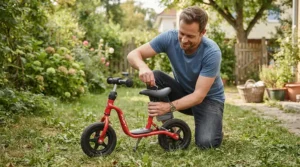
Have your child stand barefoot against a wall, slide a hardcover book up between the legs as high as is comfortable, mark the top of the book, then measure floor to mark. Brand guides suggest typical toddler inseams run roughly 11 to 14 inches, and one maker notes that 2T and 3T riders land around 12.5 to 14 inches.
Why a Low-Seat Balance Bike Matters at 24 Months
A toddler who can’t plant both feet flat can’t stop, and a toddler who can’t stop won’t trust the bike. A true low-seat balance bike like the woom GO 1 (about 10 inches) or the Prevelo Alpha Zero (about 10.75 inches) can fit a child with a 11-inch inseam. The Radio Flyer Ultra Lite, with a seat near 12.6 inches, generally can’t.
Max Height and Growth Room
Experts advise that the maximum seat height should be at least two inches above the child’s current inseam. By that math, the Strider 12 Sport‘s 17-inch ceiling lasts the longest. The Guardian Balance Bike‘s 16-inch limit runs out sooner. One caution: don’t buy a bike that’s far too big now just for the future. The seat range only helps if the minimum already fits.
Bike Weight: Why a Lightweight Balance Bike for Toddlers Wins
Bike weight is the spec parents underestimate most. Picture hauling a 25-pound backpack up a hill and you’ll understand why a toddler gives up on a heavy bike.
One buying guide suggests keeping a toddler bike under roughly 40 percent of the child’s body weight. That’s a ceiling, not a target. Assuming a typical 27-pound two-year-old, the numbers look like this:
- ⚡ woom GO 1 (~6.3 lb): about 23 percent
- ⚡ Strider 12 Sport (~6.7 lb): about 25 percent
- ⚡ Retrospec Cub (~7 lb): about 26 percent
- ⚡ Guardian Balance Bike (~8.5 lb): about 31 percent
The gap between the lightest and heaviest here is only about two pounds, but it’s about 8 percent of body weight. In practice, that’s the difference between a toddler lifting a fallen bike alone and waiting for help.
Tires drive much of the gap. Air tires typically add about a pound or more per tire compared with foam. The Banana Bike LT (foam, about 6.6 pounds) and the Banana Bike GT (air, about 8.4 pounds) show it directly. So a lightweight balance bike for toddlers with air tires, like the woom GO 1, is a genuine engineering achievement. A modest bike weight matters even more for riders under 30 pounds.
Foam Versus Air Tires: What Actually Matters at Age Two
The foam versus air tires debate gets heated online, but at age two it comes down to terrain and tolerance for maintenance.
| Factor | Foam (EVA) Tires | Air Tires |
|---|---|---|
| Maintenance | None; no flats or pumping | Check pressure; can puncture |
| Traction | Fine on pavement; slips on gravel, dirt, smooth floors | Better grip across surfaces |
| Cushioning | Minimal | Absorbs bumps and curbs |
| Weight | Lighter | About a pound or more per tire heavier |
| Best For | Strider 12 Sport, Retrospec Cub | woom GO 1, Prevelo Alpha Zero, Radio Flyer Ultra Lite |
Looking at the comparison above, foam wins on simplicity and air wins on grip and comfort. A reviewer who has examined more than 100 balance bikes reports that foam loses traction on loose dirt, gravel and smooth indoor floors, though foam performs fine on pavement. For paved neighborhood riding, foam is a reasonable, low-fuss choice. For parks and trails, air tires earn their extra weight.
One more nuance: another tester suspects most toddlers adapt to whatever they own and won’t notice the difference. That suggests overpaying for air tires only makes sense if your terrain demands them.
Balance Bikes for 2 Year Olds vs Training Wheels and Tricycles
Parents often ask whether balance bikes for 2 year olds beat the classic alternatives. Here’s how the three common options compare.
| Option | Teaches Balance? | Learning Curve at Age 2 | Best For |
|---|---|---|---|
| Balance bike | Yes, core skill | Gentle; feet stay on the ground | Building balance and steering first |
| Pedal bike with training wheels | Limited; the wheels balance for the child | Pedaling and steering at once | Kids who already pedal a trike |
| Tricycle | Not really | Easy and stable | Low-stakes fun and early coordination |
Proponents of the balance bike argue that children who learn to balance and steer first often progress to a pedal bike more smoothly. Training wheels, they say, can block the natural lean-to-turn motion and create habits that must be unlearned later. These are claims from advocates rather than guarantees, and every child’s pace differs.
Based on the table, the practical edge goes to a first bike for toddlers without pedals. It asks for one new skill at a time. A tricycle still has its place, especially for very young toddlers or kids who need a push handle.
Features That Actually Matter (And Those That Don’t)
Marketing copy loves long feature lists. Here’s the filtered version.
Worth paying for:
- Hand brake. Relying on feet to stop is a common injury cause, which is why brakes are now standard on many models. Brakes matter most on slopes, and the Guardian Balance Bike handles this with one lever.
- Steering limiter. It stops the bars from spinning too far, protects brake cables, and reduces jackknifing. The Biky Air 12 and Prevelo Alpha Zero include one.
- Tool-free adjustments. You’ll adjust the seat many times as your toddler grows.
- Low weight. Every pound counts for a lightweight balance bike for toddlers.
Mostly hype:
- Suspension. At toddler speeds, rigid frames are lighter and simpler. The tires and legs absorb the shocks.
- Convertible “6-in-1” gimmicks. A bike that does everything often does nothing well.
- Decals and colors. Fun, but they don’t change how the bike rides.
The honest summary: spend on fit, weight and tires. Skip the rest.
Common Mistakes When Buying a First Bike for Toddlers Without Pedals
Most regrets trace back to a handful of avoidable errors.
- Buying by age label. A box reading “ages 2–4” ignores your child’s legs. Inseam is the decider.
- Buying too big to grow into. The American Academy of Pediatrics specifically cautions against buying a larger bike for a child to grow into, because a bike that’s too big risks lost control.
- Ignoring bike weight. The cutest bike is useless if it’s too heavy to lift.
- Assuming air tires always win. If your toddler rides mostly on pavement, extra weight and flat risk may not be worth it.
- Skipping the helmet. Even slow balance bike rides fall under the same rule as pedal bikes.
- Chasing premium prices without checking fit. The woom GO 1 and Prevelo Alpha Zero are wonderful for small riders and may be outgrown early by tall ones.
Avoid these and you’ve dodged most of the returns that fill parenting forums.
Long-Term Cost & Maintenance
Price is only part of the story. Cost per month of use is a better lens.
| Tier | Price Range | Example Bikes | What You Gain | What You Give Up | Best For |
|---|---|---|---|---|---|
| Budget | Under ~$110 | Retrospec Cub, Radio Flyer Ultra Lite | Low cost, easy fit | Hand brake, premium finish | Trying balance riding |
| Mid-range | ~$150–$170 | Strider 12 Sport, Guardian Balance Bike | Adjustability or braking | Weight or tires, depending on model | Families planning years of use |
| Premium | ~$190–$260 | woom GO 1, Prevelo Alpha Zero, Biky Air 12 | Lightest air-tired builds, hand brakes | Price; narrower fit window | Smallest riders, hand-me-downs |
Based on the table, if a toddler rides from about 24 to 48 months, a bike under $80 works out to roughly $3 a month, and a $250 bike to about $10. Resale value is a wild card. I couldn’t find hard data, so treat any “it holds its value” claim as an assumption.
Maintenance is light but not zero. Check air-tire pressure monthly and keep a patch kit handy. Wipe steel frames dry to slow rust. Recheck the seat and handlebar clamps often, since reviewers say some quick-release clamps loosen with use.
Practical Usage Guide: Your First 30 Days on a Balance Bike
A good bike still needs a good start. Every toddler’s timeline differs, so treat this as a loose roadmap, not a schedule.
Week 1: Fit and feel. Set the seat so both feet land flat, with a slight knee bend. Fit the helmet first, every time, and let your toddler walk the bike around the living room or driveway. No pushing. This week is about confidence.
Week 2: Scoot. Move to a flat, smooth, paved spot. Encourage longer strides rather than tiny shuffles. If you own a foam-tired bike, avoid slick indoor floors, where grip is poor.
Week 3: Glide. Many toddlers start lifting their feet for a second or two. Praise it, don’t force it. A very gentle downhill can help, but only on a surface far from traffic.
Week 4: Add variety. Try a path, a ramp or a mild slope. This is also when a hand brake starts to matter.
Common first-30-day mistakes: setting the seat too high, riding near driveways with traffic, letting the clamps loosen unchecked, and treating every wobble as failure. Wobbles are the point.
Real-World Scenarios: Matching Bikes to Families
Specs only matter in context. Here are four profiles with the reasoning spelled out.
City apartment, tight budget. A toddler with a roughly 12-inch inseam, three or four short sidewalk rides a week, and about $80 to spend. The Retrospec Cub fits: it starts near 11 inches, has no flats to repair, and stores easily. The Radio Flyer Ultra Lite would sit too high at 12.6 inches.
Hilly suburb with a sibling on the way. One child now, a second in two years, mixed pavement and gravel, about $150–$170. The Guardian Balance Bike gives air tires and a brake, though its short seat ceiling limits a long hand-down life. The Strider 12 Sport lasts longer but needs paved routes.
Petite toddler, daily rides. An 11-inch inseam, ample budget, and a plan to hand the bike down. The woom GO 1 is the cleanest fit, since its seat starts near 10 inches. The Prevelo Alpha Zero begins just under the inseam, so it’s workable but tighter.
Tall two-year-old. Already in 3T pants. The Biky Air 12 or Radio Flyer Ultra Lite avoid the “maxed out in months” problem.
✨ Don’t Miss These Top Picks!
🔍 Take your toddler’s first rides to the next level with these carefully selected bikes. Click on any highlighted item to check current pricing and availability. These picks will help you build real balance and confidence your whole family will love! 🚲
Safety Guide: Helmets, Surfaces and Supervision
A balance bike is slow, but head injuries don’t need speed. The American Academy of Pediatrics explains that a helmet should sit squarely on top of the head, cover the top of the forehead, and meet the safety standards of the U.S. Consumer Product Safety Commission. Look for the CPSC label inside the helmet. The AAP also notes that all bicycle helmets made after March 1999 must comply with that mandatory standard, and it advises against buying used helmets, since they may be too old or have been in a crash.
Fit matters as much as certification. The chin strap should be snug, and the helmet shouldn’t rock side to side or front to back.
Surfaces and supervision matter too. Many bicycle injuries happen in driveways, on sidewalks and near home, not just on streets, so start in a closed, flat area. Keep your toddler away from slopes that end at roads, steps and pools. Set the helmet rule early. Making it part of every ride, even short ones, builds a habit that carries over to pedal bikes. For a first bike for toddlers without pedals, that habit may be the most valuable thing you teach.
FAQ
❓ Are balance bikes with hand brakes worth it for a 2 year old?
❓ How much should I spend on a balance bike for a toddler?
❓ What if my toddler is too small for a 12-inch balance bike?
❓ Can a toddler use a balance bike indoors on hardwood floors?
❓ When should my toddler move from a balance bike to a pedal bike?
Conclusion
Choosing among balance bikes for 2 year olds comes down to three honest questions. Does the seat fit now? Is the bike light enough to handle? And do the tires suit your streets?
If you only remember one line, make it this: measure first, buy second. A low-seat balance bike that fits beats a famous one that doesn’t.
For long-term flexibility, the Strider 12 Sport is hard to beat, thanks to its enormous seat height range and sibling-friendly design. For the smallest riders, the woom GO 1 and Prevelo Alpha Zero offer low seats and air tires at a premium. On a tight budget, the Retrospec Cub and Radio Flyer Ultra Lite deliver real value, with the Cub favoring simplicity and the Ultra Lite favoring grip. If braking confidence matters, the Guardian Balance Bike is the stable choice, and the Biky Air 12 serves bigger toddlers who need a narrow frame.
Whichever you choose, pair it with a certified helmet, and expect a wobbly-but-wonderful first month. A lightweight balance bike for toddlers isn’t just a toy. It’s the first step toward a lifetime of riding.
Recommended for You
- Folding Kick Scooter For Kids: 7 Best Safe Picks In 2026
- 12V Vs 24V Ride-On Cars: 7 Proven Picks Compared (2026)
- Ride-On Car Battery Replacement: 7 Proven Picks For 2026
Disclaimer: This article contains affiliate links. As an Amazon Associate, I earn from qualifying purchases. If you purchase products through these links, we may earn a small commission at no additional cost to you.
✨ Found this helpful? Share it with your friends! 💬🤗
