
In This Article
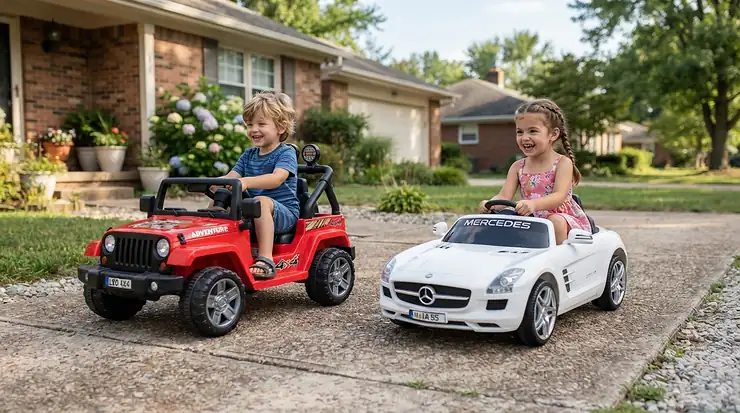
12V vs 24V ride-on cars is the choice between two battery systems in kids’ electric vehicles. 12-volt models suit preschoolers on flat ground. 24-volt models add motor power and battery energy for heavier, older riders on lawns and gentle slopes. Voltage sets the power ceiling, while battery amp-hours set the stamina.
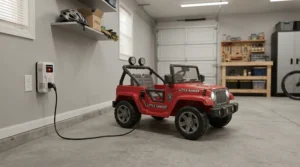
Walk down a toy aisle (or scroll a listing) and the label looks like a simple upgrade ladder: bigger number, bigger fun. Reality is messier. A 12V Power Wheels can already reach 5 mph (about 8 km/h), while some 24V trucks ship with presets of just 2 and 4 mph. So what does the extra voltage actually buy you? Mostly torque, headroom and features, not raw speed.
The category has come a long way. Power Wheels, the line that made battery-powered toy cars a backyard staple, began with 6-volt and 12-volt models, and Mattel has owned it since 1994, according to Wikipedia. Today, 24V rigs with remotes, Bluetooth and four motors sit on the same shelf.
This guide compares seven real models using manufacturer and retailer specs. It then translates them into daily life: top speed in km/h, terrain capability, run time per charge, the real value of a dual-motor ride-on car, and what to buy when you need a ride-on car for older kids. We also run the numbers on the 12-volt versus 24-volt kids’ car decision across several seasons of use.
One note on prices: you will only see ranges below, because prices move constantly. Check current price before you buy. Everything here is analysis based on published specs and the review data that could be verified, not hands-on testing.
Quick Comparison: 12V vs 24V Ride-On Cars at a Glance
Here is the 30-second version of the 12V vs 24V ride-on cars debate, built from manufacturer listings and retailer spec sheets.
| Factor | 12V | 24V |
|---|---|---|
| Typical top speed in km/h | 4-8 km/h (2.5-5 mph) | About 3-8 km/h (2-5 mph) on most two-seaters |
| Motors | Often a basic 2WD layout | Dual-motor or four-motor 4WD |
| Terrain capability | Driveways, sidewalks, flat lawns | Lawns, gravel, gentle slopes |
| Run time per charge | Roughly 1-2 hours | Roughly 1-1.5 hours, longer on bigger packs |
| Two-seater weight limit | Around 130 lb | Around 110-132 lb |
| Label age range | 3-7 | 3-8 |
| Price tier | Lower | Higher |
| Best For | Power Wheels Dune Racer Extreme for flat-yard fun | Best Choice Products 24V 2-Seater Truck for remote control and growth room |
Look closely and the speed rows overlap: a 5 mph (8 km/h) Power Wheels Dune Racer Extreme is not slower than a 4 mph (6.4 km/h) Best Choice Products 24V 2-Seater Truck. The real separation is in motors, terrain capability and extras like parental remotes. If your child is under five and your yard is flat, 12V is plenty; add gravel, a slope or a bigger kid, and the 24V column starts earning its higher price.
💬 Just one click — help others make better buying decisions too!😊
Top 7 Picks in the 12V vs 24V Ride-On Cars Showdown: Expert Analysis
Three 12V models and four 24V models follow, so the comparison stays fair. Specs come from manufacturer and retailer listings, and where review data could not be verified, that is stated plainly.
1. Power Wheels Dune Racer Extreme — wide tires built for grassy backyards
The wide-tire stance is the headline, and it is a smart one for the 12V class. Mattel lists a 12-volt rechargeable battery, two forward speeds of 2.5 and 5 mph (about 4 and 8 km/h), reverse at 2.5 mph, a 130 lb limit and an age range of 3-7. In practice, that 5 mph high gear is a brisk jog, and the 130 lb limit is shared between two riders, so two 65 lb kids hit the ceiling together.
Based on the spec comparison, the low-profile frame, steel construction and extra-wide tires give it better terrain capability than a plain-tire 12V on lawns. There is no parental remote option, so an adult has to walk alongside. It is a fine choice for two siblings under seven and a poor one as a ride-on car for older kids.
Reviewers are moderately positive: the Walmart listing shows roughly 4 out of 5 stars across several hundred ratings, and a retailer review summary for a Dune Racer variant mentions assembly can take one to two hours and that battery life varies with use.
Pros:
- ✅ Wide tires improve grip on grass
- ✅ Two forward speeds plus reverse
- ✅ Room for two riders
Cons:
- ❌ No parental remote available
- ❌ Outgrown quickly by kids near the weight limit
Independent trackers place it around the $250-$330 range, so check current price; it is good value for flat-to-grassy yards.

2. Power Wheels Jeep Wrangler — parent-controlled high-speed lockout
The standout is the lockout, which lets you cap the car at 2.5 mph (4 km/h) until your driver is ready for 5 mph (8 km/h). Mattel lists 12 volts, a 130 lb limit, ages 3-7, Power-Lock brakes that engage when the foot leaves the pedal, and hard-surface plus grass driving. At 47 x 30.5 x 33 inches, it is a roomy two-seater.
What the spec sheet won’t tell you, but the design implies: the lockout is a built-in growth path. A nervous four-year-old starts in low gear, and the same truck stays relevant when confidence arrives. That makes it a strong first car in the 12-volt versus 24-volt kids’ car decision for families who want brand support, since Mattel’s parts documentation lists a one-year vehicle warranty and six-month battery warranty.
Verified review data for this exact edition was thin in my research, so treat the verdict above as spec-driven reasoning rather than a crowd opinion.
Pros:
- ✅ Lockout caps speed for beginners
- ✅ Power-Lock brakes stop the car automatically
- ✅ Longer warranty than many 24V rivals
Cons:
- ❌ No parental remote for steering override
- ❌ 12V power limits slopes and wet grass
Expect roughly the $250-$400 range depending on edition and retailer; solid value for ages 3-5.
3. Kid Trax 12V Ford Bronco — licensed look with rubber traction strips
Kid Trax pairs Ford Bronco styling with Power Trax rubber traction strip tires. Target’s listing gives a top speed of 5 mph (8 km/h), seating for two riders aged 3-7, a 130 lb total limit, and a one-step direct-connect charging system with the 12-volt battery and wall charger included.
Direct-connect charging sounds minor until you picture a six-year-old and a parent at 7 a.m. wanting to plug in without unscrewing a battery door. Rubber strips help on pavement and dry grass, but on its terrain capability, this is a driveway-and-lawn truck. Compared with 24V dual-motor models, expect more struggle on wet or sloped ground. For families weighing a 12-volt versus 24-volt kids’ car, it is the budget-friendly answer when the yard is flat.
I could not verify enough current review data for this listing, so no crowd verdict is claimed here.
Pros:
- ✅ Direct-connect charging is convenient
- ✅ 5 mph top speed in a 12V package
- ✅ Two-rider design with 130 lb limit
Cons:
- ❌ No parental remote listed
- ❌ Likely to struggle on slopes
I couldn’t confirm a current price, but comparable 12V two-seaters commonly sit in the $200-$350 range. Good value on flat ground.
4. Best Choice Products 24V 2-Seater Truck — the review-volume leader with a remote
The standout is its sheer popularity. Best Buy’s listing for model SKY9423 shows two 24V motors in a 2WD layout, preset speeds of 2 and 4 mph (3.2 and 6.4 km/h), a 132 lb limit, a parental remote, Bluetooth and LED lights, with an assembled weight around 56 lb.
On paper, that is a dual-motor ride-on car with a slower top end than a 12V Power Wheels. The benefit of 24V here is torque, headroom and the remote, rather than speed. The 2WD layout also caps grass and gravel performance, a limitation echoed in roundups of dual-motor models. Note the 60-day limited warranty on the Best Buy listing, far shorter than Mattel’s one year.
Review sentiment varies by listing: third-party roundups cite more than 16,000 reviews at roughly 4.5 stars, while one retailer listing showed 4.2 stars from only ten ratings. Review counts differ by color and seller, so read the live listing.
Pros:
- ✅ Parental remote for steering override
- ✅ 132 lb limit gives growth room
- ✅ Bluetooth and LED lights included
Cons:
- ❌ 2WD limits wet-grass traction
- ❌ Short 60-day warranty
Around $400, in a $350-$450 range, which is fair value if you want the remote.
5. First Ride On 24V Ford Bronco Raptor — three speeds and a long-range remote
The standout is control granularity. Listings describe a 24V dual-drive system with dual 90W motors, three speeds of 2.0, 2.7 and 4.3 mph (3.2, 4.3 and 6.9 km/h), a 21-inch two-seat cabin, a 132 lb limit, and a remote with roughly 98 feet of range.
Three speed steps let you ease a child upward in small increments, and a soft-start feature (reported in listings) reduces that lurch that scares new drivers. The 21-inch cabin matters for a ride-on car for older kids, because a bigger child needs more than a toddler-width seat. At 180W of total motor power, though, it is a lighter drivetrain than the 4×200W UTVs below.
I could not verify a large review base directly, and roundups naming it a value pick are secondary sources, so confirm the live ratings before buying.
Pros:
- ✅ Three speeds enable gradual progression
- ✅ Roughly 98 ft remote range
- ✅ Wider 21-inch two-seat cabin
Cons:
- ❌ Dual-motor setup is less rugged than 4WD
- ❌ Review data hard to verify
Likely in the $300-$400 range; strong value for sibling pairs.

6. Costway 24V Kids Ride-on UTV — switchable 4WD and 2WD
The standout is the drivetrain switch. Costway’s listing describes four 100W motors that toggle between 4WD and 2WD, plus a remote with high and low speed.
That switch is genuinely practical: 4WD for wet grass and loose gravel, 2WD on pavement, where the extra motors are not helping. It makes this the most terrain-capability-focused model in the mid-range. The listing I reviewed did not give a clear weight limit or mph, so confirm both on the live page; for a heavier child, that matters more than the motor count.
Verified review data was minimal, so no crowd verdict is offered.
Pros:
- ✅ Switchable 4WD and 2WD drivetrain
- ✅ Remote with high and low speed
- ✅ Four motors spread the load
Cons:
- ❌ Weight limit and speed need checking
- ❌ Thin verifiable review history
Retailers list it in the mid-$300s, roughly $300-$400; decent value for mixed terrain.
7. Garvee Licensed Can-Am 24V UTV — dual batteries and four 200W motors
The standout is brute force on paper. Best Buy’s listing describes dual 24V 7Ah batteries, four 200W motors for 4WD, spring suspension, EVA tires, a parental remote and a 130 lb maximum load.
That is 800W of rated motor power, double the Costway 24V Kids Ride-on UTV, and two batteries mean more stored energy. It is the most capable option here as a ride-on car for older kids who push the limits. The catch: more power invites faster speeds, and the CPSC says products over 5 mph are more likely to be treated as ATVs, so verify the listed mph before you buy.
I could not verify review volume, so treat it as the least proven pick on this list.
Pros:
- ✅ Four 200W motors for 4WD traction
- ✅ Two batteries for more stored energy
- ✅ Suspension and EVA tires for rough ground
Cons:
- ❌ Heavier and harder to move when dead
- ❌ Limited verified review history
Comparable 4×200W models spanned roughly $160-$440 during research, so shop carefully; call it $300-$450 for this one.
Side-by-Side: How the 7 Compare
| Model | Voltage & Motors | Top Speed | Weight Limit | Price Range | Best For |
|---|---|---|---|---|---|
| Power Wheels Dune Racer Extreme | 12V | 5 mph (8 km/h) | 130 lb | $250-$330 | Flat-to-grassy yards, siblings under 7 |
| Power Wheels Jeep Wrangler | 12V | 5 mph (8 km/h), lockout to 2.5 mph (4 km/h) | 130 lb | $250-$400 | First-time drivers |
| Kid Trax 12V Ford Bronco | 12V | 5 mph (8 km/h) | 130 lb | $200-$350 | Pavement and driveway use |
| Best Choice Products 24V 2-Seater Truck | 24V, two motors (2WD) | 4 mph (6.4 km/h) | 132 lb | $350-$450 | Remote control and a big review base |
| First Ride On 24V Ford Bronco Raptor | 24V, dual 90W | 4.3 mph (6.9 km/h) | 132 lb | $300-$400 | Older kid plus sibling |
| Costway 24V Kids Ride-on UTV | 24V, 4×100W, 4WD/2WD | Check listing | Check listing | $300-$400 | Mixed pavement and loose ground |
| Garvee Licensed Can-Am 24V UTV | 24V, 4×200W | Check listing | 130 lb | $300-$450 | Heavier single riders on rough ground |
Price ranges are approximate at the time of research, so check current price on each listing. The table shows that speed barely separates the groups, while motor layout and remote control do. If hills are your priority, the Garvee Licensed Can-Am 24V UTV and Costway 24V Kids Ride-on UTV justify the extra spend, while budget buyers can do well with the Kid Trax 12V Ford Bronco.
✨ Ready to Pick Your Ride?
🔍 Take your backyard to the next level with these carefully selected models. Click on any highlighted product name to check current pricing and availability. Matching voltage to your child’s weight and your terrain is what turns a toy into years of safe outdoor play!
How to Choose 12V vs 24V Ride-On Cars: 7 Steps
The short answer for 12V vs 24V ride-on cars is to choose by rider weight and terrain first, then by remote control and battery capacity. Follow these steps:
- Start with weight, not age. Add the riders’ weights together and keep a margin below the listed limit, because motors strain near the cap.
- Match drivetrain to your yard. A dual-motor ride-on car handles pavement and dry grass, while 4WD earns its cost on wet lawns and gravel.
- Read the speed settings in km/h. Convert mph so you know what 4 km/h versus 8 km/h means for a child’s reaction time.
- Check amp-hours, not only volts. Energy equals volts times amp-hours, so a 24V 7Ah pack stores twice a 12V 7Ah pack.
- Demand a remote for children under five. If a model lacks one, look for a lockout like the Power Wheels Jeep Wrangler.
- Compare warranties. One-year versus 60-day coverage changes your long-term risk.
- Measure the seat. A ride-on car for older kids needs a wider cabin, like the 21 inches on the First Ride On 24V Ford Bronco Raptor.
Top Speed in km/h: What the Numbers Actually Feel Like
Manufacturers quote mph, but converting to top speed in km/h makes the experience concrete. 2.5 mph is about 4 km/h, 4 mph is about 6.4 km/h, and 5 mph is about 8 km/h. For scale, an adult walking pace of 3-4 mph is roughly 5-6.4 km/h.
That scale matters for regulation. The CPSC’s youth ATV guidance says products over 5 mph are more likely to be treated as ATVs, while those under 5 mph fit ride-on toys, partly because an adult walking at 3-4 mph can keep pace and supervise. In other words, a faster number is not automatically better, and any 24V listing promising 6-8 mph deserves skepticism.
Listed top speed in km/h is also a best case. Rider weight, surface type and a tired battery all pull it down, so treat the number as a ceiling. Based on the spec comparison, a 12V at 5 mph (8 km/h) and a 24V at 4 mph (6.4 km/h) feel similar at first. The 24V holds that pace better when the grass gets thick.
Terrain Capability in 12V vs 24V Ride-On Cars
Terrain capability is where the 24V premium is easiest to justify. The CPSC describes ride-on toys as typically used on flat, smooth surfaces such as driveways, sidewalks and lawns, which is the baseline everything here is designed around.
Voltage alone does not decide terrain capability. Drivetrain, tires and weight do. The Power Wheels Dune Racer Extreme leans on wide tires and a low profile, the Kid Trax 12V Ford Bronco on rubber traction strips, and the Costway 24V Kids Ride-on UTV and Garvee Licensed Can-Am 24V UTV on four motors and 4WD. Suspension and EVA tires, mentioned on the Garvee listing, help on bumpy ground.
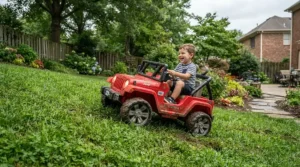
Here is a useful way to think about it: 12V cars handle “ground” while 24V cars handle “terrain.” Wet grass, loose gravel and slight inclines are where a single 2WD 12V system tends to spin or slow down, and where extra motors keep momentum. Neither category is built for hills, mud or trails.
Run Time per Charge: What to Expect Between Plug-Ins
Run time per charge depends on amp-hours more than voltage. A 12V 7Ah pack stores about 84 watt-hours, and a 24V 7Ah pack about 168, but 24V motors also pull more power, so the advantage shrinks.
Manufacturers publish different ranges. Riiroo’s help center says its 12V models run about 45-60 minutes and 24V models 60-90 minutes, while a Kid Trax 12V truck at Academy lists 1-2 hours of run time and an 8-12 hour charge. A 12V 7Ah Ford-style model’s listing quotes roughly 53 minutes at high speed and 112 minutes at low speed. Those figures illustrate the pattern: speed settings can double or halve your run time per charge.
Hills, heavy riders and cold weather all cut run time. If you want longer sessions, lock the car in low speed, charge fully before every outing and consider a second battery. Treat every listed number as a best case, since real run time per charge shifts with rider weight and terrain.
Dual-Motor Ride-On Car vs Single-Motor and 4WD: What Extra Motors Buy You
A dual-motor ride-on car typically drives the rear wheels with one motor each, while 4WD adds front-wheel drive. The Best Choice Products 24V 2-Seater Truck uses two 24V motors in 2WD, the First Ride On 24V Ford Bronco Raptor lists dual 90W motors, the Costway 24V Kids Ride-on UTV has four 100W, and the Garvee Licensed Can-Am 24V UTV has four 200W.
More motors spread the load. Each motor works less hard, and traction improves because more wheels push. In a dual-motor ride-on car, though, the front wheels still steer without helping, so wet grass can still cause slipping. Reviewers of 2WD dual-motor models note that serious grass and gravel performance is limited.
Be careful with wattage claims. “800W” on a listing is a rated sum, not delivered power at the wheels, and a heavy motor count on a flimsy gearbox is no bargain. Use motors as a clue to terrain capability, not as a score.
Ride-On Car for Older Kids: When 12V Stops Being Enough
A ride-on car for older kids has to solve three problems: weight, seat size and boredom. Most 12V two-seaters cap at about 130 lb, and 24V two-seaters run about 110-132 lb, so voltage barely changes the limit. What changes is torque: the same 80 lb child on a 24V dual-motor ride-on car climbs lawns more confidently.
Age labels also matter. The 12V Power Wheels models are rated for ages 3-7, while many 24V listings say 3-8. Past that, listings point toward 36V or 48V machines, but speeds above 5 mph can fall under the ATV category the CPSC describes, so research carefully.
| Option | Power | Supervision | Best For |
|---|---|---|---|
| 12V ride-on | Battery, no pedaling | Lockout or walk-alongside | Ages 3-5 on flat ground |
| 24V ride-on | Battery, stronger motors, often a remote | Remote override | Ages 5-8 on lawns and gravel |
| Pedal go-kart | Leg power, no battery | Visual only | Active kids who want exercise |
Looking at the comparison, a pedal go-kart builds fitness but cannot match a remote-controlled override. For a ride-on car for older kids, 24V with a remote offers the best mix of power and parental control, as the First Ride On 24V Ford Bronco Raptor shows.

12-Volt versus 24-Volt Kids’ Car: Long-Term Cost and Maintenance
The 12-volt versus 24-volt kids’ car decision is really a total-cost question. A 12V car costs less upfront, but outgrown at age six it may deliver only two summers. A 24V car with a 132 lb limit can stretch further.
Run a simple cost-per-use calculation. Spend $300 on a model used 40 hours a summer for three summers and you pay about $2.50 per hour of play. Replacement 12V batteries appeared in retail listings in the tens of dollars up to roughly $100, so budget for a battery refresh every few seasons.
Warranty also shifts the math. Mattel’s parts documentation lists a one-year vehicle warranty and a six-month battery warranty for Power Wheels, while the Best Choice Products 24V 2-Seater Truck listing shows 60 days. Maintenance is simple but non-negotiable: charge after use, keep the battery dry, check tires and clear debris from the pedal. A well-kept 12-volt versus 24-volt kids’ car can still be resold, which cuts the final cost.
Practical Usage Guide: Setup, Charging and the First 30 Days
Most frustration happens in the first month, so treat setup like a mini project.
- Budget assembly time. Retail summaries for Dune Racer variants mention one to two hours, so don’t start at sunset.
- Do the first charge by the manual. Many manuals require a long initial charge, and retailer specs for 12V cars cite 8-12 hours.
- Test in a driveway first. Check brakes, steering and the remote before heading to grass.
- Start in low gear. Lock the Power Wheels Jeep Wrangler at 2.5 mph (4 km/h) or use the 2.0 mph setting on the First Ride On 24V Ford Bronco Raptor until your child steers smoothly.
- Charge after every session. This protects run time per charge and avoids deep drains.
- Run a weekly check. Inspect wheels, wiring and the pedal, and wipe debris off.
- Watch for first-month mistakes. Overloading the weight limit, skipping the manual and driving on wet slopes are the big three.
Real-World Scenarios: Matching Cars to Kids
Scenario one: two siblings, ages 4 and 6, flat suburban yard, budget near $300. The Power Wheels Dune Racer Extreme or Power Wheels Jeep Wrangler fits. Start the four-year-old in the Jeep’s lockout, and keep sessions to an hour.
Scenario two: one 8-year-old (around 75 lb), gravel driveway, budget near $400. The First Ride On 24V Ford Bronco Raptor is the sensible pick, with its 21-inch cabin and 132 lb limit leaving room to grow. Use the remote override whenever visitors arrive.
Scenario three: two kids with a sloped backyard, using it daily. First, check combined weight. If both together exceed about 130 lb, no model here suits two riders safely. A single heavier rider on the Garvee Licensed Can-Am 24V UTV or Costway 24V Kids Ride-on UTV gets the 4WD terrain capability the slope demands, but only under supervision.
Across all three, frequency of use matters. A car used twice a month can live with 12V, while daily riders benefit from 24V stamina.
✨ Want a Ride Your Kid Will Actually Use?
🔍 Compare the models above, check each listing for weight limits and warranty, and click any highlighted product name to see current pricing and availability. The right fit will have your family outside for seasons to come!
Problem and Solution Guide: Common Complaints and Fixes
Problem: the car quits after twenty minutes. Check that the battery was fully charged, switch to low speed and reduce the load. Run time per charge falls fast with hills and heavy riders.
Problem: wheels spin on wet grass. That is a 2WD limitation. Wait for dry ground, or move to a 4WD model like the Costway 24V Kids Ride-on UTV, which can toggle between 4WD and 2WD.
Problem: your child outgrows the car in a year. Check the weight limit and seat width before buying. A 132 lb model like the Best Choice Products 24V 2-Seater Truck lasts longer than one near its cap.
Problem: the remote seems unresponsive. Re-pair it per the manual and replace weak remote batteries. Keep within the listed range, such as roughly 98 feet for the First Ride On 24V Ford Bronco Raptor.
Problem: the pedal sticks. Stop using the car and clean debris from the pedal. This is not hypothetical, as the next section shows.
Safety, Speed Rules and Compliance Guide
Safety starts with checking recalls. In 2024, the CPSC announced a recall of Mario Kart 24V Ride-On Racer cars because debris could clog the accelerator pedal and cause it to stick, creating a crash risk. The remedy was a free repair kit. It is a good reminder that a 24V system is powerful enough to make a stuck pedal matter.
Practical rules help. Keep rides on flat, enclosed ground away from streets and pools, supervise closely, and use the parental remote whenever a model has one. Add a helmet for older riders, and stop using any car that misbehaves until it is inspected.
On speed, the CPSC’s guidance points to a 5 mph line separating typical ride-on toys from ATV-style products. Check every 24V listing’s top speed in km/h and mph, and avoid any model that markets itself as a children’s ATV. Register your purchase with the manufacturer so recall notices find you.
FAQ
❓ Are 24V ride-on cars too fast for toddlers?
❓ Can I put a 24V battery in a 12V ride-on car?
❓ How long should I charge a new ride-on car before the first drive?
❓ Do 24V ride-on cars come with parental remotes?
❓ How much weight can a two-seater 24V ride-on car carry?
Conclusion
Choosing between 12V vs 24V ride-on cars comes down to three questions: how heavy is the rider, how rough is the ground, and how much remote control do you want? For flat yards and kids under six, the Power Wheels Dune Racer Extreme, Power Wheels Jeep Wrangler and Kid Trax 12V Ford Bronco deliver 5 mph (8 km/h) fun at a friendlier price. When you need a remote, extra torque or a ride-on car for older kids, the Best Choice Products 24V 2-Seater Truck, First Ride On 24V Ford Bronco Raptor, Costway 24V Kids Ride-on UTV and Garvee Licensed Can-Am 24V UTV earn their premium.
Remember that voltage is not speed. The real gains are terrain capability, drivetrain and control, and the real limits are the weight cap and the 5 mph line regulators watch. Plan for run time per charge, keep the battery maintained, and weigh the 12-volt versus 24-volt kids’ car decision across several seasons rather than one birthday.
Recommended for You
- Ride-On Car Battery Replacement: 7 Proven Picks For 2026
- Electric Ride-On Cars For Toddlers: 7 Best Picks For 2026
- Construction Toy Gifts For 3 Year Olds: 7 Ultimate Picks (2026)
Disclaimer: This article contains affiliate links. As an Amazon Associate, I earn from qualifying purchases. If you purchase products through these links, we may earn a small commission at no additional cost to you.
✨ Found this helpful? Share it with your friends! 💬🤗
