
In This Article
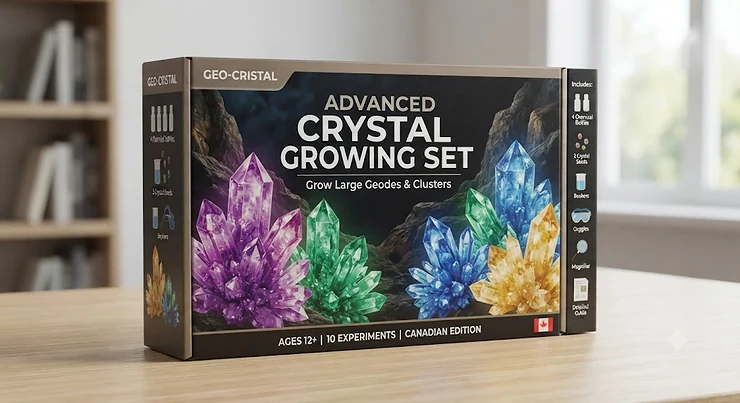
There’s a particular kind of magic in watching something grow out of nothing but salt, water, and patience. One day you’ve got a cloudy jar of solution sitting on a windowsill; two weeks later, there’s a jagged little gemstone catching the afternoon light, and a kid — or, let’s be honest, an adult — is pressing their nose against the glass to see it up close. That’s the pull of a good crystal growing set advanced enough to actually deliver on the science, not just the sparkle. A basic dollar-store kit will get you a lumpy blob. A properly engineered crystal growing set advanced learners can grow real results with teaches supersaturation, nucleation, and the slow architecture of molecular structures — while still being genuinely fun to use.
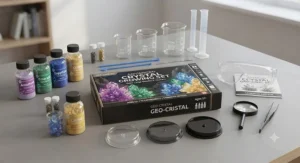
This guide skips the fluff and gets into what actually matters: real products, real specs, and honest analysis of which kits deserve a spot on your shelf. We researched seven genuine, currently available crystal growing kits spanning budget to premium, then dug into the science, the safety rules that apply in Canada, and the practical stuff nobody puts on the box — like what to do when your crystal grows lopsided or your solution won’t clear.
Before we get into rankings, here’s the quick version: what is an advanced crystal growing kit, really? It’s a science kit designed to grow larger, more complex, or faster-forming crystals than a basic beginner set, typically using multiple chemical compounds, precise temperature control, and guided experiments that teach real crystallography rather than a single one-and-done project.
What Is an Advanced Crystal Growing Set?
An advanced crystal growing set is a science kit built around multiple guided experiments — usually four or more — that use different chemical compounds (alum, monoammonium phosphate, copper sulfate, or proprietary blends) to grow crystals with distinct colours, shapes, and growth rates, paired with a detailed manual explaining the underlying chemistry.
What separates “advanced” from “beginner” isn’t marketing language. It’s the number of distinct crystal chemistries included, the presence of temperature-controlled or timed growth stages, and whether the manual actually explains why crystals form the shapes they do. A beginner kit grows one blob. An advanced one turns your kitchen counter into a small crystallography lab.
Quick Comparison Table
Here’s the fast version if you’re short on time — a snapshot of how the seven kits stack up before we dig into the details.
| Kit | Best For | Crystal Types | Price Range (CAD) |
|---|---|---|---|
| Thames & Kosmos Crystal Growing Science Kit | Serious young chemists | 4 chemically distinct crystals | C$45-C$55 |
| National Geographic Mega Crystal Growing Kit | Display-loving families | 6 crystal trees + light stand | C$35-C$45 |
| Scientific Explorer Ultimate Crystal Growing Kit | Variety seekers | 13 different activities | C$30-C$40 |
| 4M KidzLabs Crystal Growing Experiment | Budget beginners with ambition | 7 domed crystals | C$18-C$25 |
| Evviva Sciences Crystal Growing Kit | First-timers who fear failure | 3 shapes + star and dolphin | C$22-C$30 |
| BBC Earth Science of Crystal Growing | Quick weekend projects | 3 crystals on a display tray | C$18-C$28 |
| Discovery Kids Crystal Growing | Gift-givers on a tight budget | Colourful single-batch crystals | C$15-C$22 |
Looking at this lineup, the spread tells its own story: the Thames & Kosmos Crystal Growing Science Kit sits at the top for anyone who wants genuine chemical variety, while the Discovery Kids Crystal Growing kit exists purely to get a kid hooked without breaking a birthday budget. If your household already has a chemistry-curious kid who’s outgrown “grow one blob and call it a day,” the middle of this table — the National Geographic Mega Crystal Growing Kit and Scientific Explorer Ultimate Crystal Growing Kit — is where the real value lives.
💬 Just one click — help others make better buying decisions too!😊
Top 7 Advanced Crystal Growing Kits: Expert Analysis
Seven kits, all real, all currently available, spanning the full range from “grow this one weekend project” to “this is basically a starter chemistry lab.” Here’s the honest breakdown of each.
1. Thames & Kosmos Crystal Growing Science Kit — most chemically diverse advanced option
This is the one that shows up on nearly every serious science-kit shortlist, and for good reason: it doesn’t rely on one crystal chemistry dressed up four different ways. You’re working with four genuinely different compounds, each with its own solubility curve and growth personality, which means you actually see how chemistry changes outcomes rather than just repeating the same recipe. The kit includes a storage case and a 32-page colour manual covering fifteen separate experiments — everything from growing one large crystal to seeding dozens of small ones on a rock surface. What most buyers overlook about this kit is that it’s less about the finished crystal and more about the process: you’re taught to manipulate temperature, timing, and seed placement, which is the actual discipline of crystallography in miniature. Reviewers consistently note that the manual is unusually well written for a kids’ science kit, walking through the “why” behind solubility and crystallization rather than just listing steps. It’s best suited to kids around ten and up who’ve already done a basic kit and want the next level, or to a parent who wants one kit to cover a whole school term of chemistry curiosity.
Pros:
- ✅ Four distinct crystal chemistries in one box
- ✅ Manual explains real crystallization science in depth
- ✅ Reusable case keeps components organized long-term
Cons:
- ❌ Slower results than single-recipe kits
- ❌ Requires closer adult supervision for younger kids
Priced around C$45-C$55 depending on retailer, this sits at the upper end of the category — but for the depth of chemistry included, it’s a fair value verdict for anyone past the beginner stage.
2. National Geographic Mega Crystal Growing Kit — best light-up display centrepiece
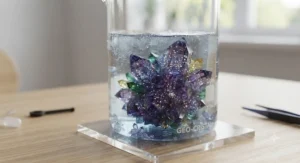
If the goal is a genuine “wow” moment, this is the kit that delivers it. Grow six crystal formations and then show them off on an included light-up stand with multiple colour modes — this isn’t a kit you tuck away in a drawer once it’s done, it’s one that ends up as a bedroom nightlight for months. The flexible growing chamber is a small but smart design choice: cheaper kits often crack or require you to smash the container to extract the crystal, while this one lets you remove your finished piece intact. Based on the spec comparison with other National Geographic science kits, this one leans harder into the “keepsake” angle than the pure chemistry-lesson angle, which makes sense given it also ships with three real gemstone specimens (a geode, green fluorite, and blue calcite) for a bit of geology alongside the chemistry. Reviewers frequently mention the light display as the standout feature that keeps kids engaged well after the growing process finishes. It’s the strongest pick for families who want crystallography science to feel like a craft project as much as a lab experiment.
Pros:
- ✅ Light-up display stand extends post-experiment enjoyment
- ✅ Includes three real gemstone specimens for bonus learning
- ✅ Flexible chamber removes crystals without damage
Cons:
- ❌ Fewer distinct chemical experiments than the Thames & Kosmos kit
- ❌ Requires batteries not included in the box
In the C$35-C$45 range, the National Geographic Mega Crystal Growing Kit earns its price through the display value as much as the science — a strong middle-ground pick.
3. Scientific Explorer Ultimate Crystal Growing Kit — widest variety of experiments
Thirteen separate activities is a lot for one box, and that breadth is the whole selling point here. You’re not just growing crystals — you’re building a glow-in-the-dark geode, spiky formations, “bouncing and jiggling” crystal novelties, and colour variants with evocative names like Golden Citrine and Red Tourmaline. What the spec sheet won’t tell you, but the activity list makes clear, is that this kit trades some depth in any single experiment for sheer range — it’s built for a kid who wants to try a new thing every weekend rather than master one process deeply. Recommended for ages twelve and up, it leans slightly older than some competitors, likely because managing thirteen separate experiment sets safely requires a bit more independence. Reviewers commonly highlight it as a science-fair favourite, since the variety means a student can pick whichever result photographs best or explains a concept most clearly for a project. If your household’s approach to hobbies is “more options, please,” this is the pick — it rewards kids who like to experiment broadly rather than repeat one recipe until it’s perfect.
Pros:
- ✅ Thirteen distinct crystal-growing activities in one kit
- ✅ Glow-in-the-dark geode option is a genuine standout
- ✅ Well suited to science-fair project selection
Cons:
- ❌ Recommended age skews older (12+)
- ❌ Individual experiments get less depth than focused kits
At roughly C$30-C$40, the value proposition here is variety per dollar — hard to beat if breadth matters more than depth for your young scientist.
4. 4M KidzLabs Crystal Growing Experiment — best budget pick with genuine multi-crystal range
Don’t let the lower price fool you into thinking this is a lightweight option — this kit runs seven separate crystal-growing experiments, each in its own labelled display dome, which is more individual results than several pricier competitors offer. Once grown, the crystals are described as lasting indefinitely in their domes, meaning this doubles as a permanent display piece rather than a one-and-done science project headed for the trash. The kit is STEM.ORG accredited, which is a genuine third-party credentialing mark rather than a marketing phrase manufacturers can slap on freely — it signals the experiment design has been reviewed against actual STEM education criteria. Based on the ingredient list, this uses standard crystal-growing compounds and mixtures rather than proprietary blends, which honestly works in the buyer’s favour: it’s straightforward, well-understood chemistry with a long safety track record in classroom settings. It’s the pick for a parent who wants to test the waters of crystallography science without committing serious grocery-budget dollars, or for a teacher stocking a classroom set on limited funds.
Pros:
- ✅ Seven separate crystal domes for multiple results
- ✅ STEM.ORG accredited experiment design
- ✅ Crystals display permanently once fully grown
Cons:
- ❌ Fewer premium extras like light stands or specimens
- ❌ Manual is thinner than higher-tier competitors
At around C$18-C$25, this is genuinely one of the better dollar-for-dollar picks in the category — proof that “budget” doesn’t have to mean “basic.”
5. Evviva Sciences Crystal Growing Kit — most foolproof for first-time growers
Every crystal-growing hobbyist has a horror story about a batch that turned into a cloudy, formless “blob” instead of a crystal — usually from an oversaturated solution or an unstable seed. This kit is built specifically to solve that problem: every powder and supply comes pre-measured, removing the guesswork that trips up first-timers. Reviewers consistently frame this as the kit that finally worked after other brands failed, which lines up with the pre-measured design — precision is genuinely the biggest variable separating a good crystal from a disappointing smear. You’ll grow three large crystals plus novelty shapes (a star and a dolphin), with your choice of colour, and the whole thing comes with an eBook covering the chemistry and geology behind the process. What most buyers overlook is that the “easy” framing doesn’t mean less educational — it just front-loads the hard part (measurement precision) so kids can focus on observing the actual crystallization process rather than troubleshooting a failed batch. Recommended for ages ten and up, it’s the safest bet if a previous kit has already left your household crystal-growing-shy.
Pros:
- ✅ Pre-measured components remove common failure points
- ✅ Includes eBook covering real chemistry and geology
- ✅ Multiple shape options including star and dolphin moulds
Cons:
- ❌ Fewer total experiments than variety-focused kits
- ❌ Novelty shapes prioritize fun over deep chemistry lessons
Priced around C$22-C$30, the Evviva Sciences Crystal Growing Kit earns its keep by converting skeptics — a smart pick after a previous kit disappointed.
6. BBC Earth Science of Crystal Growing — best for a focused weekend project
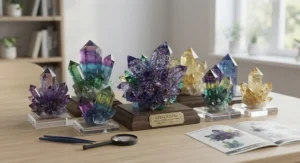
Sometimes you don’t want thirteen experiments spread across a month — you want one solid Saturday afternoon project with a satisfying result. This kit, sold directly through Amazon.ca, delivers exactly that: three crystals grown on a ready-to-use display tray, with the tray doubling as the finished showcase once growth is complete. The BBC Earth branding brings a documentary-style credibility to the packaging, and the manual leans into natural crystal formation — how crystals form underground over geologic time versus how this kit accelerates a similar process chemically in days. On paper, this means less raw quantity than the seven-crystal budget kits, but more polish per experiment, since the tray-to-display pipeline is built in rather than requiring a separate storage solution. It’s aimed at ages eight to twelve, positioning it as a solid family activity rather than a solo project for an older, more independent kid. For a parent looking for a contained, low-mess weekend activity rather than an ongoing month-long commitment, this hits the mark.
Pros:
- ✅ Ready-to-go display tray simplifies setup and showcase
- ✅ Manual ties chemistry to real geological crystal formation
- ✅ Compact, low-commitment single-weekend project
Cons:
- ❌ Only three crystals versus seven or more in other kits
- ❌ Less depth for kids wanting ongoing experimentation
At C$18-C$28 on Amazon.ca, it’s a solid mid-budget pick for a single focused activity rather than a long-term science project.
7. Discovery Kids Crystal Growing — most affordable gift-friendly option
When the goal is simply “give a kid something that sparks curiosity without a big spend,” this Horizon Group USA kit checks that box. It’s a straightforward, colourful crystal-growing set built for an afternoon of hands-on fun rather than a deep multi-week curriculum — the kind of kit that works well as a stocking stuffer, birthday-party favour upgrade, or a low-stakes first introduction to crystal chemistry before committing to a pricier advanced set. Here’s what to weigh: this isn’t positioned as a rigorous chemistry lesson the way the Thames & Kosmos or Scientific Explorer kits are, and reviewers generally frame it as light, accessible fun rather than a deep-dive science tool. That’s not a knock — it’s simply a different use case. For a household testing whether a specific kid actually enjoys crystal growing before investing in a premium kit, this low-risk option answers that question without a big financial commitment.
Pros:
- ✅ Very low price point for testing interest
- ✅ Simple, colourful, kid-friendly presentation
- ✅ Great as a gift or party favour upgrade
Cons:
- ❌ Limited chemical variety compared to advanced kits
- ❌ Manual offers less scientific depth
At around C$15-C$22, this is the entry point of the category — a reasonable first purchase before graduating to something more advanced.
Top 7 Crystal Growing Sets Comparison
| Kit | Experiments/Crystals | Recommended Age | Standout Feature | Best For |
|---|---|---|---|---|
| Thames & Kosmos Crystal Growing Science Kit | 15 experiments, 4 chemistries | 10+ | Deepest real chemistry | Serious learners |
| National Geographic Mega Crystal Growing Kit | 6 crystals | 8+ | Light-up display stand | Display lovers |
| Scientific Explorer Ultimate Crystal Growing Kit | 13 activities | 12+ | Widest variety | Science-fair projects |
| 4M KidzLabs Crystal Growing Experiment | 7 domed crystals | 10+ | STEM.ORG accredited | Budget + variety |
| Evviva Sciences Crystal Growing Kit | 3 crystals + 2 shapes | 10+ | Pre-measured, foolproof | Nervous first-timers |
| BBC Earth Science of Crystal Growing | 3 crystals | 8-12 | Built-in display tray | Weekend projects |
| Discovery Kids Crystal Growing | Multiple, single batch | 8+ | Lowest price | Gift-giving |
Interpreting the table, the age recommendations aren’t arbitrary — they roughly track how much unsupervised precision each kit demands, with the pre-measured Evviva Sciences Crystal Growing Kit and tray-based BBC Earth Science of Crystal Growing kit being the most forgiving for younger or first-time growers. If you’re choosing based purely on educational depth, the Thames & Kosmos Crystal Growing Science Kit and Scientific Explorer Ultimate Crystal Growing Kit pull ahead of the pack; if display value matters most, the National Geographic Mega Crystal Growing Kit‘s light-up stand is hard to match at its price point.
Practical Usage Guide: Setting Up and Maintaining Your Kit
Getting a great result from any crystal growing set advanced or basic comes down to a handful of habits most manuals gloss over. First: temperature matters more than most kids expect. Dissolving your growing compound in water that’s too cool means it won’t fully dissolve, leaving grit that seeds unwanted crystals all over your container instead of one clean formation. Water that’s too hot can be a safety issue and can also cause the solution to cool too quickly, which produces smaller, cloudier crystals instead of one large, clear one.
Second, location matters as much as recipe. Crystals grow best somewhere with a stable temperature and minimal vibration — a windowsill that gets direct afternoon sun will cause temperature swings that disrupt slow, even growth, while a spot near a heating vent does the same thing in reverse. A closet shelf or an out-of-the-way counter, checked daily rather than left alone for a week, tends to produce better results than a “set it and forget it” approach.
Third, patience genuinely is the whole game. The most common mistake in the first thirty days of owning any advanced kit is disturbing the solution too early — pulling the seed crystal out to check on it, bumping the container, or adding more powder mid-growth because progress looks slow. Most crystals need anywhere from three days to two weeks depending on the compound, and the manuals that come with kits like the Thames & Kosmos Crystal Growing Science Kit are specific about timing for a reason.
Maintenance-wise, once a crystal is fully grown, removing it from solution and letting it air-dry for 24 hours before handling prevents the surface from clouding. Store finished crystals away from humidity — a sealed display case or the light-up stand that ships with the National Geographic Mega Crystal Growing Kit works well here — since crystals grown from water-soluble compounds can slowly degrade if left in a damp bathroom or basement.
✨ Don’t Miss These Exclusive Deals!
🔍 Take your crystal growing set advanced projects to the next level with these carefully selected kits. Click on any highlighted item to check current pricing and availability. These tools will help you create genuinely spectacular results your whole family will love!
Real-World Scenarios: Matching the Kit to Your Home Scientist
The science-fair student. A grade-seven student needs a project that photographs well, demonstrates a clear concept, and can be documented across a two-week timeline. The Scientific Explorer Ultimate Crystal Growing Kit‘s thirteen distinct activities make it easy to pick a standout result — the glow-in-the-dark geode, for instance — while still leaving enough leftover materials to document a “failed” attempt for comparison, which judges tend to appreciate.
The reluctant beginner. A ten-year-old who tried a dollar-store crystal kit once, got a cloudy blob, and declared they “don’t like science” needs a guaranteed win before anything else. The pre-measured Evviva Sciences Crystal Growing Kit removes the most common failure point entirely, making success far more likely on the first try — which matters more for confidence-building than raw educational depth at this stage.
The budget-conscious homeschool parent. Teaching a full crystallography science unit to two or three kids without buying multiple premium kits calls for the 4M KidzLabs Crystal Growing Experiment, whose seven separate domes mean each child can run their own experiment and compare results, all for less than the price of one Thames & Kosmos kit.
Beyond Crystals: Building a Complete Home Chemistry Lab
Crystal growing is a fantastic entry point, but it’s rarely where a genuinely curious kid stops. Here’s how to round out the setup with real, currently available products across the related categories our readers ask about most.
Molecular Model Kit
Once a kid understands that crystals form ordered, repeating structures, the natural next question is why — and that’s where a molecular model kit earns its place on the shelf. The LINKTOR Chemistry Molecular Model Kit, a 444-piece set including a full fullerene (Carbon-60) build, lets students physically construct the atomic geometry that crystal lattices are built from. What most buyers overlook about model kits like this one is that they bridge two-dimensional textbook diagrams and the three-dimensional reality of molecular structures — something no amount of staring at a diagram accomplishes. Reviewers of similar kits in this category consistently note the colour-coded atoms follow standard chemistry education conventions, meaning skills transfer directly to a classroom setting later on. Pricing on comparable kits in this category typically falls in the C$30-C$50 range in Canada.
pH Testing Kit Kids
A pH testing kit kids can actually use safely is a natural companion to crystal growing, since both hinge on the same underlying idea: how dissolved substances behave in solution. Universal pH test strips covering the full 1-14 range are widely available and inexpensive, typically in the C$10-C$20 range for a large multi-strip pack, and they let kids test household liquids — vinegar, baking soda solution, tap water — to build intuition about acidity and alkalinity before tackling more abstract chemistry concepts. Based on the format, strip-based kits are the safer, more classroom-friendly choice over liquid reagent kits for younger kids, since there’s no risk of spilling a testing solution.
Chemistry Kit With Microscope
For a household wanting one purchase that covers both hands-on chemistry and observational science, a chemistry kit with microscope combo — like the Learning Resources Primary Science Deluxe Lab Set, which pairs a functional microscope with broader lab tools — solves two gift-list problems at once. What the spec sheet doesn’t always make clear is that a microscope genuinely extends the crystal-growing experience: kids can examine a crystal’s surface structure up close, spotting facets and growth striations invisible to the naked eye. Expect this category to run C$40-C$70 in Canada depending on magnification range and included accessories.
How to Choose an Advanced Crystal Growing Set
- Match the chemistry count to the attention span. A kid who loses interest quickly does better with the seven-in-one format of the 4M KidzLabs Crystal Growing Experiment than a single fifteen-experiment marathon.
- Check the recommended age against actual independence. Pre-measured kits like Evviva Sciences Crystal Growing Kit suit less-supervised growers; multi-step kits reward kids who can follow detailed instructions.
- Decide if display matters. If the finished crystal needs to survive as a bedroom decoration, prioritize kits with a built-in stand or tray, like the National Geographic Mega Crystal Growing Kit or BBC Earth Science of Crystal Growing.
- Weigh depth against variety. Deep single-topic learning favours Thames & Kosmos; broad exposure favours Scientific Explorer.
- Budget for a second kit, not just the first. Starting with an inexpensive option like Discovery Kids Crystal Growing to gauge interest before investing in a premium set is a financially sound strategy, not a compromise.
- Read the manual quality into the price. Kits that explain the “why,” not just the “how,” deliver more long-term educational value per dollar.
- Factor in growth time. If patience is a concern, favour kits with the shortest documented growth windows rather than the ones promising the largest final crystal.
The Crystallography Science Behind Every Crystal You Grow
Every crystal you grow at home is, at its core, a demonstration of crystallography science — the study of how atoms arrange themselves into repeating, ordered patterns. When a growing solution becomes supersaturated, meaning it’s holding more dissolved solute than it normally could at that temperature, the excess material has nowhere to go but into an ordered solid structure. That structure isn’t random. It follows the specific geometric rules dictated by the molecule’s shape and charge, which is why alum crystals form octahedrons while table salt forms cubes.
Canada actually has a notable tradition here: the Chemical Institute of Canada hosts a National Crystal Growing Competition every fall, open to students across the country, where the goal is simply to grow the largest, highest-quality single crystal possible. It’s been running for more than three decades specifically because the challenge teaches patience, precision, and genuine chemistry — the same qualities a good home kit tries to instill on a smaller scale. What most home growers overlook is that a “perfect” crystal and a “fast” crystal are usually in tension: competition-winning crystals typically take weeks of careful, undisturbed growth, not the three-day timelines advertised on faster kits.
Understanding the Chemical Reactions That Create Crystals
It’s worth being precise here: most crystal-growing kits aren’t demonstrating a chemical reaction in the strict sense — they’re demonstrating a physical process called crystallization, where a dissolved compound comes out of solution as an ordered solid without changing its chemical identity. True chemical reactions, where atoms rearrange into new compounds, do show up in some advanced kits’ bonus experiments (like the electrolysis or acid-base demonstrations bundled into broader Thames & Kosmos chemistry lines), but the core crystal-growing process itself is about physical state changes driven by temperature and concentration.
This distinction matters for what kids actually learn. Reviewers and educators alike note that kits explaining this difference clearly — rather than lumping “crystal growing” and “chemical reactions” together loosely — set kids up better for future chemistry coursework, since conflating the two is a common misconception that has to be unlearned later. According to the Wikipedia entry on crystallization, the process is fundamentally about the arrangement of atoms or molecules into a highly organized structure called a crystal lattice, driven by the solution’s move from supersaturation toward equilibrium — a physical, not chemical, transformation.
From Atoms to Crystals: How Molecular Structures Shape What You Grow
Here’s the detail that separates a genuinely advanced kit from a novelty one: the shape of the final crystal is dictated almost entirely by the molecular structures of the compound being grown, not by anything the kid does with their hands. Alum’s tetrahedral molecular geometry produces the characteristic octahedral crystal shape seen in several kits on this list. Copper sulfate’s structure produces the deep blue, elongated crystals associated with more advanced kits like the multi-chemistry Thames & Kosmos Crystal Growing Science Kit. Monoammonium phosphate, common in budget kits like the 4M KidzLabs Crystal Growing Experiment, tends to produce fast-forming, needle-like clusters.
What most buyers overlook is that this is genuinely useful, transferable knowledge — a kid who’s watched three different compounds grow three different shapes has an intuitive head start on the molecular geometry concepts they’ll formally encounter in high school chemistry, well before a molecular model kit or a textbook diagram ever enters the picture.
Common Mistakes When Buying an Advanced Crystal Growing Set
The single most common mistake is buying based purely on the box photo rather than checking the actual number of distinct chemistries included — some “advanced” branding is applied to kits that grow one compound in several colours, which isn’t the same as genuine chemical variety. A second common misstep is ignoring the recommended age range and assuming “advanced” always means “for older kids”; several advanced-tier kits on this list are actually rated for ages eight and up because the complexity lies in the number of experiments, not the difficulty of any single step. Third, buyers frequently underestimate growth time, expecting dramatic results within a day or two when most genuine crystal formations need three days to two weeks depending on compound and conditions. Finally, skipping the manual before starting is a mistake that compounds itself — the instructions in kits like the Thames & Kosmos Crystal Growing Science Kit front-load safety and technique information that prevents the most common early failures.
Crystal Growing Sets vs Basic Kitchen Crystal Experiments
It’s entirely possible to grow a passable crystal using nothing but table salt, borax, and a mason jar — plenty of free online tutorials walk through it. So why buy a kit at all? The honest answer is consistency and safety framing, not access to secret chemistry. Kitchen experiments use widely available household compounds with variable purity, meaning results are genuinely hit-or-miss depending on your tap water’s mineral content and the exact concentration you happen to mix. Kits like the Evviva Sciences Crystal Growing Kit solve this with pre-measured, consistent-purity compounds specifically formulated for reliable crystallization.
| Factor | Kitchen DIY | Advanced Kit |
|---|---|---|
| Consistency of results | Variable | High (pre-measured) |
| Chemical variety | Usually 1 (salt, sugar, or borax) | 3-7+ compounds |
| Safety guidance | None built in | Included in manual |
| Best For | Free, casual experimentation | Reliable, educational results |
Reading across this comparison, the real value of a purpose-built kit isn’t access to exotic chemistry — it’s the reliability and safety framing that a mason jar and a Google search simply can’t replicate, especially for younger or first-time growers who need a confidence-building win.
What to Expect: Real-World Performance
Specs on a box rarely translate directly into lived experience, so here’s the honest version. A “grows in three days” claim on budget kits like the 4M KidzLabs Crystal Growing Experiment usually refers to visible initial crystal formation, not the fully matured, display-ready result — expect another few days of continued growth for a truly photogenic outcome. Colour vibrancy tends to exceed expectations on kits using dye-infused seed crystals, like several products in this category, while colour can look muted on kits relying purely on the base compound’s natural tint. Clarity — how glass-clear versus cloudy the finished crystal looks — correlates most strongly with how undisturbed the growth process was, not with kit price, which is why the patience-focused manual in the Thames & Kosmos Crystal Growing Science Kit matters more than its premium price tag alone would suggest.
Safety, Regulations & Compliance for Crystal Growing Sets in Canada
In Canada, children’s science kits — including crystal growing sets — fall under the Canada Consumer Product Safety Act and the associated Toys Regulations, enforced by Health Canada. Health Canada’s toy safety guidance covers mechanical, chemical, and choking hazards specifically, and science kits containing chemicals for educational use are specifically called out as a category requiring warning labels under current federal rules. Before buying, it’s worth checking that a kit lists clear age recommendations and includes handling instructions for any powders or solutions — reputable brands like Thames & Kosmos and National Geographic consistently meet this bar, while unbranded or off-market kits are a bigger unknown.
Health Canada’s industry guide to toy safety requirements also addresses toxicological hazards specific to chemistry-adjacent toys, which is directly relevant here since crystal-growing compounds, while generally low-risk when used as directed, aren’t intended for ingestion and should always be used under the age guidance printed on the box. Adult supervision remains the single best safety practice regardless of what regulatory box a kit checks — no regulation substitutes for a parent reading the manual alongside their kid on the first attempt.
Long-Term Cost & Value Analysis
A single advanced crystal growing kit is a one-time-use consumable in the sense that the chemical compounds don’t regenerate — once you’ve grown your crystal, that specific batch of powder is spent. This is where total cost of ownership gets interesting: a C$45-C$55 Thames & Kosmos Crystal Growing Science Kit delivering fifteen experiments across four chemistries works out to roughly C$3-C$4 per experiment, which actually beats several budget kits offering fewer total activities for a lower sticker price. By contrast, the C$15-C$22 Discovery Kids Crystal Growing kit, while cheap upfront, typically covers a single growing session, making its per-experiment cost comparable despite the lower headline price.
| Kit | Approx. Price (CAD) | Experiments | Approx. Cost Per Experiment |
|---|---|---|---|
| Thames & Kosmos Crystal Growing Science Kit | C$45-C$55 | 15 | ~C$3-C$4 |
| 4M KidzLabs Crystal Growing Experiment | C$18-C$25 | 7 | ~C$3 |
| Discovery Kids Crystal Growing | C$15-C$22 | 1-2 | ~C$10+ |
Interpreting this table honestly: the cheapest sticker price doesn’t always mean the cheapest cost per hour of engagement. If your household is likely to want repeat sessions, the higher-experiment-count kits deliver better long-term value even at a higher upfront cost — a classic case where the “budget” option and the “value” option aren’t the same product.
Frequently Asked Questions
❓ How long does it take to grow crystals with an advanced kit?
❓ Is a crystal growing set advanced kit safe for a ten-year-old?
❓ What's the difference between a crystal growing kit and a chemistry set?
❓ Can you regrow a crystal that dissolved or didn't form?
❓ Do advanced crystal growing kits work with a molecular model kit for extra learning?
Conclusion
Choosing the right crystal growing set advanced enough to hold a curious kid’s attention really comes down to matching the kit’s chemical variety and growth style to your household’s patience level and budget. The Thames & Kosmos Crystal Growing Science Kit remains the strongest all-around pick for genuine chemistry depth, while the National Geographic Mega Crystal Growing Kit wins on display value and the 4M KidzLabs Crystal Growing Experiment is tough to beat for budget-conscious variety. Whichever kit ends up on your counter, the science underneath — supersaturation, molecular structures, and the slow, orderly chemistry of crystallization — is the same fascinating process that’s captivated curious minds for centuries, from kitchen-table hobbyists to Canada’s own National Crystal Growing Competition entrants.
Building out a fuller home lab with a molecular model kit, a pH testing kit kids can use safely, or a chemistry kit with microscope is a natural next step once the crystal-growing bug bites — each one reinforces a different angle of the same underlying chemistry, and together they turn a single kit purchase into a genuinely ongoing hobby.
✨ Ready to Start Growing?
🔍 Browse the full lineup above and pick the kit that matches your young scientist’s patience level and curiosity. Click through to check current availability and pricing — your kitchen counter’s next centrepiece is one click away!
Recommended for You
- Best Chemistry Set for a 10 Year Old: 7 Top Picks (2026)
- Meccano Advanced Sets: 7 Top Picks for Serious Builders (2026)
- Advanced LEGO Technic: 7 Sets Worth Building in 2026
Disclaimer: This article contains affiliate links. As an Amazon Associate, I earn from qualifying purchases. If you purchase products through these links, we may earn a small commission at no additional cost to you.
✨ Found this helpful? Share it with your friends! 💬🤗
