
In This Article
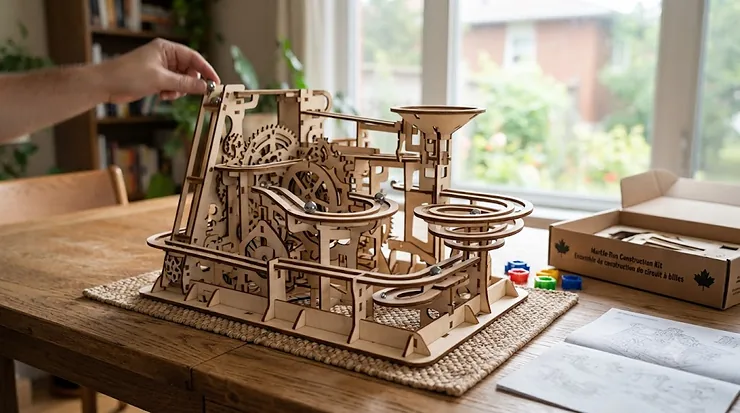
Somewhere between “I’m bored” and the sound of a marble rattling down a homemade cardboard chute, an entire branch of engineering gets discovered by accident. A marble run construction kit is a modular building toy made of tracks, ramps, funnels, and connector pieces that snap together so a marble can travel from top to bottom, teaching gravity, motion, and cause-and-effect along the way. That’s the textbook definition, but the real story is messier and better: it’s the toy that turns a rainy Saturday into a two-hour architecture project, and turns “why does it keep falling off there?” into an honest engineering debate at the kitchen table. For Canadian parents shopping in 2026, the marble run construction kit category has split into distinct tribes — motorized elevators, magnetic tile hybrids, gear-driven contraptions, and old-school wooden classics — and picking the right one depends less on the box art and more on how your particular kid plays. According to Health Canada’s toy safety guidance, small parts and detachable pieces are the leading cause of toy-related choking incidents, which matters a great deal when a set ships with a hundred-plus pieces small enough to vanish under the couch. This guide breaks down seven real, currently available kits, compares them honestly against their closest rivals, and gives you the practical groundwork — setup tips, age-matching, common mistakes — to actually get your money’s worth.
Quick Comparison Table
| Kit | Track Type | Best For | Price Range (CAD) |
|---|---|---|---|
| Ravensburger GraviTrax Starter Set | Gravity & magnetic | Older kids who like real physics | C$70–C$90 |
| Hape Quadrilla Vertigo | Wooden interlocking | Durability and heirloom quality | C$100–C$130 |
| Techno Gears Marble Mania Extreme 4.0 | Gear-driven lifter | Mechanical building fans | C$60–C$80 |
| National Geographic Motorized Elevator Run | Motorized track | Continuous, hands-off play | C$45–C$60 |
| Learning Resources Tumble Trax | Magnetic (fridge/board) | Small spaces, younger builders | Under C$40 |
| Marble Genius Super Set | Classic tube-and-track | Budget-first families | Under C$35 |
| PicassoTiles 150pc Magnetic Set | Magnetic tile hybrid | Kids who already own magnetic tiles | C$40–C$55 |
Looking across this table, the split isn’t really budget versus premium — it’s mechanism versus mechanism. The Ravensburger GraviTrax Starter Set and Techno Gears Marble Mania Extreme 4.0 reward kids who want to understand why a marble moves, while the National Geographic Motorized Elevator Run and Learning Resources Tumble Trax prioritize fast, frustration-free assembly. If your household already owns magnetic building tiles, the PicassoTiles 150pc Magnetic Set slots in as a natural extension rather than a whole new toy category to store.
💬 Just one click — help other Canadian parents make better buying decisions too!😊
Top 7 Marble Run Construction Kits: Expert Analysis
1. Ravensburger GraviTrax Starter Set — best for real physics exploration
The Ravensburger GraviTrax Starter Set treats gravity as the star of the show rather than a background assumption, which is exactly what sets it apart from track-and-tube kits. Key specs include a modular pillar system with height-adjustable vertical supports, magnetic and kinetic action tiles, and MESH-accredited STEM certification aimed at kids aged 8 and up — in practice, that height adjustability means builds can climb a full metre (about 3 feet) without the structure wobbling, something flatter starter sets can’t attempt. Based on the design philosophy here, this kit is for the kid who’s already asking “but how does it actually work,” not just “can it go faster.” Reviewers consistently note that the starter set alone feels a little limited within a few weeks, and that the real fun (and real spending) starts once expansion packs like Trax or Elevator get added to the mix. Aggregated review sentiment also flags the learning curve as steeper than average — younger or first-time builders often need a parent alongside them for the first couple of sessions.
Pros:
- ✅ Modular, expandable system compatible with add-on packs
- ✅ Teaches real gravity and momentum concepts through vertical building
- ✅ MESH-accredited STEM toy with genuine educational grounding
Cons:
- ❌ Starter set alone is small; expansions add up in cost
- ❌ Recommended age of 8+ limits use by younger siblings
At the time of research, the Ravensburger GraviTrax Starter Set sits in the C$70–C$90 range, and for families planning to build out a long-term GraviTrax collection, it’s a reasonable entry point rather than a complete solution on its own.
2. Hape Quadrilla Vertigo Wooden Marble Run — best for heirloom-quality durability
The Hape Quadrilla Vertigo Wooden Marble Run swaps plastic snap-fit connectors for solid, FSC-certified beechwood pieces that lock together through gravity and precision-cut grooves rather than clips that eventually crack. The 134-piece set is built around curved, spiral, and switchback track sections, and here’s what most buyers overlook: wood changes the sound of the toy, not just the material — that low, rolling clatter is genuinely different from the tinny plastic rattle of cheaper kits, and kids notice. What the spec sheet won’t tell you, but reviewers note, is that the smooth wood finish makes marbles run noticeably faster on straightaways than comparable plastic track, so tighter curves are needed to slow things down before a launch off the table. This is the kit for families who see a toy as a multi-year investment or who already lean toward wooden, screen-free play. Aggregated sentiment describes it as sturdy enough to survive being handed down between siblings, with minimal wear even after years of use.
Pros:
- ✅ Durable solid FSC-certified wood built to survive years of play
- ✅ Distinctive rolling sound and smoother marble momentum than plastic
- ✅ Sustainably sourced material appeals to eco-conscious households
Cons:
- ❌ Premium price point compared to plastic competitors
- ❌ Wooden pieces are bulkier and heavier to store than snap-track kits
Expect a price in the C$100–C$130 range, making the Hape Quadrilla Vertigo Wooden Marble Run one of the pricier picks here — but if longevity is your priority, the value math looks different once you factor in years of use instead of months.
3. Techno Gears Marble Mania Extreme 4.0 — best for visible mechanical building
Where most marble runs hide their mechanics, the Techno Gears Marble Mania Extreme 4.0 puts them front and centre: this 200-plus-piece set uses a visible corkscrew power lifter and interlocking gear trains to haul marbles back to the top, so kids watch mechanical advantage happening in real time instead of taking it on faith. On paper, this means the build teaches gear ratios and rotational motion the way a diagram in a textbook never quite manages, and it’s compatible with the wider Techno Gears line for anyone who wants to keep expanding. Based on the spec comparison with simpler kits, the finished structure stands close to 74 cm (about 29 inches) tall, which is genuinely impressive as a centrepiece build. Reviewers consistently mention that assembly is a multi-hour project best tackled with an adult on standby, and a recurring complaint in aggregated feedback is that a handful of the smaller connector pieces feel less robust than the sturdier track sections around them.
Pros:
- ✅ Visible gears teach mechanical advantage in a hands-on way
- ✅ Interchangeable with other Techno Gears sets for bigger builds
- ✅ Large finished scale makes an impressive display piece
Cons:
- ❌ Assembly commonly takes several hours and needs adult help
- ❌ Some smaller connector pieces feel less durable than the tracks
At a price in the C$60–C$80 range, the Techno Gears Marble Mania Extreme 4.0 earns its keep for kids who are already fascinated by how machines work, rather than kids who just want quick, repeatable marble drops.
4. National Geographic Marble Run with Motorized Elevator — best for continuous hands-off play
The National Geographic Marble Run with Motorized Elevator solves the single biggest annoyance in traditional marble runs: the constant walk back to the top to reload. This 150-piece set includes a battery-powered spiral lift and 30 marbles, so the play loop becomes genuinely continuous rather than stop-and-go. Here’s what most buyers overlook about this model — the motorized lift isn’t just a novelty, it’s the difference between a toy that holds a group of kids’ attention for twenty minutes versus two. Based on the design, that large marble count matters more than it sounds; with 30 marbles in circulation, siblings or a small group of friends can build competing tracks and race simultaneously without constantly waiting their turn. Aggregated review sentiment is largely positive on the “wow factor” of watching the perpetual-motion-style loop run on its own, though a recurring theme is that the motorized lift needs a fairly precise track angle to avoid jamming, and battery life becomes an ongoing (if modest) running cost.
Pros:
- ✅ Motorized elevator keeps marbles cycling without manual reloading
- ✅ 30 marbles included, ideal for group or sibling play
- ✅ Included storage bag keeps 150 pieces organized between uses
Cons:
- ❌ Requires batteries, an ongoing cost and occasional hassle
- ❌ Motorized lift can jam if track angle isn’t calibrated correctly
Typically priced in the C$45–C$60 range, the National Geographic Marble Run with Motorized Elevator hits a comfortable mid-tier spot — noticeably more capable than budget sets without venturing into premium territory.
5. Learning Resources Tumble Trax Magnetic Marble Run — best for small spaces and younger builders
Instead of sprawling across the living room floor, the Learning Resources Tumble Trax Magnetic Marble Run sticks directly to any magnetic surface — the fridge, a whiteboard, a locker at school — turning a vertical wall into the building canvas. The magnetic backing on each track piece is the whole trick here, and what most buyers overlook is how much this changes the play pattern: instead of needing a sturdy floor-based frame, gravity does the structural work, and kids can rearrange pieces mid-build without the whole thing collapsing like a tower of blocks. Based on the mechanics, this makes the Tumble Trax set noticeably more forgiving for younger or less patient builders who get frustrated when a base plate tips over. Reviewers consistently describe it as a strong “first marble run” for kids around age 4 to 6, though the trade-off is a smaller selection of dramatic trick pieces — loops, funnels, and multi-lane splits — compared to bigger track-and-tube competitors.
Pros:
- ✅ Magnetic pieces build vertically, saving floor space entirely
- ✅ Simple attachment mechanism suits younger, less patient builders
- ✅ Encourages easy experimentation with angles without a rigid base
Cons:
- ❌ Only usable on a magnetic surface, limiting play locations
- ❌ Fewer dramatic trick pieces than larger tube-based sets
Priced under C$40 at the time of research, the Learning Resources Tumble Trax Magnetic Marble Run is a smart, low-commitment entry point before investing in a bigger system.
6. Marble Genius Marble Run Super Set — best budget pick with genuine piece count
The Marble Genius Marble Run Super Set proves that “budget” doesn’t have to mean “sparse” — this 150-piece set (translucent track plus glass marbles) delivers roughly the same piece count as sets costing twice as much. The translucent tubing is the standout feature worth expanding on: kids can watch the marble’s entire path rather than losing sight of it inside opaque tunnels, which turns troubleshooting a bad drop into a visible, teachable moment instead of a mystery. Based on the included instruction booklet with sample builds, this set is deliberately aimed at first-timers who need a starting blueprint before they’re ready to freestyle their own designs — a detail that matters more than it sounds, since a blank pile of parts can be genuinely intimidating for a six-year-old. Aggregated customer sentiment is generally favourable for the price point, though a recurring complaint is that base connectors feel less rigid once builds get tall, and the plastic tubing scuffs and scratches faster than harder, more expensive alternatives.
Pros:
- ✅ Large 150-piece count at a genuinely budget-friendly price
- ✅ Translucent tubing lets kids track the marble’s full path
- ✅ Instruction booklet with sample builds helps first-time builders
Cons:
- ❌ Base connectors feel less rigid under taller structures
- ❌ Plastic tubing shows scuffs and scratches faster than pricier sets
Sitting under C$35 at the time of research, the Marble Genius Marble Run Super Set is arguably the best value-per-piece on this whole list, provided expectations are kept realistic about long-term durability.
7. PicassoTiles 150pc Magnetic Marble Run Track Set — best for households that already own magnetic tiles
The PicassoTiles 150pc Magnetic Marble Run Track Set quietly does double duty: it’s a marble run built from the same magnetic tile system found in dozens of other building-block brands, meaning it plugs directly into whatever magnetic tile collection is already living in the toy bin. That cross-compatibility is the real selling point — what most buyers overlook is that this isn’t just a marble run, it’s an expansion pack for a toy category your kids may already be obsessed with. Based on the strong magnetic connection points, assembly is nearly instant compared to snap-fit or gear-driven kits, which matters a lot for younger kids whose patience for fiddly connectors runs thin fast. Reviewers consistently praise how quickly builds go together, though the trade-off is a flatter, more horizontal design overall — without a gravity-fed vertical lift or motor, builds here tend to sprawl outward rather than climb dramatically upward.
Pros:
- ✅ Doubles as a standard magnetic tile building set
- ✅ Compatible with many other magnetic tile brands already owned
- ✅ Strong magnets snap together almost instantly for younger builders
Cons:
- ❌ Flatter, more horizontal builds than gravity-lift systems
- ❌ Loose magnetic pieces are a choking hazard requiring supervision
Priced in the C$40–C$55 range, the PicassoTiles 150pc Magnetic Marble Run Track Set earns its spot as the smartest add-on purchase for magnetic-tile households rather than a first standalone kit.
Full Product Comparison: Specs at a Glance
| Kit | Pieces | Recommended Age | Price Range (CAD) | Best For |
|---|---|---|---|---|
| Ravensburger GraviTrax Starter Set | ~120 | 8+ | C$70–C$90 | Real physics learners |
| Hape Quadrilla Vertigo | 134 | 4+ | C$100–C$130 | Long-term durability |
| Techno Gears Marble Mania Extreme 4.0 | 200+ | 6+ | C$60–C$80 | Gear and mechanism fans |
| National Geographic Motorized Elevator Run | 150 | 4–8 | C$45–C$60 | Group or sibling play |
| Learning Resources Tumble Trax | 24+ | 4–8 | Under C$40 | Small spaces, first-timers |
| Marble Genius Super Set | 150 | 4–8 | Under C$35 | Budget-first shoppers |
| PicassoTiles 150pc Magnetic Set | 150 | 3+ | C$40–C$55 | Existing magnetic tile owners |
Reading this table left to right, piece count alone is a poor proxy for value — the Techno Gears Marble Mania Extreme 4.0 and PicassoTiles 150pc Magnetic Set both land near 150–200 pieces, yet one demands hours of assembly for a mechanical showpiece while the other snaps together in minutes for casual play. Age recommendations track mechanism complexity fairly closely: gear-driven and gravity-based systems skew older, while magnetic and tube-based systems welcome younger hands. If you’re shopping for a mixed-age household, the National Geographic Motorized Elevator Run or Marble Genius Super Set tend to satisfy the widest age band without requiring constant adult supervision.
How to Choose a Marble Run Construction Kit
- Match the mechanism to your kid’s patience level. Motorized and magnetic kits like the National Geographic Motorized Elevator Run reward quick wins; gear-driven kits like the Techno Gears Marble Mania Extreme 4.0 reward kids who enjoy longer builds.
- Check the piece count against your available floor space. A 200-plus piece set sounds impressive until it’s sprawled across the only clear patch of carpet in the house.
- Decide whether expandability matters. Systems like GraviTrax are designed as an ongoing collection, not a one-and-done purchase — budget accordingly.
- Weigh material against your household’s play style. Wooden sets like the Hape Quadrilla Vertigo survive rougher handling and longer timelines than budget plastic tubing.
- Confirm the age range against actual skill, not just the calendar. A precocious 5-year-old might handle a 6+ set fine with supervision; a distractible 8-year-old might still prefer the simpler magnetic build.
- Consider storage realistically. Loose pieces without a bag or bin, as with some magnetic tile sets, end up scattered and incomplete within a month.
- Read aggregated review themes, not star ratings alone. A 4.2-star average hides a lot; recurring complaints about a specific part (like connector durability) matter more than the overall number.
Mechanical Building Toys, Gear Building Kits, and Circuit Building Kids Sets Compared
Marble run construction kits sit inside a much bigger family of mechanical building toys, and it’s worth understanding where they fit. Gear building kits — the category the Techno Gears Marble Mania Extreme 4.0 belongs to — teach rotational force and mechanical advantage directly, since kids watch one gear’s motion transfer to the next in real time. Circuit building kids’ sets, by contrast, teach an entirely different kind of cause-and-effect: instead of gravity and momentum, they demonstrate electrical flow, switches, and closed-loop circuits, usually through snap-together components rather than falling marbles. Both categories share a DNA with marble runs in that they reward experimentation over instructions — a kid who rebuilds a broken circuit twenty different ways is doing the same kind of trial-and-error problem-solving as a kid re-angling a marble ramp that keeps launching balls off the table. Where marble runs pull ahead is accessibility: there’s no wiring diagram to misread, no battery polarity to get backwards, just gravity doing the heavy lifting. For households debating between categories, a reasonable rule of thumb is to start with a marble run or gear kit around ages 4 to 7, then layer in circuit building sets once reading comprehension and fine motor control catch up, typically closer to age 8.
Cause-Effect Learning and Gravity Exploration
Cause-effect learning is really the entire premise of a marble run construction kit, just dressed up in bright plastic. Drop a marble, watch it either glide smoothly or fly off the track, and a child is running an experiment whether they realize it or not — adjust the angle, try again, observe the difference. This kind of direct feedback loop is exactly what researchers point to when discussing how everyday, hands-on materials build STEM-relevant thinking long before formal science class starts; the branded packaging matters less than the repeated cycle of predicting, testing, and revising. Gravity exploration specifically shows up whenever a kit like the Ravensburger GraviTrax Starter Set lets a child manipulate track height and steepness directly — steeper drops mean faster, louder, sometimes chaotic runs, and gentler slopes mean slower, more controlled ones. What the spec sheet won’t tell you, but any parent watching a rebuild session will notice, is that kids often arrive at genuinely correct physics intuitions (steeper equals faster, curves slow things down) well before they have the vocabulary to explain why. That’s the quiet magic of the category: understanding arrives through hands, not through lectures.
Kinetic Energy Toys: What to Expect from Real-World Performance
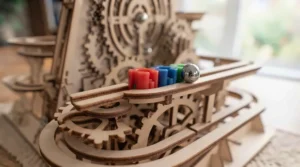
On a spec sheet, “teaches kinetic energy” is a marketing line. In practice, watching a marble run in action turns kinetic energy — the energy an object has because it’s moving — into something a kid can see, hear, and predict. A marble released from a taller drop hits the bottom curve harder and louder than one released from a gentler slope, and that difference is the entire concept in miniature. Motorized kits like the National Geographic Motorized Elevator Run add a second layer: instead of gravity alone converting potential energy into motion, a motor continuously re-supplies potential energy by lifting marbles back up, creating a loop that looks — though isn’t truly — perpetual. Gear-driven kits such as the Techno Gears Marble Mania Extreme 4.0 demonstrate a related but distinct idea: energy transferred through mechanical linkage rather than free fall. Here’s what most buyers overlook: the “best” kinetic energy toy isn’t necessarily the flashiest one, it’s whichever kit lets a child change one variable (height, angle, weight of marble) and immediately see the consequence. That immediate feedback is what separates a genuinely educational build from a toy that just looks impressive sitting on a shelf.
Common Mistakes When Buying a Marble Run Construction Kit
The single most common mistake is buying by piece count alone — a 300-piece set isn’t automatically better than a 130-piece set if half those pieces are duplicate straight tracks. Another frequent misstep is ignoring floor space at home; sprawling sets like the Techno Gears Marble Mania Extreme 4.0 need a dedicated corner, not just “somewhere on the rug.” Parents also commonly underestimate assembly time, expecting a quick 20-minute build when reviewers consistently describe multi-hour sessions for the larger gear-driven kits. A less obvious mistake is skipping the age recommendation in either direction — buying “up” too early leads to frustration and abandoned builds, while buying “down” for an older, more capable kid leads to boredom within a week. Finally, many buyers overlook storage entirely; a kit without a dedicated bag or bin, however good the track pieces are, tends to end up incomplete and scattered within a month or two, undermining the whole investment.
Features That Actually Matter (And Those That Don’t)
Marketing copy loves to tout total piece count and flashy colour schemes, but what actually determines long-term satisfaction is connector durability, expandability, and whether the marbles themselves are a safe, standard size. A large number of trick pieces (funnels, spirals, multi-lane splits) matters more than raw piece count, since these are what keep builds interesting after the third or fourth rebuild. Motorized features, like the lift in the National Geographic Motorized Elevator Run, genuinely extend play time by removing the reload bottleneck — that’s a real feature, not just a gimmick. On the other hand, glow-in-the-dark marbles, while fun for a night or two, rarely change how often a kit gets played with after the novelty fades, and neither does a taller box or more dramatic packaging art. Compatibility with an existing toy ecosystem, as with the PicassoTiles 150pc Magnetic Marble Run Track Set and standard magnetic tiles, quietly matters more than most buyers expect, since it multiplies the effective size of the collection without a full second purchase.
Marble Run Kits for Different Ages and Skill Levels
Younger builders, roughly ages 3 to 5, do best with magnetic or simplified systems like the PicassoTiles 150pc Magnetic Marble Run Track Set or Learning Resources Tumble Trax, where strong magnets forgive imprecise placement and gravity does most of the structural work. Mid-range builders, around ages 5 to 8, are the sweet spot for classic tube-and-track sets such as the Marble Genius Marble Run Super Set and motorized kits like the National Geographic Motorized Elevator Run, both of which balance genuine building challenge with a manageable frustration ceiling. Older kids and pre-teens, roughly 8 and up, are ready for systems that demand planning ahead — the Ravensburger GraviTrax Starter Set and Techno Gears Marble Mania Extreme 4.0 both reward the kind of trial-and-revise patience that younger builders haven’t developed yet. Mixed-age households have an easier time than it might seem: a motorized or magnetic set tends to keep a 5-year-old and an 8-year-old both engaged, since younger kids can handle the simpler assembly steps while older siblings take on trickier configurations.
Long-Term Cost & Maintenance
The sticker price is rarely the whole story with marble runs, especially for expandable systems. The Ravensburger GraviTrax Starter Set is explicitly designed as an entry point, meaning the realistic long-term cost includes at least one, and often several, expansion packs over the following year or two. Motorized kits like the National Geographic Motorized Elevator Run carry a small ongoing cost in replacement batteries, which adds up over dozens of play sessions but remains modest compared to a full expansion purchase. Wooden sets such as the Hape Quadrilla Vertigo sit at the opposite end of the maintenance spectrum — higher upfront cost, but close to zero ongoing cost, since there are no batteries, no easily cracked plastic clips, and minimal wear over years of handling. Budget plastic sets like the Marble Genius Marble Run Super Set carry the lowest upfront cost but the highest realistic replacement risk, since scuffed or cracked tubing eventually needs individual pieces replaced or the whole set retired. When comparing total cost of ownership, it’s worth mentally amortizing the price over years of expected use rather than judging purely by the number on the price tag today.
Safety, Regulations & Compliance Guide for Canadian Families
In Canada, children’s toys fall under the Canada Consumer Product Safety Act and its associated Toys Regulations, which set mandatory standards for small parts, sharp edges, and structural durability under normal and reasonably foreseeable rough use. Marble run kits, almost by design, involve dozens or hundreds of small components, which makes the small-parts choking hazard genuinely relevant for households with children under three, even if the marble run itself is intended for an older sibling. Parachute Canada’s home safety guidance recommends checking any small part against a standard toilet paper roll — if it fits inside, it’s a choking risk for a child under three, a simple test that applies directly to loose marbles and small connector pieces. Magnetic marble run sets deserve an extra note of caution: small, strong magnets can cause serious internal injury if swallowed, particularly if more than one is ingested, so magnetic kits like the PicassoTiles 150pc Magnetic Marble Run Track Set and Learning Resources Tumble Trax should be kept away from toddlers and used under supervision in mixed-age households. Battery compartments on motorized kits should also be checked periodically to confirm they remain securely fastened, since loose button batteries carry their own well-documented hazard.
Practical Setup Guide: Your First 30 Days
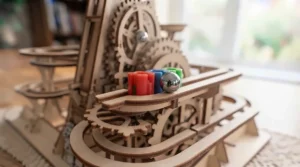
Getting the most out of a new marble run construction kit starts before the first piece even snaps into place. In the first session, resist the urge to follow the instruction booklet exactly start to finish — build the base structure together, then let the kid experiment freely with the trick pieces, since ownership over the design is what keeps interest alive past week one. A common early mistake is building too tall too fast; start with a modest, stable structure and only add height once the base connections feel solid, especially with taller sets like the Techno Gears Marble Mania Extreme 4.0. For motorized kits such as the National Geographic Motorized Elevator Run, test the elevator alone before adding the full track, since a miscalibrated angle is the single most common cause of early jamming complaints. Establish a simple storage routine from day one — even a basic labeled bin — because loose-piece chaos is the number one reason marble runs get abandoned within the first month. Finally, schedule a “rebuild day” roughly once a week rather than leaving the same structure standing indefinitely; repeated rebuilding is where most of the actual learning happens, not the first assembly.
Real-World Scenarios: Matching Kits to Kids
Consider a 5-year-old in a small Toronto condo with limited floor space and a short attention span for fiddly assembly — the Learning Resources Tumble Trax Magnetic Marble Run fits well here, since it builds vertically on the fridge and forgives imprecise placement. Now picture an 8-year-old in a suburban Calgary basement rec room who’s already obsessed with how bikes and clocks work — the Techno Gears Marble Mania Extreme 4.0 matches that curiosity directly, turning an afternoon into a genuine mechanical engineering project. Finally, imagine two siblings, ages 6 and 9, sharing a playroom in Halifax with a decent-sized rug for building — the National Geographic Motorized Elevator Run works as a shared project, since the younger child can handle simple track placement while the older one manages the trickier motorized lift alignment, and the large marble count means neither kid is stuck waiting their turn.
Problem → Solution: Fixing Common Marble Run Frustrations
Problem: The track keeps collapsing mid-build. Solution: widen the base footprint before adding height, and check that connector pieces are fully seated rather than just resting against each other — this is a frequent issue with taller builds on kits like the Techno Gears Marble Mania Extreme 4.0.
Problem: Marbles fly off curves instead of following the track. Solution: reduce the incline angle slightly on that section; too steep a drop feeding into a tight curve is the most common cause, especially on smoother wooden track like the Hape Quadrilla Vertigo.
Problem: The motorized lift keeps jamming. Solution: check that the receiving track is aligned precisely with the lift’s exit point, since even a small gap causes marbles to miss the hand-off on kits like the National Geographic Motorized Elevator Run.
Problem: Pieces keep going missing between play sessions. Solution: introduce a labeled storage bin on day one and make “putting pieces back” part of the build routine rather than an afterthought.
Problem: A younger sibling keeps knocking down the build. Solution: switch that household to a vertical, wall-mounted system like the Learning Resources Tumble Trax, which is physically out of toddler reach compared to floor-based structures.
✨ Ready to Start Building? 🔍
Take your family’s next rainy-day project to the next level with one of these carefully chosen marble run construction kits. Click through to check current pricing and availability on amazon.ca, and give your kids a hands-on physics lesson they’ll actually beg to repeat!
Benefits vs Traditional Building Toys
| Factor | Marble Run Construction Kits | Traditional Building Blocks | Screen-Based Games |
|---|---|---|---|
| Teaches physics concepts | Directly, through observation | Indirectly, through structure | Rarely, unless purpose-built |
| Physical engagement | High — full-body building | High | Low |
| Immediate feedback loop | Excellent (visible cause-effect) | Moderate | Variable |
| Best For | Cause-effect and gravity learning | Open-ended creative building | Passive or guided entertainment |
The comparison above makes clear that marble run construction kits occupy a specific niche traditional blocks don’t quite fill — the instant, visible feedback of a marble either completing or failing its run is a stronger teaching tool for cause-and-effect than static block structures, which don’t “fail” in the same dramatic, informative way. That said, traditional building blocks still win on pure open-ended creativity, since there’s no physics to satisfy — a block tower can be any shape at all. For households weighing screen time against hands-on play, a kit like the Ravensburger GraviTrax Starter Set offers a genuinely competitive alternative to tablet games, since the trial-and-error loop of adjusting a real track scratches a similar problem-solving itch without the screen.
Price Range & Value Analysis
| Tier | Typical Price Range (CAD) | Example Kit | Value Verdict |
|---|---|---|---|
| Budget | Under C$40 | Marble Genius Marble Run Super Set | Best entry point, moderate lifespan |
| Mid-Range | C$40–C$80 | National Geographic Motorized Elevator Run, Techno Gears Marble Mania Extreme 4.0 | Strong feature-to-price balance |
| Premium | C$80 and up | Ravensburger GraviTrax Starter Set, Hape Quadrilla Vertigo | Best for long-term or expandable use |
Budget kits deliver excellent value for a family testing the marble-run waters for the first time, but mid-range options tend to offer the strongest overall balance, since they add either genuine mechanical complexity or motorized convenience without crossing into expansion-pack territory. Premium kits only make financial sense if the household is committed to the format long-term, whether that means investing in more GraviTrax expansions or simply wanting a wooden set built to survive a decade of use.
Frequently Asked Questions
❓ What age is best for a marble run construction kit?
❓ Are marble run construction kits worth the money?
❓ Can adults enjoy marble run construction kits too?
❓ What's the difference between magnetic and gear-driven marble runs?
❓ Are marble run construction kits safe for younger siblings?
Conclusion
Choosing a marble run construction kit really comes down to matching mechanism to household — and personality. Families chasing genuine physics depth will get more out of the Ravensburger GraviTrax Starter Set, while anyone who wants a build that keeps running without constant reloading should look at the National Geographic Marble Run with Motorized Elevator. Kids who already love taking things apart to see how they work will gravitate toward the visible gears of the Techno Gears Marble Mania Extreme 4.0, and households prioritizing longevity over novelty will find the Hape Quadrilla Vertigo Wooden Marble Run worth the higher upfront cost. Budget-first families shouldn’t feel like they’re settling either — the Marble Genius Marble Run Super Set and PicassoTiles 150pc Magnetic Marble Run Track Set both deliver genuine building value without the premium price tag, and the Learning Resources Tumble Trax Magnetic Marble Run remains one of the smartest low-commitment starting points for younger builders. Whichever kit ends up on the shelf, the real payoff isn’t the box art — it’s the quiet, repeated cycle of building, watching, adjusting, and rebuilding that turns a simple marble drop into a genuine lesson in gravity, momentum, and mechanical cause and effect.
Recommended for You
- STEM Toys 6-8 Year Old: 7 Top Picks for 2026 (Canada Edition)
- Star Wars Figures 2026: 7 Best Poseable Picks for Every Budget
- best action figures: 7 Top Picks Canadians Will Love (2026)
Disclaimer: This article contains affiliate links. As an Amazon Associate, I earn from qualifying purchases. If you purchase products through these links, we may earn a small commission at no additional cost to you.
✨ Found this helpful? Share it with your friends! 💬🤗
