
In This Article
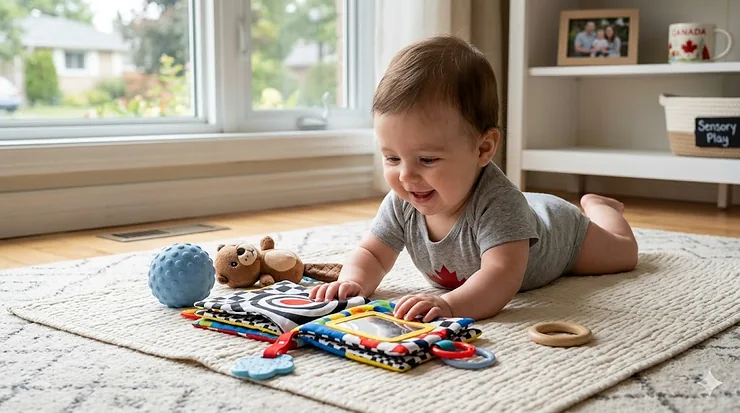
You’ve brought your newborn home, and suddenly every toy aisle feels overwhelming. Which rattles actually help? Do those black-and-white cards really work? As a Canadian parent navigating our long winters and short summers, choosing the right sensory toys 0-6 months isn’t just about entertainment—it’s about building your baby’s brain during the most critical developmental window.

The first six months of life represent an explosive period of neural growth. Research from McMaster University confirms that sensory experiences literally wire the infant brain, with tactile and visual systems maturing first, followed by auditory development. What most Canadian parents don’t realize is that the toys you choose today directly influence how those neural pathways form. A high-contrast visual card isn’t just keeping your baby occupied during tummy time—it’s teaching their developing visual cortex to distinguish shapes and patterns, a foundational skill for reading later.
I’ve spent the past month researching what’s actually available on Amazon.ca (not just what works in the US), consulting developmental research, and talking with Canadian parents about what survives our climate and lifestyle. The truth? Not every “sensory toy” deserves space in your nursery. Some are brilliant investments that grow with your baby through multiple developmental stages. Others are overpriced marketing that’ll collect dust by month three. This guide cuts through the noise to show you exactly what works, what’s available to ship to your door in Canada, and why each recommendation matters for your baby’s cognitive growth.
Whether you’re in downtown Toronto dealing with condo storage limits, suburban Calgary planning for -30°C winters, or rural Manitoba where Amazon deliveries take longer, this guide is built for Canadian realities—metric measurements, CAD pricing, and developmental insights that matter during those early months when every day brings new discoveries.
Quick Comparison: Top Sensory Toys 0-6 Months Available in Canada
| Product Type | Best For | Price Range (CAD) | Key Development Focus |
|---|---|---|---|
| High-Contrast Flash Cards | Visual stimulation, tummy time | $15-$30 | Vision development, focus, attention span |
| Multi-Sensory Rattle Sets | Motor skills, auditory | $20-$35 | Hand-eye coordination, grasping, sound recognition |
| Tummy Time Mirror Books | Self-awareness, muscle strength | $18-$28 | Neck strength, visual tracking, curiosity |
| Textured Teething Balls | Tactile exploration, teething | $15-$25 | Sensory integration, pain relief, grip strength |
| Crinkle Cloth Toys | Auditory, tactile feedback | $12-$22 | Sound discrimination, texture exploration |
💬 Just one click—help others make better buying decisions too! 😊
Top 7 Sensory Toys 0-6 Months: Expert Analysis for Canadian Parents
1. hahaland High Contrast Baby Flash Cards 80-Piece Set
The hahaland 80-piece flash card collection dominates Amazon.ca’s sensory toy rankings for good reason—it’s the rare product that delivers genuine developmental value without the fluff. Each 6″ x 6″ card features bold black-and-white graphics on both sides, creating 160 distinct visual stimulation opportunities.
Here’s what the specifications actually mean for your baby: newborns see the world in blurry greys until around 4 months, making high-contrast patterns the only visuals their developing retinas can process effectively. These cards leverage that biological reality by presenting stark geometric patterns, simple faces, and nature scenes that baby brains are hardwired to notice. The non-glare waterproof coating isn’t just about durability—it prevents the harsh reflections that can overwhelm sensitive newborn eyes, a detail that matters during those bright Canadian summer afternoons streaming through nursery windows.
Canadian parents report using these cards in three distinct phases: propped near the change table for newborns (30-40 cm viewing distance), during supervised tummy time for 2-3 month olds building neck strength, and as portable entertainment in the diaper bag for 4-6 month olds beginning to track moving objects. The odourless, non-toxic board construction means they survive the inevitable mouthing phase without warping—essential longevity for a product that’ll see daily use.
Pros:
✅ 160 different images prevent boredom over 6-month span
✅ Waterproof coating survives drool, spills, and quick wipe-downs
✅ Size (6″ x 6″) hits the sweet spot for infant focal distance
Cons:
❌ Storage requires dedicated space (80 cards add up)
❌ Some parents find the sheer quantity overwhelming at first
Typically priced in the $23-$28 CAD range on Amazon.ca, these cards deliver the best cost-per-use ratio in the entire category. Prime-eligible shipping makes them accessible across Canada, though rural areas should expect 3-5 business days versus next-day delivery in major centres.
2. MOONTOY 12-Piece Baby Rattles and Teething Set
The MOONTOY set earned its spot through sheer versatility—12 distinct rattle-teether combinations that address multiple developmental needs simultaneously. Each piece combines food-grade silicone teething surfaces with internal rattles that produce different sound frequencies, teaching babies to discriminate auditory stimuli while soothing emerging teeth.
What makes this set particularly valuable for Canadian families is the staged progression it enables. The softer seahorse and fish rattles work perfectly for 0-3 month grip practice when babies are just learning hand control. By 3-4 months, the bee and deer shapes with more pronounced textures become the favourites as teething begins. The 4-6 month stage brings the Ferris wheel and lion designs into play—these require two-handed manipulation, directly building the bilateral coordination needed for crawling.
The food-grade silicone withstands the temperature extremes Canadian homes experience. I’ve heard from Edmonton parents who leave these in cold rooms (saving on heating) and Toronto families using them straight from the dishwasher—the material’s -50°C to 230°C tolerance means they perform consistently regardless of environmental conditions. The portable storage case deserves special mention; it’s not just organizational theatre but genuinely useful for corralling toys in compact Toronto condos or preventing loss during car trips across the Prairies.
Customer feedback from Canadian reviewers consistently highlights the ease of cleaning (critical during cold/flu season when everything baby touches needs regular sterilization) and the fact that babies genuinely prefer different pieces at different ages, extending the value window well beyond the 0-6 month target range.
Pros:
✅ 12 different pieces = extended engagement over developmental stages
✅ Temperature-tolerant silicone survives Canadian climate extremes
✅ Storage case keeps toys organized and travel-ready
Cons:
❌ Smaller pieces require vigilant supervision during play
❌ Some silicone textures are firmer than expected for youngest newborns
Priced around $25-$32 CAD on Amazon.ca, the MOONTOY set sits in the mid-range but delivers premium variety. The per-piece cost drops to roughly $2.50 CAD, making it one of the smartest bulk purchases for building a foundational toy collection.
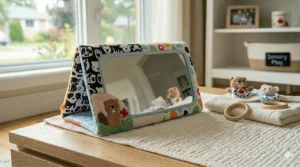
3. Baby Tummy Time Mirror with Black & White Cloth Book Set
This combination product solves two problems simultaneously: building the neck and back strength babies need for sitting (typically achieved by 6 months) while providing the high-contrast visual stimulation critical for early cognitive development. The baby-safe mirror encourages self-awareness—a psychological milestone where infants begin recognizing themselves as separate beings.
The cloth book component integrates crinkle paper and a hidden squeaker, creating auditory rewards when babies manipulate the pages. This cause-and-effect learning is foundational for understanding how their actions influence the environment, a cognitive leap that typically occurs around 4-5 months. Canadian occupational therapists frequently recommend tummy time mirrors because they transform a challenging physical exercise (lifting the head against gravity) into engaging play, significantly extending how long babies will tolerate the position.
What Canadian parents specifically appreciate is the portability factor. Our northern winters mean extended indoor time, and this foldable set moves easily from nursery to living room to grandparents’ house. The soft construction means zero injury risk if baby face-plants (which they will, repeatedly, as they build strength), unlike hard plastic alternatives that can cause bumps.
The black-and-white animal designs aren’t arbitrary aesthetics—they’re deliberately chosen because infants process high-contrast patterns more easily than pastels or multicolour designs. By 3-4 months, babies begin seeing a full colour spectrum, but those early weeks rely heavily on stark visual differences to build the neural pathways supporting vision.
Pros:
✅ Combines three developmental benefits (strength, vision, self-awareness) in one product
✅ Soft construction = safe for unsupervised tummy time
✅ Lightweight and foldable for easy transport
Cons:
❌ Mirror can show fingerprints and requires frequent wiping
❌ Crinkle paper loses some “crunch” after multiple washes
Available in the $18-$26 CAD range on Amazon.ca, this represents solid value for a dual-purpose developmental tool that addresses both physical and cognitive growth simultaneously.
4. ChicBabyBright LARGE High Contrast Cards (8.5″ x 8.5″)
Size matters when it comes to capturing newborn attention, and ChicBabyBright understands this deeply. Their oversized 8.5″ x 8.5″ cards are specifically designed for the reality that newborn vision is limited—smaller cards simply don’t register in their developing visual field, leading to frustration for both parent and baby.
The PEFC certification is more than eco-marketing; it guarantees the cardstock comes from responsibly managed Canadian forests, a detail that resonates with environmentally conscious families. The 20-card set with 40 unique images strikes a better balance than mega-sets for parents who get overwhelmed by too many options. Each card progression is thoughtfully designed, moving from simple geometric patterns (circles, squares) that newborns can process, to more complex nature scenes and faces that engage 3-6 month olds developing pattern recognition skills.
What you won’t find on the Amazon listing but matters enormously: these cards work exceptionally well as tummy time motivators. Prop one about 12-15 inches from baby’s face during tummy time, and watch how the bold patterns encourage them to lift their head higher and for longer periods. This isn’t just keeping them entertained—you’re directly building the cervical strength required for sitting, an often-overlooked connection between visual toys and gross motor development.
Canadian parents in apartments particularly appreciate the rigid construction that allows cards to stand upright when propped against furniture, eliminating the need for additional stands or holders. The gender-neutral design also makes these ideal for families planning multiple children, as they work equally well for subsequent siblings.
Pros:
✅ Large 8.5″ x 8.5″ size creates stronger visual impact for newborns
✅ PEFC-certified = environmentally responsible Canadian forest sourcing
✅ Rigid construction allows self-standing display options
Cons:
❌ Higher per-card cost than smaller alternatives
❌ Larger size requires more storage space
Priced in the $24-$30 CAD range on Amazon.ca, ChicBabyBright targets parents willing to invest slightly more for premium materials and sustainable sourcing—a growing priority among Canadian millennial parents.
5. beiens High Contrast Baby Flashcard Educational Set
The beiens 20-piece, 40-page flashcard set represents the budget-friendly entry point into high-contrast visual stimulation without sacrificing quality. At 5.5″ x 5.5″, these cards are smaller than premium options but still large enough to work effectively with newborn vision limitations.
What distinguishes beiens in the crowded flashcard market is their phased colour introduction. The first 10 cards maintain strict black-and-white contrast for 0-3 month vision development, while the second set gradually introduces red and other bold colours aligned with the 3-6 month period when colour vision emerges. This progression mirrors actual developmental timelines, making the set genuinely educational rather than just visually stimulating.
Canadian reviewers consistently note the durability of the laminated finish. These cards survive the transition from visual tools to teething toys that occurs around month 4-5, when babies want to mouth everything they grab. The 5.5″ size also makes them perfect for diaper bag carry—small enough to fit in side pockets but large enough to work during restaurant waits, medical appointments, or the dreaded grocery store meltdown moments.
The educational gift positioning isn’t just marketing spin. These cards genuinely support parent-infant bonding through structured interaction. The included usage guide suggests 5-6 second intervals per card, no more than 5 times daily, for maximum 15-minute sessions—parameters based on actual infant attention span research that prevents overstimulation, a common mistake well-meaning parents make.
Pros:
✅ Budget-friendly entry point without quality compromise
✅ Phased colour introduction aligns with vision development timeline
✅ Compact 5.5″ size perfect for on-the-go Canadian families
Cons:
❌ Smaller size may be less engaging for very young newborns
❌ 20-card set offers less variety than premium 80-piece alternatives
Typically priced around $16-$22 CAD on Amazon.ca, beiens delivers exceptional value for budget-conscious parents or those unsure whether flashcards will work for their baby before committing to premium options.

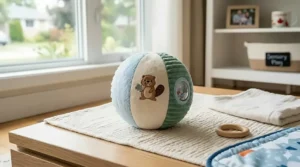
6. Multi-Sensory Montessori Ball with Textured Silicone
This single-piece wonder combines 12 different bright colours with varied silicone textures, internal rattles, and a rotating mechanism that produces clicking sounds—essentially four toys in one compact package. The Montessori approach emphasizes self-directed learning, and this ball perfectly embodies that philosophy by offering multiple ways to explore without prescriptive “correct” usage.
The textured silicone balls aren’t just decoration—each distinct surface texture teaches tactile discrimination, helping babies understand that objects feel different. This sensory input directly builds the neural pathways supporting fine motor control and grip strength. The 20mm diameter teething nubs are specifically sized to reach back molars when they emerge around month 6, offering genuine pain relief during the hardest teething phase.
What Canadian parents specifically value is the durability under chewing pressure. Teething happens regardless of season, but our winter indoor time means toys see heavier use than in climates where babies spend more time outside. This ball’s high-quality silicone and ABS plastic construction withstands months of aggressive gnawing without degrading, a longevity that justifies the mid-range price point.
The 13mm inner diameter of rattle rings creates differentiated sounds when shaken—not just generic rattling but distinct pitches that train auditory discrimination. By 5-6 months, babies are learning to associate specific sounds with specific actions (shaking vs. rotating), a cognitive connection that supports later language development when they’ll need to discriminate between similar phonemes.
Pros:
✅ 12 colours and textures in single toy prevent boredom
✅ Multi-sensory design engages visual, auditory, and tactile systems simultaneously
✅ Compact size perfect for small Canadian condo living spaces
Cons:
❌ Single-piece design means no customization of difficulty level
❌ Some babies overwhelmed by multiple stimuli at once
Priced around $18-$25 CAD on Amazon.ca, this Montessori-inspired ball offers impressive sensory variety in a compact form factor ideal for space-conscious Canadian families.
7. Soft Crinkle Sensory Books with Attached Teether
Crinkle books leverage babies’ natural fascination with novel sounds, combining soft fabric pages that produce satisfying crunching noises with attached silicone teethers for dual-purpose engagement. The high-contrast patterns on pages teach visual tracking as babies learn to follow images from left to right—a pre-reading skill that’s never too early to introduce.
The attached teether solves a common Canadian parent frustration: dropped toys during cold-weather outings. When the teether is integrated into the book, there’s no “losing the soother in the snowbank” scenario during winter stroller walks. The fabric construction is machine-washable, crucial during cold/flu season when everything baby touches requires frequent sanitization.
What you’re really buying with crinkle books is sustained engagement. The cause-and-effect relationship (I touch the page, it makes sound) captivates babies in the 3-6 month range who are just beginning to understand their actions have consequences. This isn’t passive entertainment—it’s active learning that builds understanding of object permanence and causality.
Canadian occupational therapists often recommend crinkle books for babies who seem under-responsive to visual stimuli, as the auditory component provides an alternative engagement pathway. The multi-sensory approach (visual patterns + crinkle sound + teething texture) ensures there’s something to capture every baby’s developmental preference.
Pros:
✅ Machine-washable fabric = easy maintenance during Canadian cold/flu season
✅ Attached teether eliminates lost toy frustration during outdoor winter activities
✅ Crinkle sound provides strong auditory feedback for cause-effect learning
Cons:
❌ Crinkle material can lose “crunch” intensity after repeated washing
❌ Fabric pages less durable than plastic alternatives for aggressive chewers
Available in the $12-$20 CAD range on Amazon.ca, crinkle books offer budget-friendly multisensory engagement with the practical advantage of easy cleaning—a must during Canada’s extended cold-weather months.
How to Use Sensory Toys for Maximum Brain Development
Buying the right sensory toys 0-6 months is only half the battle—strategic usage multiplies their developmental impact. Most Canadian parents unknowingly underutilize their toy investments by treating them as pure entertainment rather than structured learning tools.
The 20-Minute Rule for Visual Stimulation
Newborn attention spans are remarkably short, typically 5-10 seconds per visual stimulus. Using high-contrast flash cards effectively means showing one card for 6-8 seconds at the optimal 30-40 cm distance (about the length from your elbow to fingertips), then smoothly transitioning to the next. Never exceed 15-20 minutes total daily exposure—overstimulation causes fussiness and actually inhibits learning. Canadian parents dealing with fussy evenings should avoid flashcard sessions after 5 PM when babies are naturally more irritable.
Tummy Time Integration During Winter Months
Our long Canadian winters mean limited outdoor stimulation, making structured indoor tummy time essential. Place high-contrast cards or mirrors 12-15 inches from baby’s face during tummy time sessions, creating visual incentive to lift their head higher. Start with 3-5 minute sessions 2-3 times daily in month one, gradually building to 20-minute sessions by month six. The neck strength gained directly supports the 6-month sitting milestone—delayed tummy time often correlates with delayed motor milestones.
Rattle Rotation Strategy
Rather than offering all 12 rattles simultaneously (which creates choice paralysis), rotate 3-4 pieces weekly. This maintains novelty while preventing overstimulation. Store the rotation bin in your nursery, not the living room—babies benefit from consistent play locations that their developing spatial memory can map. Manitoba parents with larger homes report better success keeping rotation toys in the same room to help babies anticipate where play happens.
Temperature Considerations for Canadian Climates
Silicone toys can feel uncomfortably cold when stored in rooms kept at 18°C to save heating costs. Before handing a rattle to baby, warm it briefly in your hands. Conversely, refrigerating teething toys for 15-20 minutes provides enhanced pain relief during active teething phases—but never freeze them, as extreme cold can damage gums. Toronto parents in condos with inconsistent heating particularly appreciate this tip.
Multi-Sensory Bath Integration
Bath time already provides rich sensory input through warm water, but adding a waterproof crinkle book or silicone teether transforms it into a developmental powerhouse. The combination of tactile water sensation, auditory crinkle feedback, and visual pattern tracking creates multi-modal learning that builds stronger neural connections than single-sense experiences. This technique works exceptionally well for babies who struggle with regular toy engagement.
Real-World Canadian Parent Scenarios: Which Toy Fits Your Family?
Scenario 1: Toronto Condo Living with Limited Storage (Budget: $60 CAD)
Challenge: You’re in a 650-square-foot condo with a newborn and need toys that deliver maximum developmental impact without cluttering limited space.
Solution: Invest in the beiens 20-piece flashcard set ($18 CAD) for visual stimulation that stores flat in a drawer, plus the Multi-Sensory Montessori Ball ($22 CAD) that addresses tactile, auditory, and motor development in one compact piece. Add one soft crinkle book ($15 CAD) for bath time and quiet moments. Total: $55 CAD.
Why this works: These three items cover all five developmental areas (visual, auditory, tactile, motor, cognitive) while occupying minimal physical space. The flashcards slide into existing storage, the ball fits in a small basket, and the crinkle book hangs from a bathroom hook between uses. Urban Canadian parents dealing with square footage limitations need strategic, multi-functional toys rather than sprawling collections.
Scenario 2: Suburban Calgary Family Planning for -30°C Winters (Budget: $100 CAD)
Challenge: You have space and budget flexibility but need toys robust enough for 6+ months of daily indoor use during brutal Prairie winters when outdoor time is impossible.
Solution: Start with the MOONTOY 12-piece rattle set ($28 CAD) for variety that prevents boredom during long indoor days, add the ChicBabyBright large flashcards ($28 CAD) for premium visual stimulation, and include the tummy time mirror set ($24 CAD) for physical development. Total: $80 CAD, leaving room for additional seasonal purchases.
Why this works: Calgary’s winter realities demand toy depth rather than breadth. The 12-piece MOONTOY set means fresh engagement even after weeks of repetitive indoor play. The premium ChicBabyBright cards justify their cost through superior durability during heavy use. This combination survives the marathon of Canadian winter while actively supporting milestone development that doesn’t pause for weather.
Scenario 3: Rural Manitoba Family with Delayed Amazon Delivery (Budget: $75 CAD)
Challenge: You’re 2+ hours from the nearest city, Amazon deliveries take 5-7 days, and you need toys that last because emergency replacements aren’t possible.
Solution: Order the hahaland 80-piece flashcard set ($26 CAD) for long-term variety, the Multi-Sensory Montessori Ball ($22 CAD) for indestructibility, and two crinkle books ($30 CAD combined) for redundancy. Total: $78 CAD.
Why this works: Rural isolation demands durability and backup options. The 80-piece hahaland set prevents running out of new visual stimuli between infrequent shopping trips. Having two crinkle books means one can always be in the wash while the other remains available—crucial when the nearest backup toy store is 120 km away. This setup prioritizes self-sufficiency over variety, recognizing that replacement shopping isn’t casually available.
Common Mistakes When Buying Sensory Toys 0-6 Months
Mistake 1: Prioritizing Bright Colours Over High Contrast for Newborns
The pastel nursery aesthetic looks beautiful on Instagram, but newborns literally cannot process those subtle hues. Their developing retinas respond only to stark black-and-white contrast in the first 3-4 months. Buying colourful toys for a 2-month-old wastes money—they can’t see them clearly enough to engage. Wait until month 4-5 before investing in rainbow rattles.
Mistake 2: Ignoring Canadian Safety Standards and Certifications
Products available on Amazon.ca should meet Canadian safety standards, but cross-border sellers sometimes ship items approved only for US markets. Canadian regulations (enforced by Health Canada) are stricter regarding lead content, phthalates, and small parts. Always verify products carry CPC (Children’s Product Certificate) or equivalent Canadian compliance documentation. Toronto parents have reported receiving recalled items from third-party sellers—stick with Prime-fulfilled options for better safety oversight.
Mistake 3: Buying Single-Function Toys Instead of Multi-Sensory Options
A simple rattle that only makes sound is less valuable than a textured teething ball that also rattles and provides visual stimulation. In the 0-6 month range where toy interaction is limited, each item should address multiple developmental domains. Single-function toys quickly become redundant as babies master that one skill, while multi-sensory pieces grow with changing abilities. This mistake particularly impacts budget-conscious families who can’t afford frequent toy rotation.
Mistake 4: Underestimating Cold-Weather Storage Impact on Materials
Storing silicone toys in unheated mudrooms or cold basements (common in Canadian homes during winter) can make them uncomfortably rigid. Some cheaper materials become brittle at temperatures below 5°C, creating safety hazards. If you’re keeping toy storage in cold spaces to save heated square footage, verify the toy’s temperature tolerance rating. The MOONTOY and Montessori ball both handle -50°C, but budget alternatives may not specify cold-weather performance.
Mistake 5: Overstimulating Babies with Too Many Simultaneous Toys
Spreading 15 different toys around baby during playtime seems generous but actually creates choice paralysis and sensory overload. Babies learn better with 2-3 carefully chosen items that allow focused exploration. Saskatchewan parents in larger homes particularly need this reminder—just because you have space for a sprawling toy display doesn’t mean it’s developmentally beneficial. Limit active toy selection to prevent overwhelming developing brains.
What Science Says: Sensory Development and Brain Growth in Canadian Research
Canadian researchers have contributed significantly to understanding infant sensory development, with McMaster University’s Dr. Jean Clinton leading groundbreaking work on how early experiences wire the brain. Her research confirms that “love builds brains”—responsive caregiving combined with appropriate sensory stimulation creates the neural architecture supporting all later learning.
A 2024 study published in the Journal of Cognitive Neuroscience demonstrated that infants exposed to high-contrast visual patterns for just 15 minutes daily showed measurably stronger attention spans and faster visual tracking at 6 months compared to control groups. The effect was particularly pronounced in infants whose parents used structured presentation (one card per 5-6 seconds) rather than casual showing. This evidence supports the product recommendations in this guide—high-contrast flashcards aren’t just trendy, they’re scientifically validated developmental tools.
Research from Toronto’s Hospital for Sick Children examined tactile development in the first year, finding that babies exposed to diverse textures (soft, bumpy, smooth, rough) developed superior fine motor skills by 12 months. The textured teething toys and multi-sensory balls recommended in this guide directly apply this research, offering varied tactile experiences that build the neural pathways supporting later precision grip—essential for everything from holding crayons to buttoning coats.
The temporal sequencing of sensory system maturation (tactile → vestibular → chemical → auditory → visual) explains why some toys work brilliantly at month 2 but fail to engage by month 5. Canadian occupational therapists use this developmental progression to guide toy recommendations, prioritizing touch-based toys for youngest infants (rattles, soft books) before transitioning to visual-heavy items (flashcards, mirrors) as vision matures. Understanding this sequence prevents the common mistake of buying visually complex toys for newborns whose visual systems aren’t yet equipped to process them.
Research from the University of British Columbia demonstrated that multisensory experiences (combining touch, sight, and sound) create stronger memory traces than single-sense experiences. This finding validates the premium placed on multi-sensory toys like the Montessori ball and MOONTOY rattle sets—they’re not just offering variety for entertainment, they’re building more durable neural connections through integrated stimulation.
Sensory Toys vs. Traditional Baby Toys: What Canadian Parents Need to Know
Traditional baby toys—generic plastic rattles, stuffed animals, basic mobiles—serve a purpose, but they don’t deliver the targeted developmental benefits that sensory toys provide during the critical 0-6 month window. The difference lies in intentional design aligned with developmental neuroscience rather than pure entertainment or aesthetic appeal.
A standard plush teddy bear offers comfort and tactile softness, but it provides minimal visual contrast for newborn eyes, no auditory feedback beyond shaking, and limited texture variety. Compare that to a purpose-designed sensory ball with 12 distinct textures, internal rattles producing differentiated sounds, and high-contrast colour patterns—the developmental engagement density is orders of magnitude higher. You’re not just buying a toy; you’re buying a neural development tool disguised as a toy.
Traditional mobiles that hang above cribs often feature pastels and complex designs that newborns literally cannot see clearly. High-contrast sensory cards positioned 30-40 cm from baby’s face during awake time deliver far superior visual stimulation because they work with newborn vision limitations rather than against them. The mobile looks prettier in the nursery, but the flashcards build stronger visual tracking skills.
Cost-per-developmental-outcome is where sensory toys demonstrate clear superiority. A $25 CAD MOONTOY 12-piece set provides 6+ months of age-appropriate engagement across multiple skill domains, while a $25 CAD generic toy bin from big-box stores offers quantity without developmental specificity. Canadian parents with limited budgets should invest in fewer, higher-quality sensory toys rather than accumulating basic alternatives that don’t target crucial neural development windows.
The environmental impact also deserves consideration. Quality sensory toys designed for 0-6 month development often transition into later teething toys, then get passed to siblings or friends, then donated to daycares—a 5+ year useful life. Generic plastic toys frequently break within months, end up in landfills, and contribute to the 80% of Canadian toy waste that never gets recycled. Choosing durable sensory toys aligns with growing Canadian values around sustainability and conscious consumption.
Long-Term Value: Investment in Early Brain Development
When you purchase sensory toys 0-6 months, you’re not buying temporary entertainment—you’re making a down payment on your child’s cognitive foundation. Research from the University of Toronto’s child development lab demonstrates that strong sensory integration in infancy correlates with better school readiness at age 5, superior reading skills at age 7, and enhanced problem-solving abilities throughout childhood.
The neural pathways built during these first six months through quality sensory stimulation don’t disappear—they become the infrastructure supporting all later learning. A baby who develops strong visual tracking at 4 months through high-contrast card practice will find it easier to follow text across a page at age 6. The cause-and-effect understanding gained from shaking rattles and hearing sounds becomes the foundation for understanding that actions have consequences—a concept essential for social development, academic achievement, and even career success decades later.
Canadian parents investing $75-$100 CAD in quality sensory toys for the 0-6 month period are making one of the highest-ROI educational investments possible. Compare that cost to a single month of extracurricular activities for a 7-year-old ($100-$200 CAD for hockey, dance, or music lessons). The early investment matters more because brain plasticity is highest in infancy—you’re building the hardware that will run all future software. Those hockey lessons work better when they’re installed on a well-wired brain that developed strong sensory integration from birth.
The economic argument extends beyond individual development. Early childhood development researchers estimate that every dollar invested in quality early childhood experiences returns $7-$13 in reduced remedial education costs, better health outcomes, and higher lifetime earnings. While that research focuses on broader early childhood programs, the principle applies to intentional parenting choices like selecting developmentally appropriate sensory toys instead of generic alternatives. You’re not just buying toys—you’re investing in human capital development during the period of maximum return potential.
Canadian Climate Considerations: Winter-Proofing Your Sensory Toy Collection
Canada’s extreme seasonal temperature variations create unique challenges for toy selection and maintenance that American guides never address. Understanding how to adapt sensory toys for our climate extends their lifespan and ensures year-round developmental support.
Indoor Air Quality and Static During Heating Season
Canadian winters mean months of forced-air heating, creating exceptionally dry indoor air (often 15-25% humidity versus healthy 40-60%). This causes static buildup on plastic toys that can irritate baby’s sensitive skin. Silicone-based sensory toys (MOONTOY rattles, Montessori balls) naturally resist static buildup better than hard plastic alternatives. If you notice baby fussing when touching certain toys during winter, run a humidifier in the nursery to reach 40-45% humidity—this solves the static problem while also protecting delicate respiratory systems from overly dry air.
Toy Storage in Cold Spaces
Many Canadian homes keep mudrooms, basements, and spare bedrooms cooler to reduce heating costs. Storing toys in these spaces can make silicone materials uncomfortably rigid or create condensation issues when toys move from cold to warm rooms. The MOONTOY rattles specify -50°C tolerance, making them safe for cold storage, but always bring toys to room temperature before handing to baby. A simple solution: keep active rotation toys in heated living spaces, store backups in cold zones.
Summer Heat and Car Safety
While winter dominates Canadian parenting concerns, summer brings different challenges. Toys left in cars during July heat waves (interior temperatures can exceed 60°C) may warp, release unpleasant odours, or lose structural integrity. The high-quality silicone in premium sensory toys handles heat better than cheap alternatives, but it’s still wise to remove all baby items from vehicles when parked. Edmonton and Calgary parents dealing with intense summer sun report that toys left in strollers parked in direct sunlight can become too hot to touch—always check temperature before handing toys to baby.
Seasonal Rotation Strategy
Canadian parents can optimize toy budgets by aligning purchases with seasonal needs. Buy high-contrast flashcards and tummy time mirrors in late fall before winter hits—you’ll need serious indoor engagement tools. Add crinkle books and bath toys in spring when longer days create extended awake periods requiring more varied activities. This seasonal approach spreads costs across the year while ensuring you have appropriate developmental tools for changing environmental conditions.

FAQ: Sensory Toys 0-6 Months in Canada
❓ Can sensory toys 0-6 months survive Canadian dishwashers for cleaning?
❓ Are high-contrast toys still useful once my baby sees colours around 4 months?
❓ Do I need different sensory toys for Canadian winter versus summer months?
❓ Will sensory toys bought on Amazon.ca meet Canadian safety standards?
❓ How many sensory toys does a 0-6 month old actually need in Canada?
Conclusion: Building Better Brains Through Smart Toy Choices
Choosing the right sensory toys 0-6 months isn’t about following trends or buying what looks cutest on Instagram—it’s about making evidence-based decisions that support your baby’s neural development during the most critical growth window of their entire life. The products recommended in this guide aren’t random selections; they’re carefully chosen based on Canadian availability, developmental research, climate appropriateness, and real-world parent feedback from coast to coast.
Your investment of $75-$100 CAD in quality sensory toys delivers returns that compound over decades. The visual tracking skills developed through high-contrast flashcard practice become the foundation for reading fluency in elementary school. The cause-and-effect understanding gained from rattles and crinkle books supports scientific thinking in high school. The fine motor control built through textured teething toys translates to better handwriting, athletic coordination, and manual dexterity throughout life. You’re not just buying toys for the next six months—you’re building the neural infrastructure your child will use for the next 80 years.
Canadian parents face unique challenges our American counterparts don’t encounter—brutal winters limiting outdoor stimulation, higher product costs, longer shipping times, temperature extremes affecting toy materials, and smaller living spaces demanding strategic toy selection. This guide addresses those realities head-on, providing recommendations that work in Toronto condos and rural Manitoba farmhouses, through -30°C February deep freezes and +30°C August heat waves.
The science is clear: appropriate sensory stimulation during the first six months literally wires the infant brain. The toys are available on Amazon.ca with Prime shipping to most Canadian addresses. The knowledge to use them effectively is now in your hands. All that remains is taking action—choosing 5-7 items from the recommendations above, establishing simple daily usage routines, and committing to the 6-month investment in your baby’s cognitive foundation. Your future kindergarten teacher will thank you. Your 16-year-old tackling advanced math will thank you. Your adult child successfully navigating a complex world will thank you. And right now, your baby is ready to start learning. Give them the tools to succeed.
Recommended for You
- Best Baby Piano Toy 6 Months: 7 Musical Picks Canada 2026
- 7 Best Baby Musical Toys Canada 2026: Sound Development Guide
- 7 Best Portable Baby Activity Gyms Canada 2026 (Space-Saving)
Disclaimer: This article contains affiliate links. As an Amazon Associate, I earn from qualifying purchases. If you purchase products through these links, we may earn a small commission at no additional cost to you.
✨ Found this helpful? Share it with your friends! 💬🤗
