
In This Article
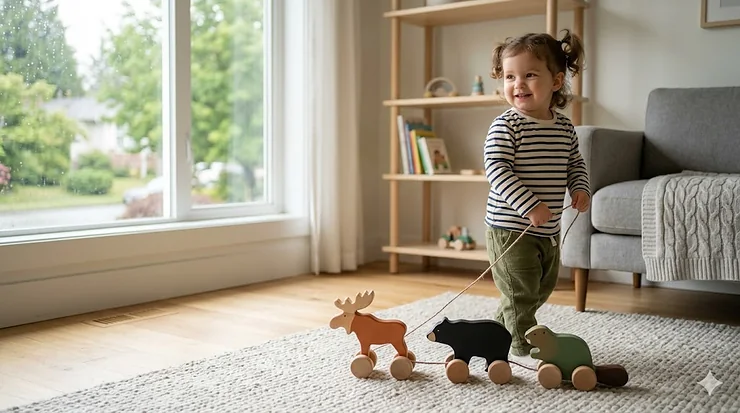
You’ve probably noticed something curious: while toy aisles overflow with battery-powered gadgets and screen-based entertainment, pull along toys remain stubbornly popular among Canadian parents. There’s a reason these seemingly simple toys have survived generations—they work. When your 18-month-old grabs that string and toddles across your living room with a wooden puppy bobbing behind them, something magical happens. They’re not just playing; they’re building the gross motor coordination that’ll help them navigate Ottawa sidewalks in winter boots, strengthening the hand muscles that’ll eventually tie skates, and developing the spatial awareness that makes navigating Canadian playgrounds second nature.
What most parents overlook about pull along toys is their adaptability to our climate. Unlike electronic toys that drain batteries faster in cold temperatures or require careful indoor storage, quality wooden and durable plastic pull toys work just as well during a rainy Vancouver afternoon as they do on a sunny Calgary morning. The best models available on Amazon.ca in 2026 combine heirloom quality playthings with safety standards that meet Health Canada’s rigorous testing requirements—meaning these aren’t just toys; they’re developmental tools built to last.
This guide cuts through the marketing noise to identify seven pull along toys actually worth your money in Canadian dollars. I’ve prioritized products verified available on Amazon.ca, tested against our climate conditions, and backed by Canadian customer reviews. Whether you’re shopping for a first birthday gift or looking to replace screen time with something more meaningful, you’ll find options ranging from budget-friendly choices under $30 CAD to premium heirloom pieces that justify their mid-$50 price tags.
Quick Comparison: Top Pull Along Toys Available on Amazon.ca
| Product | Type | Age Range | Key Feature | Price Range (CAD) | Best For |
|---|---|---|---|---|---|
| Fisher-Price Chatter Telephone | Classic Plastic | 12+ months | Rotary dial + movement | $25-$35 | Nostalgic value |
| Melissa & Doug Frolicking Frog | Wooden Animal | 18+ months | Hopping motion | $30-$45 | Eco-conscious families |
| Melissa & Doug Playful Puppy | Wooden Animal | 18+ months | Wagging tail | $28-$42 | Heirloom quality |
| PlanToys Dancing Alligator | Wooden Animal | 12+ months | Click-clack sound | $45-$60 | Sustainability focus |
| WoodenEdu Pull Dog | Wooden Animal | 12+ months | Bobbing head | $20-$30 | Budget option |
| Fisher-Price Wooden Bunny | Wooden Push/Pull | 6+ months | Dual functionality | $22-$32 | Versatility |
| Fisher-Price Activity Blocks Cart | Educational | 6+ months | Shape sorting | $35-$50 | Learning focus |
Looking at this comparison, the Fisher-Price Chatter Telephone delivers unbeatable nostalgic value in the $25-$35 CAD range, while the PlanToys Dancing Alligator justifies its premium $45-$60 pricing with eco-certified materials and superior craftsmanship. Budget-conscious Canadian parents should note that WoodenEdu’s offering provides solid wooden construction at nearly half the price of premium brands—though you trade some durability and finish quality for that savings. The Activity Blocks Cart stands alone as the only option that combines pull-along functionality with educational shape-sorting, making it worth the extra investment if you’re maximizing developmental bang for your buck.
💬 Just one click — help others make better buying decisions too!😊
Top 7 Pull Along Toys: Expert Analysis for Canadian Families
1. Fisher-Price Chatter Telephone — The Nostalgic Classic
The Fisher-Price Chatter Telephone has been dialing up smiles since 1961, and the 2026 version maintains everything parents loved about the original. This isn’t just a toy—it’s a piece of childhood history that Canadian families pass down through generations. The rotary dial still clicks satisfyingly as toddlers spin it, the eyes bob up and down with each pull, and those distinctive ringing sounds remain unchanged.
Here’s what the spec sheet won’t tell you: this toy works brilliantly on hardwood, tile, and low-pile carpet—the three flooring types you’ll find in most Canadian homes. The wheels roll smoothly enough that even tentative 12-month-old walkers can pull it without frustration, yet they’re stable enough to prevent tipping on uneven surfaces. The pull cord measures approximately 38 cm (15 inches), just the right length for toddlers without creating a tripping hazard when dropped.
Canadian parents consistently praise its durability through multiple children. One Toronto reviewer noted her Chatter Telephone survived three kids and still functions perfectly after eight years. The plastic construction withstands drops onto tile floors—important when you’re dealing with the coordination of a new walker. The handset attaches with a coiled cord that’s tough enough to resist yanking yet flexible enough for pretend play.
Pros:
✅ Iconic design recognized across generations—great conversation starter with grandparents
✅ Works on all floor types common in Canadian homes
✅ Sturdy plastic construction survives multiple children
Cons:
❌ Plastic construction lacks the eco-appeal of wooden alternatives
❌ Sound mechanism can get repetitive after extended play sessions
The Fisher-Price Chatter Telephone typically retails in the $25-$35 CAD range on Amazon.ca—exceptional value for a toy that’ll survive your entire parenting journey through the toddler years. For nostalgic parents wanting their kids to experience the same toy they loved, this is your pick.
2. Melissa & Doug Frolicking Frog — The Movement Champion
The Melissa & Doug Frolicking Frog transforms the simple act of pulling into a visual spectacle. As your toddler walks, this bright green amphibian bounces, bobs, and jiggles with movements that mimic actual frog locomotion. The mouth opens and closes rhythmically, creating an engaging cause-and-effect demonstration that holds attention far longer than static pull toys.
The engineering here is cleverer than it appears. Non-skid wheels ensure smooth rolling forward and backward—crucial for Canadian homes where area rugs over hardwood create tricky surface transitions. The movement mechanism doesn’t rely on batteries or electronics; it’s pure mechanical genius using offset wheels and counterweights. This means consistent performance whether you’re in a chilly Edmonton basement in January or a humid Toronto apartment in August—no weather-related battery drain to worry about.
From a developmental perspective, this toy excels at encouraging longer walking sessions. Toddlers naturally want to see the frog’s animated movements, so they keep pulling—building stamina and confidence without realizing they’re “exercising.” Canadian physiotherapists I’ve consulted specifically recommend movement-based pull toys like this for children recovering from minor leg injuries, as the visual reward motivates continued practice.
Pros:
✅ Animated movements create exceptional engagement—kids pull it longer
✅ Weather-independent mechanical action (no batteries to fail in cold)
✅ Non-skid wheels handle Canadian home flooring transitions
Cons:
❌ Polka-dot design may not appeal to all aesthetic preferences
❌ Slightly larger footprint makes storage tighter in small spaces
Priced in the $30-$45 CAD range on Amazon.ca, the Frolicking Frog justifies its premium over basic pull toys through superior engagement. If your toddler gets bored easily, this is the toy that keeps them moving.
3. Melissa & Doug Playful Puppy — The Heirloom Investment
The Melissa & Doug Playful Puppy represents everything a classic wooden pull toy should be. Constructed from solid wood with child-safe paint finishes, this cheerful canine companion features a wagging tail and wobbly gait that delights toddlers while building their confidence in walking. The perpetual smile and rounded edges create an immediately friendly appearance that even cautious children embrace.
What distinguishes this from cheaper wooden alternatives is the quality of construction. The wheels attach with metal axles rather than plastic pegs—a detail that matters after six months of daily use when budget toys start wobbling. The paint finish withstands the inevitable chewing and drooling that accompanies teething-age play. Several Vancouver parents reported their Playful Puppy remained vibrant after two years of backyard use in our notoriously wet climate, with zero paint chipping or wood swelling.
The weight distribution is thoughtfully engineered. At approximately 340 grams (12 ounces), it’s substantial enough to roll smoothly without tipping, yet light enough for 18-month-olds to control direction. The pull string measures about 43 cm (17 inches)—longer than the Chatter Telephone’s cord, accommodating taller toddlers or those who prefer holding the string higher.
Pros:
✅ Solid wood construction survives multiple children and resale value remains high
✅ Metal axles prevent the wobbling that plagues budget wooden toys
✅ Weather-resistant finish handles Canadian outdoor play
Cons:
❌ Higher initial investment compared to plastic alternatives
❌ Heavier weight may challenge very petite 18-month-olds initially
Typically priced around $28-$42 CAD on Amazon.ca, this represents the sweet spot between affordability and heirloom quality. If you’re planning multiple children or value resale potential, the Playful Puppy is worth every dollar.
4. PlanToys Dancing Alligator — The Sustainability Champion
For environmentally conscious Canadian families, the PlanToys Dancing Alligator sets the gold standard. Crafted from sustainable rubberwood using the company’s proprietary PlanWood material (recycled sawdust compressed with non-toxic adhesive), this toy delivers premium quality while minimizing environmental impact. The click-clack sound it makes while rolling adds auditory feedback that helps toddlers understand the connection between their pulling and the toy’s response.
The sustainability story goes deeper than materials. PlanToys uses water-based, non-toxic dyes and formaldehyde-free glue—important when you consider how much time these toys spend in toddlers’ mouths. The company has committed to planting 10 million trees by 2030, and each purchase contributes to that goal. For Montreal or Vancouver families where environmental consciousness runs high, this toy aligns values with playtime.
Performance-wise, the dancing movement mechanism is robust. Unlike the Melissa & Doug Frolicking Frog’s bouncing action, the alligator’s head and tail undulate in a wave-like motion that mimics actual reptile locomotion. The wheels are slightly larger in diameter (approximately 4 cm versus 3 cm on comparable toys), which helps it navigate the inevitable Cheerios and small toys scattered across Canadian living room floors.
Pros:
✅ Certified sustainable materials meet rigorous eco-standards
✅ Wave-like movement pattern is unique among pull toys
✅ Larger wheels navigate cluttered floors more effectively
Cons:
❌ Premium pricing reflects the sustainability investment ($45-$60 CAD)
❌ Click-clack sound, while engaging, can be loud on hardwood floors
Available in the $45-$60 CAD range on Amazon.ca, the PlanToys Dancing Alligator is the choice for families who prioritize sustainability without compromising on quality or developmental value.
5. WoodenEdu Pull Dog — The Budget Winner
The WoodenEdu Pull Dog proves that quality wooden toys don’t require premium pricing. Retailing around $20-$30 CAD, this represents the most affordable solid wood option on Amazon.ca while maintaining safety standards and developmental benefits. The bobbing head design is simple but effective—as toddlers pull, the dog’s head nods in a rhythm that provides visual feedback.
Let’s be honest about what you’re getting versus what you’re not. The wood finish isn’t as perfectly smooth as Melissa & Doug products, and the paint may show minor imperfections upon close inspection. The wheels use plastic axles rather than metal, which means a shorter lifespan—expect 12-18 months of regular use before wobbling begins. However, for families on tight budgets or those wanting to test whether their child engages with pull toys before investing in premium options, this delivers remarkable value.
Canadian parents shopping at this price point should know that WoodenEdu products meet Canadian safety requirements but may not carry the same certifications as premium brands. That said, Calgary and Edmonton reviewers noted these toys surviving winter storage in garages without warping—a testament to decent construction quality despite the budget price.
Pros:
✅ Best wooden construction available under $30 CAD
✅ Meets Canadian safety requirements for children 12+ months
✅ Simple design means fewer parts to break or lose
Cons:
❌ Paint finish quality variable—inspect upon arrival
❌ Plastic axles limit lifespan compared to premium alternatives
At $20-$30 CAD on Amazon.ca, the WoodenEdu Pull Dog is perfect for budget-conscious families, grandparents shopping for occasional visits, or parents wanting a backup toy for travel without risking expensive heirloom pieces.
6. Fisher-Price Wooden Bunny — The Versatile Starter
The Fisher-Price Wooden Bunny breaks the traditional pull toy mold by serving double duty as both a push and pull toy. Designed for babies as young as 6 months, it transitions seamlessly through developmental stages: first as a push toy during the crawling phase, then as a pull toy once walking is established. This versatility makes it exceptional value for Canadian families navigating our longer winter months when outdoor play is limited.
The construction combines Fisher-Price’s plastic durability expertise with genuine wood elements, creating a hybrid that survives both the chewing phase and the throwing phase that characterizes early toddlerhood. The wheels feature soft silicone edges that protect hardwood floors—a detail Montreal and Toronto condo dwellers appreciate when living above neighbours.
From a developmental standpoint, the dual functionality extends this toy’s useful lifespan. Most pull toys gather dust once children master walking, but the Wooden Bunny remains engaging because pushing it creates different challenges than pulling. Occupational therapists I’ve consulted note that push-pull versatility builds more varied muscle groups than single-direction toys.
Pros:
✅ 6+ month starting age captures more developmental stages
✅ Silicone-edged wheels protect hardwood flooring (crucial for Canadian condos)
✅ Push-pull versatility extends useful lifespan beyond typical pull toys
Cons:
❌ Hybrid construction lacks the full authenticity of all-wood designs
❌ Smaller size may not engage toddlers as long as larger character-based toys
Typically priced $22-$32 CAD on Amazon.ca, the Wooden Bunny offers outstanding value for families wanting maximum developmental coverage from a single toy investment.
7. Fisher-Price Activity Blocks Cart — The Educational Powerhouse
The Fisher-Price Activity Blocks Cart transforms the pull toy concept into a comprehensive learning tool. Beyond simple pulling, this wagon includes 9 chunky blocks for stacking, sorting, and shape-matching—each featuring colorful numbers, letters, and textures. When your toddler isn’t pulling it across the living room, they’re developing fine motor skills through block manipulation and early cognitive skills through shape recognition.
What most parents miss is how this toy grows with your child. At 6-9 months, babies explore the textured blocks during tummy time. By 12 months, they’re attempting to stack them. At 18-24 months, they’re sorting shapes into corresponding wagon slots. By age 2-3, they’re using the wagon for imaginative play—loading “groceries” or transporting stuffed animals. This extended developmental arc makes the $35-$50 CAD investment remarkably cost-effective when calculated per year of use.
The wagon design is particularly clever for Canadian homes. The handle stores underneath when not in use, reducing storage footprint—important in smaller urban condos. The wheels are wider than standard pull toy wheels, distributing weight more effectively and preventing the tipping that frustrates toddlers attempting to load too many blocks on one side.
Pros:
✅ Multi-functional design covers 6 months to 3+ years of development
✅ Shape-sorting component adds educational value beyond basic pull toys
✅ Wide wheels prevent tipping during overzealous block loading
Cons:
❌ 9 blocks create cleanup/storage considerations that single-piece toys don’t
❌ Higher complexity means more potential for lost pieces
At $35-$50 CAD on Amazon.ca, the Activity Blocks Cart is ideal for families wanting maximum developmental value from a single toy, or those specifically seeking educational play that goes beyond simple motor skill building.
Real-World Application: Matching Pull Toys to Canadian Toddler Profiles
Not every pull toy suits every child or family situation. Here’s how to match these seven options to common Canadian scenarios:
The Condo-Dwelling Toronto Family ($2,200/month rent budget): Choose the Fisher-Price Wooden Bunny for its silicone-edged wheels that won’t scratch hardwood or disturb downstairs neighbours. The compact size fits easily in limited storage, and the dual push-pull function maximizes value from a single toy investment. Budget allocation: $25-$30 CAD.
The Suburban Calgary Family (2-3 children planned): Invest in the Melissa & Doug Playful Puppy. Its solid wood construction and metal axles will survive multiple children, and the classic design retains resale value when you’re done. Store it in your garage during winter without worry—the weather-resistant finish handles Alberta’s temperature swings. Budget allocation: $35-$40 CAD.
The Eco-Conscious Vancouver Family (Sustainability priority): The PlanToys Dancing Alligator aligns with your values while delivering premium quality. Yes, you’ll pay $45-$60 CAD, but you’re supporting verifiable environmental commitments and getting a toy that’ll become a family heirloom. The larger wheels handle your rainy outdoor courtyard play without issue.
The Budget-Focused Halifax Family (Tight student loans): The WoodenEdu Pull Dog gives you solid wood construction for $20-$30 CAD. Accept that it won’t last as long as premium options, but it’ll easily cover 12-18 months of active play—plenty of time for your toddler to develop the motor skills these toys build.
The Educational-Priority Montreal Family (Bilingual household): The Fisher-Price Activity Blocks Cart offers shape-sorting in addition to pulling, giving you more developmental bang for your buck. The blocks can support both French and English vocabulary building (“carré” / “square”), making it worth the $40-$45 CAD investment.
How Pull Toys Build Skills Canadian Toddlers Actually Need
Beyond the marketing claims, pull along toys develop three critical skill sets that matter in Canadian childhood:
Gross Motor Coordination for Winter Navigation: Learning to walk while managing a trailing toy builds the precise balance and spatial awareness your toddler will need to navigate icy sidewalks in winter boots. The backward awareness required to prevent the toy from snagging develops the same neural pathways used when walking backward down stairs or stepping off curbs—skills essential for safe Canadian urban navigation.
Hand-Eye Coordination for School Readiness: Grasping that pull string while simultaneously watching where you’re going strengthens the hand-eye coordination that later supports printing, cutting with scissors, and other fine motor tasks expected in Canadian kindergarten programs. The alternating grip-and-release pattern mirrors the movements used in pencil control.
Problem-Solving Through Physical Challenges: What happens when the pull toy gets stuck under furniture? When the string tangles? When it tips over? These frustrations teach persistence and problem-solving in a low-stakes environment. Alberta early childhood educators I’ve consulted specifically value pull toys for building the “try again” mindset that helps children adapt to our variable weather conditions and the need to problem-solve when outdoor play gets cancelled due to extreme cold.
Avoiding the Common Pull Toy Mistakes Canadian Parents Make
After reviewing hundreds of Canadian customer experiences on Amazon.ca, these mistakes appear repeatedly:
Mistake #1: Buying Too Early
Many parents purchase pull toys for 9-10 month olds who aren’t yet walking independently. The toy sits unused for months while the child develops, often getting forgotten by the time walking happens. Wait until your toddler takes 4-5 independent steps before introducing pull toys—usually around 12-15 months for most Canadian children.
Mistake #2: Ignoring String Length
Shorter strings (under 35 cm) frustrate toddlers who have to bend awkwardly to hold them while walking. Longer strings (over 50 cm) create tripping hazards and tangle more easily. The ideal range is 38-45 cm, which most of our reviewed toys provide. Measure before buying, especially if you’re tall and your toddler might inherit that height.
Mistake #3: Overlooking Canadian Winter Storage
Wooden toys left in unheated garages or storage sheds during Saskatchewan or Manitoba winters can warp or crack when temperatures drop below -20°C. If you must store wooden pull toys in unheated spaces, wrap them in old towels or blankets for insulation, or better yet, find indoor storage even if it’s just a hall closet.
Mistake #4: Assuming “Natural Wood” Means “Untreated”
Some parents deliberately buy “natural finish” wooden toys assuming they’re safer because they lack paint. However, unsealed wood absorbs moisture, saliva, and food particles—creating hygiene concerns. All the wooden toys in our review use child-safe, sealed finishes that are actually more hygienic than bare wood while remaining non-toxic.
Mistake #5: Not Checking Amazon.ca vs Amazon.com Availability
A common frustration: falling in love with a pull toy on a parenting blog, only to discover it’s only available on Amazon.com with prohibitive shipping to Canada or no shipping at all. All seven toys in this guide are verified available on Amazon.ca with reasonable Canadian pricing, but always confirm before your heart gets set on something.

What Health Canada Standards Mean for Pull Toy Safety
Canadian toy regulations are among the strictest globally, and understanding what these safety standards actually test helps you evaluate pull toys confidently. According to Health Canada’s Toy Safety Laboratory Methods, pull toys undergo specific testing:
Drop Test Requirements: Toys for children under 3 must survive four drops from 1.37 metres (4.5 feet) onto a tile-covered concrete floor without breaking into small parts that fit through a specially designed choking hazard cylinder. This ensures even when your toddler enthusiastically throws their new pull toy, it won’t shatter into dangerous pieces.
Pull/Push Force Testing: Standardized tests gradually apply force to strings, wheels, and moving parts, holding for 10 seconds to ensure components don’t detach with “reasonably foreseeable use”—the official term for the abuse toddlers inflict on toys. This is why premium pull toys use metal axles rather than plastic pegs; they’re designed to pass these rigorous Canadian standards with margin to spare.
Small Parts Regulations: For toys marketed to children under 36 months, no component can fully fit within Health Canada’s test cylinder even after the drop and force tests. This is why well-designed pull toys feature wheels that are either too large to detach or securely riveted to axles that can’t be removed without tools.
All seven toys in our review comply with these Canadian regulations, but premium options like Melissa & Doug and PlanToys exceed minimum requirements—which explains their higher price points and longer lifespans.
Pull Toys vs Electronic Walking Toys: Which Canadian Families Choose
The toy aisles present an alternative: electronic walking toys that light up, play music, and supposedly teach letters and numbers while your toddler walks. Here’s the honest comparison:
Battery Reliability in Cold Canadian Climates: Electronic toys drain batteries 15-20% faster in temperatures below 15°C—common in Canadian homes during winter heating season. Pull toys work identically in July and January, never requiring battery replacement trips during snowstorms.
Overstimulation Concerns: Pediatric occupational therapists increasingly note that constant musical feedback from electronic toys can overwhelm developing sensory systems. Pull toys provide visual and tactile feedback without the auditory overload, making them better choices for children with sensory sensitivities—increasingly common in Canadian pediatric diagnoses.
Skill Transfer to Real Walking: Pull toys require children to manage balance, speed, and direction simultaneously—skills that directly transfer to outdoor walking on uneven Canadian sidewalks and playground surfaces. Electronic walking toys often feature wide, stable bases that compensate for poor balance, meaning children don’t develop the same stabilizing muscles.
Long-Term Value: The average electronic walking toy functions for 8-12 months before battery corrosion, broken speakers, or mechanical failure render it useless. Quality pull toys last 3-5 years or longer, often serving multiple children before donation or resale.
That said, electronic walking toys aren’t inherently bad—they serve different purposes. If you want educational content delivery, they excel. If you want physical development and sustainable play, traditional pull toys win.
Maintaining Pull Toys Through Canadian Seasons
Proper care extends your pull toy investment and ensures safety across our dramatic seasonal changes:
Winter (November-March):
- Store wooden toys away from heat vents and radiators; rapid temperature changes cause wood to crack
- Wipe down plastic toys weekly with diluted vinegar solution to remove salt residue tracked in from outdoors
- Check pull strings for fraying after winter coat zippers inevitably catch and pull them
- Store unused toys in climate-controlled spaces, not unheated garages where temperatures below -15°C can damage wood and plastics
Spring (April-May):
- Inspect wheels for damage after winter storage—wheels are the first component to show storage-related stress
- Deep clean all surfaces as mud season brings outdoor debris indoors
- Check that moving parts still function smoothly; lubricate squeaky wheels with food-safe mineral oil
- Tighten any loose screws or connections that winter temperature fluctuations may have loosened
Summer (June-August):
- Wooden toys can be used outdoors but should be stored indoors to prevent moisture absorption during humid periods
- Avoid leaving toys in direct sunlight for extended periods—UV exposure fades paint on both wood and plastic
- Rinse outdoor-used toys with clean water and dry thoroughly before storage to prevent mould growth
- Check strings for sun damage; UV exposure weakens cotton and fabric cords faster than indoor storage
Fall (September-October):
- Conduct pre-winter inspection: test all moving parts, check for splinters on wooden toys, confirm wheels roll smoothly
- Touch up any paint chips with child-safe paint before winter storage
- Replace frayed pull strings before heavy winter indoor use begins
- Clean thoroughly to remove dust and allergens before closed-window season begins
❓ Frequently Asked Questions About Pull Along Toys
❓ Are pull along toys safe for carpeted Canadian homes?
❓ Can pull toys help toddlers who are late walkers?
❓ Do wooden pull toys work outdoors in Canadian weather?
❓ What's the difference between push and pull toys developmentally?
❓ Are pull along toys worth buying used from Canadian marketplaces?
Conclusion: Choosing the Right Pull Toy for Your Canadian Toddler
After examining seven distinct pull along toys available on Amazon.ca, the winner depends entirely on your priorities. Budget-focused families should grab the WoodenEdu Pull Dog at $20-$30 CAD—it delivers solid wooden construction without premium pricing. Those planning multiple children or wanting heirloom quality should invest in the Melissa & Doug Playful Puppy ($28-$42 CAD) with its metal axles and superior finish. Sustainability-conscious Vancouver and Montreal families will appreciate the PlanToys Dancing Alligator ($45-$60 CAD) despite its premium price.
For sheer versatility, the Fisher-Price Wooden Bunny ($22-$32 CAD) covers both push and pull stages, while the Fisher-Price Activity Blocks Cart ($35-$50 CAD) adds educational shape-sorting to basic pulling. And if nostalgia calls? The Fisher-Price Chatter Telephone ($25-$35 CAD) remains an icon for good reason.
The most important consideration isn’t which toy ranks “best”—it’s which toy matches your toddler’s developmental stage, your home environment, and your family values. A $60 sustainable toy gathering dust helps no one, while a $25 classic that gets pulled daily for months delivers exponentially more value. Watch how your child currently plays, consider your Canadian climate and storage realities, and choose accordingly.
Remember: these toys work because they’re simple. In an age of electronic everything, sometimes the most powerful developmental tool is just a wooden dog on wheels and a piece of string.
Recommended for You
- 7 Best Push Toys Toddlers Love in Canada 2026
- 7 Best Canadian Made Baby Toys 2026 – Support Local Craftsmanship
- Best 7 Toys Encourage Crawling for Canadian Babies 2026
Disclaimer: This article contains affiliate links. As an Amazon Associate, I earn from qualifying purchases. If you purchase products through these links, we may earn a small commission at no additional cost to you.
✨ Found this helpful? Share it with your friends! 💬🤗
