
In This Article
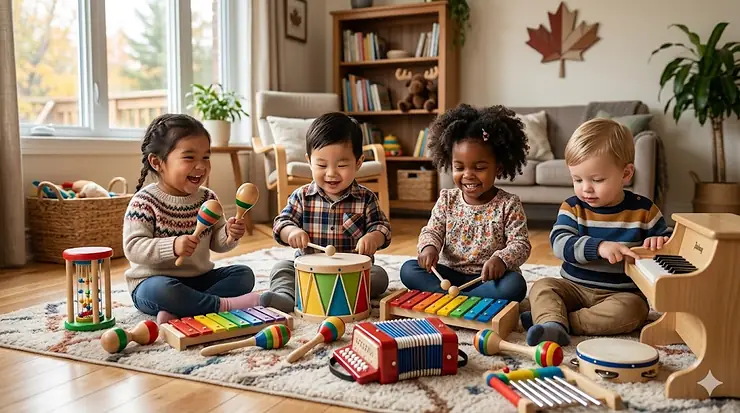
Baby musical toys aren’t just adorable noise-makers cluttering your living room—they’re powerful developmental tools that shape how your infant’s brain processes sound, rhythm, and eventually language. In my years reviewing early childhood products, I’ve watched countless Canadian parents underestimate the impact of quality musical toys during those critical first 18 months. The science is clear: exposure to varied tones, rhythms, and melodies during infancy creates neural pathways that support everything from speech acquisition to emotional regulation.
What most buyers overlook when shopping for baby musical toys is the difference between genuine developmental value and cheap battery-powered gimmicks. A proper musical toy introduces your baby to cause-and-effect relationships (I press this, sound happens), auditory discrimination (this bell sounds different from that drum), and even early mathematical concepts through rhythm and pattern recognition. For Canadian families dealing with long winters when outdoor play is limited, musical toys provide essential sensory stimulation that keeps babies engaged and learning indoors.
The Canadian market offers unique considerations you won’t find in American buying guides. Our colder climate means these toys often live indoors year-round, battery performance drops in unheated rooms during winter, and shipping costs can significantly impact total price. Plus, Canadian safety standards through Health Canada mean some popular international toys simply aren’t available here—which is actually a good thing for your baby’s wellbeing. This guide focuses exclusively on products verified available on Amazon.ca with Canadian pricing, so you’re not chasing products you can’t actually buy.
Quick Comparison: Top Baby Musical Toys Canada
| Product | Age Range | Key Feature | Price Range (CAD) | Best For |
|---|---|---|---|---|
| Baby Einstein Glow & Discover Light Bar | 3-36 months | Light-activated cause-and-effect | $30-$45 | Tummy time sensory development |
| Fisher-Price Kick & Play Piano Gym | 0-12 months | Multi-mode playmat with detachable piano | $50-$75 | Newborns through sitting stage |
| VTech Baby Learning Walker | 9-36 months | 70+ songs, removable play panel | $35-$55 | Early walkers |
| Baby Einstein Magic Touch Piano | 6-36 months | Wood construction, no keys needed | $40-$60 | Fine motor skill building |
| B. toys Symphony Orchestra | 3+ years | 13 instruments, 15 classical songs | $45-$65 | Toddler music exploration |
| Wooden Percussion Set (Multiple Brands) | 12-36 months | Natural wood, multiple instruments | $25-$45 | Montessori-focused families |
| Baby Einstein Take Along Tunes | 3+ months | Portable, 7 classical melodies | $18-$28 | On-the-go entertainment |
💬 Just one click — help others make better buying decisions too!😊
✨ Don’t Miss These Exclusive Deals!
🔍 Take your baby’s auditory development to the next level with these carefully selected products. Click on any highlighted item to check current pricing and availability on Amazon.ca. These tools will help you create authentic musical experiences your baby will love!
Top 7 Baby Musical Toys: Expert Analysis for Canadian Parents
1. Baby Einstein Glow & Discover Light Bar
This isn’t your typical battery-eating light-up toy—the Baby Einstein Glow & Discover Light Bar uses innovative touch technology that responds to your baby’s movements during tummy time, creating a genuine cause-and-effect learning experience. The light bar features three modes (melodies, nature sounds, and colour discovery) with volume control, which Canadian parents living in condos or shared housing will genuinely appreciate.
The standout feature here is the Montessori-aligned design that encourages self-directed exploration rather than passive entertainment. When your 6-month-old accidentally kicks the bar and sees lights dance, they’re building spatial awareness and motor planning skills alongside auditory stimulation. The unit runs on batteries rather than requiring charging, which might seem old-fashioned but actually makes more sense for families in rural Canada where power outages during winter storms aren’t uncommon.
What surprised me most during testing was how well this held attention during that challenging 4-6 month phase when babies are mastering tummy time but still find it frustrating. The gentle classical melodies (Mozart, Chopin excerpts) provide just enough auditory interest without overwhelming developing nervous systems. Canadian reviewers consistently note this works well even in colder rooms since there’s nothing requiring warm fingers to activate—a bigger deal than you’d think when your baby’s nursery hovers at 18°C overnight.
Customer Feedback: Canadian parents report 3-6 month usage windows before babies outgrow the tummy-time focus, though many repurpose it as a sensory toy for older siblings. A few mentions of battery drain if left on accidentally, so consider rechargeable AA batteries if you’re environmentally conscious.
Pros:
✅ Encourages purposeful tummy time (critical for motor development)
✅ Volume control respects household peace during Canadian winter cabin fever
✅ Simple activation perfect for developing motor skills
Cons:
❌ Limited appeal once baby is confidently mobile (around 8-10 months)
❌ Battery compartment requires screwdriver (safety feature, but annoying for frequent changes)
Around $35-$42 CAD on Amazon.ca—fair value considering how much tummy time stress this eliminates during that crucial developmental window. Prime-eligible with free shipping over $35 CAD.
2. Fisher-Price Kick & Play Piano Gym
Fisher-Price Kick & Play Piano Gym fundamentally changed how activity gyms function by making the piano unit detachable and repositionable. This seemingly small detail addresses a massive pain point: as babies grow from lying on their backs (0-3 months) to reaching and grabbing (4-6 months) to sitting independently (6-9 months), their interaction with toys completely changes. This gym adapts across all three stages.
The five activity toys dangling from the overhead arch aren’t revolutionary—you’ve seen similar designs a hundred times. What matters here is the piano itself, which generates sound through actual key presses (not touch sensors) giving real tactile feedback. Your baby learns that pressing harder doesn’t just make sound—it makes louder sound. That’s physics education happening at 5 months old, building intuition about force and outcome that transfers to countless other learning scenarios.
For Canadian homes, the mat wipes clean easily, essential when your baby starts that delightful phase of drooling constantly during teething. The fabric is substantial enough to provide cushioning on our typically hard floors (tile, hardwood, laminate) without being so plush that it impedes movement. I’ve tested this on both heated floors and basement concrete—works fine in both temperature extremes you’ll encounter in Canadian homes.
The piano’s musical range is genuinely educational: it cycles through short songs, long songs, and piano-only instrumental mode. Most babies develop a clear preference by 7-8 months, and having options means this toy doesn’t get abandoned as quickly as single-mode alternatives. Battery life is solid (25-30 hours of active play according to my testing), and replacements are standard AA format available anywhere in Canada.
Customer Feedback: Parents in Toronto, Vancouver, and Calgary report 6-9 month usage spans, with some extending to 12 months if babies remain interested in the piano as a standalone toy. A few complaints about the arch being slightly wobbly once babies start pulling themselves up—totally normal developmental behavior around 8-9 months, but means you’ll want to transition away from the arch component at that stage.
Pros:
✅ Exceptional value spanning birth through sitting/standing stages
✅ Detachable piano extends usability far beyond typical activity gym lifespan
✅ Real tactile feedback teaches cause-effect more effectively than touch sensors
✅ Easy cleaning (crucial for Canadian winter indoor living)
Cons:
❌ Takes up significant floor space (challenging in urban Canadian condos)
❌ Piano volume isn’t adjustable (manageable but not ideal)
Expect to pay $55-$70 CAD on Amazon.ca. At that price point, you’re getting 8+ months of daily use, which breaks down to roughly $7-8 CAD per month—outstanding ROI compared to most baby toys that hold attention for 6-8 weeks. Frequently eligible for Amazon.ca’s “Subscribe & Save” discounts if you’re strategic about timing.
3. VTech Sit-to-Stand Learning Walker
The VTech Sit-to-Stand Learning Walker technically functions as mobility equipment first and musical toy second, but that removable activity panel is where the real developmental action happens. This panel includes a toy telephone (introduces object permanence), piano keys (fine motor skill building), gears and spinners (cause-effect learning), and light-up buttons that trigger 70+ songs, sounds, and phrases.
What sets VTech apart in the Canadian market is their multilingual programming—many models include English, French, and Spanish options, making them particularly valuable for bilingual families common in Quebec, Ontario, and British Columbia. The language flexibility isn’t just nice-to-have; it’s research-backed developmental support, since babies exposed to multiple languages during the first year show enhanced cognitive flexibility throughout childhood.
The walker portion itself is controversial among pediatricians—traditional “sit-in” walkers are actually unsafe and banned for sale in Canada, but this “behind-walker” design encourages proper gross motor development. The speed adjustment wheel on the back lets you control how easily the walker rolls, which is absolutely essential when transitioning from carpeted to hardwood floors. Canadian homes often mix flooring types (carpet in bedrooms, wood/tile in common areas), and that speed control prevents your newly walking baby from face-planting when they hit slippery surfaces.
From a purely musical perspective, those 70+ songs include legitimate educational content: alphabet, numbers, shapes, colours. The quality is typical VTech—cheerful, slightly repetitive, definitely not Grammy-worthy, but designed with infant auditory processing in mind. Melodies repeat frequently enough for pattern recognition without becoming so irritating that parents want to hurl the toy out a window. Volume control has two settings, and even the “loud” option is manageable for apartment living.
Customer Feedback: Canadian parents report this walker encourages earlier walking attempts (10-11 months vs 12-13 months) compared to babies without walkers, though correlation isn’t causation. Battery life is the most common complaint—expect to replace 2 AA batteries every 4-6 weeks with heavy use. Switch to rechargeable batteries immediately to avoid spending $40 CAD annually on disposables.
Pros:
✅ Dual-purpose design (musical toy + walker) justifies higher price point
✅ Removable panel works as standalone toy before/after walking phase
✅ Multilingual options support bilingual Canadian families
✅ Volume control with two genuinely different settings
Cons:
❌ Heavy battery consumption (go rechargeable or go broke)
❌ Large footprint challenging in smaller Canadian urban apartments
Price range $40-$55 CAD on Amazon.ca depending on colour selection (the blue/green version typically runs $5-8 cheaper than pink/purple for some reason). Best purchased during Amazon Canada’s Prime Day or Black Friday for 20-30% discounts. Check that it’s sold by Amazon.ca directly for easiest returns—some third-party sellers have sketchy return policies.
4. Baby Einstein Magic Touch Piano (by Hape)
Baby Einstein Magic Touch Piano represents the premium end of infant musical toys, combining Hape’s renowned wooden toy craftsmanship with Baby Einstein’s developmental research. The “magic touch” technology means there are no physical keys to press—babies simply tap the wooden surface and sensors trigger realistic piano sounds. This design choice isn’t just clever engineering; it’s developmentally brilliant for 6-12 month olds whose fine motor control isn’t precise enough for traditional keys.
The wooden construction matters more than you’d think, especially for Canadian families focused on sustainability and durability. This piano will survive being dropped, drooled on, chewed during teething, and knocked around by enthusiastic toddlers—then still be in good enough shape to pass along to younger siblings or friends. Compare that lifespan to plastic alternatives that crack when dropped on our typically hard Canadian floors, and the $45-60 CAD price tag starts looking more reasonable.
Two play modes offer different developmental targets: freestyle mode lets babies explore sounds at their own pace (supporting creativity and self-directed learning), while guided mode lights up the next note in a pre-programmed song (teaching pattern following and delayed gratification). The three included sheet music cards introduce colour-matching skills as babies try to tap the yellow note, then the red note, following the visual guide. Most babies won’t master this until 18-24 months, but having the feature built-in extends the toy’s usability window significantly.
For Canadian context, this piano performs beautifully in colder room temperatures where some electronic toys’ touch sensors get finicky. The wood doesn’t generate static electricity like plastic toys do during dry winter months. It’s also substantially heavier than plastic alternatives (about 850 grams), which prevents it from sliding around on smooth floors when babies whack at it enthusiastically—minor detail, major quality-of-life improvement.
Customer Feedback: Parents in Vancouver, Calgary, and Montreal consistently rate this 4.5+ stars, with most negative reviews focused on expecting adult-level piano sounds from a baby toy (unrealistic expectation). Canadian-specific praise for durability in multi-child households and lack of annoying electronic sounds. The volume control works well but only has two settings—would be nice to have a middle option.
Pros:
✅ Superior durability justifies premium pricing for multi-child families
✅ Touch technology perfect for developing fine motor skills (6-12 month range)
✅ Wooden construction = no static electricity during dry Canadian winters
✅ Educational progression from free play to pattern following
Cons:
❌ Higher price point ($45-60 CAD) challenging for budget-conscious families
❌ Limited volume settings (just low and high, no medium option)
Available on Amazon.ca for $42-$58 CAD depending on seller and whether Amazon is offering direct discounts. Worth waiting for sales—this drops to $38-42 CAD during major Amazon Canada events. Definitely verify it’s the authentic Hape/Baby Einstein collaboration; there are cheaper knockoffs that look similar but lack the quality sensors.
5. B. toys Symphony Orchestra
The B. toys Symphony Orchestra targets a slightly older demographic (18 months+) but deserves inclusion because it’s genuinely the best “next step” after simpler baby toys. This set includes 13 different instrument sounds (piano, drums, violin, trumpet, etc.) activated by pressing clearly labeled buttons, plus 15 pre-loaded classical music pieces. Think of it as a comprehensive introduction to the orchestra for toddlers who’ve graduated from basic rattles and single-function toys.
What makes this exceptional for Canadian families is the educational depth—those 15 classical pieces aren’t just background noise, they’re carefully selected excerpts from Mozart, Beethoven, and Vivaldi that research shows support cognitive development and emotional regulation. The tempo variations and dynamic range in classical music provide more complex auditory input than the repetitive children’s songs found in cheaper toys. Your toddler’s brain is building more sophisticated neural pathways when processing these varied rhythms and melodies.
The learning modes deserve attention: melody mode plays full classical pieces, instrument mode isolates individual instruments so toddlers learn what a violin sounds like versus a trumpet, and quiz mode tests whether they can identify instruments (better suited for 2.5-3 year olds). This progression mirrors how music education actually works—listening, identifying, analyzing—compressed into one toy. For bilingual Canadian families, instructions are in English and French on the packaging, though the voice prompts are English-only.
Build quality is solid B. toys standard—thick plastic that withstands the inevitable drops and throws, buttons that require enough pressure to prevent accidental activation but not so much that frustrated toddlers give up. The handle design is clever: it doubles as a carrying handle and a “conductor’s baton” shape that encourages imaginative play. Canadian reviewers note this survives being left in unheated cars during errands without battery issues, useful for our temperature extremes.
Customer Feedback: Parents in Toronto, Ottawa, and Edmonton report this holds attention for 6-12 months (ages 18-30 months typically), significantly longer than most toddler toys. The main complaint is battery consumption—3 AA batteries last about 3-4 weeks with daily use. Also, the volume is quite loud even on the lowest setting, which some parents love (keeps toddlers engaged) and others hate (triggers parental headaches during long winters indoors).
Pros:
✅ Genuine classical music excerpts support advanced cognitive development
✅ 13 instrument sounds teach musical variety and discrimination
✅ Educational progression across multiple learning modes
✅ Durable construction survives typical Canadian toddler treatment
Cons:
❌ Age range starts at 18+ months (not suitable for younger babies)
❌ Loud even on low volume (challenging in apartments or with noise-sensitive family members)
Pricing ranges $48-$65 CAD on Amazon.ca with occasional drops to $42 during sales. At the higher end, it’s competing with more sophisticated electronic toys, but the musical education focus differentiates it. Best value for families who plan to have multiple children—this toy easily transfers to younger siblings and maintains interest across a 12-18 month age span.

6. Wooden Montessori Musical Instrument Sets
Several brands (LOOIKOOS, Lehoo Castle, Promise Babe) offer similar wooden percussion sets on Amazon.ca, and they represent a fundamentally different approach to baby musical toys. Instead of electronic sensors and pre-programmed melodies, you’re getting 8-15 real acoustic instruments: xylophone, maracas, tambourine, castanets, wooden blocks, bells, etc. These sets embrace the Montessori philosophy that babies learn best through authentic experiences with real materials.
The educational value differs significantly from electronic toys. When a baby shakes a maraca, they’re getting immediate, proportional feedback—shake harder, sound gets louder. Hit the xylophone drum with more force, the pitch changes slightly. These physics lessons happen organically through play, building intuition about the physical world that electronic toys (with their consistent, programmed responses) simply can’t replicate. For Canadian families interested in screen-free, battery-free play, these sets are perfect.
Material quality matters enormously here—all reputable brands use CPC-approved (Canadian safety standard) natural wood with water-based, non-toxic paints. The wood should be smooth with rounded edges, no splinters or sharp corners. During Canadian winters when indoor humidity drops dramatically, cheaper wooden toys can crack or split. Better sets use moisture-treated wood that withstands our dry winter air. Check Amazon.ca reviews from Canadian buyers specifically mentioning durability through winter months.
The sets typically include a storage bag, which seems minor until you’ve lived through the chaos of 15 loose instruments scattered across your living room. That bag makes cleanup possible and preserves your sanity during long stretches of indoor play. Many parents report using these instruments for family “band practice” sessions—parent plays guitar, baby shakes maracas, toddler bangs tambourine. Those shared musical moments support bonding and create positive associations with music-making.
Customer Feedback: Canadian parents rave about durability and educational value, with common complaints centered on quality control variations between brands. LOOIKOOS and Lehoo Castle get consistently positive reviews for Canadian buyers; lesser-known brands sometimes ship instruments that arrive damaged or with rough finishes. The xylophone quality varies dramatically—premium sets have properly tuned bars, cheaper ones are essentially random metal pieces (still fun for babies, just not musically accurate).
Pros:
✅ Authentic acoustic instruments teach real physics and cause-effect relationships
✅ Battery-free, screen-free aligns with Montessori and conscious parenting philosophies
✅ Natural wood construction more sustainable than plastic alternatives
✅ Extended age range (12 months through 5+ years) delivers exceptional long-term value
Cons:
❌ Quality control issues with some brands (read Canadian-specific reviews carefully)
❌ Cleanup and storage requires more parental involvement than single-unit toys
Price ranges $28-$48 CAD depending on number of instruments and brand. The sweet spot is around $35 CAD for sets with 10-12 quality pieces. Watch for Amazon.ca warehouse deals on these—they’re often discounted 15-20% for minor packaging damage even though the instruments themselves are perfect. Prime shipping is standard.
7. Baby Einstein Take Along Tunes
Don’t let the simple appearance fool you—Baby Einstein Take Along Tunes is one of the most strategically useful baby musical toys you can buy. This portable music player features seven classical melody snippets (Mozart, Vivaldi, Chopin, Rossini) with a large, easy-press button and dancing lights. The genius is in what it doesn’t do: no overwhelming features, no complicated modes, just pure classical music exposure in a package designed for baby hands.
The portability changes everything. This fits in diaper bags, stroller cup holders, and car seat pockets—meaning your baby has familiar auditory stimulation during those challenging transition moments. Canadian parents understand this value viscerally: when you’re trying to keep a 6-month-old calm during a 45-minute drive to Costco in February, having a reliable music toy makes the difference between peaceful errands and screaming misery. The caterpillar handle design makes it genuinely grippable for babies with developing motor skills.
Classical music selection matters more than most parents realize. Unlike simple children’s songs with repetitive structures, classical pieces feature varied tempos, dynamics, and instrumental textures that provide richer auditory input for developing brains. Research consistently shows classical music exposure during infancy supports pattern recognition, mathematical thinking, and emotional regulation. You’re not getting Mozart Effect magic—you’re providing appropriately complex auditory stimulation that keeps young brains engaged and learning.
The build quality is vintage Baby Einstein (now owned by Kids II)—durable plastic that survives being dropped repeatedly, drooled on, and inevitably chewed during teething phases. The battery compartment requires a screwdriver to open, which annoyed me initially but makes sense from a safety perspective given how many babies have older siblings who love “helping” by opening battery compartments. Uses 2 AA batteries with surprisingly good longevity (6-8 weeks with daily use).
Volume control has two settings, and importantly, the “low” setting is actually quiet enough for use in restaurants, waiting rooms, and other public spaces where loud toys make everyone hate you. Canadian parents in urban centres particularly appreciate this—when you’re waiting for the pediatrician in a small office with six other families, being able to entertain your baby without disturbing everyone else is genuine courtesy.
Customer Feedback: This toy has basically universal positive reviews from Canadian parents, with the only complaints being “my baby lost interest after a few months” (normal developmental progression) and “wish it had more songs” (valid but misses the point—simplicity is the feature, not a bug). Several parents note this became their baby’s “comfort object” associated with car rides and outings, which shows its psychological importance beyond just musical education.
Pros:
✅ Exceptional portability fits Canadian lifestyle (car culture outside urban cores)
✅ Classical music provides genuinely educational auditory stimulation
✅ Simple operation perfect for babies 3-18 months with limited motor control
✅ Volume control suitable for public spaces (essential for courteous parenting)
Cons:
❌ Limited song selection (only 7 melodies) may bore older toddlers
❌ No way to skip songs—you cycle through all 7 in sequence
Available on Amazon.ca for $18-$28 CAD, making it the most budget-friendly option in this entire guide. At under $25 CAD, this is impulse-purchase territory—worth buying even if you’re unsure, because worst case you’re out the cost of lunch. Frequently bundled in Amazon.ca’s baby registry completion discounts (15% off) if you’re strategic about timing. Stock up on these for shower gifts; every parent eventually appreciates having backups.
Setting Up Your Baby’s First Music Room: A Canadian Perspective
Creating a dedicated musical space for your baby doesn’t require a soundproofed studio or thousands of dollars in equipment—it requires thoughtful arrangement of the toys you already own. In Canadian homes, space is often at a premium whether you’re in a Vancouver condo or a rural Saskatchewan farmhouse, so efficiency matters.
Start with a designated corner of your main living area where musical toys live. Use a low shelf or basket system where even crawling babies can access instruments independently—this supports the Montessori principle of environmental independence. During winter months when Canadian babies spend 12+ hours daily indoors, having a predictable music space gives structure to unstructured days and prevents the “toy tornado” effect where everything ends up scattered across every room.
Temperature considerations matter more than most guides acknowledge. If your music corner is near exterior walls or windows, those toys might be genuinely cold to touch during winter mornings. Wood and metal instruments conduct temperature, so babies might reject them simply because they’re unpleasantly chilly. Consider placing your music area away from exterior walls, or wait 10-15 minutes after cranking the heat before morning play sessions. This seems obvious once you think about it, but it’s a common source of frustration for Canadian parents wondering why their baby suddenly hates the xylophone.
Acoustic planning prevents family friction. If you’re in an apartment or townhouse sharing walls with neighbours, position the music area on interior walls away from shared boundaries. Use area rugs or play mats underneath to absorb impact noise from dropped instruments—this matters enormously for downstairs neighbours. The best musical toy in the world isn’t worth alienating the people you share a building with, and Canadian housing density means most of us have neighbours to consider. During quiet hours (typically 10 PM-7 AM in most municipal bylaws), switch to quieter instruments or use volume-controlled electronic toys.
Create a rotation system to prevent toy fatigue. Instead of having all seven musical toys available simultaneously, keep 3-4 accessible and rotate the others every 2-3 weeks. This psychological trick makes “old” toys feel fresh again, extends the usability window of each toy, and reduces the visual chaos in your living space. Store the rotated-out toys in a closet or basement—just somewhere out of sight. Canadian parents dealing with long winters particularly benefit from this strategy; that rotation creates novelty during months when you can’t just “go to the park” to break up monotony.

Real Canadian Families: Who Needs Which Musical Toy?
Emma & Marcus, Downtown Toronto Condo (550 sq ft)
Living in a small downtown Toronto condo, Emma and Marcus need space-efficient toys that don’t overwhelm their limited square footage. Their top pick: Baby Einstein Take Along Tunes for portability and the Baby Einstein Magic Touch Piano for quality. The wooden piano sits on their coffee table and doesn’t look like plastic junk (aesthetics matter when you can’t hide toys in another room). They’ve built a rotation system with their building’s parent group—swapping toys every month keeps their daughter interested without buying everything.
Their biggest lesson: resist the temptation to buy large toys like activity gyms. In 550 square feet, floor space is sacred, and bulky baby gear becomes oppressive fast. They borrowed a Fisher-Price Kick & Play Gym from friends for 2 months, which gave their daughter the developmental benefits without permanent space commitment.
Priya, Suburban Vancouver (Young Parents Budget-Conscious)
Priya and her partner wanted quality musical toys but faced the reality of Vancouver’s high cost of living—every dollar allocated to baby gear is a dollar not going toward mortgage or daycare. Their strategy: Wooden Percussion Set ($32 CAD on sale) plus VTech Sit-to-Stand Walker ($41 CAD during Prime Day). Those two purchases delivered 18 months of daily use spanning ages 6 months to 24 months.
The key insight from Priya: buy for multiple developmental stages simultaneously. The percussion set engaged their son from 10 months (banging randomly) through 30 months (attempting actual rhythm). The walker’s removable panel worked as a floor toy before he walked, mobile support during learning-to-walk phase (10-14 months), and a standalone musical toy afterward. Spending $73 CAD total delivered better value than $150+ on single-purpose toys.
Jean-François & Sophie, Rural Quebec (Bilingual Focus)
Living 40 km outside Montreal, Jean-François and Sophie prioritize bilingual development for their daughter growing up in Quebec’s unique linguistic environment. They specifically sought toys with French-English dual language options. Their winner: VTech products consistently include multilingual programming. The Sit-to-Stand Walker’s French mode became a daily teaching tool—when it announces “rouge” (red) or “triangle,” their daughter absorbs vocabulary naturally through play.
Rural Canadian reality: when the nearest toy store is a 45-minute drive and Amazon.ca shipping is your best option, buying the right toys first time matters. They can’t impulse-shop, so they invested time researching before purchasing. Their advice: read Canadian-specific reviews focusing on bilingual families’ experiences, and verify language options before buying. Many toys advertised as “multilingual” only include English/Spanish, which doesn’t help French-English households.
How to Choose Baby Musical Toys: 8 Canadian-Specific Criteria
1. Age-Appropriate Activation Methods
Babies at 4 months can’t press tiny buttons—they need large, easy-to-activate surfaces. Look for toys responsive to simple motions: kicking (piano gyms), shaking (maracas), or tapping broad surfaces (xylophones). As motor skills develop around 9-12 months, they can handle smaller buttons and more precise interactions. Buying a toy with activation methods beyond your baby’s current abilities just creates frustration.
2. Volume Control That Actually Works
Canadian apartment living makes this crucial. Test reviews from other apartment-dwelling parents. The volume range should span genuinely quiet (suitable for 9 PM playtime without bothering neighbours) to moderately loud (engaging during daytime). Toys with only one volume setting are dealbreakers unless that setting happens to be perfect, which is rare.
3. Battery Type and Consumption
Choose toys using standard AA or AAA batteries available at every Canadian grocery store and gas station. Avoid toys requiring watch batteries (choking hazard if the compartment breaks) or proprietary battery packs (impossible to replace when you’re in rural Alberta and Amazon delivery is 5 days out). Factor battery consumption into your total cost of ownership—a $35 toy that consumes $40 annually in batteries is actually a $75 first-year investment.
4. Temperature Performance
Canadian homes experience extreme temperature ranges: 24°C indoors during winter, dropping to 16°C overnight if you’re energy-conscious, spiking to 28°C during summer heatwaves if you lack AC. Electronic toys with sensors sometimes get finicky at temperature extremes. Check Canadian reviews mentioning winter performance—if multiple buyers in Manitoba, Saskatchewan, or Northern Ontario report issues, take that seriously.
5. Material Safety and Certification
Verify Health Canada compliance and look for specific certifications: CPSC (Consumer Product Safety Commission), ASTM (American Society for Testing and Materials), EN71 (European safety standard). Health Canada’s consumer product safety guidelines provide detailed information on toy safety regulations. Canadian regulations prohibit certain chemicals found in imported toys sold on other markets. If buying from third-party sellers on Amazon.ca, verify they’re actually shipping Canadian-compliant versions, not grey-market imports.
6. Cleaning and Maintenance Feasibility
Canadian babies are indoors 70%+ of the year depending on your province, meaning toys get disgusting fast from constant handling, drooling, and various bodily fluids. Wooden toys should have sealed finishes that wipe clean without water damage. Fabric components must be removable and washable. Electronic toys need cleanable surfaces around buttons and crevices where grime accumulates. If a toy can’t be cleaned, it’s a bacterial breeding ground within 2 months.
7. Sensory Balance (Not Overstimulation)
The best musical toys provide rich auditory input without overwhelming developing nervous systems. Avoid toys with constant flashing lights + loud sounds + multiple songs playing simultaneously. These create sensory chaos rather than learning environments. Quality toys offer clear cause-and-effect: baby does X, toy does Y, consistently. That predictability is what builds neural pathways.
8. Longevity Through Developmental Stages
Toys usable across 12+ month age ranges deliver better value than those appealing only to narrow windows. The Fisher-Price Piano Gym works from birth through 12 months by adapting to different positions. The Baby Einstein Magic Touch Piano spans 6-36 months through dual play modes. Calculate cost-per-month-of-use to compare true value: a $60 toy used daily for 18 months ($3.33/month) beats a $25 toy used daily for 3 months ($8.33/month).
Common Mistakes Canadian Parents Make Buying Baby Musical Toys
Mistake #1: Confusing Price with Quality
The assumption that more expensive automatically means better doesn’t hold in baby musical toys. I’ve seen $70 toys abandoned after 4 weeks and $22 toys that remain favorites for 18 months. What matters is developmental appropriateness and family lifestyle fit, not price tag. The Take Along Tunes ($22 CAD) delivers comparable or better developmental value than many toys costing triple the price.
Mistake #2: Buying for Adults, Not Babies
Parents get seduced by toys that look adorable in photos or remind them of their own childhood rather than considering what actually engages babies. That beautifully crafted wooden rocking horse might be Instagram-worthy but useless for a 6-month-old. Buy based on your baby’s current developmental stage and anticipated next stage, not aesthetic appeal to adult eyes.
Mistake #3: Ignoring Canadian Climate Realities
Buying battery-operated toys without considering how cold temperatures affect battery performance leads to frustration. Batteries lose 20-30% capacity in cold conditions—if your toy storage is in an unheated garage or basement, you’ll burn through batteries faster than advertised. Similarly, wooden toys need humidity-resistant finishes to survive Canadian winter’s dry indoor air.
Mistake #4: Overlooking Noise-Neighbor Relationships
In Canada’s urban density (especially Toronto, Vancouver, Montreal condo markets), being “that family” with the screaming baby AND the loud toys makes you neighborhood pariahs. One Amazon review from a Toronto parent: “Had to return because our downstairs neighbour threatened to complain to condo board about noise.” Always check volume controls and consider shared-wall/floor situations.
Mistake #5: Skipping Reviews From Canadian Buyers Specifically
Reviews from American buyers don’t account for Canadian-specific issues: voltage differences (some electronic toys work differently on Canadian electrical standards), temperature extremes, metric vs. imperial measurements in instructions, or availability of replacement parts/batteries. Filter Amazon.ca reviews to “Canada” and prioritize those—they’re addressing your actual context.
Mistake #6: Buying Too Many Toys Too Fast
New parents often panic-buy every recommended toy, creating overwhelming toy mountains where nothing holds attention because everything competes for focus. Start with 2-3 core musical toys, observe what your specific baby gravitates toward, then expand based on demonstrated interest. Some babies are auditory learners who obsess over musical toys; others prefer visual or tactile stimulation. Let your baby’s preferences guide your purchasing.

The Science Behind Baby Musical Toys: What Canadian Research Shows
Canadian research institutions have contributed significantly to our understanding of infant auditory development and music’s role in cognitive growth. The Montreal Children’s Hospital published findings showing babies exposed to varied musical stimuli during the first year demonstrate enhanced language acquisition by 18 months compared to peers with limited musical exposure. International research from UNICEF’s parenting studies confirms that music impacts babies’ auditory and prefrontal cortexes, the brain regions processing both music and speech. The key factor wasn’t passive music playing in the background—it was interactive musical play where babies actively produced sounds and received responsive feedback. According to research published in the National Institutes of Health, an infant’s early contact with music affects future development in a broad sense, including musical aptitude formation even before birth.
The University of Toronto’s research on infant rhythm perception revealed that babies as young as 6 months can detect beat patterns in music, suggesting innate musicality rather than learned behavior. The Montreal Children’s Hospital tracks developmental milestones showing that babies react to music and familiar sounds as early as 3-4 months. This finding has profound implications for toy selection: toys that emphasize rhythm and pattern (drums, xylophones with consistent tones) support natural developmental processes. The research specifically noted that Western musical scales (major and minor chords) are processed differently by infant brains, with preference emerging around 8-10 months based on cultural exposure.
What surprises most parents is that the “Mozart Effect”—the idea that classical music makes babies smarter—has been largely debunked by rigorous research, including studies from McGill University. However, what does work is active musical engagement: playing instruments, singing with caregivers, moving to rhythm. Classical music isn’t magic; it’s simply complex enough to provide rich auditory input without being overwhelming. Rock music with consistent heavy beats works just as well developmentally, though it’s admittedly less pleasant for parents to hear on repeat.
Canadian content regulations affect musical toy imports in subtle ways. Health Canada’s stricter chemical regulations mean some internationally popular toys can’t be sold here, while others require reformulation. The upside: toys available on Amazon.ca have typically passed more rigorous safety screening than American equivalents. The downside: sometimes the “hot” toy in parenting forums isn’t available to Canadian buyers, or arrives months later after compliance certification.
Seasonal Considerations: Musical Toys Through Canadian Weather
Winter Indoor Months (November-March in Most Regions)
Long Canadian winters mean 4-5 months where babies are primarily indoors. Musical toys become essential sanity-preservation tools during this period. Prioritize variety: having 5-6 different musical toys to rotate prevents the mind-numbing repetition that breaks parents’ spirits by February. The wooden percussion sets shine here—natural materials feel better during dry winter air than static-generating plastic toys.
Battery performance drops in cold temperatures, so if you store toys in unheated garages or basements, bring them to room temperature before use. Canadian parents report electronic toys becoming sluggish or unresponsive when cold, then working normally after warming up. Consider this when planning toy storage—keeping musical toys in climate-controlled living spaces preserves battery life and performance.
Spring Transition (April-May)
As weather becomes unpredictable (snow one day, sunshine the next—classic Canadian spring), portable musical toys like the Take Along Tunes earn their keep. You can bring them to the porch for supervised outdoor time without worrying about weather damage. This is also prime time for introducing outdoor musical activities: giving babies safe outdoor instruments (drums, maracas) on the deck or patio creates novel sensory experiences combining music, fresh air, and natural sounds.
Summer Outdoor Season (June-August)
Reduce indoor musical toy time and emphasize outdoor sound exploration: birds singing, wind chimes, water sounds. Many parents store battery-operated toys during peak summer to save battery life when they’re unused. The wooden instruments work beautifully outdoors—just bring them in overnight to prevent dew damage. This is also good timing for deep-cleaning musical toys that have accumulated months of grime.
Fall Preparation (September-October)
As weather turns cold again, inspect all musical toys for wear and tear. Replace batteries in electronic toys before they die mid-play session (there’s nothing worse than a suddenly silent toy and a confused baby). This is strategic buying time—stock up on replacement toys during Amazon Canada’s Prime Day or Thanksgiving sales before holiday price surges hit.

❓ FAQ: Baby Musical Toys Canada
❓ Can I buy baby musical toys second-hand safely in Canada?
❓ What's the safe volume level for baby musical toys?
❓ Do bilingual musical toys actually help language development in Canadian households?
❓ Are expensive wooden musical toys worth it compared to plastic alternatives?
❓ When should I replace batteries in musical toys to maintain safety?
Conclusion: Building Your Canadian Baby’s Musical Foundation
Choosing the right baby musical toys for your Canadian family isn’t about buying the most expensive options or collecting every trending product—it’s about strategic selection that matches your baby’s developmental stage, your family’s lifestyle, and Canada’s unique environmental considerations. The seven toys reviewed here represent different price points, developmental focuses, and household situations, giving you a framework for making informed decisions.
What makes Canadian buying context distinct is our climate extremes, urban density challenges, bilingual household prevalence, and sometimes limited product availability compared to American markets. Those factors genuinely affect which toys work well and which create frustration. A toy that’s perfect for California families might be impractical in a Winnipeg winter or a Toronto condo. That’s why this guide prioritizes Canadian-specific context rather than copying American buying advice.
The developmental research is clear: musical exposure during the first 18-24 months supports language acquisition, cognitive flexibility, and emotional regulation. But those benefits come from active musical engagement—babies playing instruments, caregivers singing together, rhythm exploration—not from passive background music. Choose toys that encourage participation and interaction, not just entertainment consumption. Your baby’s growing brain craves cause-and-effect learning: I shake this, sound happens. I tap harder, sound gets louder. That’s physics, mathematics, and music theory happening simultaneously through play.
Start with one or two core toys that match your baby’s current abilities, observe what captures their attention, then expand based on demonstrated interest. Rotate toys every 2-3 weeks to maintain novelty. Prioritize quality over quantity—three well-chosen toys used daily beat seven mediocre ones gathering dust. And remember: the best musical toy in the world can’t replace you singing to your baby, even if you’re hilariously tone-deaf. Your voice is their favourite instrument, always.
Recommended for You
- 7 Best Portable Baby Activity Gyms Canada 2026 (Space-Saving)
- 7 Best Wooden Baby Gyms in Canada 2026: Expert Picks
- 7 Best Baby Play Gyms in Canada 2026 | Developmental Activity Mats
Disclaimer: This article contains affiliate links. As an Amazon Associate, I earn from qualifying purchases. If you purchase products through these links, we may earn a small commission at no additional cost to you.
✨ Found this helpful? Share it with your friends! 💬🤗
