
In This Article
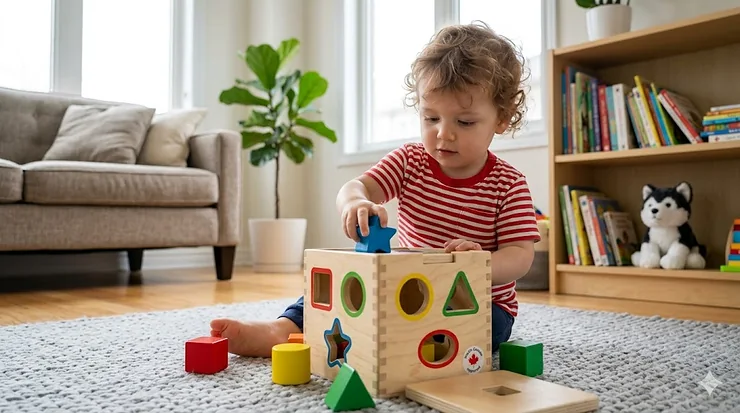
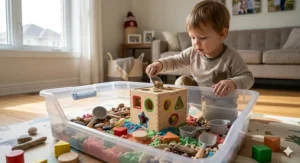
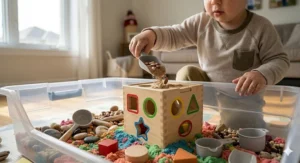
re your child will use for decades to come. When your 18-month-old concentrates intensely on fitting that star-shaped block through the correct opening, they’re not just playing. They’re developing spatial awareness, practising problem solving skills, strengthening hand-eye coordination, and building the neural pathways that support mathematical thinking.
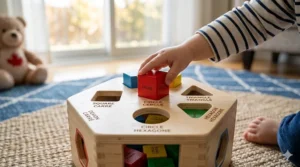
Canadian parents investing in quality early learning tools face unique considerations. Our long winters mean extended indoor play periods where developmental toys earn their keep month after month. The crisp autumn air and snowy January afternoons create perfect opportunities for focused, screen-free cognitive development activities. What makes a shape sorter toy particularly valuable in Canadian households is its durability through repeated use and its ability to grow with your child—starting as a simple cause-and-effect toy at 12 months and evolving into complex problem-solving practice by age three.
Research from the Government of Canada’s Early Learning and Child Care framework emphasizes that high-quality early learning experiences foster social, emotional, physical and cognitive development of young children. Shape sorter toys deliver on all four dimensions: they build fine motor skills (physical), teach patience and persistence (emotional), can be enjoyed with siblings or parents (social), and create countless cognitive learning opportunities through spatial reasoning and pattern recognition.
Quick Comparison: Top Shape Sorter Toys Available in Canada
| Product | Age Range | Material | Key Feature | Price Range (CAD) | Best For |
|---|---|---|---|---|---|
| Melissa & Doug Shape Sorting Cube | 2-4 years | Hardwood | 12 chunky shapes | $35-$50 | Classic simplicity |
| Battat Shape & Colour Sorting House | 2+ years | Plastic | 6 colour-coded keys | $30-$45 | Multi-sensory learning |
| HELLOWOOD Montessori Sorter Cube | 12+ months | Wood | Elastic band entry | $40-$55 | Sensory exploration |
| B. toys Wonder Cube | 18+ months | Wood | 9 shapes, compact | $25-$40 | Budget-conscious |
| Melissa & Doug Match & Roll | 12+ months | Wood | Rolling drum design | $45-$60 | Active play combo |
| KMTJT Montessori Farm Toy | 1-3 years | Wood | Multi-activity | $50-$70 | Comprehensive learning |
| Amazon Basics Shape Sorter | 12+ months | Wood | Simple, effective | $20-$35 | Entry-level choice |
Looking at this comparison, the Melissa & Doug Shape Sorting Cube offers the best balance of quality and versatility for most Canadian families in the mid-$40 CAD range. For parents prioritizing Montessori principles, the HELLOWOOD model’s elastic bands create unique tactile feedback that traditional rigid holes cannot match—though you’ll pay slightly more for this innovation. Budget shoppers should note that the Amazon Basics option sacrifices some durability for its lower price point, which matters less if you’re buying for one child but becomes relevant for families planning to pass toys down to younger siblings or planning multiple children.
💬 Just one click — help others make better buying decisions too!😊
✨ Don’t Miss These Exclusive Deals!
🔍 Take your child’s development to the next level with these carefully selected products. Click on any highlighted item to check current pricing and availability on Amazon.ca. These tools will help you create authentic learning experiences your family will love!
Top 7 Shape Sorter Toys: Expert Analysis for Canadian Families
1. Melissa & Doug Shape Sorting Cube — The Gold Standard
The Melissa & Doug Shape Sorting Cube has earned its reputation as the benchmark against which all other shape sorters are measured. This natural-finish hardwood cube features 12 chunky, vibrantly coloured shapes—going beyond basic circles and squares to include hexagons, octagons, and stars that challenge developing spatial reasoning.
What sets this apart from cheaper alternatives is the satisfying “clunk” sound the wooden blocks make when they drop through the correct opening. This auditory feedback creates a multi-sensory learning experience that reinforces success and keeps toddlers engaged far longer than silent plastic alternatives. The cube measures approximately 14 cm per side—substantial enough to prevent frustration from tiny openings, yet compact enough for easy storage in Canadian condos and apartments where space comes at a premium.
The hinged lid opens easily for parents but requires enough dexterity that most toddlers under 30 months will ask for help retrieving the blocks—creating natural opportunities for verbal interaction about shapes, colours, and spatial concepts. During Edmonton’s or Winnipeg’s long winters, this becomes valuable structured parent-child time rather than passive screen watching.
Canadian customer reviews consistently praise the toy’s durability through multiple children. One Calgary parent noted their cube has survived three children over seven years without any splits or loose hinges—exceptional value when you calculate cost-per-year of use. The wood’s natural finish shows wear gracefully rather than looking shabby like scratched plastic, and Melissa & Doug’s partnership with the American Academy of Pediatrics (similar principles apply through Canadian pediatric associations) ensures their design priorities align with developmental milestones.
Pros:
✅ Superior construction survives years of use—critical for Canadian families with multiple or future children
✅ 12 diverse shapes provide extended challenge as cognitive abilities develop
✅ Natural wood finish integrates aesthetically with Canadian homes favouring minimalist Scandinavian design
Cons:
❌ Higher initial investment than basic plastic alternatives
❌ Heavier weight makes it less suitable for travel to the cottage or grandparents’ homes
At around $40-$50 CAD, this represents solid middle-tier value. It’s not the cheapest option on Amazon.ca, but calculating a seven-year lifespan brings the annual cost to roughly $6-7 CAD—less than two coffees from Tim Hortons.
2. Battat Shape & Colour Sorting House — Interactive Learning Excellence
The Battat Shape & Colour Sorting House takes the traditional shape sorter concept and elevates it with an ingenious colour-coding system that teaches cause-and-effect reasoning alongside spatial skills. This 14-piece set includes a house structure with doors that unlock using six colour-coded keys—creating multiple layers of cognitive challenge.
Here’s why this matters for developmental progression: basic shape sorters teach one-to-one matching (star shape → star hole). The Battat house adds a second layer where children must remember which coloured key opens which door to retrieve their sorted blocks. This builds working memory and sequential thinking—the same mental processes they’ll later use for multi-step math problems and following recipe instructions.
The house measures approximately 18 cm tall with a stable base that won’t tip during enthusiastic play—important when your toddler pounds on those doors in frustration. Unlike wooden alternatives, the BPA-free plastic construction is lightweight enough for independent play without safety concerns if dropped. This becomes relevant in Canadian homes where hardwood or tile floors are common—a dropped wooden cube can crack a toe, while this bounces harmlessly.
The 12 different shapes go beyond geometry basics to include recognizable objects like cars, cats, and hearts. This supports semantic development (building vocabulary) alongside spatial learning. Your 24-month-old might not know what a “rhombus” is, but they’ll enthusiastically identify “the kitty shape!”—creating positive emotional associations with problem-solving tasks.
Canadian parents shopping on Amazon.ca report that Battat products ship quickly within Canada and customer service responds promptly to replacement requests—relevant given that small keys are easy to lose. One Toronto parent mentioned Battat sent replacement keys free of charge when two went missing after a playdate.
Pros:
✅ Dual-learning system (shapes + colour-coded locks) provides extended value through age 4+
✅ Lightweight plastic ideal for carrying between rooms during long Canadian winters indoors
✅ Recognizable shapes maintain engagement better than abstract geometry
Cons:
❌ Small keys pose loss risk—though Battat’s replacement policy mitigates this
❌ Plastic construction less appealing to parents prioritizing eco-friendly wooden toys
Priced in the $30-$45 CAD range on Amazon.ca, this offers exceptional value-per-learning-opportunity. The colour-coding system alone justifies the cost for families wanting more than basic shape matching.
3. HELLOWOOD Montessori Wooden Sorter Cube — Sensory Innovation
The HELLOWOOD Montessori Wooden Sorter Cube introduces elastic bands as the entry mechanism—a brilliant adaptation that creates unique tactile feedback absent from traditional rigid-hole sorters. Instead of simply dropping blocks through openings, children push them through stretchy bands that provide gentle resistance then release with a satisfying “pop.”
This sensory difference engages proprioceptive learning—the body awareness system that tells your brain where your limbs are in space. The varying resistance levels (thicker blocks require more force) teach toddlers to modulate their strength, building the same motor control they’ll later use for printing letters or using scissors. During Calgary’s or Ottawa’s indoor seasons, these tactile variations create richer sensory experiences than passive screen time can provide.
The eight rattling shapes add another dimension: each block contains small beads that create different sounds when shaken. This transforms shape sorting into a cause-and-effect experiment where children discover that identical-looking squares might sound different—encouraging hypothesis testing and scientific thinking before age two.
The cube’s compact design (approximately 12 cm per side) makes it ideal for smaller spaces common in Vancouver or Toronto condos. The storage function is thoughtfully executed—all blocks fit inside with the lid closed, preventing the endless hunt for missing pieces that plagues larger sets. This matters on weekday mornings when you need to tidy quickly before rushing to daycare.
Canadian Montessori practitioners would approve of this toy’s open-ended nature. There’s no wrong way to explore it—children might sort by shape, by sound, or simply enjoy the sensory feedback of pushing blocks through elastic bands. This unstructured play supports executive function development better than prescriptive toys with only one “correct” use.
Pros:
✅ Unique elastic band system creates proprioceptive learning impossible with rigid holes
✅ Rattling blocks add auditory dimension supporting multi-sensory exploration
✅ Compact storage ideal for space-conscious Canadian urban dwellers
Cons:
❌ Only 8 shapes provides less variety than 12-shape competitors
❌ Elastic bands may eventually wear out with intensive use (though replaceable)
At $40-$55 CAD on Amazon.ca, you’re paying a slight premium for the Montessori-inspired innovation. For families already investing in Montessori principles, this aligns perfectly with that educational philosophy.
4. B. toys Wonder Cube — Compact Value Champion
The B. toys Wonder Cube proves that smaller can be smarter. This thoughtfully designed wooden cube measures just 10 cm per side—making it genuinely portable for trips to Grandma’s house in Saskatoon or summer vacations to Muskoka. Yet it doesn’t sacrifice educational value for its compact footprint.
The nine colourful shapes include both traditional geometry (circles, squares, triangles) and slightly more challenging forms (crosses, crescents) that bridge the gap between “too easy” and “too frustrating.” This sweet spot is critical for maintaining engagement—educational psychologists call it the zone of proximal development, where tasks are challenging enough to promote growth without causing shutdown.
What Canadian parents particularly appreciate is the elastic-sided storage system. Unlike cubes with rigid lids that pinch small fingers, the B. toys design uses elastic cords that forgive clumsy attempts at closure. This encourages independence—your 22-month-old can put blocks away themselves rather than needing constant parental assistance. During those -30°C Winnipeg or Edmonton days when everyone’s patience runs thin, reducing friction points around cleanup becomes genuinely valuable.
The vibrant colour palette uses safe, non-toxic water-based paints that won’t fade even with years of handling. The wood’s smooth finish has no splinters or rough edges—important when your teething 18-month-old inevitably mouths everything they touch. Unlike cheaper imports occasionally flagged by Health Canada for lead concerns, B. toys maintains consistent safety standards meeting both American ASTM and European CE regulations (Canada generally accepts products meeting these standards).
Pros:
✅ Truly portable size fits in diaper bags for outings or travel to winter getaways
✅ Elastic storage system prevents finger pinches and encourages independent cleanup
✅ Mid-tier pricing makes it accessible for families on tighter budgets
Cons:
❌ Smaller cube size might frustrate children with less developed fine motor skills under 18 months
❌ Only 9 shapes provides fewer learning opportunities than premium 12-piece sets
In the $25-$40 CAD range on Amazon.ca, the Wonder Cube delivers exceptional value for families wanting quality wooden construction without premium pricing. It’s particularly smart for families planning international travel—its compact size passes airport security smoothly and provides familiar comfort in hotel rooms from Vancouver to St. John’s.
5. Melissa & Doug Match & Roll Shape Sorter — Active Play Integration
The Melissa & Doug Match & Roll Shape Sorter solves a problem many Canadian parents face during winter months: how to combine cognitive development with physical activity when outdoor play is limited. This cylindrical drum design rolls along the floor, transforming shape sorting into a chase-and-sort game that burns energy alongside building neural connections.
The rolling function isn’t just gimmicky—it teaches object permanence at deeper levels. When blocks disappear inside the rolling drum, children must mentally track where they’ve gone and understand they still exist even when hidden. This cognitive leap typically emerges around 12-18 months and is fundamental to later understanding that Mom still exists when she’s in another room or that toys remain under the couch even when out of sight.
The dozen-plus wooden shapes include some genuinely challenging options like parallelograms and quatrefoils—geometric forms most adults can’t name. This linguistic gap actually benefits learning. Instead of parent-led instruction (“that’s a parallelogram”), children develop their own spatial understanding through hands-on manipulation. The shape names can come later; the spatial reasoning comes first.
The colour-matched holes create a dual-challenge system similar to the Battat house but implemented more subtly. Children can succeed by matching just shapes or just colours initially, then progress to matching both simultaneously as skills develop. This self-scaffolding design respects individual developmental timelines—a 15-month-old and 30-month-old can both engage productively but at different complexity levels.
Canadian customer reviews from Amazon.ca frequently mention this toy’s durability through toddler sibling rivalries. The wooden construction handles being fought over, dropped down stairs, and used as an impromptu drum far better than plastic alternatives. One Halifax parent noted it survived being left outdoors through a Maritime rainstorm—not recommended, but reassuring for the inevitable accidents.
Pros:
✅ Rolling mechanism adds gross motor activity to cognitive learning—perfect for Canadian winter indoor days
✅ Colour-matching adds challenge layer that extends useful age range through 36+ months
✅ Cylindrical shape rolls smoothly on hardwood floors common in modern Canadian homes
Cons:
❌ Rolling function means it takes more floor space during play than stationary cubes
❌ Higher price point reflects the additional engineering in the rolling mechanism
At $45-$60 CAD on Amazon.ca, this costs more than basic cubes but serves dual purposes: shape sorter and active toy. For families living in Calgary or Montreal apartments without private outdoor space, toys that encourage movement indoors justify their premium pricing through extended winter months.
6. KMTJT Montessori Farm Toy — Comprehensive Learning System
The KMTJT Montessori Wooden Farm Toy redefines what a shape sorter can be by combining multiple Montessori-inspired activities into one five-sided cart. This isn’t just a shape sorter—it’s a carrot-pulling game, a worm-catching activity, a colour-recognition exercise, and a storage cart all integrated into one wooden structure.
This comprehensive approach reflects authentic Montessori philosophy: children learn through self-directed exploration of carefully designed materials. The 12 fruit blocks serve as shape-sorting pieces, but they’re also counting manipulatives and colour-identification tools. The eight carrots teach fine motor control through the pulling motion. The 10 worms develop hand-eye coordination through a magnetic “catching” mechanism.
What makes this particularly valuable for Canadian families is the extended engagement it provides. A single-purpose shape sorter might hold attention for 15-20 minutes before boredom sets in. The KMTJT farm toy offers multiple activities that children rotate through, potentially occupying an hour or more—critical during those long Saturdays when it’s -40°C with the wind chill and outdoor play is impossible.
The five-sided cart design teaches spatial concepts from multiple angles. Unlike traditional cubes where all sides look similar, each face of this cart has distinct activities—helping children understand that three-dimensional objects have different properties depending on which side you examine. This multi-perspective thinking is foundational to later geometry and even social-emotional skills like perspective-taking.
The large wooden pieces are intentionally oversized to prevent choking hazards—meeting Canadian safety standards for children 12+ months. The water-based, non-toxic paint withstands mouthing and chewing without flaking. Parents in Vancouver and Victoria particularly appreciate that B.C.’s dampness doesn’t warp the wood or peel the finish—a quality issue that plagues some cheaper imports.
Pros:
✅ Multi-activity design provides exceptional value and extended engagement through diverse challenges
✅ Montessori principles support self-directed learning and executive function development
✅ Cart design with wheels adds functional play (transportation) alongside cognitive tasks
Cons:
❌ Higher complexity means children need slightly more maturity to fully utilize all features
❌ More pieces create greater cleanup challenge—though storage cart somewhat mitigates this
Priced at $50-$70 CAD on Amazon.ca, this represents a significant investment. However, calculating the cost-per-activity reveals better value than buying multiple single-purpose toys. It’s particularly smart for Canadian families with limited storage space—one comprehensive toy replaces four or five individual purchases.
7. Amazon Basics Wooden Shape Sorter & Rainbow Stacker Set — Entry-Level Excellence
The Amazon Basics Wooden Shape Sorter & Rainbow Stacker Set proves that budget-friendly doesn’t mean low-quality. This two-piece set includes a traditional shape sorter cube plus a rainbow stacking ring toy—covering two major developmental domains (spatial reasoning and fine motor coordination) at an entry-level price point accessible to all Canadian families.
The shape sorter component is stripped-down simplicity: basic geometric shapes, natural wood finish, straightforward design. There are no bells, whistles, or electronic sounds—which is precisely the point. Child development research consistently shows that simple, open-ended toys promote deeper, longer-lasting play than feature-heavy alternatives that do the “playing” for the child.
What Canadian parents on Amazon.ca particularly value is Amazon’s shipping reliability and return policy. Unlike specialty toy stores that might be unavailable in smaller communities from Yellowknife to Corner Brook, Amazon delivers to virtually every postal code in Canada—usually within two days for Prime members. If the toy arrives damaged or doesn’t meet expectations, returns are hassle-free through Amazon’s established process.
The rainbow stacker included in this set adds colour sequencing and size gradation learning—skills that support mathematical thinking about seriation (arranging objects in order). When your 20-month-old experiments with stacking rings in different orders, they’re conducting informal geometry experiments about circumference and spatial relationships.
The natural wood construction has that satisfying heft that signals durability to adult hands. The blocks are substantial enough that they won’t get vacuumed up accidentally or lost in couch cushions—a practical consideration for busy Canadian households where toys seem to disappear into interdimensional portals located behind furniture.
Pros:
✅ Dual-set provides two developmental tools at budget-friendly pricing perfect for cost-conscious families
✅ Amazon.ca’s delivery network reaches remote Canadian communities traditional retailers don’t serve
✅ Simple design encourages open-ended play without distracting electronics or sounds
Cons:
❌ Basic construction lacks the refined details of premium Melissa & Doug or HABA products
❌ Fewer shapes (typically 8-10) provides less variety than comprehensive 12-piece sets
At $20-$35 CAD on Amazon.ca, this set delivers remarkable value for families just beginning their developmental toy collection or grandparents wanting quality gifts without premium pricing. It won’t become a cherished heirloom passed through generations, but it will absolutely support healthy development during the critical 12-36 month window—which is exactly what it needs to do.
How Canadian Families Use Shape Sorters: Real-World Scenarios
Understanding which shape sorter toy fits your family requires considering your specific Canadian lifestyle. Here are three typical profiles:
The Urban Condo Family (Toronto/Vancouver): Sarah and Ahmed live in a 750-square-foot two-bedroom condo in Toronto’s Liberty Village. Storage is precious, and toy clutter drives them crazy. They need the B. toys Wonder Cube for its compact design and elastic storage system that encourages their 22-month-old daughter to clean up independently. The portability means it moves easily between living room and bedroom, and its small footprint doesn’t dominate their limited floor space. At $25-$40 CAD, it fits their budget while meeting their space constraints.
The Suburban Family (Ottawa/Calgary): Jennifer and Mike have a three-bedroom house in Kanata with a dedicated playroom. Their twins are 18 months old, and they want a shape sorter that will last through both children and possibly a third. The Melissa & Doug Shape Sorting Cube at $40-$50 CAD represents the quality-durability sweet spot. They appreciate that it’s visually attractive enough to leave out in their open-concept living space rather than hiding it away. The hardwood construction handles two toddlers fighting over the same triangle block without splitting or cracking.
The Rural/Northern Family (Whitehorse/Thunder Bay): Maria lives in a rural community 90 km from the nearest toy store. Amazon.ca is her primary source for children’s products. She needs something that ships reliably and won’t break easily—replacement isn’t convenient when you’re hours from retail options. The Amazon Basics Set at $20-$35 CAD ships quickly with Prime, arrives intact, and if there’s a problem, Amazon’s return process doesn’t require driving to a store. The combination shape sorter and stacker provides variety during long northern winters when outdoor play is limited.
Shape Sorting Mastery: A Parent’s Guide to Supporting Development
Simply buying a shape sorter toy isn’t enough—how you introduce and support the activity dramatically impacts developmental outcomes. Here’s how to maximize learning while respecting your child’s natural progression:
Stage 1: Exploration (12-15 months) Don’t expect sorted shapes. Your child will mouth blocks, bang them together, drop them, and investigate textures. This sensory exploration is the foundation for later cognitive work. Your role is providing safe space and narrating their discoveries: “You’re shaking the star! It makes noise!” Avoid correcting or redirecting—let them lead.
Stage 2: Assisted Matching (15-20 months) Children begin noticing shapes match holes but lack the fine motor skills or problem-solving strategies to align them correctly. They’ll try forcing squares through circular holes, not from stubbornness but from incomplete understanding of rotation and orientation. Help by stabilizing the cube and offering verbal cues: “Try turning it… yes, that way worked!” Celebrate attempts, not just successes.
Stage 3: Independent Success (20-30 months) Most Canadian toddlers achieve consistent shape-sorting success between 24-30 months, though individual timelines vary widely. They’ll still struggle with complex shapes like hexagons but master circles and squares. Reduce your assistance gradually—resist jumping in at first frustration. Count to 10 silently before offering help. This teaches persistence and builds confidence in problem-solving.
Stage 4: Mastery and Beyond (30+ months) Once shape sorting becomes automatic, children need new challenges. Introduce verbal instructions: “Can you find all the red shapes?” or “Which shapes have straight edges?” This transitions from spatial-motor tasks to classification and categorical thinking—building blocks of mathematical reasoning and scientific categorization skills they’ll use throughout school.
During Canadian winters when cabin fever strikes, shape sorters become particularly valuable. Set up “shape sorting races” between siblings, create challenges (“can you sort with your eyes closed?”), or build stories around the shapes becoming characters. This extended engagement transforms a simple toy into weeks or months of developmental support.
The Science Behind Shape Sorting: Why It Matters
Shape sorter toys aren’t just entertainment—they’re building blocks of intelligence. Research published in developmental psychology journals demonstrates that spatial reasoning skills developed through activities like shape sorting predict later mathematics achievement more reliably than early number knowledge does.
When your 18-month-old rotates a triangle to align with its matching hole, they’re conducting geometric experiments. They’re learning that objects have properties that remain constant (a triangle has three sides) even when orientation changes (it looks different when upside down). This concept of conservation—that fundamental properties persist despite superficial changes—is a cognitive milestone that emerges during toddlerhood and underpins all later mathematical thinking.
The spatial awareness development fostered by shape sorting extends far beyond geometry. Studies from institutions like the University of British Columbia show that children with strong spatial skills demonstrate advantages in reading comprehension (understanding how letters combine into words requires spatial processing) and even social-emotional skills (perspective-taking involves mentally rotating your viewpoint to imagine how situations appear from another angle).
Problem solving skills practiced through shape sorting transfer to countless life domains. The persistence required to figure out why a hexagon won’t fit through a star-shaped hole—trying different orientations, examining the hole more carefully, comparing the block to other shapes—is the same executive function process needed for adult problem-solving in careers from engineering to healthcare to business management.
Canadian researchers studying early childhood development emphasize that these skills develop most robustly through hands-on manipulation of physical objects rather than screen-based games. The tactile feedback of wooden blocks, the proprioceptive awareness of pushing shapes through resistant openings, and the three-dimensional spatial reasoning required for physical manipulation engage more neural systems than two-dimensional touchscreen swiping.
The Government of Canada’s investment in early learning and child care reflects recognition that the years from birth to age five are critical for brain architecture formation. High-quality learning toys like wooden shape sorters represent parents’ parallel investment in those same foundational years—with research showing returns that compound throughout childhood and into adulthood.
What to Look For: Shopping Guide for Canadian Parents
Shopping on Amazon.ca for shape sorter toys can be overwhelming—hundreds of options ranging from $15 to $100+ CAD. Here’s what actually matters:
Material Quality Hierarchy: Top tier: Solid hardwood (maple, beech) with smooth, rounded edges and non-toxic finishes. These last through multiple children and maintain their appearance. Middle tier: Quality engineered wood with durable construction. Lower tier: Plastic that’s BPA-free and phthalate-free but shows wear quickly.
Age Appropriateness Reality Check: Manufacturers often label toys “12+ months” when developmental reality suggests 18+ months is more realistic. Canadian safety standards prohibit small parts for under-3s, but individual children develop motor skills on their own timeline. If your 15-month-old isn’t interested yet, store it for two months and try again—forced engagement creates negative associations.
Canadian-Specific Considerations: Check reviews mentioning “shipped to Canada” to confirm reliable delivery to your postal code. Verify the seller is Amazon.ca or ships from Canadian warehouses—imported toys sometimes arrive damaged or delayed. Watch for voltage compatibility if the toy has electronic features (though traditional wooden sorters avoid this issue entirely).
Red Flags to Avoid: Chemically smell from paints or finishes suggests non-food-grade materials. Rough edges or splinters indicate poor quality control. Pieces that fit too tightly make the toy frustrating; pieces that fit too loosely provide insufficient challenge. Very lightweight blocks might indicate hollow construction that won’t withstand Canadian toddler enthusiasm.
Value Calculation Beyond Price: Don’t just compare sticker prices—consider cost-per-year of use. A $50 CAD toy lasting five years costs $10 annually. A $20 CAD toy lasting one year before breaking costs $20 annually. Canadian families planning multiple children should particularly prioritize durability—that Melissa & Doug cube serving three siblings over a decade represents exceptional value despite higher upfront cost.
Frequently Asked Questions
❓ Can shape sorter toys help with speech development in toddlers?
❓ Are wooden shape sorters better than plastic ones for Canadian climates?
❓ What age should children master shape sorting in Canada?
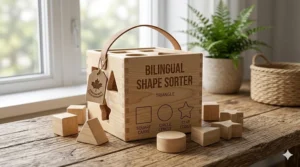
❓ Can I find bilingual shape sorter toys on Amazon.ca for French-English households?
❓ Do shape sorters ship reliably to remote Canadian communities?
Conclusion: Investing in Developmental Foundations
Choosing a shape sorter toy represents far more than selecting another plastic distraction. You’re investing in your child’s cognitive architecture during the most neurologically plastic years of human development. The spatial awareness, problem solving skills, and fine motor coordination developed through these seemingly simple toys create foundations for mathematical thinking, reading comprehension, and executive function that compound throughout childhood.
For Canadian families navigating long winters with limited outdoor play options, quality developmental toys earn their keep through extended indoor seasons. The Melissa & Doug Shape Sorting Cube remains my top recommendation for most families—exceptional durability, comprehensive shape variety, and mid-tier pricing ($40-$50 CAD) deliver outstanding value through years of use. The natural wood construction aligns with both Scandinavian minimalist aesthetics popular in Canadian homes and Montessori educational principles emphasizing natural materials.
Budget-conscious families should seriously consider the Amazon Basics Wooden Shape Sorter Set at $20-$35 CAD—it lacks premium refinements but delivers solid developmental support at accessible pricing with reliable Amazon.ca shipping nationwide. For families prioritizing Montessori approaches, the HELLOWOOD Montessori Sorter Cube at $40-$55 CAD offers unique elastic-band entry creating tactile feedback impossible with traditional rigid designs.
Whatever you choose, remember that the toy itself is just a tool—the real developmental magic happens through your engaged presence, verbal narration of spatial concepts, and patient support as your toddler navigates frustration toward mastery. Those February afternoons in Medicine Hat or Saint John when you’re both going stir-crazy from winter confinement become opportunities for building cognitive pathways that will serve your child for decades.
The Government of Canada’s commitment to accessible, high-quality early learning and child care recognizes that these foundational years determine lifelong trajectories. Your parallel investment in thoughtfully chosen developmental toys aligns with that national priority—giving your child the best possible start regardless of where in Canada you call home.
Recommended for You
- Best Pull Along Toys Canada 2026: 7 Timeless Picks for Toddlers
- 7 Best Push Toys Toddlers Love in Canada 2026
- 7 Best Canadian Made Baby Toys 2026 – Support Local Craftsmanship
Disclaimer: This article contains affiliate links. As an Amazon Associate, I earn from qualifying purchases. If you purchase products through these links, we may earn a small commission at no additional cost to you.
✨ Found this helpful? Share it with your friends! 💬🤗
