
In This Article
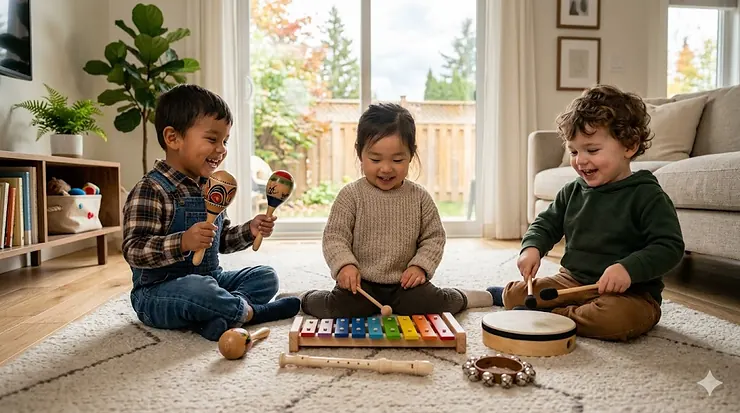
Every Canadian parent knows that nagging feeling—am I doing enough to support my toddler’s development? Here’s something that might surprise you: the simple act of handing your 18-month-old a wooden xylophone or tambourine could be setting them up for success in ways that go far beyond just making noise (though there will be plenty of that, trust me).

Music education develops brain areas related to language and reasoning, with the left side of the brain showing enhanced development through early musical exposure. What most Canadian parents don’t realise is that toddler music instruments aren’t just toys—they’re powerful developmental tools disguised as colourful, noisy fun. From stimulating neural pathways to building fine motor skills that’ll help with printing and colouring later on, these instruments pack serious educational value into formats that toddlers naturally gravitate toward.
In Canada’s bilingual landscape, this becomes even more relevant. Early exposure to rhythm and pitch through musical play can actually support language acquisition in both English and French, making instruments an unexpectedly useful tool for families navigating our multicultural environment. The sensory-rich experience of banging a drum or shaking a maraca engages multiple brain regions simultaneously—something screens simply can’t replicate, no matter how “educational” the app claims to be.
Whether you’re in a Toronto condo where volume matters, a Vancouver townhouse with neighbours to consider, or a rural Alberta home where your toddler can bang away freely, choosing the right instruments matters. This guide breaks down the best options available on Amazon.ca in 2026, with expert insights on what actually works for Canadian families dealing with everything from cramped storage spaces to harsh winter months when outdoor play isn’t an option.
Quick Comparison: Top Toddler Music Instruments Available in Canada
| Product | Age Range | Price Range (CAD) | Best For | Material | Prime Eligible |
|---|---|---|---|---|---|
| Hape Pound & Tap Bench | 12+ months | $35-$45 | Multi-sensory learning | Wood/Metal | Yes |
| Stoie’s Wooden Instrument Set | 12-36 months | $40-$55 | Complete starter kit | Natural wood | Yes |
| VTech KidiBeats Drum Set | 2-5 years | $30-$40 | Electronic learning | Plastic | Yes |
| Lehoo Castle Montessori Set | 12-36 months | $38-$48 | Natural materials | Pine wood | Yes |
| Melissa & Doug Caterpillar Xylophone | 24+ months | $20-$28 | Melodic play | Wood/Metal | Yes |
| LOOIKOOS Natural Wooden Set | 3+ years | $45-$60 | Premium quality | Solid pine | Yes |
| Fisher-Price Classic Xylophone | 18+ months | $15-$22 | Budget-friendly | Wood/Metal | Yes |
Looking at this comparison, the sweet spot for most Canadian families falls in the $35-$50 CAD range, where you’re getting quality construction that’ll survive enthusiastic toddler use without breaking the bank. What stands out immediately is how wooden instruments dominate the market—there’s good reason for that. Natural wood provides authentic sound quality that helps toddlers develop their auditory discrimination skills properly, unlike some plastic alternatives that produce tinny, artificial tones. The Hape and Stoie’s options both offer excellent value because they’re multi-instrument sets, meaning you’re not buying individual pieces that’ll cost $80-100 total when purchased separately. For families concerned about chemicals and off-gassing (especially relevant in winter when Canadian homes are sealed tight for heating), these formaldehyde-free wooden options provide peace of mind.
💬 Just one click — help others make better buying decisions too! 😊
Top 7 Toddler Music Instruments in Canada: Expert Analysis
1. Hape Pound & Tap Bench with Sliding Xylophone
This isn’t just another pretty toy sitting on Amazon.ca’s bestseller list—it’s one of those rare products that genuinely earns its popularity among Canadian parents. The Hape Pound & Tap Bench combines a pounding bench, ball-roller system, and removable 8-key xylophone in one compact design that measures roughly 24 cm × 15 cm × 14 cm.
Here’s what sets this apart from other toddler music instruments: the xylophone component slides out completely, giving you two toys in one. When your 14-month-old is obsessed with cause-and-effect (hitting ball, ball goes down, ball makes noise), the bench satisfies that developmental need. When your two-year-old is ready for more structured melodic play, you pull out the xylophone for proper musical exploration. The metal keys are tuned to actual notes—C, D, E, F, G, A, B, C—which means your toddler is hearing correct pitch from the start. This matters more than you might think for developing pitch recognition, a skill that supports both music ability and language processing as they grow.
Canadian parents consistently mention in reviews how this has become their go-to rainy day activity during Vancouver’s winter months or Toronto’s humid summers when outdoor play is limited. The solid beechwood construction handles the aggressive play style most toddlers favor—you know, the “let’s see how hard I can smash this” phase that every child goes through. What Amazon.ca reviews won’t tell you: the mallet storage is genius for preventing those “where did the mallet go?” moments that plague other instruments.
Pros:
✅ Two-in-one design maximises value
✅ Properly tuned xylophone develops accurate pitch recognition
✅ Durable beechwood survives years of toddler enthusiasm
Cons:
❌ Balls can roll under furniture (typical for any ball toy)
❌ Slightly bulkier than standalone xylophones for travel
Price & Verdict: Typically priced around $35-$45 CAD on Amazon.ca with Prime shipping. This represents excellent value for Canadian families because you’re getting multiple developmental tools in one purchase—essential if you’re dealing with limited storage space in urban housing.

2. Stoie’s Wooden Montessori Musical Instruments Set
Walk into any Montessori daycare in Canada and you’ll likely spot something similar to the Stoie’s Wooden Musical Instruments Set. This 10-piece collection includes a hand drum, maracas, castanets, triangle, bells, wood block, tambourine, flute, tone block, and chime bar—basically everything your toddler needs to explore different sound types and textures.
What most parents miss when they first see this set is how each instrument targets specific developmental skills. The maracas build wrist strength and coordination (crucial for holding pencils later). The triangle introduces the concept of sustained vs. struck sounds, teaching cause-and-effect at an auditory level. The wooden flute, while seemingly simple, actually requires controlled breathing—early practice for speech articulation and breath control during physical activity.
The set comes from child-safe pine wood with a smooth, splinter-free finish. No toxic paints or chemical coatings, which Canadian parents particularly appreciate given our cold climate means kids spend significant indoor time in close contact with their toys. At roughly 23 cm × 18 cm × 6 cm packaged in a portable cotton storage bag, this works brilliantly for Canadian families who travel between provinces to visit grandparents or head to cottage country in summer.
One insight from Edmonton and Calgary parents: this set has become their secret weapon during Alberta’s brutal -30°C weeks when cabin fever hits hard. Having multiple instruments means siblings (or parent-child pairs) can play together, creating impromptu “family bands” that burn energy and provide sensory stimulation when outdoor play isn’t possible. The instruments are loud enough to be satisfying but not so ear-splitting that you’ll regret the purchase by day three—a delicate balance that Stoie’s manages well.
Pros:
✅ Complete set means no ongoing purchases needed
✅ Natural wood construction safe for mouthing (common under age 2)
✅ Portable bag makes cleanup and travel manageable
Cons:
❌ Small parts require supervision for children under 3 years
❌ No electronic sounds (some toddlers prefer buttons and lights)
Price & Verdict: Runs $40-$55 CAD on Amazon.ca depending on availability. For families committed to Montessori principles or preferring natural toys, this delivers unmatched variety. Canadian reviewers particularly note the storage bag makes a huge difference for keeping pieces together—crucial in households with multiple kids or pets.
3. VTech KidiBeats Electronic Drum Set
Let’s be real—sometimes you need that electronic option, and the VTech KidiBeats Drum Set dominates the Canadian market for good reason. This set features three drum pads plus one cymbal, each producing unique sounds, along with nine built-in melodies spanning rock, pop, dance, and hip-hop styles. The four modes (Free Play, Letters, Numbers, Follow-Along) transform this from simple instrument to genuine learning tool.
Here’s what separates this from cheaper electronic drums flooding Amazon.ca: the LED light-up feature actually teaches pattern recognition, not just providing flashy distraction. In Follow-Along mode, lights guide which drum to hit next, building memory sequencing—a foundational pre-reading skill. The Letters and Numbers modes sneak in educational content while your toddler thinks they’re just making noise, teaching phonics and basic counting through musical play.
Canadian parents in condos and townhouses report this as their top choice because it includes volume control (bless VTech for that feature) and automatic shut-off to preserve batteries. During Ontario winters when your two-year-old has been cooped up for days, having an energetic outlet that doesn’t require outdoor clothing or parental supervision has saved many Canadian parents’ sanity. The 3 AA battery requirement (included for demo, replace for regular use) means no charging cables—handy when you’re dealing with toddlers who yank cords.
What Amazon.ca reviews don’t emphasise enough: this drum set works beautifully for bilingual households. The music is universal, and the letter/number modes can be discussed in either English or French, making it genuinely useful across Canada’s linguistic landscape. Montréal and Ottawa-Gatineau parents particularly appreciate this flexibility.
Pros:
✅ Volume control prevents neighbour complaints in multi-unit housing
✅ Educational modes teach beyond just music
✅ Durable plastic survives rough handling and temperature fluctuations
Cons:
❌ Requires ongoing battery purchases (though batteries last months with regular use)
❌ Electronic sounds lack the authenticity of acoustic instruments
Price & Verdict: Sits around $30-$40 CAD on Amazon.ca with regular Prime availability. This represents the best value in electronic toddler instruments for Canadian families wanting educational content packaged with musical play. The learning modes justify the higher price compared to basic plastic drums.
4. Lehoo Castle Wooden Montessori Toddler Drum Set
The Lehoo Castle Montessori Toddler Drum Set takes a different approach than most toddler music instruments—it’s specifically designed as an entry-level percussion set rather than a generic toy. The set includes a wooden drum (roughly 15 cm diameter), maracas, xylophone, tambourine, and castanets, all crafted from formaldehyde-free pine wood with non-toxic water-based finishes.
What Canadian early childhood educators appreciate about this set is how it mirrors instruments found in actual music programs, preparing toddlers for potential future classes. Unlike cheaper sets where everything sounds vaguely similar, each Lehoo Castle instrument produces distinctly different tones and requires different playing techniques. The drum responds to tapping intensity, teaching toddlers about dynamics (loud vs. soft). The xylophone’s eight keys are colour-coded but properly tuned, bridging the gap between toy and real instrument.
For families in Halifax, Winnipeg, or other cities with limited space, this set’s compact footprint (everything stores in a box roughly 25 cm × 18 cm × 10 cm) makes it apartment-friendly. Saskatchewan and Manitoba parents mention how well these hold up through temperature extremes—important when you’re going from heated indoor air in winter to garage storage in summer. The wood doesn’t warp or crack like some cheaper alternatives available on Amazon.ca.
One thing buyers should know: this set assumes parental involvement. It’s not designed for independent play like the VTech electronic option—it’s meant for guided musical exploration where you sit with your toddler, demonstrating techniques and creating simple rhythms together. For Canadian parents following Montessori or Waldorf philosophies, this aligns perfectly with their educational approach. For parents wanting something to occupy their toddler while they cook dinner, this might frustrate rather than help.
Pros:
✅ Authentic sound quality supports proper auditory development
✅ Montessori-aligned design encourages purposeful, mindful play
✅ Durable construction justifies the investment
Cons:
❌ Requires more parental participation than electronic alternatives
❌ Limited variety compared to larger sets
Price & Verdict: Typically $38-$48 CAD on Amazon.ca with Prime shipping. This hits the sweet spot for quality-conscious Canadian families willing to invest in authentic materials but not ready to spend $80+ on premium brands. The focus on percussion makes this excellent for toddlers who gravitate toward rhythm over melody.
5. Melissa & Doug Caterpillar Xylophone
Sometimes the classics remain classics for good reason, and the Melissa & Doug Caterpillar Xylophone has been introducing Canadian toddlers to melodic play since long before Amazon.ca existed. This 38 cm long pull-toy features eight rainbow-coloured metal keys tuned to a proper major scale, two wooden mallets, and a friendly caterpillar design that appeals to the under-three crowd.
What sets this apart from other xylophones flooding the market is Melissa & Doug’s attention to sound quality. The metal keys produce clear, resonant tones rather than the dull “thunk” you get from cheaper alternatives. This matters tremendously for developing pitch discrimination—your toddler’s brain is learning to distinguish between notes, building neural pathways that support both musical ability and language processing. Canadian speech-language pathologists actually recommend quality musical toys like this for children working on auditory processing skills.
The pull-toy aspect addresses a challenge many Canadian parents face: getting their newly-mobile toddler to practice walking. During those February and March weeks when Maritime provinces get pounded with storms or Prairie cities hit -40°C, having an indoor walking toy that produces rewarding sounds encourages movement when outdoor practice isn’t an option. The wheels are sized appropriately—not so fast that toddlers face-plant, not so slow they get frustrated.
One consideration for Canadian buyers: the 38 cm length makes this less travel-friendly than compact sets. However, Ontario and Québec parents report this becomes a “permanent fixture” in their living rooms anyway—it’s decorative enough that you won’t mind seeing it daily, unlike some garish plastic toys that offend adult sensibilities. The caterpillar design ages well; even four-year-olds who’ve outgrown other “baby toys” still enjoy playing simple melodies on this.
Pros:
✅ Pull-toy feature encourages gross motor development alongside music
✅ Properly tuned metal keys last years without detuning
✅ Sturdy construction survives sibling hand-me-downs
Cons:
❌ Single-purpose design (unlike multi-instrument sets)
❌ Size makes it less portable for travel
Price & Verdict: Generally $20-$28 CAD on Amazon.ca, making this the most budget-friendly quality xylophone option for Canadian families. If you can only afford one musical toy and want something that’ll genuinely support development rather than just occupy time, this delivers impressive value.

6. LOOIKOOS Premium Natural Wooden Musical Instruments Set
If you’re the Canadian parent who researches formaldehyde levels, reads certification documents, and won’t compromise on material safety, the LOOIKOOS Natural Wooden Musical Instruments Set deserves your attention. This 10-piece collection uses solid pine wood with absolutely zero chemical coatings—just polished natural wood—and has passed CPC/ASTM certification for safety.
The set includes hand drums, maracas, bells, castanets, tambourine, wooden blocks, and shakers, all sized specifically for toddler hands (each piece roughly 8-15 cm depending on instrument type). What distinguishes LOOIKOOS from competitors is their commitment to authentic sound production. The bells use real metal rather than plastic copies, producing genuine chime tones. The drum heads are tight enough to create proper percussive sounds, not the muffled thuds that frustrate toddlers trying to make “real” music.
Canadian parents with children in music programs—Kindermusik, Music Together, or local community classes—report this set closely matches what’s used in actual lessons. This continuity matters for toddlers who thrive on consistency; being able to practice at home with similar instruments reinforces what they’re learning in class. For families in smaller Canadian cities or rural areas without access to formal music programs, this set provides comparable quality for at-home exploration.
One practical consideration for Canadian storage: the included cotton bag measures approximately 30 cm × 25 cm when packed, fitting nicely into IKEA Kallax cubes or standard toy storage systems popular in Canadian homes. Parents in British Columbia and Nova Scotia mention this set’s resilience to humidity changes near coastal areas—the solid wood construction doesn’t swell or warp like cheaper alternatives that use plywood or compressed materials.
Pros:
✅ Zero chemical coating addresses health-conscious parents’ concerns
✅ Authentic sound quality rivals professional children’s instruments
✅ Storage bag keeps all pieces together (game-changer for busy families)
Cons:
❌ Higher price point than basic sets
❌ Natural wood shows scratches/dings more than painted alternatives
Price & Verdict: Runs $45-$60 CAD on Amazon.ca depending on availability. This represents premium tier pricing, but Canadian parents treating this as an investment rather than disposable toy consistently rate it highly. The material quality justifies the cost for families planning to pass it down to younger siblings or emphasising sustainable, natural toys.
7. Fisher-Price Classic Wood Xylophone
Let’s end with the tried-and-true budget champion that’s been introducing Canadian (and global) toddlers to music since 1964—the Fisher-Price Classic Wood Xylophone. This pull-toy features eight coloured metal keys, a smooth-rolling wooden base, attached mallet (no losing it!), and that iconic Fisher-Price reliability Canadian parents trust.
What many parents don’t realise is this xylophone was redesigned in recent years using wood from FSC-certified forests and non-toxic water-based paints—addressing previous generations’ concerns about materials. The keys are still tuned to proper notes (though not as precisely as premium options), providing acceptable pitch reference for toddlers’ developing ears. The 26 cm length and pull-string design make this genuinely portable—it fits in larger diaper bags or tote bags for trips to grandparents’ houses or cottage weekends.
For Canadian families on tight budgets—particularly those managing student loans, mortgage payments, and childcare costs that feel uniquely burdensome in cities like Toronto, Vancouver, or Calgary—this delivers surprising quality at the lowest price point in our comparison. Will it sound as rich as the Melissa & Doug? No. Will it include the variety of a multi-instrument set? Obviously not. But will it introduce your toddler to cause-and-effect, basic pitch relationships, and musical exploration without requiring a second mortgage? Absolutely.
Ontario Early Years Centres and Alberta Parent Link Centres often stock these in their toy libraries because they’re nearly indestructible—critical for toys serving hundreds of children. The attached mallet means no small parts to lose or choke on, addressing safety concerns for families with multiple kids at different developmental stages. Canadian reviews consistently mention this surviving 2-3 children before showing significant wear.
Pros:
✅ Lowest price point among quality instruments
✅ Attached mallet prevents loss and choking hazards
✅ Pull-toy design encourages walking practice
Cons:
❌ Tuning less precise than higher-end xylophones
❌ Single-purpose design limits play variety
Price & Verdict: Usually $15-$22 CAD on Amazon.ca with regular stock availability. For Canadian families wanting to test whether their toddler enjoys musical play before investing in comprehensive sets, this provides a low-risk entry point. It’s also perfect for grandparents or caregivers looking for affordable gifts that aren’t screen-based.
How to Create a Musical Environment at Home: Canadian Parent’s Guide
Most Canadian parents buy toddler music instruments thinking they’ll magically entertain their child, then get frustrated when the xylophone sits untouched after two days. The difference between gathering dust and daily use comes down to how you integrate instruments into your home environment and routines.
Start with Strategic Placement
Your toddler can’t develop rhythm skills if the instruments are buried in the toy box. Create a dedicated “music corner” in your main living space—not hidden in a bedroom. In smaller Canadian homes (the average Toronto condo is about 90 square metres), this might mean one shelf on a bookcase or a small basket accessible at toddler height. The key is availability: when your 18-month-old suddenly feels the urge to shake a maraca, they can grab it without adult assistance.
For families in open-concept Canadian housing (increasingly common in new builds from 2015 onward), position the music area away from spaces where quiet concentration happens. Not next to where older siblings do homework, not beside your work-from-home desk, not in the corner where the cat sleeps. This separation prevents constant conflicts about noise levels while establishing that music-making has its own special place.
Build Routine Around Music Time
Canadian toddlers thrive on predictable routines—especially during those long winter months when outdoor schedules get disrupted by weather. Designate specific times for musical play: maybe 20 minutes after breakfast before morning nap, or a wind-down session before dinner. Consistency teaches your toddler that music time is regular and valued, not just something that happens when you’re desperate to keep them occupied.
One technique that works brilliantly in bilingual households: pair music time with language practice. Play “Frère Jacques” while exploring French vocabulary, then switch to “Twinkle Twinkle” in English. The rhythm and melody help cement language learning in ways conversation alone can’t match—something Canadian French immersion educators have known for decades.
Model Musical Engagement
Your toddler won’t magically know that the xylophone mallets should tap gently rather than smash violently. Sit with them initially, demonstrating techniques: “Let’s play softly like rain. Now let’s play loudly like thunder!” This approach teaches dynamics (soft/loud) while connecting abstract concepts to concrete experiences your Canadian toddler understands—everyone in this country knows what thunder sounds like during summer storms or spring breakup.
For working Canadian parents juggling careers and childcare, this doesn’t require elaborate time commitments. Ten minutes of focused, engaged musical play daily beats 40 minutes of distracted parallel play where you’re checking emails while your toddler bangs randomly. Quality over quantity applies here just as much as in other parenting domains.
Rotate Instruments Seasonally
A trick used by Canadian early childhood educators: don’t present all instruments simultaneously. Keep half stored away, rotating quarterly. This keeps instruments feeling “new” and prevents overwhelming your toddler with too many choices—decision paralysis affects little people too. During winter months when cabin fever peaks, introduce more energetic percussion. During summer when you want calmer indoor activities, rotate in melodic instruments like xylophones.
Canadian parents with cottage access mention packing 2-3 portable instruments for weekends away—enough variety for musical exploration without overwhelming limited luggage space. Maracas, a small tambourine, and finger cymbals fit easily in a canvas bag while providing sufficient range for toddler experimentation during rainy cottage days.
The Science Behind Music and Brain Development in Toddlers
Let’s talk about what’s actually happening in your toddler’s brain when they’re enthusiastically banging that drum at 7 AM on Saturday morning. Understanding the developmental mechanics might help you appreciate the noise a bit more (or at least tolerate it better).
Music learning builds on language learning principles and needs to start at very early ages, with listening, imitation, and repetition as key components. Your toddler isn’t just making random sounds—they’re actively building neural pathways that support language acquisition, mathematical reasoning, and social-emotional regulation.
Neural Pathway Formation
Between ages one and three, your toddler’s brain is forming synaptic connections at an astounding rate—up to one million new neural connections every second during peak periods. Musical experiences contribute unique pathways that cross-link different brain regions. When your 20-month-old shakes a maraca, their brain is simultaneously processing: the visual input of the moving object, the proprioceptive feedback of arm movement, the auditory sensation of the sound, and the cause-effect relationship connecting action to result.
This multi-sensory integration explains why Canadian occupational therapists often recommend musical play for toddlers showing sensory processing challenges. The instruments provide controlled, predictable sensory input that helps calibrate developing nervous systems—particularly valuable during Canadian winters when sensory-rich outdoor play is limited.
Rhythm and Language Development
Here’s something fascinating: the brain processes rhythm and language in overlapping regions. When your toddler drums a steady beat, they’re practicing the same temporal sequencing skills required for understanding sentence structure. This connection explains research finding that children with strong rhythmic abilities often excel at language tasks later—including reading comprehension and vocabulary acquisition.
For Canadian bilingual families, this has practical implications. Musical rhythm provides a “neutral ground” where English and French flow patterns can both be explored without language-specific anxiety. A two-year-old drumming to French nursery rhymes is absorbing phonological patterns that’ll support pronunciation years later, even if they can’t articulate French sentences yet.
Fine Motor Precision
Those tiny hands grasping drumsticks or pinching triangle beaters are practicing precision grip—the same motor pattern required for holding pencils, using utensils, and buttoning clothing. Early childhood educators in Canada’s kindergarten programs report that children who’ve had regular instrument exposure show better pencil control and writing readiness than peers without musical experience.
The progression matters: shaking maracas (gross motor) at 12 months builds foundation for finger cymbal control (fine motor) at 24 months, which supports the pincer grip needed for printing letters at 48 months. Each stage scaffolds the next, with musical play providing endless motivation for practice—your toddler will voluntarily drum for 20 minutes straight, but try getting that same focus with “practice holding this pencil.”
Common Mistakes Canadian Parents Make with Toddler Music Instruments
Mistake 1: Expecting Instant Musical Ability
You bought the xylophone. Your 15-month-old whacks it randomly. You feel disappointed, wondering why they’re not playing recognisable tunes. Here’s the reality: musical development follows predictable stages just like walking or talking. At 12-18 months, toddlers explore cause-effect (“I hit this, sound happens”). At 18-24 months, they begin experimenting with dynamics (soft vs. loud). Around age two, they start imitating simple rhythms. Melodic understanding develops around 2.5-3 years for most children.
Canadian parents, particularly those in achievement-oriented urban centres, sometimes push musical milestones prematurely. Your toddler doesn’t need to play “Twinkle Twinkle” on key by 20 months. They need freedom to explore sounds, discover what each instrument does, and develop intrinsic motivation for musical experimentation. Skip the pressure; trust the process.
Mistake 2: Forgetting Canadian Winter Storage Realities
Wood instruments stored in unheated garages during Prairies winters or humid Maritime basements in summer can warp, crack, or detune. Proper storage means climate-controlled spaces—basically, if you wouldn’t store fine furniture there, don’t store quality wooden instruments there either. Temperature extremes that damage instruments are common across Canada from November through March, yet many parents learn this lesson only after watching their $50 xylophone crack.
The solution? Keep instruments indoors year-round. For families in smaller homes where storage is precious, choose multi-instrument sets with included bags rather than bulky individual pieces. The LOOIKOOS and Stoie’s options mentioned earlier both provide compact storage solutions that fit Canadian housing realities.
Mistake 3: Isolating Music from Daily Life
Many Canadian parents create artificial boundaries: “We do music time for 15 minutes daily.” But musical exploration shouldn’t be compartmentalised like scheduled activities. The best musical learning happens organically—drumming on the dinner table while waiting for food, humming along to car radio songs, discovering rhythm in windshield wipers during rainy Vancouver drives.
Instruments should be available but not mandatory. Some days your toddler will ignore them completely; other days they’ll drum for 45 minutes straight. This natural rhythm of interest and disinterest is developmentally appropriate. Forcing daily “music time” when your toddler wants to read books or build blocks teaches them that music is an obligation, not a joy—exactly opposite the goal.
Mistake 4: Prioritising Quiet Over Development
Understandably, Canadian parents living in condos or townhouses worry about noise complaints. But choosing silent/near-silent instruments solely to appease neighbours means sacrificing authentic sound quality that supports proper auditory development. The solution isn’t eliminating volume; it’s managing timing and teaching dynamics.
Have the loud drum sessions before 8 PM when most noise bylaws become strict. Teach your toddler about “inside voice drums” (gentle tapping) and “outside voice drums” (enthusiastic banging you save for afternoon park visits). This teaches self-regulation while honouring your toddler’s developmental need for vigorous, energetic expression—something Canadian winters make especially challenging to satisfy.
Toddler Music Instruments vs. Electronic Music Toys: What Canadian Parents Need to Know
Walk through any Canadian Walmart or Toys “R” Us and you’ll face dozens of electronic music toys: keyboards with pre-recorded songs, tablets with “music apps,” battery-powered guitars with flashing lights. How do these compare to traditional toddler music instruments? The answer is nuanced and depends heavily on your family’s priorities and circumstances.
Sound Quality and Authenticity
Traditional acoustic instruments (xylophones, drums, maracas) produce authentic tones created by physical vibration. When your toddler hits a wooden xylophone key, they’re hearing the natural harmonics of metal resonating against wood—complex sound waves that engage their auditory system fully. Electronic toys produce synthesised approximations of these sounds, often compressed to save battery life or simplified to reduce speaker requirements.
For developing ears—particularly toddlers under age three whose auditory cortex is rapidly organising—authentic instrument sounds provide richer input than electronic reproductions. This doesn’t mean electronic toys are harmful; rather, they shouldn’t be your only musical option. Canadian audiologists and speech-language pathologists recommend predominantly acoustic instruments during critical early development periods, saving electronics for supplementary variety.
Self-Directed vs. Guided Play
Here’s a crucial distinction many parents miss: acoustic instruments respond directly to your toddler’s actions with immediate, varied feedback. Hit the drum softly—quiet sound. Hit harder—loud sound. This natural cause-effect teaches dynamics and control through experimentation. Most electronic toys, conversely, have binary responses (button on/off) or predetermined sequences (press button, hear pre-recorded song) that limit exploratory learning.
The VTech KidiBeats mentioned earlier bridges this gap successfully by allowing both free-play drumming and structured learning modes. But simpler electronic toys that just play pre-recorded melodies when buttons are pushed teach toddlers to be consumers of music rather than creators—a distinction Canadian early childhood music educators emphasise strongly.

Battery Dependence and Canadian Winters
Here’s a practical consideration: acoustic instruments work regardless of battery availability. During power outages (increasingly common in Canadian winters with extreme weather events), acoustic instruments keep functioning. No finding new batteries at midnight when everything’s closed. No frustration when the electronics stop working mid-play session.
For Canadian families in rural or remote areas where battery purchases mean 40-minute drives to the nearest store, this independence from batteries becomes genuinely significant. The natural instruments keep providing value regardless of infrastructure access—something urbanites might not consider but rural families understand intimately.
Screen-Time Concerns
Many electronic music toys blur the line between instrument and screen entertainment. Tablet-based music apps or video-component toys contribute to overall screen time—a legitimate concern given Canadian Paediatric Society recommendations limiting screen exposure for under-twos to essentially zero. Acoustic instruments provide sensory-rich, three-dimensional play that develops spatial reasoning and tactile awareness in ways flat screens cannot replicate.
That said, the occasional electronic drum set that teaches letters alongside music offers educational value that parents juggling multiple demands appreciate. The key is balance: predominantly acoustic instruments supplemented by thoughtfully chosen electronic options, not the reverse.
Frequently Asked Questions About Toddler Music Instruments in Canada
❓ Can toddler music instruments really help with language development in bilingual Canadian homes?
❓ Are wooden instruments safe for Canadian toddlers who still mouth everything?
❓ What's the minimum amount to spend on toddler music instruments in Canada without wasting money?
❓ How can I manage noise complaints in a Toronto or Vancouver condo with toddler instruments?
❓ Should I buy separate instruments or a complete set for my Canadian toddler?
Conclusion: Choosing the Right Toddler Music Instruments for Your Canadian Family
After exploring options from budget-friendly classics to premium natural wood sets, the best toddler music instruments for your Canadian family ultimately depends on your specific circumstances, values, and your child’s developmental stage. There’s no single “perfect” choice—but there are definitely right choices for different situations.
If you’re raising toddlers in urban Canadian housing where space is precious and noise concerns are real, the VTech KidiBeats Drum Set or compact Melissa & Doug Caterpillar Xylophone provide quality learning without overwhelming small living spaces. For families committed to natural materials and Montessori principles, the LOOIKOOS or Stoie’s wooden sets align with your values while delivering authentic sound quality. And for grandparents or budget-conscious parents wanting to test the waters before major investment, the Fisher-Price Classic Xylophone proves that good instruments don’t require breaking the bank.
Remember that toddler music instruments aren’t just toys—they’re tools for brain development, language acquisition, motor skill refinement, and emotional regulation. Every time your toddler bangs that drum enthusiastically or experiments with xylophone melodies, they’re building neural pathways that’ll support learning across all domains for years to come. During those long Canadian winters when outdoor play is limited and cabin fever threatens everyone’s sanity, having quality instruments available provides sensory-rich, screen-free engagement that benefits the whole family.
The instruments covered in this guide all excel in different ways, backed by positive Canadian customer reviews on Amazon.ca and proven track records with early childhood educators across the country. Whichever option you choose, you’re making an investment in your toddler’s development that’ll pay dividends long after they’ve outgrown the actual instruments themselves.
Recommended for You
- Mega Bloks vs Duplo: 7 Best Large Blocks Canada 2026
- 7 Best Building Blocks Toddlers Love in Canada 2026
- 7 Best Shape Sorter Toys Canada 2026
Disclaimer: This article contains affiliate links. As an Amazon Associate, I earn from qualifying purchases. If you purchase products through these links, we may earn a small commission at no additional cost to you.
✨ Found this helpful? Share it with your friends! 💬🤗
