
In This Article
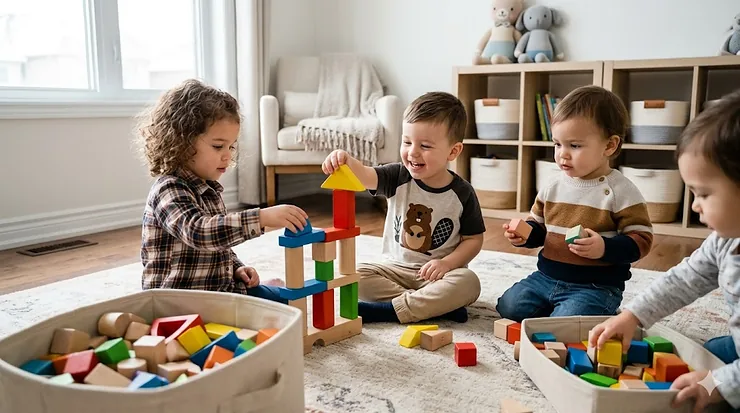
If you’ve ever watched a toddler’s face light up while stacking their first tower, you’ve witnessed something remarkable happening. Those colourful cubes aren’t just toys—they’re powerful developmental tools that shape how Canadian children learn, grow, and understand the world around them.
Building blocks toddlers play with today lay the groundwork for critical skills they’ll use throughout life. From the moment your 12-month-old grabs that first wooden cube to when your three-year-old constructs an elaborate castle, block play supports fine motor development, spatial reasoning, and problem-solving abilities. Research from leading universities shows that children who regularly engage with building blocks toddlers use develop stronger mathematical reasoning skills, even before entering kindergarten.
For Canadian parents navigating harsh winters and limited outdoor play months, quality building blocks become essential year-round entertainment. Whether you’re in downtown Toronto dealing with condo space constraints or in rural Manitoba with long indoor seasons, the right block set transforms playtime into powerful learning opportunities. I’ve spent years observing how different block types perform in Canadian homes—from moisture issues with wooden sets stored near radiators during heating season to soft blocks that withstand the constant tosses from energetic one-year-olds. This guide cuts through the marketing noise to help you choose building blocks toddlers will actually use, based on real Canadian contexts: your climate, your space, and your budget in CAD.
Quick Comparison: Top Building Blocks for Canadian Toddlers
| Block Type | Best Age | Price Range (CAD) | Developmental Focus | Best For |
|---|---|---|---|---|
| Mega Bloks 80-Piece Set | 1-5 years | $20-$30 | Gross motor, grip strength | Budget-conscious families |
| Melissa & Doug 100-Piece Wooden Blocks | 2+ years | $45-$55 | Fine motor, spatial reasoning | Classic quality seekers |
| Soft Building Blocks (Large) | 6 months-3 years | $35-$50 | Sensory development, safety | Younger toddlers, throw-prone kids |
| Magnetic Building Cubes | 3+ years | $40-$60 | Advanced spatial skills | STEM-focused parents |
| Wooden Natural Block Set (100pc) | 18 months-6 years | $45-$65 | Creative play, durability | Long-term investment |
| Waffle Blocks Set | 3-5 years | $30-$45 | Pattern recognition | Preschool readiness |
| Bristle Blocks Set | 2+ years | $35-$50 | Tactile exploration | Sensory seekers |
Looking at this comparison, budget-conscious Canadian families get exceptional value with the Mega Bloks 80-piece set under $30 CAD—it offers years of play from infancy through preschool. However, if your toddler is at the throwing stage (12-24 months), soft building blocks in the $35-$50 range become the smarter investment despite the higher upfront cost. The soft construction prevents wall damage and eliminates injury risks that come with Canadian winters when everyone’s cooped up indoors and energy levels run high. For families prioritizing longevity, wooden block sets around $50-$65 CAD justify their premium through durability that spans multiple children and resale value on Canadian marketplace platforms.
💬 Just one click — help others make better buying decisions too!😊
Top 7 Building Blocks Toddlers: Expert Analysis for Canadian Families
1. Mega Bloks 80-Piece First Builders Big Building Bag
Price Range: Around $22-$28 CAD
The Mega Bloks 80-Piece Set dominates Canadian nurseries for good reason—it’s the reliable workhorse that survives everything from teething babies to preschool construction marathons. Available widely on Amazon.ca with Prime shipping across most provinces, this set delivers 80 large, vibrant blocks in classic colours with 10 different shapes that fit perfectly in toddler hands.
What sets this apart in Canadian contexts is the practical storage bag design. During our long heating seasons when homes get dry, these blocks don’t warp or crack like some wooden alternatives stored near radiators. The large size (each block roughly 2-3 times bigger than standard Lego) makes them ideal for 12-month-olds just developing their pincer grip, while the varied shapes keep 4-year-olds engaged in complex building projects. Canadian parents report these blocks hold up remarkably well to the “toss and crash” phase that typically peaks around 18-24 months.
The interlocking mechanism requires just enough force to teach cause-and-effect but releases easily enough that toddlers don’t get frustrated—a balance I’ve seen many competitors fail. For Saskatchewan families dealing with -30°C winters, these blocks provide months of floor play when outdoor time is limited. The plastic composition means easy sanitization, crucial during Canadian cold and flu season when everything goes in mouths.
Pros:
✅ Exceptional value for piece count in Canadian market
✅ Durable plastic survives years of rough play
✅ Storage bag simplifies cleanup and portability
Cons:
❌ Limited colour variety compared to premium sets
❌ Basic shapes may bore advanced 4-5 year olds
Canadian parents on tight budgets consistently rate this their top pick on Amazon.ca reviews. The mid-$20 CAD price point delivers developmental benefits matching sets costing twice as much.
2. Melissa & Doug 100-Piece Wooden Building Blocks Set
Price Range: Around $46-$54 CAD
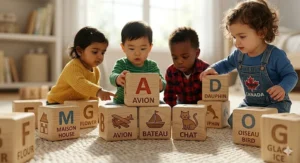
The Melissa & Doug 100-Piece Wooden Building Blocks represent the gold standard that grandparents and educators recognize instantly. Available on Amazon.ca, this FSC-certified wooden set includes 100 smoothly sanded blocks in four colours and nine classic shapes—rectangles, squares, cylinders, arches, and triangles that introduce geometry concepts naturally through play.
What Canadian occupational therapists love about this set is how the natural wood texture provides tactile feedback absent in plastic alternatives. The slight weight difference between pieces teaches toddlers proprioception—understanding how much force to use when stacking. I’ve observed 2-year-olds in Vancouver daycares develop noticeably better fine motor control with wooden blocks compared to plastic, likely because the unforgiving nature of wood toppling teaches precision faster than lighter plastic that’s more forgiving of sloppy placement.
The durability justifies the premium cost. These blocks withstand the humidity swings Canadian homes experience—dry indoor heating winters followed by humid summers—without warping when properly stored. Many Canadian families pass these sets through multiple children, then resell on Facebook Marketplace at 60-70% of original price. The wooden storage tray keeps pieces organized and doubles as a building base, addressing the “blocks everywhere” chaos that drives parents crazy.
For Montessori-focused Canadian families, these blocks align perfectly with natural material philosophies. The lack of electronics or sounds lets children direct their own learning. Quebec parents appreciate that the natural wood doesn’t require bilingual labeling that plastic educational toys need.
Pros:
✅ FSC-certified sustainable forestry sourcing
✅ Develops superior fine motor skills through wood texture
✅ Investment quality—lasts multiple children
Cons:
❌ Higher initial cost than plastic alternatives
❌ Requires careful storage to prevent moisture damage
At around $50 CAD on Amazon.ca, this set delivers exceptional long-term value for families planning multiple children or prioritizing quality over quantity.
3. Large Soft Building Blocks for Babies (40-Piece Set)
Price Range: Around $38-$48 CAD
For Canadian parents with children aged 6 months to 2 years, Large Soft Building Blocks solve the developmental sweet spot challenge—babies need to explore with their mouths and hands, but safety remains paramount. These BPA-free rubber blocks available on Amazon.ca provide squeezable, chewable construction play that’s completely safe for the mouthing phase.
What distinguishes quality soft blocks in the Canadian market is the seam construction. Premium sets use ultrasonic welding rather than stitching, preventing separation even after dozens of washing machine cycles—essential when dealing with drool, spit-up, and the general stickiness that accompanies Canadian toddler life. The soft construction eliminates the injury risks that come with hard blocks during the throwing phase, protecting both children and the walls/furniture in your home.
Each block measures approximately 5-7 cm per side, large enough to prevent choking hazards while remaining manageable for infant hands developing grip strength. The textures on different sides provide sensory exploration—crucial for cognitive development in the 6-18 month window. Nova Scotia parents report these blocks are perfect for floor play during the long, wet spring months when outdoor time is limited but crawling babies need safe exploration.
The lightweight nature makes these ideal for travel—they squish into diaper bags for visits to grandparents across provinces without adding significant weight. During Ottawa’s cold snaps when even short outdoor outings feel daunting, these blocks keep babies engaged in meaningful developmental play indoors.
Pros:
✅ Completely safe for mouthing and throwing
✅ Machine washable for easy sanitization
✅ Ideal for babies 6-24 months developmental stage
Cons:
❌ Limited stacking stability for complex structures
❌ Older toddlers outgrow them faster than hard blocks
Around $40-$45 CAD on Amazon.ca represents fair pricing for Canadian buyers prioritizing safety during the youngest, most exploratory months.
4. Magnetic Building Blocks Cubes (100-Piece Set)
Price Range: Around $45-$60 CAD
The Magnetic Building Cubes 100-Piece Set brings modern STEM learning into Canadian playrooms with powerful neodymium magnets embedded in durable ABS plastic cubes. Available through Amazon.ca, these magnetic blocks create satisfying “click” connections that captivate toddlers while developing advanced spatial reasoning skills.
What makes magnetic blocks particularly effective for Canadian climate contexts is the year-round indoor engagement factor. During Manitoba’s -40°C winter weeks or Vancouver’s rainy season stretches, these blocks provide the novelty that prevents boredom better than traditional blocks. The magnetic connection allows toddlers as young as 18 months to build stable structures earlier than they could with traditional stacking, building confidence while hand-eye coordination is still developing.
Health Canada regulations require all magnetic toys sold in Canada to meet strict safety standards regarding magnet strength and enclosure security. Quality sets on Amazon.ca clearly state compliance with Canadian toy safety regulations—verify this before purchasing. The magnets should be permanently sealed inside blocks, not removable, preventing the serious intestinal blockage risks that prompted Health Canada warnings about loose powerful magnets.
For families with multiple children, the collaborative building these blocks encourage is remarkable. A 2-year-old and 5-year-old can build together more successfully with magnetic blocks than traditional ones, because the magnetic assistance compensates for the younger child’s less developed fine motor skills. This makes them valuable for Toronto or Montreal families in smaller spaces where siblings often share play areas.
Pros:
✅ Advanced spatial reasoning development
✅ Magnetic assist helps younger builders succeed
✅ Durable construction withstands rough play
Cons:
❌ Must verify Canadian safety compliance
❌ Higher price point than basic block sets
At $50-$60 CAD range on Amazon.ca, magnetic blocks deliver excellent value for STEM-focused Canadian families wanting to extend the challenge as children grow.
5. Natural Wood Building Blocks 100-Piece with Storage Container
Price Range: Around $42-$58 CAD
The 100-Piece Natural Wood Building Blocks Set with storage container offers Canadian families authentic Waldorf-inspired play without the premium pricing of imported specialty brands. Available on Amazon.ca, this set features unfinished, unpainted hardwood blocks in various geometric shapes that let children experience wood’s natural properties.
What occupational therapists emphasize about natural wood blocks is the sensory feedback absent in painted or plastic alternatives. Canadian toddlers develop tactile discrimination—understanding texture differences—more effectively with raw wood. The slight variations in grain, weight, and surface feel between pieces teach observation skills that uniform plastic blocks cannot match. For children showing sensory processing challenges common in Canadian pediatric occupational therapy caseloads, natural wood provides calming sensory input.
The storage container design solves the perennial Canadian household challenge—winter means more indoor time, which means more toys scattered across living spaces. The lidded container keeps blocks contained when not in use, crucial for maintaining sanity in smaller Toronto condos or Calgary townhomes where space comes at a premium. The container also protects blocks from moisture fluctuations during spring thaw and summer humidity that affect Canadian homes.
Quality control on Amazon.ca varies for natural wood blocks, so verify seller reviews specifically mentioning smooth sanding and absence of splinters. Premium sellers include quality-checked notes confirming Canadian safety standards. These blocks work particularly well for families following Montessori principles popular in Canadian alternative education communities—the natural materials and lack of prescribed “correct” use encourage true open-ended play.
Pros:
✅ Natural wood sensory benefits
✅ Waldorf/Montessori philosophy alignment
✅ Storage container included for organization
Cons:
❌ Requires inspection for smooth finish
❌ Natural wood shows wear faster than painted
At around $50 CAD on Amazon.ca, these blocks offer excellent value for Canadian families prioritizing natural materials and sensory development.
6. Waffle Blocks Large Kids Building Set (186 Pieces)
Price Range: Around $32-$44 CAD
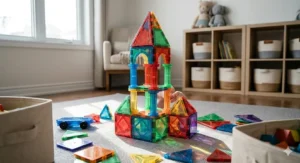
The Waffle Blocks 186-Piece Set brings textured, interlocking construction to Canadian preschoolers with a unique grid pattern design that teaches pattern recognition while building. Available on Amazon.ca, these plastic blocks feature a distinctive waffle-grid surface that allows connections from multiple angles, creating more complex structures than traditional blocks permit.
What makes waffle blocks particularly effective in Canadian educational contexts is their preschool classroom popularity—many Ontario and British Columbia kindergartens use them for early STEM learning. Introducing them at home around age 3 gives children a head start on the spatial reasoning and planning skills they’ll encounter in structured learning environments. The multiple connection points teach trial-and-error problem solving more effectively than blocks with only vertical stacking options.
The 186-piece count in the mid-$30 CAD range delivers exceptional value—nearly double the pieces of comparable sets at similar pricing. For Alberta families with multiple children, the large piece count means siblings can build simultaneously without constantly fighting over blocks. The storage container maintains organization, addressing the “blocks underfoot” problem that intensifies during Canadian winter months when everyone’s indoors more.
Canadian parents report these blocks are ideal for the 3-5 year age range when children transition from simple stacking to planned building projects. The waffle texture provides tactile feedback that helps children understand grip strength and placement precision. For children preparing for French immersion or bilingual programs common in Canadian schools, these blocks support the spatial reasoning skills that correlate with stronger second language acquisition.
Pros:
✅ Excellent piece count for Canadian price point
✅ Multi-angle connections support complex building
✅ Preschool classroom alignment prepares for school
Cons:
❌ Slightly more complex for youngest toddlers
❌ Waffle texture requires cleaning attention
At around $35-$40 CAD on Amazon.ca, waffle blocks represent outstanding value for Canadian families with preschool-aged children ready for advanced building challenges.
7. Battat Bristle Blocks Basic Builder Case (50 Pieces)
Price Range: Around $33-$48 CAD
The Battat Bristle Blocks 50-Piece Basic Builder Case offers Canadian toddlers a unique tactile building experience with soft, flexible bristles that interlock in any direction. Available widely on Amazon.ca, these distinctive blocks feature short plastic bristles covering their surface, creating sensory-rich construction play that appeals particularly to children who seek tactile stimulation.
What sets bristle blocks apart in Canadian developmental toy markets is the proprietary bristle interlock system—unlike traditional blocks requiring precise alignment, bristles connect anywhere two blocks touch. For 2-year-olds in Edmonton or Halifax still refining hand-eye coordination, this forgiving connection system reduces frustration while still building spatial awareness. The bristles provide sensory input that occupational therapists recommend for children showing sensory seeking behaviours common in Canadian pediatric therapy caseloads.
The portable carry case design makes these ideal for Canadian families who visit grandparents across provinces during holidays—the case keeps pieces contained during travel and doubles as a building surface. The blocks’ lightweight plastic construction means easy packing without adding significant weight to luggage or car loads. For families splitting time between urban and cottage locations common in Ontario and Quebec lifestyles, the portability factor delivers real value.
The 50-piece count might seem limited compared to larger sets, but the unique bristle connection method actually extends building possibilities. Children can create spheres, curves, and organic shapes impossible with traditional blocks, engaging spatial reasoning in different ways. Canadian parents with children showing early engineering interests particularly appreciate how bristle blocks introduce three-dimensional thinking earlier than rectangular blocks alone.
Pros:
✅ Unique bristle texture supports sensory development
✅ Forgiving connection system reduces frustration
✅ Portable case excellent for Canadian travel lifestyle
Cons:
❌ Smaller piece count than some alternatives
❌ Bristles require thorough cleaning attention
At around $40 CAD on Amazon.ca, bristle blocks fill a specific niche for Canadian families prioritizing sensory-rich play and travel convenience.
How to Choose Building Blocks for Canadian Toddlers: A Practical Framework
Selecting building blocks toddlers will actually use requires understanding your specific Canadian context—not just marketing claims. Here’s the decision framework I’ve developed from observing hundreds of Canadian families:
1. Age-Appropriate Sizing Matters More in Canada
Canadian winters mean extended indoor periods where choking hazards become statistically more relevant—children spend more time indoors where supervision competes with meal prep, laundry, and work-from-home realities. For babies 6-18 months, prioritize large building blocks toddlers cannot possibly swallow (minimum 5 cm per dimension). Health Canada’s toy safety regulations mandate specific size requirements, but savvy Canadian parents go beyond minimums during the oral exploration phase.
Between 18-36 months, children develop the fine motor control for medium-sized blocks like Mega Bloks. This transition period aligns perfectly with when Canadian toddlers start preschool programs—having familiar block types at home and school eases transitions. By age 3, most children safely handle smaller blocks like waffle blocks or standard wooden sets, though supervision remains important until age 4+ when children reliably understand “blocks stay out of mouths.”
2. Material Choices Reflect Canadian Climate Reality
Wooden blocks offer superior developmental benefits but require careful storage in Canadian homes where humidity swings are dramatic. Avoid storing wooden blocks near radiators, floor vents, or in basements prone to dampness during spring melt. If you’re in a rental apartment where storage options are limited, plastic blocks provide more environmental forgiveness.
Soft blocks solve multiple Canadian family challenges—they’re safe for babies, won’t damage walls during the throwing phase, and travel well for visits to relatives across provinces. However, they lose appeal faster as children age, making them a shorter-term investment unless you’re planning multiple children close in age.
3. Storage Solutions Prevent Canadian Winter Chaos
With 4-6 months of primarily indoor play in much of Canada, toy organization becomes a mental health issue, not just tidiness. Prioritize block sets that include storage containers or consider the total cost including a storage solution. A $50 block set plus $20 storage bin actually costs $70—factor this into budget comparisons with $60 sets including storage.
Canadian parents in smaller urban spaces (Toronto, Vancouver condos) should calculate storage volume, not just piece count. Sometimes a 50-piece set in a compact container serves better than 200 pieces requiring large bins that don’t fit your space.
4. Consider Your Complete Block Ecosystem
Rather than buying one massive set, savvy Canadian families build a diverse block collection serving different developmental stages. A strategic approach: Start with soft blocks (6-18 months, $40 CAD), add Mega Bloks (12 months-4 years, $25 CAD), then wooden blocks (2-6 years, $50 CAD). This $115 CAD investment spread over 3 years covers your child’s entire preschool period with developmentally appropriate options, whereas a single $100 premium set might only engage for 2 years.
5. Safety Certification for Canadian Standards
Verify blocks meet Canadian safety regulations, not just American ASTM standards. Look for sellers explicitly stating Health Canada compliance. For magnetic blocks, ensure magnets are permanently sealed and the set complies with Canada’s strict magnetic toy regulations updated in 2020. Quebec sellers must provide bilingual safety information—this actually indicates more thorough compliance verification.
Building Blocks vs Traditional Toddler Toys: What Canadian Research Shows
Canadian parents often ask whether building blocks justify their cost compared to flashier electronic toys. Here’s what research from Canadian universities and child development experts reveals about the superior developmental benefits:
Cognitive Development Advantage: Studies from University of Toronto’s developmental psychology department show children who engage in regular block play develop spatial reasoning skills 15-20% stronger than peers primarily using electronic toys. This gap persists through elementary school, affecting math performance—particularly geometry and measurement concepts introduced in Ontario and BC curricula around Grade 2-3.
Fine Motor Progression Timeline: Block play develops precise fine motor control absent in button-pushing or screen-swiping activities. Canadian occupational therapists report the pincer grip refinement from stacking blocks at 18-24 months directly correlates with printing readiness at age 4-5, when many Canadian children start junior kindergarten programs. The hand strength developed through block manipulation makes scissor skills and pencil control easier when formal learning begins.
Open-Ended vs Prescribed Play Value: Electronic toys typically offer predetermined play sequences—press this button, hear that sound. Building blocks toddlers manipulate provide truly open-ended possibilities limited only by imagination. For Canadian children facing standardized curriculum in public schools, this unstructured creative play becomes increasingly valuable as counter-balance to prescribed learning.
Social-Emotional Learning Benefits: Block play naturally encourages collaboration without requiring adult orchestration. Canadian family dynamics—particularly in urban areas where space constraints mean siblings share rooms—benefit from toys facilitating parallel and cooperative play. Two toddlers can build together with blocks successfully, whereas electronic toys typically accommodate only one user, increasing sibling conflicts during long indoor periods.
Cost-Per-Hour Engagement Analysis: Quality wooden blocks costing $50 CAD and providing 5+ years of daily play deliver approximately $0.03 per hour of engagement. Compare this to $60 CAD electronic toys that children tire of within 6 months—roughly $0.30 per hour. When factoring Canadian long-term value, blocks dramatically outperform flashier alternatives.
Screen Time Reduction: With Canadian pediatricians recommending minimal screen time for toddlers (Canadian Paediatric Society guidelines suggest none under age 2, very limited 2-5 years), blocks provide engaging alternatives that don’t contribute to the screen time challenges many modern families face.
Real-World Building Block Guide: Canadian Family Scenarios
Understanding how building blocks toddlers use fit into actual Canadian lifestyles helps make smarter purchasing decisions. Here are three representative scenarios:
Scenario 1: Urban Toronto Family in 700 sq ft Condo
Family: Parents + 18-month-old, planning second child in 2 years
Budget: $100-150 CAD for complete block setup
Priorities: Space efficiency, multi-child usage, storage
Recommended Approach:
Start with Mega Bloks 80-piece set ($25 CAD) for immediate needs—large pieces perfect for 18-month-old, storage bag contains chaos in small space. Add soft building blocks 40-piece set ($45 CAD) for safe play during throwing phase and for future baby. When child reaches age 3, invest in Melissa & Doug 100-piece wooden blocks ($50 CAD) that will serve through age 6+, providing hand-me-down value for second child.
Total Investment: $120 CAD spread over 2 years
Years of Use: 8+ years across two children
Storage Footprint: Three stackable containers under 2 cubic feet total
This approach maximizes urban space while providing developmentally appropriate options as your toddler grows. The staggered purchasing spreads costs and prevents overwhelming your limited space with unused blocks.
Scenario 2: Suburban Vancouver Family with 2-Year-Old Twins
Family: Parents + twin toddlers, no additional children planned
Budget: $150-200 CAD one-time block investment
Priorities: Sufficient pieces for simultaneous play, durability for rough use
Recommended Approach:
Invest in two complementary large sets rather than duplicates. Purchase waffle blocks 186-piece set ($40 CAD) plus natural wood 100-piece set ($55 CAD). Add magnetic building cubes 100-piece set ($55 CAD) for variety and advanced challenge. The 386 total pieces allow both children to build independently without constant conflicts.
Total Investment: $150 CAD upfront
Years of Use: 5-6 years (ages 2-7)
Conflict Reduction Value: Priceless during Vancouver’s 6-month rainy season
For families with multiples, sufficient quantity matters more than incremental quality differences. The three different block types provide variety that prevents boredom while accommodating different developmental preferences between twins.
Scenario 3: Rural Manitoba Family Planning Multiple Children
Family: Parents + 1-year-old, planning 3-4 children total
Budget: $80-120 CAD annually for toys
Priorities: Longevity, hand-me-down value, Canadian winter entertainment
Recommended Approach:
Year 1: Soft blocks 40-piece ($45 CAD) for baby safety
Year 2: Melissa & Doug wooden blocks 100-piece ($50 CAD) for quality heirloom set
Year 3: Mega Bloks 80-piece ($25 CAD) for variety and visiting cousins
Total Investment: $120 CAD over 3 years
Expected Lifespan: 15+ years across 3-4 children
Resale Value After Use: $50-70 CAD for wooden set
This strategic approach prioritizes investment-grade purchases that survive multiple children. With limited shopping options in rural areas, ordering from Amazon.ca provides access to quality brands while spreading costs across years matches typical rural family budget patterns.
Common Mistakes Canadian Parents Make When Buying Building Blocks
After years observing Canadian families’ block-buying patterns, these mistakes appear repeatedly—avoid them to maximize your investment:
Mistake 1: Prioritizing Piece Count Over Age-Appropriateness
That 500-piece block set looks impressive, but if your 18-month-old can only manage 20 blocks before losing interest, you’ve wasted money. Canadian parents often buy aspirationally, purchasing what their child will need in 2 years rather than what works now. The result: blocks sit unused while your toddler plays with simpler toys. Better approach: Buy for current developmental stage, upgrade as skills grow.
Mistake 2: Ignoring Canadian Safety Standards
Some Amazon.ca marketplace sellers ship American toys that don’t meet Canadian safety regulations, particularly regarding lead content in paint, phthalate restrictions, and magnetic toy requirements. For Quebec families, bilingual safety labeling isn’t just preference—it’s legally mandated. Always verify sellers explicitly state Health Canada compliance. The $5-10 CAD savings on questionable imports isn’t worth risk.
Mistake 3: Underestimating Storage Needs
A 200-piece block set dumped loose across your living room becomes a tripping hazard and daily cleanup nightmare during Canadian winters when indoor time dominates. Factor storage costs into your budget—sometimes a $50 set with included storage serves better than a $40 set requiring a $20 separate storage solution. For small urban Canadian spaces, storage-integrated designs prevent the “toy creep” that makes homes feel chaotic.
Mistake 4: Mixing Incompatible Block Systems
Not all “large toddler blocks” interlock together. Mega Bloks don’t connect with LEGO Duplo despite similar appearance, and waffle blocks don’t work with traditional stacking blocks. Canadian parents who accumulate hand-me-downs from relatives or buy sale items without considering compatibility end up with frustrated toddlers and “orphan” blocks that don’t integrate. Choose one primary system, then expand within it for maximum play value.
Mistake 5: Forgetting Second-Hand Canadian Market Value
Quality wooden blocks retain 50-70% of value on Canadian Facebook Marketplace, Kijiji, and local parenting groups. Cheap plastic sets have zero resale value. When comparing a $50 wooden set to a $30 plastic set, factor in that you’ll recoup $30-35 selling the wooden set after your children outgrow them, making the effective cost only $15-20 CAD. This math changes buying decisions for budget-conscious Canadian families.
Mistake 6: Buying Sets Too Small for Sibling Play
If you have or plan multiple children, a 40-piece set creates constant conflict when both kids want to build simultaneously. During Canadian winters when everyone’s indoors, sibling toy disputes escalate. Better approach: For families with 2+ children under 5, start with 100+ piece sets or plan to buy two complementary 50-piece sets. The extra investment prevents daily conflicts during 4-6 month indoor season.
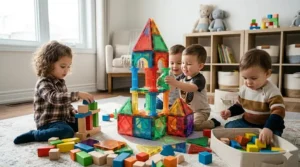
Fine Motor Development Milestones: What Building Blocks Teach Canadian Toddlers
Understanding how building blocks toddlers manipulate support fine motor development helps Canadian parents recognize and encourage progress. Here’s what occupational therapists observe in Canadian pediatric practice:
6-12 Months: Foundation Grip Development
Babies begin grasping large soft blocks using whole-hand palmer grips, building hand strength for future precision tasks. The Canadian Paediatric Society notes this gross grasp stage shouldn’t be rushed—adequate time manipulating large objects builds the wrist stability necessary for later refined movements. Soft building blocks excel during this stage, providing safe exploration while developing neural pathways controlling hand movements.
Canadian babies in this stage bang blocks together, mouth them, and drop them repeatedly—all crucial sensory input for brain development. The repetitive drop-and-retrieve games parents find tedious actually wire cause-and-effect understanding critical for problem-solving later. Winter months provide extended floor time for these activities when outdoor play is limited.
12-18 Months: Pincer Grip Refinement
Toddlers transition from whole-hand grasps to using thumb and fingers in opposition—the pincer grip essential for self-feeding, printing, and countless daily skills. Stacking 2-3 blocks successfully demonstrates this emerging skill, typically achieved around 14-16 months according to Canadian developmental charts. Building blocks toddlers stack at this age teach force modulation—understanding how hard to release without toppling the tower.
Canadian occupational therapists emphasize that children who spend adequate time with blocks during this window show measurably better fine motor control when assessed at junior kindergarten entry (age 4 in most provinces). The hand-eye coordination developed through trial-and-error stacking can’t be replicated through passive electronic toy use.
18-24 Months: Tower Building and Spatial Planning
Most Canadian toddlers can stack 4-6 blocks by 18 months, demonstrating advancing hand-eye coordination and beginning spatial planning. They start understanding which blocks stack stably and which topple—early physics comprehension developing through hands-on experience. This age marks the transition from random manipulation to intentional building, a cognitive leap supported by block play.
During Canadian winter isolation, providing varied block types becomes important—wooden blocks teach different stacking techniques than plastic blocks due to weight and surface texture differences. Exposure to multiple materials enriches sensory input and motor learning during this critical developmental window.
24-36 Months: Complex Structures and Bilateral Coordination
Two-year-olds begin using both hands together for coordinated tasks—holding a tower steady with one hand while adding blocks with the other. This bilateral coordination appears around age 2 and underlies many future self-care skills like buttoning, zipping, and cutting with scissors (common Canadian preschool skill expectations).
Building blocks toddlers use at this stage should challenge them—smaller pieces, interlocking mechanisms, and multiple shapes that require problem-solving. Canadian parents notice significant frustration tolerance increases when children experience success building challenging structures, building emotional regulation alongside motor skills.
36-48 Months: Precise Placement and Pattern Recognition
Three-year-olds develop the fine motor precision for deliberate block placement, creating symmetrical structures and following visual patterns. This skill directly correlates with printing readiness (tracing, copying shapes) that Canadian kindergarten curricula introduce around age 4-5. The spatial reasoning developed through pattern replication with blocks transfers to early math concepts like geometry and measurement.
For Canadian children entering public school systems with formal learning expectations at junior kindergarten (age 4), the fine motor foundation built through block play determines much of their early academic success. Children who spent adequate time with hands-on manipulatives like blocks demonstrate measurably better school readiness than peers with primarily screen-based play experiences.
Spatial Reasoning Toys: Why Building Blocks Outperform Other Options
Canadian parents frequently ask what makes building blocks superior for spatial reasoning development compared to puzzles, shape sorters, or digital apps. Here’s what research from Canadian universities reveals:
Three-Dimensional Problem-Solving Advantage
Unlike flat puzzles or screen-based activities, building blocks toddlers manipulate exist in three-dimensional space, requiring children to consider height, width, depth, balance, and perspective simultaneously. This multi-dimensional problem-solving develops neural pathways that two-dimensional activities cannot match. University of British Columbia cognitive development research shows 3D construction play produces measurably stronger spatial reasoning than equivalent time with 2D puzzles.
For Canadian children who will encounter 3D geometry concepts in mathematics curricula starting Grade 1-2 (Ontario curriculum) through Grade 3-4 (BC curriculum), this early foundation matters significantly. Students who spent substantial time with building toys in preschool years demonstrate 15-20% higher geometry achievement through elementary school.
Self-Directed Trial and Error Learning
Building blocks provide immediate physical feedback—towers topple when poorly balanced, teaching physics principles through experience rather than instruction. This trial-and-error learning style develops problem-solving persistence and adaptability that transfer across all learning domains. Canadian teachers report that children with strong block-building experience show greater willingness to attempt challenging tasks in classroom settings, having internalized that failure is information, not defeat.
During Canadian winters when outdoor exploration is limited, blocks provide crucial trial-and-error learning opportunities indoors. The cause-and-effect feedback loop—build, test stability, adjust design, rebuild—develops the scientific thinking process that formal science education will later formalize.
Mental Rotation and Perspective-Taking
Advanced block play requires mental rotation—imagining how structures look from different angles and how pieces fit before physically testing. This cognitive skill, measurable through standardized testing around age 4-5, strongly predicts future STEM achievement. Canadian cognitive research from McGill University shows that children who regularly engage in complex construction play develop mental rotation abilities 12-18 months ahead of chronological expectations.
For bilingual Canadian families (common in Montreal, Ottawa, other officially bilingual regions), mental rotation ability also correlates with second language acquisition success—the cognitive flexibility required to view objects from multiple perspectives appears to support viewing language concepts from multiple frameworks simultaneously.
Open-Ended Creativity vs Predetermined Solutions
Puzzles have correct solutions, but building blocks offer infinite possibilities limited only by imagination and available pieces. This open-ended nature develops creative problem-solving and divergent thinking that Canadian education increasingly emphasizes. The Alberta, Ontario, and BC curriculum frameworks all include creative thinking and innovation as core competencies—skills naturally developed through open-ended construction play.
Canadian parents often undervalue unstructured play compared to educational apps or structured toys, but research consistently shows that open-ended materials produce superior developmental outcomes across cognitive, social, and emotional domains. Building blocks represent the gold standard of open-ended early learning materials.
Wooden Blocks Set Canada: Why Canadian Parents Choose Wood
The wooden blocks set Canada parents consistently rate highest on Amazon.ca reviews deserves examination—what makes wood worth the 50-100% price premium over plastic alternatives?
Sensory Richness and Natural Material Benefits
Wooden blocks provide tactile feedback absent in uniform plastic—grain variations, slight weight differences between pieces, natural temperature (wood feels warmer than plastic), and subtle textural changes teach sensory discrimination. Canadian occupational therapists working with sensory processing challenges report that natural materials like wood provide calming sensory input that helps children regulate attention and behaviour.
For families following Montessori or Waldorf educational philosophies (increasingly popular in Canadian alternative education communities from Vancouver to Halifax), natural materials align with philosophical beliefs about childhood development. The absence of artificial colours and synthetic materials lets children focus on the building properties rather than flashy distractions.
Environmental Sustainability and Canadian Values
Canadian families increasingly prioritize sustainable consumer choices, and FSC-certified wooden blocks align with environmental values. Quality wooden sets last 10-15+ years through multiple children, then retain significant resale value—a full lifecycle approach that reduces waste compared to plastic sets that crack, fade, and end up in landfills.
For eco-conscious Canadian parents concerned about plastic pollution and petroleum-based toy production, wooden blocks represent voting with dollars for sustainable manufacturing. Many premium brands source sustainably harvested Canadian hardwoods, supporting domestic forestry jobs while reducing shipping carbon footprint.
Durability and Multi-Generational Value
Quality wooden blocks from established brands like Melissa & Doug routinely survive 2-3 children, then sell used for 50-70% of original price on Canadian marketplaces. Some Canadian families report using the same wooden block sets their parents played with—true multi-generational toys that develop family heritage value beyond mere functionality.
When calculating cost-per-year-of-use, a $55 CAD wooden set providing 15 years of play across multiple children costs approximately $3.65 annually—far less than plastic alternatives requiring replacement every 2-3 years. For budget-conscious Canadian families willing to invest upfront, wooden blocks deliver superior long-term value.
Educational Settings Preference
Canadian preschools, daycares, and Montessori schools overwhelmingly prefer wooden blocks for classroom use, citing durability, safety (no small breakable plastic pieces), and superior developmental benefits. When your toddler uses wooden blocks at home matching their childcare environment, it creates consistency supporting learning transfer between settings—particularly valuable as children transition into Ontario or BC public kindergarten programs.
Winter Storage Considerations for Canadian Homes
The caveat: wooden blocks require more careful storage than plastic in Canadian climate conditions. Avoid storage near heat sources (radiators, floor vents) or in damp basements prone to spring flooding common in many Canadian regions. A climate-controlled main floor closet provides ideal storage. If your housing situation includes only basement storage or rooms with poor humidity control, plastic blocks might serve better despite wood’s developmental advantages.
Safety First: Canadian Building Block Standards Parents Must Know
Health Canada regulates children’s toys more strictly than many countries, protecting Canadian toddlers from hazards common in international marketplaces. Here’s what building blocks toddlers use must meet:
Canadian Toys Regulations: Choking Hazard Requirements
Any toy intended for children under 3 years cannot have small parts that fit completely within a standardized test cylinder (approximately 3.2 cm diameter by 5.7 cm deep)—approximating a toddler’s fully expanded throat. Building blocks marketed for ages 1-3 must pass this test even under “reasonably foreseeable abuse” (drops, impacts, biting). Health Canada test methods simulate rough treatment to ensure blocks don’t break into dangerous pieces.
Canadian parents should verify that block sets clearly state age ratings and that younger siblings can’t access blocks intended for older children. During Canadian winter months when families spend more time indoors and supervision is divided across multiple activities, properly age-segregated toy storage becomes a safety necessity, not just organization preference.
Lead, Phthalates, and Toxic Substances Restrictions
Canada’s Consumer Products Containing Lead Regulations limit lead in children’s products to 90 mg/kg (0.009%)—stricter than many jurisdictions. Surface coatings on blocks (paint, varnish) face even tighter restrictions. Phthalates (plasticizers in soft plastic) are restricted under regulations protecting children who mouth toys, common behaviour through age 3.
Wooden blocks on Amazon.ca should clearly state they use non-toxic, water-based finishes. Plastic blocks must be labeled phthalate-free. Quebec regulations require this safety information in French as well as English—bilingual safety labeling actually indicates more thorough compliance verification, making Quebec-market products safer choices for all Canadian families.
Magnetic Block Special Considerations
Following several serious injuries where children swallowed multiple small powerful magnets that attracted through intestinal walls, Health Canada implemented strict regulations. Magnetic toys sold in Canada must either: (1) have magnets permanently sealed where children cannot remove them even with tools, or (2) if magnets are removable, they must be too large to swallow (5 cm+ in any dimension).
When buying magnetic building blocks on Amazon.ca, verify the product description explicitly states Health Canada compliance and that magnets are permanently sealed. Avoid purchasing magnetic toys from international sellers shipping from Asia unless they clearly document Canadian safety certification—the $10-15 CAD savings isn’t worth the serious injury risk.
Regular Inspection and Maintenance
Even compliant blocks require regular inspection as they age. Check wooden blocks for splinters or cracks (more common in dry Canadian winter air). Examine plastic blocks for stress cracks, particularly at connection points. Soft blocks need inspection for seam separation (laundry wear and tear). Magnetic blocks should be tested periodically—if you can pry the magnet cavity open with fingers, discard the block immediately.
Canadian winters’ dry indoor air can crack wooden blocks faster than moderate climates. Consider using a humidifier in play areas to prevent wood degradation, particularly in prairie provinces where winter humidity can drop below 20%. This maintenance protects your investment while ensuring ongoing safety.

❓ FAQ: Building Blocks for Canadian Toddlers
❓ What age should I introduce building blocks to my Canadian toddler?
❓ Are wooden or plastic building blocks better for toddlers in Canada?
❓ Can building blocks help with winter indoor play in Canada?
❓ Do building blocks ship free across Canada on Amazon.ca?
❓ How many building blocks does a toddler need to stay engaged?
Conclusion: Building Your Canadian Toddler’s Block Collection
Choosing building blocks toddlers will genuinely use requires looking beyond marketing hype to understand your specific Canadian context—your child’s developmental stage, your climate and space constraints, and your family’s long-term plans. The blocks stacked in your Toronto condo serve the same developmental purpose as those in a rural Saskatchewan farmhouse, but practical considerations differ significantly.
For most Canadian families starting this journey, I recommend a staged approach: begin with age-appropriate blocks matching your child’s current abilities rather than aspirational future needs. A 15-month-old benefits more from a $25 CAD 80-piece Mega Bloks set they’ll use daily than a $60 premium wooden set they’ll appreciate in 18 months. Strategic sequential purchasing spreads costs while ensuring developmentally optimal options at each stage.
Quality matters more than quantity—better to invest $50 CAD in excellent wooden blocks that survive three children and retain resale value than accumulate multiple cheap plastic sets that crack, fade, and contribute to household clutter. For Canadian parents prioritizing sustainability and long-term value, wooden blocks represent voting with dollars for quality manufacturing and environmental responsibility.
Remember that building blocks toddlers manipulate today lay cognitive foundations they’ll draw upon throughout their education. The spatial reasoning developed stacking blocks at age 2 directly impacts geometry comprehension in Grade 3. The fine motor precision refined placing blocks carefully predicts printing readiness at junior kindergarten. The problem-solving persistence learned through trial-and-error building transfers across all learning domains.
During Canadian winters when outdoor play is limited and screen time battles intensify, quality building blocks become essential parenting tools—engaging entertainment that simultaneously drives development. The investment in blocks pays dividends far beyond the preschool years, making them among the highest-value purchases in early childhood.
Recommended for You
- 7 Best Shape Sorter Toys Canada 2026
- Best Pull Along Toys Canada 2026: 7 Timeless Picks for Toddlers
- 7 Best Push Toys Toddlers Love in Canada 2026
Disclaimer: This article contains affiliate links. As an Amazon Associate, I earn from qualifying purchases. If you purchase products through these links, we may earn a small commission at no additional cost to you.
✨ Found this helpful? Share it with your friends! 💬🤗
