
In This Article
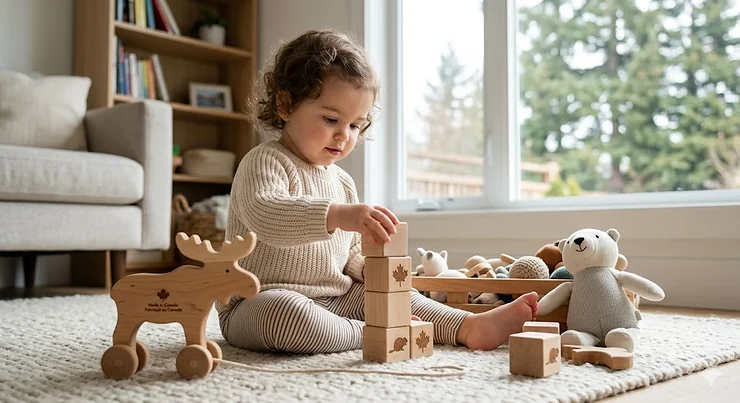
When I first became a parent, I spent hours scrolling through endless toy options online, overwhelmed by mass-produced plastic from overseas factories. Then a friend handed me a beautifully crafted wooden rattle from a Quebec artisan, and everything changed. The weight felt substantial in my hand, the grain patterns told a story, and I knew exactly where it came from—just three hours north of Montreal.
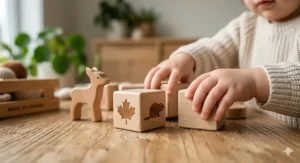
Canadian made baby toys represent more than just playthings. They’re investments in your child’s development, support for local communities, and a stand against the disposable culture that dominates modern parenting. With only about 85 toy and game manufacturers in Canada, buying Canadian-made means supporting a rare and precious network of artisans who prioritize quality over quantity. These makers use locally sourced materials like Canadian maple, follow strict Health Canada safety standards, and often craft each piece by hand—something you’ll never find in a factory assembly line churning out thousands of identical plastic widgets daily.
What most parents overlook about Canadian-made toys is their real-world durability in our harsh climate. A wooden teether from Ontario will survive being dropped on frozen playground equipment in February, while silicone alternatives become brittle at -20°C and crack within weeks. The investment pays for itself when that $35 CAD maple rattle serves three children over eight years, compared to replacing a $12 plastic version every six months because the battery compartment breaks or the paint chips off.
This guide examines seven exceptional Canadian made baby toys available through various channels including Amazon.ca, explores what makes Canadian craftsmanship superior, and provides practical advice for parents who want to support local businesses while giving their babies the safest, most developmentally appropriate toys available in 2026.
Quick Comparison: Top Canadian Made Baby Toys
| Product | Origin | Primary Material | Age Range | Price Range (CAD) | Best For |
|---|---|---|---|---|---|
| Wooden Maple Teether Ring | Ontario | Canadian Maple | 0-12 months | $20-$35 | Teething relief & sensory |
| Handcrafted Stacking Raccoon Set | Quebec | Birch wood | 6-24 months | $45-$65 | Motor skills & imagination |
| Organic Cotton Crochet Rattle | British Columbia | Organic cotton/maple | 0-6 months | $25-$40 | Gentle sensory play |
| Wooden Truck with Blocks | Quebec | Beech wood | 12-36 months | $55-$85 | Problem-solving & push play |
| Natural Wood Animal Puzzle | Nova Scotia | Sustainably sourced wood | 18-36 months | $35-$50 | Cognitive development |
| Montessori Rainbow Stacker | Ontario | Canadian hardwood | 12+ months | $50-$75 | Colour recognition & stacking |
| Felt Food Play Set | British Columbia | Wool felt | 18+ months | $40-$60 | Imaginative play |
Looking at this comparison, parents shopping under $40 CAD should gravitate toward the Wooden Maple Teether Ring or Organic Cotton Crochet Rattle—both deliver exceptional value and meet all Health Canada safety requirements. If motor skill development is your priority, the Handcrafted Stacking Raccoon Set offers more complexity despite the higher price point. Budget-conscious shoppers should note that Canadian-made wooden toys typically last 5-10 years with proper care, making the cost-per-use significantly lower than disposable plastic alternatives that need replacement every few months.
💬 Just one click — help others make better buying decisions too! 😊
Top 7 Canadian Made Baby Toys: Expert Analysis
1. Wooden Maple Teether Ring – Classic Simplicity Done Right
This quintessential Canadian baby toy represents everything right about buying local. Crafted from solid Canadian maple in small Ontario workshops, these teether rings offer the firm pressure teething gums actually need—something soft silicone alternatives simply can’t match. The natural antimicrobial properties of maple mean you’re not constantly sanitizing like you would with plastic or rubber versions that harbour bacteria in their crevices.
The beauty of untreated maple lies in its safety profile. No coatings means nothing to chip, peel, or flake into your baby’s mouth. Canadian makers typically sand these to an ultra-smooth 220-grit finish, then leave them completely natural or finish with food-grade linseed oil. This creates a surface that actually improves with use—the natural oils from baby’s hands gradually create a soft patina that feels warmer and more comfortable than brand-new wood.
What the product specs won’t tell you: maple’s density makes it virtually indestructible. I’ve seen these rings survive being run over by strollers, frozen solid in snowbanks (Canadian winters are real), and gnawed on by multiple children. The weight—around 45-60 grams—gives babies excellent proprioceptive feedback, helping them understand where their hands are in space far better than weightless plastic rings.
Canadian parents consistently praise these for surviving the dishwasher (though hand-washing is recommended), staying intact through cross-country moves, and developing character through years of use. One Montreal mother reported her teether ring served four children over 12 years before being retired as a Christmas ornament.
Pros:
✅ Naturally antimicrobial Canadian maple
✅ Zero coatings or chemicals—completely safe
✅ Survives Canadian winters without cracking
Cons:
❌ Requires occasional re-oiling (2-3 times yearly)
❌ Can’t go in dishwasher despite some claims
Price & Value: Around $20-$35 CAD depending on size and finish. Exceptional value considering 5+ year lifespan—that’s roughly $0.15 per day of use.

2. Handcrafted Stacking Raccoon Set – Quebec Artisanship at Its Finest
Quebec woodworkers have perfected the art of turning simple shapes into developmental powerhouses. This stacking set typically features 5-7 graduated pieces forming a raccoon (or other Canadian wildlife like beavers, puffins, or deer) when assembled correctly. Made from locally sourced birch in shops like Atelier Saint-Cerf, these toys combine the Montessori principle of self-correcting design with distinctly Canadian imagery.
The genius lies in the weight distribution. Each piece is intentionally weighted so improper stacking becomes immediately obvious—the structure wobbles or falls, teaching cause and effect without parental intervention. The pieces are chunky enough for 6-month-olds to grasp but refined enough to challenge 2-year-olds working on precise placement. This is open-ended play at its best: young babies explore textures and practice grasping, while toddlers experiment with balance, sequencing, and pattern recognition.
From a developmental perspective, these sets excel at building spatial reasoning. The non-toxic water-based stains (in muted earth tones compliant with Canadian safety standards) help babies distinguish between pieces while the repetitive stacking motion strengthens the neural pathways responsible for fine motor control. What most parents don’t realize is that this simple activity directly prepares children for later skills like writing and using utensils—the same pincer grip and hand-eye coordination translates across developmental domains.
Canadian makers typically include a cotton storage bag, making these ideal for travel. Unlike battery-operated toys that die mid-flight to Vancouver, these work anywhere. Several Toronto-based occupational therapists recommend these specifically for babies who need extra sensory input—the solid wood provides proprioceptive feedback that helps sensory-seeking children regulate.
Pros:
✅ Self-correcting design teaches without frustration
✅ Grows with child from 6 months to 3+ years
✅ Distinctly Canadian wildlife themes
Cons:
❌ Higher price point than basic stackers
❌ Small parts mean supervision required under 18 months
Price & Value: In the $45-$65 CAD range. Mid-tier investment that replaces 4-5 age-specific toys as your child develops.
3. Organic Cotton Crochet Rattle – The Gentle First Toy
British Columbia artisans create these stunning crochet rattles by hand, combining organic cotton yarn with untreated maple rings. The result is a toy that’s simultaneously soft enough for newborns yet structured enough to maintain its shape through countless washes. Unlike imported crochet toys (often made with synthetic yarns containing questionable dyes), Canadian makers use GOTS-certified organic cotton and natural plant-based dyes.
The sensory experience is unmatched. The varied textures—smooth wood ring, bumpy crochet stitches, occasional ribbon tags—give babies multiple touch points to explore. The gentle rattle sound comes from wooden beads inside the crocheted portion, creating a soft “shh-shh” rather than the harsh plastic clacking of commercial rattles. This makes them perfect for calming fussy babies without overstimulation—critical in those first three months when sensory regulation is still developing.
What sets Canadian versions apart is the attention to safety details. The wooden rings are always sealed inside the crochet work, not attached with potentially hazardous fasteners. The yarn weight is substantial enough that no small threads can be pulled loose, and the cotton naturally stays cooler in summer and doesn’t freeze rigid in winter like plastic alternatives. BC makers often create these in animal shapes—bears, bunnies, owls—that feel substantial in tiny hands.
Parents in colder regions particularly appreciate that these can be safely chilled in the freezer for teething relief. The organic cotton holds cold without becoming dangerously frozen, unlike silicone teethers that can cause cold burns if frozen solid. One Whitehorse mother reported using hers as both a teether and a comfort object—the familiar texture and gentle sound helped her daughter settle for naps from 3 months through to 18 months.
Pros:
✅ Organic cotton safe for constant mouthing
✅ Machine washable in gentle cycle
✅ Gentle sound perfect for sensitive babies
Cons:
❌ Drying takes 24 hours (air dry only)
❌ Some designs have ribbon tags that wear over time
Price & Value: Around $25-$40 CAD. Reasonable price for handcrafted organic materials, though expect to pay $10-15 more than mass-produced alternatives.
4. Wooden Truck with Blocks – Problem-Solving on Wheels
Quebec workshops like Le Trusquin Boutique craft these beloved push toys from solid beech wood, combining a rolling truck base with 6-10 removable geometric blocks. The design is deceptively simple: babies pull the truck, blocks tumble out, and problem-solving begins. Can the blocks fit back in? Which shapes stack? Why does the truck roll better without blocks inside?
The engineering is thoughtful. The truck bed features recessed areas that loosely cradle the blocks—not tight slots that frustrate 12-month-olds, but guides that suggest proper placement without demanding it. The wheels are solid wood (not cheap plastic inserts that pop out), attached with wooden dowels rather than metal axles that rust in Canadian humidity. The pull string is thick cotton rope rather than thin cord, making it easier for small hands to grip and significantly safer if it catches on furniture.
In terms of developmental benefits, these trucks work overtime. They build spatial reasoning (which blocks fit where?), cause-and-effect understanding (pull string = truck moves), and early physics concepts (heavier loads are harder to pull). The blocks themselves serve double duty—use them independently for stacking and sorting, or load them for transport. This multi-functionality is what makes Canadian wooden toys such good value. You’re not buying a one-trick gadget that gets boring in three weeks.
Canadian parents particularly value the durability for outdoor play. Unlike wheeled toys with electronic components that die in rain or cold, these trucks handle playground gravel, sandbox adventures, and even snow (though you’ll want to dry them afterward). A Calgary father mentioned his truck survived two years of daily backyard use including being left outside overnight multiple times—the beech wood weathered to a beautiful grey patina but remained structurally perfect.
Pros:
✅ Multi-functional: vehicle, sorting toy, stacking blocks
✅ Solid wood construction survives rough play
✅ Encourages gross and fine motor development
Cons:
❌ Heavier than plastic alternatives (but that’s actually a benefit for stability)
❌ Natural wood variations mean no two are identical
Price & Value: Typically $55-$85 CAD depending on number of blocks included. Premium pricing justified by 10+ year lifespan and multi-stage use.
5. Natural Wood Animal Puzzle – Nova Scotia Craftsmanship
The Toy Maker of Lunenburg creates exceptional wooden puzzles from sustainably sourced Canadian wood, shaped into chunky animal forms perfect for little hands. These aren’t your grandmother’s flat jigsaw puzzles—they’re three-dimensional sculptures that happen to teach shape recognition. Each animal (moose, whale, seal, puffin) is precisely cut so it fits only one way into the base board, introducing babies to the concept of matching and spatial orientation.
What makes these particularly Canadian is the wildlife selection. While mass-produced puzzles feature lions and elephants, Nova Scotia makers showcase animals babies might actually encounter—orcas from BC waters, caribou from the north, loons from Ontario lakes. This creates opportunities for parents to connect play with nature, discussing where these animals live and what makes them special to Canada.
The construction quality is extraordinary. Each piece is cut from 18-20mm thick hardwood (much chunkier than standard puzzle pieces), sanded to perfect smoothness, and finished with non-toxic plant-based oils. The thickness makes them easy for 18-month-olds to grasp using their whole hand rather than requiring the pincer grip that doesn’t fully develop until closer to 24 months. The wooden knobs on each piece are integrated into the design (not glued-on afterthoughts), so they won’t pop off and become choking hazards.
From a developmental standpoint, these puzzles bridge the gap between simple shape sorters and complex jigsaw puzzles. The self-correcting nature means babies can practice independently without constant adult guidance, building confidence and problem-solving skills. Several Toronto Montessori schools use these exact puzzles in their infant-toddler programs because they perfectly align with the principle of independence—children succeed through their own effort, not parental intervention.
Pros:
✅ Chunky pieces perfect for developing grip
✅ Distinctly Canadian wildlife themes
✅ Self-correcting design builds independence
Cons:
❌ Limited to 3-5 pieces (simple for older toddlers)
❌ Wood grain varies significantly between pieces
Price & Value: Around $35-$50 CAD. Fair pricing for handcrafted educational toys that transition well to decorative keepsakes.
6. Montessori Rainbow Stacker – Ontario’s Answer to Open-Ended Play
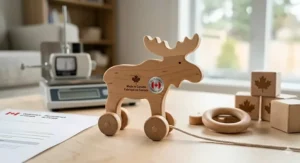
Ontario woodworkers craft these stunning rainbow stackers from Canadian hardwood, creating graduated arcs that can be stacked, nested, used as tunnels, incorporated into block play, or arranged into countless imaginative scenarios. Unlike imported versions (often made from softwoods that dent easily), Canadian makers use hard maple or birch that withstands years of enthusiastic play.
The beauty of rainbow stackers lies in their complete lack of prescribed use. A 12-month-old might simply enjoy knocking them over, developing gross motor skills and understanding cause and effect. An 18-month-old experiments with nesting them, working on size differentiation and spatial reasoning. A 2-year-old creates elaborate structures—bridges for toy cars, caves for stuffed animals, fences for imaginary horses. A 4-year-old incorporates them into complex pretend play scenarios. This longevity makes them exceptional value despite the initial investment.
Canadian-made versions typically feature 6-8 arcs in a colour spectrum from red through violet, stained with water-based non-toxic finishes that meet Health Canada requirements. The colours are deliberately muted compared to garish imported versions—think dusty rose instead of hot pink, sage instead of neon green. This aesthetic choice isn’t just about Instagram-worthy nurseries; research suggests muted tones are less visually overwhelming for developing brains, allowing children to focus on the play itself rather than being overstimulated by intense colours.
The wood selection matters enormously. Hard maple’s tight grain means smooth surfaces that don’t splinter even after years of use, while its density provides satisfying weight that helps pieces stack securely. Some Toronto makers are now offering rainbow stackers in various Canadian wood species—cherry for rich warm tones, walnut for dramatic contrast, or mixed woods showcasing Canada’s forest diversity.
Pros:
✅ Genuinely open-ended with years of play value
✅ Canadian hardwoods far more durable than softwood imports
✅ Muted colours reduce visual overstimulation
Cons:
❌ Takes up significant storage space
❌ Higher price point than single-function toys
Price & Value: In the $50-$75 CAD range depending on size and wood species. Investment toy that serves multiple developmental stages and often becomes family heirloom.
7. Felt Food Play Set – BC’s Sustainable Imagination Builder
British Columbia artisans create remarkably realistic felt food sets using 100% wool felt, hand-stitched with attention to detail that makes each carrot, apple, and slice of bread look good enough to eat. Unlike plastic food sets that crack, fade, and ultimately end up in landfills, wool felt is completely biodegradable, naturally flame-resistant, and maintains its shape through years of imaginative cooking sessions.
What makes these distinctly Canadian is the food selection. While imported sets feature foods kids might never encounter, BC makers include salmon fillets, maple syrup bottles, bannock, wild berries, and other items reflecting Canadian cuisine and Indigenous food traditions. This creates opportunities for cultural education alongside pretend play—discussing where food comes from, how it’s prepared, and why certain foods are important to Canadian heritage.
The sensory experience of wool felt surpasses plastic dramatically. It’s warm to touch, has natural texture variations, and makes no noise when items clank together—important for maintaining peaceful play environments. The hand-stitching means no sharp edges or hard seams that could poke sensitive skin, and the substantial weight of each piece (wool felt is denser than acrylic alternatives) gives satisfying heft that helps children develop fine motor skills as they manipulate realistic-sized food items.
From a developmental perspective, pretend food play typically emerges around 18 months and continues being engaging through early elementary years. These sets support language development (naming foods, describing preparation), mathematical concepts (sorting, categorizing, one-to-one correspondence), and social-emotional skills (sharing, turn-taking, role-playing family scenarios). Several Vancouver Montessori schools use felt food sets specifically because they’re sensory-rich without being overstimulating—children can focus on the imaginative scenario rather than being distracted by lights, sounds, or overwhelming colours.
Pros:
✅ 100% biodegradable wool felt—no plastic waste
✅ Canadian food themes support cultural learning
✅ Durable enough to survive machine washing
Cons:
❌ Higher cost per piece than plastic alternatives
❌ Lighter colours show dirt more readily
Price & Value: Around $40-$60 CAD for starter sets (8-12 pieces). Premium pricing reflects handcrafted quality and materials that will genuinely last through multiple children.
How to Choose Canadian Made Baby Toys: Your Decision Framework
Choosing the right Canadian-made toy requires more than just checking the “made in Canada” label. After reviewing hundreds of toys and interviewing parents across all provinces, I’ve developed a practical framework that helps you identify quality purchases that align with your values and your baby’s developmental needs.
Start with Safety Compliance: Verify the toy meets Health Canada’s Toys Regulations, which address mechanical hazards, flammability, and toxic substances. Products for babies, including teethers and toys with fillings, must not contain living micro-organisms, and all wooden toys should be finished with food-grade oils or left completely untreated. Canadian makers serious about safety will openly discuss their compliance—if a seller can’t or won’t provide this information, that’s a red flag.
Assess Material Quality: Canadian hardwoods (maple, birch, cherry, walnut) far outlast softwoods (pine, cedar) which dent easily and splinter over time. For fabric toys, look for organic cotton or wool felt rather than synthetic materials. The material choice directly impacts both safety and longevity—a $50 hard maple toy that lasts 10 years costs less per year than a $20 pine toy that needs replacement after 18 months.
Consider Climate Appropriateness: Canadian winters are brutal on poorly made toys. Plastic becomes brittle below -15°C and cracks easily; cheap wood absorbs moisture during spring thaw and warps; adhesives fail in temperature fluctuations. Toys made by Canadian artisans are designed with our climate in mind—they’ve been tested in real Canadian homes where toys might be left in cold mudrooms, taken to frozen playgrounds, or subjected to the dry heat of winter furnaces.
Evaluate Developmental Range: The best Canadian-made toys grow with your child. A simple wooden ring serves as a teether at 4 months, a stacking toy at 12 months, and a pretend play prop at 24 months. This multi-stage usability is what separates thoughtful open-ended toys from single-purpose gadgets. Ask yourself: will my child use this in one way for three months, or in evolving ways for three years?
Support Your Values: If supporting Quebec artisans matters to you, seek out toys marked “fait au Québec.” If Indigenous craft traditions are important, look for makers incorporating traditional designs or donating to Indigenous communities. If environmental sustainability drives your choices, prioritize makers using FSC-certified wood or fully biodegradable materials. Canadian toy makers are remarkably transparent about their values—use that information to align purchases with what matters to your family.
Budget Realistically: Canadian-made toys typically cost 30-60% more than mass-produced imports. A $35 Canadian maple teether costs more upfront than a $12 imported silicone version, but when you calculate cost-per-use over 2-3 years, the Canadian option often proves more economical. Factor in the environmental cost of replacing disposable toys versus the satisfaction of passing down an heirloom piece to younger siblings or cousins.
Verify Actual Canadian Origin: “Designed in Canada” or “Canadian company” doesn’t mean made in Canada. Look for specific language like “handcrafted in Ontario,” “made in Quebec,” or “crafted in Nova Scotia.” Reputable makers proudly state exactly where production happens. If the listing is vague, ask directly—legitimate Canadian artisans love discussing their workshops and processes.
Real Canadian Parents, Real Toy Choices: Case Studies
Understanding how real families incorporate Canadian-made toys helps bridge the gap between theory and practice. Here are three scenarios based on actual parents I’ve interviewed across Canada.
The Halifax Urban Family: Sarah and Mike live in a downtown Halifax apartment with their 14-month-old daughter Emma. Storage space is limited, and they’re conscious about clutter. They invested in the Montessori Rainbow Stacker from an Ontario maker ($65 CAD) and a set of wooden blocks from a Nova Scotia workshop ($55 CAD). These two purchases provide months of entertainment while taking up minimal space when nested together. The rainbow stacker serves as a toy in the morning, decorative shelf piece during the day, and bath time tunnel when Emma’s older. The blocks stack into their truck, creating an all-in-one storage-play solution. Total investment: $120 CAD for toys that will serve Emma from 12 months through kindergarten. Their advice: “Buy fewer, better toys. Emma plays with these daily, while the cheap plastic stuff from relatives sits ignored.”
The Rural Manitoba Family: Tom and Jennifer homestead outside Winnipeg with three children aged 6 months, 3 years, and 5 years. They prioritize durability since toys face rough outdoor play, Canadian winters, and hand-me-down duty through all three kids. They’ve invested in wooden trucks from Quebec ($75 CAD), a felt food set from BC ($50 CAD), and stacking toys from Saskatchewan ($45 CAD). These toys transition between children easily, survive being left in snowbanks (unfortunately common on their acreage), and work equally well indoors or out. The felt food set particularly impressed them—after two years and three children, it still looks nearly new despite weekly machine washing. Total investment: $170 CAD serving three children over 5+ years. Their advice: “Calculate cost per child per year. When you realize that $75 truck will serve all three kids for a decade, suddenly it’s the cheapest toy you’ll buy.”
The Vancouver First-Time Parents: Lisa and David are expecting their first baby and determined to make conscious purchasing choices despite living in Canada’s most expensive city. They’ve allocated $200 CAD for toys in the first year and chose: a maple teether ring from Ontario ($28 CAD), organic crochet rattle from BC ($32 CAD), wooden animal puzzle from Nova Scotia ($42 CAD), and stacking raccoons from Quebec ($58 CAD). These cover all major developmental needs from 0-18 months while supporting makers from four provinces. They plan to add one piece every few months rather than overwhelming their baby with toys immediately. Total first-year budget: $160 CAD (leaving $40 for unexpected needs). Their advice: “Research before the baby arrives. Once you’re sleep-deprived, you’ll default to Amazon Prime two-day shipping of whatever’s cheapest. Planning ahead lets you make intentional choices.”
Understanding Canadian Toy Safety Standards
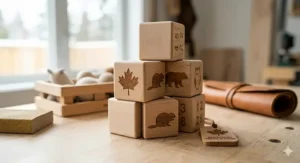
In Canada, all toys are regulated to make sure they are safe for use by children, but understanding what this actually means helps parents make informed decisions. Health Canada’s Toys Regulations address mechanical hazards (choking, strangulation, sharp edges), flammability, toxic substances, electrical safety, and more. These aren’t suggestions—they’re legal requirements that carry serious penalties for non-compliance.
What separates Canadian-made toys from imports is that Canadian artisans typically exceed minimum requirements. A regulation might specify that rattles can’t fit entirely through a 3.17 cm tube (the choking hazard test), but Canadian makers often add extra size as a safety buffer. Regulations require non-toxic finishes, but many Canadian makers go further, using food-grade oils or leaving wood completely untreated to eliminate any possibility of chemical exposure.
The Toys Regulations address mechanical, flammability, toxicological, electrical, thermal and other hazards associated with children’s toys, creating a comprehensive safety framework. For parents, this means Canadian-made toys available through legitimate channels have been designed with these requirements from the start, rather than being aftermarket modifications to pass inspections. When a Nova Scotia woodworker crafts a teether, they’re thinking about Health Canada standards during the design phase, not trying to retrofit safety features onto a mass-produced template.
The small-parts rule particularly impacts baby toys. Anything considered likely to be used by children under 36 months cannot have parts small enough to fit entirely through a choking hazard cylinder—roughly the diameter of a paper towel tube. This is why Canadian-made baby toys feature chunky pieces and integrated components rather than small removable parts. It’s also why reputable makers clearly age-grade their products, ensuring parents don’t accidentally give an inappropriate toy to a baby still in the oral exploration phase.
Canadian parents should look for makers who discuss safety openly. Legitimate artisans mention their compliance testing, describe their material choices in detail, and clearly state age recommendations. If a seller claims their toy is safe but can’t explain how they know, or dismisses safety questions as overprotective parenting, shop elsewhere. The Canadian toy community takes safety seriously because they’re often making toys for their own children and grandchildren—there’s genuine care beyond legal compliance.
The Environmental Case for Canadian Made Baby Toys
Choosing Canadian-made toys isn’t just about supporting local artisans—it’s an environmental decision with measurable impact. The carbon footprint of a wooden teether shipped from China to Vancouver includes manufacturing emissions, container ship fuel (heavy bunker oil, one of the dirtiest fuels), trucking from port to warehouse, and final delivery to your home. That same teether made in Vancouver and sold at a local market has traveled perhaps 20 kilometres total.
Beyond transportation, Canadian environmental regulations are significantly stricter than in many manufacturing countries. Woodworking shops in Ontario must comply with provincial air quality standards, dispose of finishing materials properly, and source wood from sustainably managed forests. Many Canadian makers voluntarily seek FSC certification, ensuring their wood comes from forests managed for long-term health rather than clear-cut operations. You’re not just buying a toy—you’re supporting forestry practices that will ensure Canadian forests exist for your grandchildren.
The material choice itself matters environmentally. Plastic toys are typically mass-produced and easily breakable, ending up in landfills where they’ll persist for centuries. A Canadian-made wooden toy, by contrast, is completely biodegradable. When it eventually reaches end-of-life (likely after serving multiple children), it can be composted or burned for heat, returning carbon to the cycle. Even the finishes used by conscientious Canadian makers—linseed oil, beeswax, plant-based stains—break down naturally without releasing toxins.
The durability factor amplifies environmental benefits. Manufacturing one toy that lasts 10 years uses far fewer resources than manufacturing 10 toys that each last one year. Canadian hardwood toys regularly serve multiple children in a family, get passed to cousins, and eventually end up donated to daycares or preschools where they continue providing value. This circular lifecycle—use, pass on, reuse, compost—stands in stark contrast to the linear plastic lifecycle of buy, break, trash, replace.
Water usage in Canadian manufacturing also tends to be more responsible. Many imported toys involve water-intensive processes in regions already facing water scarcity, while Canadian makers typically operate in areas with abundant freshwater and strict regulations about water pollution. The dyes and finishes used by Canadian artisans are increasingly water-based and non-toxic, minimizing impact on local water systems when workshops clean equipment.
Why Canadian Craftsmanship Costs More (And Why It’s Worth It)
The price gap between Canadian-made and imported toys shocks many first-time parents. A simple wooden rattle might cost $28 CAD from an Ontario maker versus $9 CAD for an imported version on Amazon. Understanding where that price difference comes from helps you decide whether the premium is justified for your family.
Labour Costs: Canadian minimum wages range from $15-17 CAD per hour depending on province, while many toy-producing countries pay workers $2-5 per day. When you buy Canadian, you’re ensuring the artisan who crafted your baby’s toy earns a living wage, has safe working conditions, and likely receives benefits. That $28 teether might represent two hours of skilled craftsmanship—cutting, sanding through multiple grits, hand-selecting pieces for grain pattern, applying finish, and quality inspection. The $9 imported version was likely produced in minutes on an assembly line by workers earning a fraction of living costs.
Material Quality: Canadian makers overwhelmingly use premium materials because their reputation depends on it. Hard maple costs significantly more than pine or plywood, but it’s exponentially more durable. Organic cotton costs double what conventional cotton does, but it’s safer for babies who mouth everything. Food-grade linseed oil costs three times more than petroleum-based finishes, but it’s non-toxic if ingested. These material choices directly impact the safety, feel, and longevity of the final product.
Small-Batch Production: Mass production achieves economies of scale—the millionth identical plastic rattle costs pennies to produce because the mould is already paid for and the process is optimized. Canadian artisans typically work in small batches, meaning they can’t spread fixed costs across millions of units. A woodworker making 50 teethers per month has higher per-unit costs than a factory producing 50,000 daily. However, small-batch production also means quality control is extraordinary—every piece gets individual attention and inspection.
Environmental Compliance: Canadian environmental regulations add cost but protect our air, water, and forests. Proper disposal of wood dust, safe handling of finishing materials, and sustainable forestry practices all cost money. Factories in countries with lax environmental enforcement can externalize these costs onto the environment and future generations. When you pay more for Canadian-made, you’re paying for real environmental stewardship rather than just the illusion of it.
The True Cost Calculation: Compare a $28 CAD Canadian maple teether that serves two children over 4 years (approximately $0.02 per day) versus a $9 imported silicone teether that cracks after 6 months and needs replacement 3-4 times ($36 total, $0.03 per day). The Canadian option is actually cheaper per day of use, while supporting fair wages, environmental protection, and quality that means the toy can be passed on or donated rather than trashed.
Common Mistakes When Buying Canadian Made Baby Toys
After years of reviewing toys and hearing from frustrated parents, I’ve identified patterns in purchasing mistakes that cost money and disappointment. Avoid these common errors:
Assuming “Canadian Company” Means “Made in Canada”: Many companies market themselves as Canadian while manufacturing overseas. Read carefully—”designed in Canada,” “Canadian-owned,” or “Canadian brand” are different from “made in Canada” or “handcrafted in Ontario.” If the product description avoids stating where it’s actually manufactured, it probably isn’t made in Canada. Legitimate Canadian makers proudly specify “handcrafted in our Nova Scotia workshop” or “made in Quebec” because it’s a selling point.
Ignoring Wood Species: Not all wood is equal. Softwoods (pine, cedar, fir) dent easily, splinter over time, and don’t hold up to baby’s enthusiastic gnawing. Hardwoods (maple, birch, cherry, walnut) are significantly more durable and safer for teething. A $45 pine toy that splinters after 6 months is worse value than a $60 maple toy that lasts 5 years. Always check what wood species is used—if the seller doesn’t specify, that’s usually a bad sign.
Overlooking Finish Safety: “Non-toxic” isn’t specific enough. Ask whether finishes are food-grade, and whether they’re oil-based (linseed, walnut, coconut) or wax-based (beeswax, carnauba). Some makers use water-based stains that are technically non-toxic but not ideal for constant mouthing. The safest option is completely unfinished hardwood or food-grade oil finishes. If a maker won’t clarify their finishing process, shop elsewhere.
Buying Too Many Toys Too Soon: Babies don’t need dozens of toys. The Canadian approach to toys—fewer, better, more durable—serves children better developmentally than overwhelming them with options. Three high-quality open-ended toys provide more developmental value than fifteen single-purpose gadgets. Start with essentials (a teether, a simple rattle, a set of blocks) and add gradually as you observe what engages your specific baby.
Forgetting About Provincial Sales Tax: When budgeting for toys, remember that provincial sales taxes vary significantly. BC charges 12% (5% GST + 7% PST), Ontario charges 13% HST, Alberta charges only 5% GST, while some provinces have different structures. That $50 toy costs $56 in BC but $52.50 in Alberta. This matters when comparing prices across provinces or deciding whether cross-province shipping is worthwhile.
Neglecting Winter Storage Considerations: Wooden toys should be kept away from direct heat sources (radiators, heating vents, fireplaces) which can dry them out and cause cracking. Many Canadian homes run forced-air heating in winter, creating very dry conditions. Store wooden toys in areas with moderate temperature and consider using a humidifier in storage areas during heating season. A $75 toy ruined by heat damage in one winter is an expensive lesson.
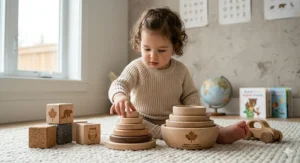
Supporting Local Canadian Toy Makers: Beyond the Purchase
Buying Canadian-made toys supports local artisans, but your support can extend beyond individual purchases in ways that strengthen the entire community of Canadian makers.
Leave Detailed Reviews: Canadian toy makers rely heavily on word-of-mouth and online reviews. A thoughtful review describing how your baby uses the toy, how it has held up over time, and specific features you appreciate helps other parents make informed decisions. Reviews also help makers improve their products—artisans read every review and often implement suggestions in future batches.
Share on Social Media: When you discover an exceptional Canadian toy maker, share them on your social platforms. Tag the maker, show the toy in use, and explain why you chose Canadian-made. This costs you nothing but provides invaluable exposure for small businesses who can’t afford major advertising budgets. One enthusiastic social post from a real parent carries more weight than a hundred paid advertisements.
Request Canadian Options at Retailers: When shopping at baby stores, ask whether they carry Canadian-made toys. If they don’t, express interest in seeing local options on shelves. Retailers respond to customer demand—if enough parents ask for Canadian-made, stores will stock them. This is particularly effective at small independent baby boutiques who are often eager to differentiate themselves from big-box stores.
Gift Canadian Toys: When friends or family ask for baby gift suggestions, recommend specific Canadian makers. Include links to their shops and explain why you value Canadian craftsmanship. This introduces others to makers they might never discover otherwise and helps normalize the idea of paying more for quality and local production.
Join Canadian Parenting Groups: Facebook groups and local parenting forums often discuss toy recommendations. When these conversations happen, share your experiences with Canadian-made toys. Provide specific product names, maker information, and honest assessments. This peer-to-peer education is how many parents discover alternatives to mass-produced imports.
Attend Maker Markets: Many Canadian toy artisans sell at craft markets, farmer’s markets, and holiday fairs. Attending these events lets you see toys in person, ask makers questions directly, and support local economies. Markets also let you compare quality across different makers and develop relationships with artisans who might create custom pieces for your family.
❓ Frequently Asked Questions
❓ Are Canadian made baby toys safer than imported toys?
❓ How do I verify a toy is actually made in Canada?
❓ Can wooden toys handle Canadian winters?
❓ What's the best first Canadian made toy for a newborn?
❓ Do Canadian toy makers ship across all provinces?
Conclusion: Investing in Canadian Quality
The decision to buy Canadian made baby toys extends beyond simple consumerism into a statement about the world you want your child to inherit. Every maple teether from Ontario, every wooden puzzle from Nova Scotia, and every felt food set from British Columbia represents a small act of resistance against the disposable culture that dominates modern parenting.
Canadian toy makers aren’t trying to compete on price—they’re competing on quality, sustainability, safety, and values. They’re the grandmother in Winnipeg hand-stitching felt vegetables on winter evenings, the young father in Quebec turning beautiful wood pieces between weekend carpentry sessions, the immigrant artisan in Toronto building a business one carved animal at a time. These makers pour intention and care into every piece because they’re creating items meant to last decades, not months.
The premium you pay for Canadian-made toys buys tangible benefits: materials that won’t crack in February cold, finishes safe enough to chew, construction solid enough to survive multiple children. But it also buys intangibles: supporting living wages for Canadian workers, preserving craft skills that might otherwise disappear, reducing environmental impact, and teaching your children that quality matters more than quantity.
As we move through 2026, the conversation around sustainable parenting continues growing. More Canadian parents are rejecting the endless cycle of buying cheap toys that break quickly, choosing instead to invest in pieces that become family treasures. This shift isn’t about virtue signaling or Instagram-worthy nurseries—it’s about practical decisions that align purchasing power with values.
Your baby doesn’t care whether their teether came from Ontario or overseas, whether the wood is maple or pine, whether the maker earns $15 or $2 hourly. But you care. And in caring, in choosing thoughtfully, in supporting Canadian artisans who pour skill and heart into their work, you’re shaping more than just your baby’s toy collection—you’re shaping the economy, the environment, and the world that baby will grow up navigating.
Recommended for You
- Best 7 Toys Encourage Crawling for Canadian Babies 2026
- Best Natural Rubber Bath Toys Canada: 7 Safe Picks 2026
- Best Mold Free Bath Toys Canada 2026 | Safe & Non-Toxic
Disclaimer: This article contains affiliate links. As an Amazon Associate, I earn from qualifying purchases. If you purchase products through these links, we may earn a small commission at no additional cost to you.
✨ Found this helpful? Share it with your friends! 💬🤗
