
In This Article
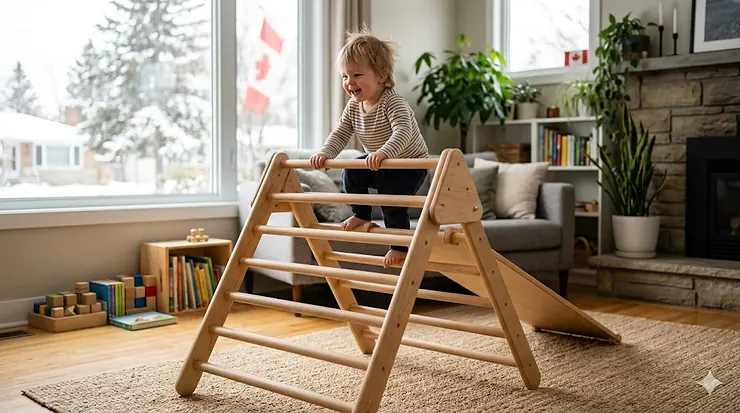
It’s February in Calgary. The windchill is −28°C, the backyard is buried under half a metre of snow, and your two-year-old has been bouncing off the walls — literally — since 7 a.m. Sound familiar? Every Canadian parent knows this scene. That’s exactly why indoor climbing toys for toddlers aren’t a luxury here; they’re practically a survival tool.
What are indoor climbing toys for toddlers, exactly? They’re a category of soft play equipment and structured climbing frames — foam block sets, Pikler triangles, mini trampolines, and modular jungle gyms — specifically engineered for safe, active indoor play in children roughly 1 to 4 years old, supporting gross motor development, balance, and spatial reasoning.
But here’s what the Amazon product listings won’t tell you: not all of these toys are built equally, and some that shine on paper fall apart under the real conditions of Canadian family life — sticky humidity in July, dry static-charged winters in January, apartment living in Toronto, or multi-kid households in suburban Edmonton. I’ve dug into what’s actually available on Amazon.ca, cross-referenced customer feedback, and applied a lens shaped by Canadian climate, safety regulations, and real-world apartment constraints. Whether you’re looking for the best indoor playground for a toddler on a budget or a premium Montessori-style gym that will survive three kids and a dog, this guide has you covered.
Quick Comparison: Best Indoor Climbing Toys for Toddlers in Canada 2026
| Product | Type | Age Range | Price Range (CAD) | Best For |
|---|---|---|---|---|
| Tiny Land Pikler Triangle Set 7-in-1 | Wooden Montessori | 12 mo – 6 yr | $150–$220 | Montessori families, mid-range budget |
| BlueWood Pikler Triangle Set 8-in-1 with Cushion | Wooden with cushion | 12 mo – 6 yr | $180–$250 | Safety-conscious buyers, soft landings |
| CAMELUS 6-Piece Foam Climbing Blocks | Foam soft play set | 6 mo – 3 yr | $100–$150 | Apartments, babies & young toddlers |
| VEVOR 6-Piece PU Leather Foam Climber | Foam soft play set | 6 mo – 3 yr | $90–$140 | Easy-clean, budget-friendly families |
| YOLEO Large Pikler Triangle Set 7-in-1 | Wooden, adjustable height | 12 mo – 5 yr | $120–$180 | Families with multiple kids, long-term use |
| MIND&ACTION 6-Piece Foam Climbing Blocks | Foam soft play set | 12 mo – 3 yr | $80–$130 | First-time buyers, small spaces |
| Little Tikes 3-in-1 Deluxe Climb & Slide | Plastic indoor gym | 9 mo – 3 yr | $80–$120 | Youngest toddlers, budget shoppers |
The table above highlights how the market neatly splits into two categories: wooden Montessori-style frames for older toddlers who want a real challenge, and foam soft play sets for babies and younger kids who are just beginning to pull themselves up. The BlueWood’s bundled cushion is a genuine differentiator worth the extra CAD spend if you have hardwood or tile floors — something a lot of Canadian urban apartments have. Budget buyers should note that MIND&ACTION and VEVOR sacrifice some size and premium finishes to hit their lower price points, but both remain surprisingly solid performers for casual daily use.
💬 Just one click — help others make better buying decisions too!😊
✨ Don’t Miss These Exclusive Deals!
🔍 Take your toddler’s active play to the next level with these carefully selected products. Click on any highlighted item to check current pricing and availability on Amazon.ca. These tools will help you create an indoor playground your little one will absolutely love!
Top 7 Indoor Climbing Toys for Toddlers: Expert Analysis
1. Tiny Land Pikler Triangle Set 7-in-1 Foldable Wooden Climbing Toys
The Tiny Land Pikler Triangle Set is one of the most well-rounded wooden climbing sets on Amazon.ca, and it earns that reputation honestly. Built around the principles of Montessori philosophy, it includes a triangle ladder, reversible ramp (doubles as a slide), and a climbing arch that flips into a rocker — seven distinct play configurations from three core pieces.
The natural-finish birch wood frame supports children up to approximately 45 kg (99 lbs), which in practice means this set will comfortably carry one toddler through to early school age without wobbling. The foldable hinge mechanism is where Tiny Land earns real points for Canadian homes: when folded flat, the frame stows behind a sofa or in a closet — a genuine consideration for those in smaller Toronto condos or Vancouver townhouses where square footage is precious. The rungs are sanded to a smooth finish and spaced widely enough that small feet can grip confidently.
In my assessment, the Tiny Land is best suited to families who want a Montessori climbing toys toddlers can grow with rather than out of quickly. It’s not the flashiest option on this list, but its clean design fits naturally into most Canadian living rooms without dominating the space.
Canadian buyers note that the natural wood version ships from Amazon.ca warehouses without customs delays. The rainbow version is equally popular and adds visual stimulation for younger toddlers.
✅ Foldable and compact for apartment storage
✅ 7 versatile play configurations
✅ Smooth, splinter-resistant natural birch wood
❌ No cushion included — add a foam mat underneath
❌ Assembly takes 20–30 minutes on first setup
Price range: around $150–$220 CAD. Check current price on Amazon.ca.
2. BlueWood Pikler Triangle Set 8-in-1 with Cushion, Foldable Wooden Climbing Toys
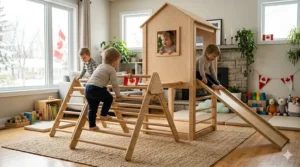
If safety margins are your top priority — and for many Canadian parents on hardwood floors, they absolutely should be — the BlueWood Pikler Triangle Set with Cushion is the standout choice. What separates BlueWood from its competitors isn’t the wooden frame itself (which is excellent) but the included cushioned ramp mat. This is not a token foam pad; it’s a generously sized mat that noticeably softens the landing zone under the slide configuration, particularly important when you’re dealing with a tumble-prone 18-month-old who hasn’t quite mastered the controlled descent.
The 8-in-1 configuration adds a balance beam and an extra climbing component compared to the base 7-in-1 designs. The frame itself is natural solid wood with a weight capacity of roughly 68 kg (150 lbs), which gives it multi-child durability — a meaningful feature for families in the suburbs of Ottawa or Winnipeg who host plenty of playdates. BlueWood also uses a “Transparency” verification code on each unit, which is a reassuring quality control measure for parents concerned about counterfeit products on Amazon.ca.
The trade-off is price — BlueWood sits at the higher end of the wooden frame category in CAD. But when you factor in the cushion (which would cost $40–$60 CAD separately), the value proposition closes considerably.
✅ Bundled cushion mat — significant safety upgrade on hard floors
✅ 8 play configurations for extended development value
✅ Solid wood frame verified for quality with transparency codes
❌ Highest price point in the wooden frame category
❌ Bulkier to store than non-cushion alternatives
Price range: around $180–$250 CAD. Check current price on Amazon.ca.
3. CAMELUS Toddler Climbing Toys Indoor 6-Piece Baby Foam Climbing Blocks with Ball Pit
For Canadian families with babies and younger toddlers — roughly 6 to 18 months — the CAMELUS 6-Piece Foam Climbing Blocks set is a top-tier choice, and here’s why: it’s fundamentally designed around the crawling and early-climbing phase rather than the confident-walker phase. The six-piece PU leather-covered foam blocks include a ramp section, a flat climbing step, a wedge, and a ball pit frame — all of which reconfigure into dozens of soft play layouts.
The PU leather covering deserves special mention for Canadian households. Unlike fabric covers, PU leather wipes clean in seconds — critical in a country where muddy boots, spilled juice, and the occasional craft-time disaster are facts of life. The high-density foam core holds its shape through hundreds of use cycles without compressing flat, which is a real problem with cheaper foam alternatives after about three months of enthusiastic toddler use.
Parents across Canada give this set high marks for its durability and the surprisingly generous size of the pieces — each block is large enough that even a vigorous toddler can’t easily knock the whole structure over. The ball pit component is a delightful bonus, though it requires balls to be purchased separately (budget an extra $15–$25 CAD for a bag of soft balls).
This is hands-down the best indoor playground toddler option for families with hardwood floors and a baby under 18 months. The low profile means even a wobbly first-time climber can’t take a dangerous fall.
✅ PU leather — easy to wipe clean, critical for Canadian family life
✅ High-density foam resists permanent compression
✅ Low-profile design ideal for very young toddlers
❌ Balls not included — extra purchase needed
❌ Takes up significant floor space when fully laid out
Price range: around $100–$150 CAD. Check current price on Amazon.ca.
4. VEVOR 6-Piece PU Leather Foam Climbing Toys for Toddlers
The VEVOR 6-Piece Foam Climbing Set enters the market as the value-per-square-centimetre champion on this list. VEVOR as a brand is well-known among Canadian Amazon.ca shoppers for producing functional, no-frills equipment at competitive CAD price points, and their foam climbing set lives up to that reputation. The PU leather finish is wipeable and water-resistant (essential if you’re in a humid basement playroom), and the six-piece set offers enough configuration variety to keep a toddler engaged through multiple rainy-day sessions — an important consideration given Canada’s lengthy indoor season from October through April in most provinces.
What most buyers overlook about the VEVOR set is the weight-to-size ratio: the pieces are noticeably lighter than competitors like CAMELUS, which makes it easier for parents to rearrange the layout mid-play or store the pieces vertically along a wall. This is a real advantage in a Vancouver apartment where every square metre counts. The trade-off is that the foam density is slightly lower, which means very active older toddlers (2.5–3 years) who throw themselves into the blocks with abandon may eventually notice some compression at the climbing edges.
Canadian reviewers frequently mention it as the best “starter” soft play equipment purchase — buy this first, see how much use it gets, then upgrade to a Pikler triangle when the child is ready for vertical climbing.
✅ Lightweight and easy to reconfigure during play
✅ Budget-friendly CAD price makes it accessible for most families
✅ PU leather is water-resistant — great for basement playrooms
❌ Slightly lower foam density than premium alternatives
❌ Not ideal for very active 3-year-olds — consider a wooden set instead
Price range: around $90–$140 CAD. Check current price on Amazon.ca.
5. YOLEO Large Pikler Triangle Set 7-in-1 with Adjustable Height
The YOLEO Large Pikler Triangle Set is the long-game investment on this list, and its standout feature is one that no other wooden frame on Amazon.ca offers at this price point: a 3-level height-adjustable mechanism at the base. Most Pikler triangle sets are fixed — you buy them for your 18-month-old, they work brilliantly, and then your four-year-old finds them too easy. The YOLEO solves that problem by letting you raise the frame height as the child grows, essentially future-proofing your purchase for $20–$30 CAD less than the BlueWood premium tier.
Crafted from FSC-certified natural wood — a sustainability credential worth noting for eco-conscious Canadian families — the frame features 14 rung bars on a notably wider-than-average ladder, which means siblings can actually climb side-by-side without the usual toddler traffic jam. The reinforced H-base adds stability that parents with wiggly, fearless toddlers will genuinely appreciate.
For a family in suburban Mississauga or Edmonton with two kids aged 2 and 4, the YOLEO is arguably the most financially rational choice on this entire list. One set serves both children across multiple developmental stages, and the FSC wood credential gives it genuine appeal for buyers who care about sustainable sourcing.
✅ Height-adjustable design grows with the child — exceptional long-term value in CAD
✅ FSC-certified wood — appealing to eco-conscious Canadian families
✅ Extra-wide ladder supports side-by-side play for siblings
❌ No cushion or ramp mat included — factor in accessories cost
❌ H-base design is bulkier to fold than pin-hinge alternatives
Price range: around $120–$180 CAD. Check current price on Amazon.ca.
6. MIND&ACTION 6-Piece Foam Climbing Blocks for Toddlers 1–3
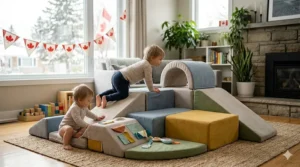
The MIND&ACTION 6-Piece Foam Climbing Blocks set is the quiet workhorse of the soft play category on Amazon.ca. It doesn’t have the name recognition of CAMELUS or the bulk-buying appeal of VEVOR, but it hits a sweet spot that first-time buyers often miss: it’s sized specifically for the 12–36 month range, meaning the pieces aren’t so large that a small apartment becomes impassable, but aren’t so small that they tip over when a determined toddler tries a running start.
The six-piece set includes a tunnel piece — a feature that’s genuinely rare at this price point — which transforms the set from a simple climbing obstacle into a full crawl-through sensory circuit. For winter indoor exercise in a 900 sq ft condo in downtown Montréal, this kind of circuit play (crawl, climb, slide, repeat) is essentially the closest thing to a playground run that a toddler can get indoors. Parents report that the Velcro straps holding the pieces together are surprisingly robust, and the covers zip off for washing — a meaningful advantage given the inevitable spill situations.
MIND&ACTION is an underrated choice for parents buying their first indoor soft play set who aren’t sure how much use it’ll get. At its CAD price point, the risk is low and the upside — a toddler who naps properly because they actually burned energy — is very high.
✅ Tunnel piece adds crawl-through sensory circuit — rare at this price
✅ Zip-off, washable covers — practical for Canadian family life
✅ Compact footprint suits smaller apartments
❌ Foam density is entry-level — best for ages 1–2.5 years
❌ Less versatile than larger 8+ piece sets
Price range: around $80–$130 CAD. Check current price on Amazon.ca.
7. Little Tikes 3-in-1 Deluxe Climb & Slide
Little Tikes is one of those brands that Canadian parents quietly trust because it’s been in Canadian toy stores for decades. The Little Tikes 3-in-1 Deluxe Climb & Slide earns its place on this list not because it’s the most sophisticated option, but because it bridges the gap between the foam soft play sets and full Pikler triangle systems — and it does so in a form that’s appropriate for children as young as 9 months.
The rotationally moulded plastic construction is the kind that Little Tikes built its reputation on: impact-resistant, smooth enough that scraped knees are rare, and easy to wipe down after an enthusiastic snack session. The three-in-1 configuration includes a crawl-through tunnel position, a low climb-and-slide position, and a flat rocking position — all of which are genuinely different enough to maintain a younger toddler’s attention. The weight limit of approximately 25 kg (55 lbs) means it won’t carry an older toddler the way the wooden frames do, but for the 9–30 month window it’s remarkably well-engineered.
For Canadian Prime members, this is often available with next-day shipping from Amazon.ca’s Canadian warehouses, making it a strong rainy-day emergency purchase. The compact footprint (about 80 cm × 50 cm / 31″ × 20″ in crawl position) makes it genuinely apartment-friendly.
✅ Suitable from 9 months — the youngest age range on this list
✅ Trusted Canadian-market brand with decades of track record
✅ Compact, apartment-friendly footprint
❌ Lower weight limit — outgrown faster than wooden alternatives
❌ Fewer play configurations than multi-piece foam sets
Price range: around $80–$120 CAD. Check current price on Amazon.ca.
How to Set Up Your Indoor Climbing Space: A Canadian Parent’s Practical Guide
Getting the right product is only half the equation. Where and how you set it up in a Canadian home matters just as much — especially during our six-month indoor seasons.
Step 1: Choose the right flooring zone. Hardwood and tile floors are common in Canadian homes, and they are unforgiving. Place a thick foam play mat (at least 2 cm / ¾” dense) under any wooden climbing frame. For foam block sets, the blocks themselves provide cushioning, but a mat around the perimeter catches the sideways tumbles. Look for interlocking EVA foam tiles, widely available on Amazon.ca in the $40–$80 CAD range.
Step 2: Mind your ceiling height. Most toddler climbing frames stay well under 1.2 metres (4 feet), but if you’re in an older Canadian home with standard 2.4-metre (8-foot) ceilings, you’ll have plenty of clearance. Basement rec rooms with drop ceilings sometimes present low-clearance issues — measure before you buy.
Step 3: Establish a “climbing zone” boundary. Toddlers benefit from understanding that climbing happens in one specific area of the home, not on the sofa or the kitchen table. Use a brightly coloured mat or a simple tape boundary to define the zone. Consistency here significantly reduces the furniture-climbing behaviour that drives Canadian parents to buy climbing toys in the first place.
Step 4: Rotate configurations seasonally. The best indoor climbing toys are modular for a reason. Change up the layout every two to four weeks to maintain novelty. A Pikler triangle left in the same configuration for months will be ignored by week three. Rotate the ramp angle, flip the arch into rocker mode, or combine the wooden set with a foam block course to create a full indoor playground.
Step 5: Winter storage considerations. During the brief glorious Canadian summer, you may move the wooden frame outdoors. Bring it back inside before the first frost — extended exposure to freeze-thaw cycles can affect wooden joints and PU leather seams. Store foam blocks in a dry area; prolonged humidity (common in basement playrooms) can cause PU leather seams to delaminate over time.
Canadian Buyer Profiles: Which Climbing Set Matches Your Family?
Real Canadian families don’t fit neatly into a single category. Here’s how I’d match the products above to three common situations:
Profile 1 — The Toronto Condo Family. You have a 900 sq ft apartment, an 18-month-old, and exactly one corner of the living room to dedicate to active play. Floor space is your binding constraint. In this case, the MIND&ACTION 6-Piece Foam Set or the VEVOR Foam Climber wins on footprint. The foam blocks can stack vertically against a wall when not in use. Avoid the YOLEO’s H-base at this size; it’s too wide for tight spaces.
Profile 2 — The Suburban Edmonton Two-Kid Household. You have a finished basement, kids aged 2 and 4, and winters that run from October to April. You want something that will survive both children and actually encourage physical activity during winter indoor exercise days. The YOLEO Large Pikler Triangle with its adjustable height and wide ladder is your answer. Pair it with a secondhand foam ball pit and you have a legitimate indoor playground setup for under $250 CAD total.
Profile 3 — The Vancouver Island New Parent. Your baby just turned 9 months, you’re overwhelmed by options, and you want something safe to start with that isn’t going to be outgrown in six weeks. The Little Tikes 3-in-1 Deluxe Climb & Slide is your entry point — widely available on Amazon.ca with fast shipping, trusted build quality, and a size that fits naturally into a living room without consuming it. Upgrade to a foam block set or Pikler triangle around 18 months.
How to Choose Indoor Climbing Toys for Toddlers in Canada: A 6-Step Framework
Choosing the right set is much easier when you work through these criteria in order:
- Age and developmental stage first. A 10-month-old needs low-profile foam blocks. A 3-year-old wants the vertical challenge of a Pikler triangle. Match the product to your child’s current stage, not where you hope they’ll be in six months.
- Measure your available space — including clearance. Footprint isn’t the whole story. Measure height clearance, distance from walls and furniture (at least 60 cm / 24″ on all sides), and the walking path around the set. Many Canadian homes have furniture placement that limits usable floor space considerably.
- Consider your flooring. Hardwood or tile floors need a foam mat buffer. Carpeted playrooms reduce the urgency of a cushioned ramp. This single factor can shift the cost-benefit calculation of buying the BlueWood (with cushion included) versus the less expensive Tiny Land.
- Budget for the complete setup in CAD. The product price is never the full number. Add: foam play mat ($40–$80), soft balls for ball pit sets ($15–$25), and possible accessories like balance boards or ring attachments. The YOLEO and Tiny Land both accept third-party accessories sold separately on Amazon.ca.
- Verify Health Canada compliance. All toys sold in Canada are subject to the Canada Consumer Product Safety Act (CCPSA), which mandates mechanical, flammability, and toxicological safety standards for children’s products. When purchasing on Amazon.ca, look for products explicitly listed as complying with Canadian toy regulations. Products sold by Amazon.ca directly (rather than third-party sellers without Canadian presence) generally carry a higher degree of accountability.
- Think about the Canadian resale market. Quality wooden sets like the Tiny Land and BlueWood hold their value remarkably well on Facebook Marketplace and local buy-and-sell groups across Canada. If you buy wisely, you’ll recoup 40–60% of your CAD spend when your child outgrows the set. Foam block sets have a shorter resale life but still sell quickly to families with younger babies.
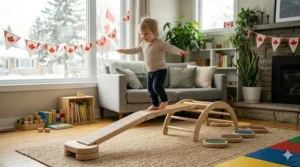
Common Mistakes Canadian Parents Make When Buying Indoor Climbing Toys
Mistake 1: Buying for the future rather than the present. The most common buying error is purchasing a challenging Pikler triangle for a 10-month-old who isn’t walking confidently yet. The child ignores it for six months, and parents conclude climbing toys are a waste of money. Buy for the developmental stage your child is in, not the one you’re anticipating.
Mistake 2: Ignoring the floor situation. Skipping a foam mat under a wooden Pikler triangle on hardwood floors is a genuine safety oversight, not just a minor inconvenience. A toddler falling sideways from the top rung of a triangle frame onto bare hardwood can result in a significant injury. Health Canada’s consumer safety guidance emphasizes that the environment in which a toy is used is part of the overall safety equation.
Mistake 3: Underestimating the noise factor in Canadian condos. Foam climbing blocks are nearly silent. Wooden Pikler triangles, however, produce real noise when a toddler drops the ramp section or bounces the arch. In a densely built urban condo in Montréal or Calgary, this can create strata/condo bylaw issues with downstairs neighbours. Consider placing a thick rug under all wooden equipment to dampen impact noise.
Mistake 4: Overlooking warranty and Canadian after-sales support. A product may ship from Amazon.ca, but if the manufacturer has no Canadian service presence and the warranty process requires shipping back to the US or China, the effective warranty value is near zero. Prioritize brands that explicitly offer warranty replacement parts shipped from Canadian warehouses.
Mistake 5: Assuming Prime shipping reaches everyone equally. Amazon Prime’s next-day or two-day delivery is a reality for Toronto, Vancouver, and Calgary. For families in northern Ontario, rural Nova Scotia, or Yukon, shipping timelines stretch significantly. Factor in 5–10 additional business days when planning purchases for specific occasions or the start of the indoor season.
Indoor Climbing Toys vs. Traditional Rainy Day Alternatives: The Real Trade-Off
| Alternative | Avg. Cost (CAD) | Physical Activity Level | Space Required | Developmental Value |
|---|---|---|---|---|
| Climbing toys set | $80–$250 | High | Medium | Gross motor, balance, problem-solving |
| Colouring/art table | $50–$150 | Very low | Small | Fine motor, creativity |
| Tablet/screen time | $200–$600 | None | Minimal | Limited for toddlers |
| Indoor ball pit only | $60–$120 | Medium | Large | Sensory, low gross motor |
| Soft play class subscription | $80–$200/month | High | None (offsite) | High, but costly over time |
The comparison here is instructive: a one-time investment of $150–$250 CAD in a quality indoor climbing set delivers daily high-intensity physical activity at a per-use cost that becomes negligible over a Canadian winter season. A monthly soft play class subscription in a city like Ottawa or Halifax can run $80–$200 CAD per month — meaning the climbing set pays for itself in 1–3 months. The developmental evidence for physical activity in toddlers is robust; according to the Canadian Society for Exercise Physiology, children aged 1–4 should accumulate at least 180 minutes of physical activity daily, spread throughout the day, with energetic play several times per week.
Traditional rainy day activities like screen time or passive colouring simply don’t move the needle on gross motor development the way active climbing does. That’s not a criticism of those activities — they serve real developmental functions — but as a primary response to a winter-locked, energy-filled toddler, indoor climbing toys for toddlers are genuinely hard to beat.
Canadian Safety Standards & What to Look for on Amazon.ca
Every toy sold in Canada must comply with the Toys Regulations under the Canada Consumer Product Safety Act, which sets out mechanical, flammability, toxicological, and structural requirements. Here’s what this means practically for climbing toy buyers:
Wood finish and paint. Any painted, stained, or lacquered surface on a toddler climbing frame must comply with Canadian lead regulations (Consumer Products Containing Lead Regulations, SOR/2018-83). Natural unfinished wood, like what Tiny Land and YOLEO offer, sidesteps this concern entirely. When buying coloured wooden frames (rainbow rungs, etc.), look for confirmation that the finish is non-toxic and water-based.
Foam material safety. Foam climbing blocks should be free of formamide and other regulated substances. PU leather covers — standard on CAMELUS, VEVOR, and MIND&ACTION — are generally compliant, but buyers purchasing off-brand foam sets on Amazon.ca should look for explicit mention of Toys Regulations compliance or ASTM F963 (the US equivalent, often referenced alongside Canadian standards).
Gap safety. For wooden frames, rung spacing matters enormously. Health Canada safety guidelines require that gaps in climbing equipment designed for young children not create head entrapment hazards. Look for rung spacing in the 6–9 cm (2.4–3.5″) range — wide enough for hands and feet, narrow enough to prevent head entrapment. The WINGYZ Pikler (referenced in other roundups) specifically cites a 2.35″ (6 cm) gap as ASTM F963 compliant, which aligns with Canadian standards.
Bilingual labelling. Under the Official Languages Act and consumer product labelling regulations, products sold in Canada should carry bilingual (English and French) safety warnings on the packaging. This doesn’t affect product quality, but it’s a useful signal that the seller has met Canadian import requirements and isn’t simply cross-listing a US-only product.
✨ Check These Canadian Deals Before You Decide!
🔍 Don’t leave without checking current pricing on Amazon.ca — deals change daily and Prime members often get free shipping with no minimum order. Click any product name to see real-time availability, Canadian reviews, and current CAD pricing!
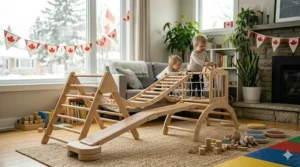
Frequently Asked Questions
❓ Are indoor climbing toys safe for toddlers in a Canadian apartment?
❓ What age is an indoor trampoline suitable for a 2-year-old in Canada?
❓ Do indoor climbing toys for toddlers need to meet Canadian safety standards?
❓ Does Amazon.ca ship indoor climbing toys to northern Canada and remote provinces?
❓ How do I clean foam climbing blocks in a Canadian home during cold and flu season?
Conclusion
Canada’s climate is simultaneously the biggest problem and the best argument for investing in indoor climbing toys for toddlers. When your yard is under 40 cm of snow and the forecast is calling for another week of −20°C, the question isn’t whether your toddler should have an indoor activity outlet — it’s which one will actually serve your family through six months of grey skies and salt-crusted boots at the door.
The seven products on this list cover every budget, living situation, and developmental stage that Canadian families navigate. For a young baby just finding their feet, the Little Tikes 3-in-1 or CAMELUS foam blocks offer safe, gentle introduction to active play. For a growing 2–3 year old who’s ready for real challenge, the Tiny Land or YOLEO Pikler Triangle deliver Montessori-style development with genuine longevity in CAD value. And for apartment families working with 80 square feet of playable floor, the VEVOR and MIND&ACTION foam sets prove that apartment-friendly toys don’t have to mean passive or boring.
Before you shop, remember to verify CCPSA compliance, account for the full setup cost (mat, accessories), and consider your floor surface. And if you’re still on the fence — picture February in your living room, a fully rested toddler who burned real energy on a real climbing structure, and a coffee that stayed warm for once.
✨ Find the Best Indoor Climbing Toys on Amazon.ca Today!
🔍 Click on any highlighted product name in this article to browse current pricing and Canadian availability. These carefully chosen indoor climbing toys for toddlers will help keep your little one active, happy, and developing through every Canadian season!
Recommended for You
- Best Water Table Toddlers: 7 Expert Canadian Picks 2026
- 7 Best LeapFrog Tablet Options Canadian Parents Love (2026)
- 7 Best Pretend Play Sets Canada 2026
Disclaimer: This article contains affiliate links. As an Amazon Associate, I earn from qualifying purchases. If you purchase products through these links, we may earn a small commission at no additional cost to you.
✨ Found this helpful? Share it with your friends! 💬🤗
