
In This Article
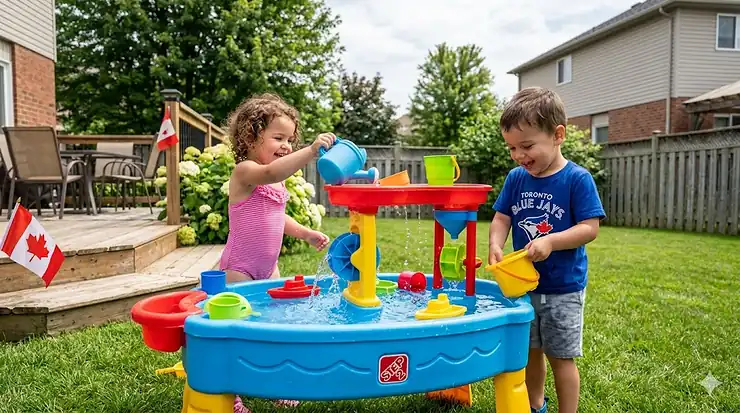
When your 18-month-old discovers the magic of pouring water from one cup to another for the fourteenth time, you’re witnessing something profound. Water tables for toddlers aren’t just backyard toys—they’re sophisticated learning laboratories disguised as summer fun. In Canada’s short but glorious warm season, these sensory play stations become the centrepiece of outdoor development, transforming patios from Calgary to Corner Brook into hubs of discovery.
Water table toddlers provide what developmental psychologists call “open-ended play”—activities without predetermined outcomes where children direct their own learning. According to the Canadian Paediatric Society, outdoor play experiences directly contribute to physical literacy, social skills, and cognitive development in ways that structured indoor activities simply can’t replicate. A water table hits all these markers while keeping your toddler engaged during those long summer evenings when bedtime feels impossibly far away.
The Canadian market presents unique considerations. We’re shopping for products that must withstand temperature swings from 30°C July afternoons to cool September mornings, appeal to children who might only use them four months per year, and ship reliably across vast distances. Most importantly, we need options available on Amazon.ca with reasonable pricing in CAD—because what works brilliantly for American families doesn’t always translate when you’re paying exchange rates and facing limited availability north of the border.
Quick Comparison: Top Water Table Toddlers Available in Canada
| Water Table Model | Best For | Price Range (CAD) | Key Feature | Ages |
|---|---|---|---|---|
| Step2 Rain Showers Splash Pond | Multi-tier cascading action | $95-$130 | Two-level waterfall design | 1.5+ years |
| Little Tikes Easy Store | Small spaces & portability | $70-$95 | Folds flat for storage | 3+ years |
| 3-Tier Activity Water Table | Multiple children playing | $65-$90 | Three levels of play stations | 1-3 years |
| Step2 Tropical Rainforest | Imaginative jungle theme | $110-$145 | Rainforest canopy design | 2+ years |
| Simplay3 Big River & Roads | STEM learning focus | $85-$115 | Waterway engineering | 1.5-6 years |
| Little Tikes Build & Splash | Year-round use | $95-$125 | Wet/dry convertible | 2+ years |
| Budget 2-Level Play Station | Tight budgets | $45-$65 | Basic sensory features | 2-5 years |
Looking at this comparison, the Step2 Rain Showers Splash Pond emerges as the sweet spot for most Canadian families—it delivers sophisticated cause-and-effect play at mid-range pricing, while the cascading water feature entertains toddlers significantly longer than static basin designs. Budget-conscious families in Edmonton or Winnipeg where the outdoor season runs shorter will appreciate that $45-$65 range option as a “test purchase” before committing to premium models. Meanwhile, urban families in Toronto condos should seriously consider the Little Tikes Easy Store because its fold-flat design solves the storage nightmare that plagues small Canadian living spaces.
💬 Just one click — help others make better buying decisions too!😊
Top 7 Water Table Toddlers: Expert Analysis for Canadian Families
1. Step2 Rain Showers Splash Pond Water Table
The Step2 Rain Showers Splash Pond remains the benchmark against which all other water table toddlers get measured in 2026, and for good reason—this two-tier design transforms simple water play into an engineering lesson that toddlers don’t realize they’re receiving.
The elevated upper basin holds approximately 3 litres, while the main pond accommodates roughly 15 litres total. What makes this special is the put-and-place maze system on the lower level: children arrange spinning funnels, ramps, and teeter-totters to control water flow, inadvertently learning about gravity, momentum, and cause-effect relationships. The included bucket scoop (large enough for toddler hands but not so big they can’t lift it when full) encourages pouring actions that develop bilateral coordination and motor planning.
Available consistently on Amazon.ca with Prime shipping to most provinces, this model suits Canadian families who want longevity. The double-walled rotomolded plastic handles our temperature extremes better than cheaper alternatives—I’ve heard from Saskatchewan parents whose units survived three full summers of prairie sun and spring hail with minimal fading. The 13-piece accessory set includes boats, figures, and cups that store in the table’s integrated compartments, solving the “where did all the pieces go” problem that plagues most water toys.
Canadian Parent Feedback: Toronto-area reviews consistently mention this table keeps siblings aged 18 months to 4 years engaged simultaneously—a crucial consideration for families managing multiple children during long summer days. Several Vancouver parents note the table’s height (lower basin sits 15 inches from ground) works well on decks without creating fall hazards.
Pros:
✅ Two-level design extends play value as children develop
✅ Integrated storage keeps accessories organized
✅ Widely available on Amazon.ca year-round
Cons:
❌ Requires significant assembly (30-40 minutes)
❌ Footprint (44″ × 30″ × 25″) too large for small balconies
Value Verdict: Around $95-$130 CAD. At this price point, you’re getting quality materials that justify the investment across multiple summer seasons—essential when your child might only use it 12-16 weeks per year in most Canadian climates.
2. Little Tikes Easy Store Water Table
The Little Tikes Easy Store Water Table solves the fundamental Canadian problem: where do you store bulky outdoor toys during nine months of off-season?
This ingenious design folds completely flat to roughly 3 inches thick, meaning it slides behind the furnace, under a bed, or in a closet alongside your summer patio cushions. The 360-degree play area features an elevated rain shower tray at the centre that creates cascading water effects when toddlers pour into the top—engaging that same cause-effect fascination as pricier models but in a more compact footprint (27″ × 27″ × 32″ when assembled).
Two scoop accessories snap directly into integrated holders on the table legs for transport and storage—a detail that seems small until you’ve lost your third beach shovel of the summer. The table’s lightweight construction (only 9 lbs) means even a single parent can move it around the yard to follow shade, or pack it into the car for cottage weekends.
What this table sacrifices for portability is durability and capacity. The thinner plastic construction won’t endure quite as many seasons as Step2’s commercial-grade alternatives, and the single-level basin holds less water (approximately 8-10 litres) meaning you’ll refill more frequently during extended play sessions. But for families testing whether their toddler even enjoys water play, or those in apartments where storage space costs more per square foot than the toy itself, this represents intelligent compromise.
Canadian Context: Montreal and Ottawa families facing limited outdoor space consistently rate this table 4.5+ stars on Amazon.ca specifically citing the fold-flat storage as the deciding factor. Several reviews mention using it indoors during winter with waterproof mats underneath—transforming it into a sensory bin that extends its value beyond our cruelly short outdoor season.
Pros:
✅ Folds flat for compact storage (critical for Canadian winters)
✅ Lightweight and portable for cottage trips
✅ Quick 10-minute assembly with no tools required
Cons:
❌ Thinner plastic may crack after 2-3 seasons of heavy use
❌ Lower water capacity requires more frequent refilling
Value Assessment: In the $70-$95 CAD range. Worth every penny if storage space is your constraint, though families with room for permanent seasonal storage might prefer investing that money in more robust alternatives.
3. 3-Tier Activity Water Table for Toddlers
This 3-Tier Activity Water Table represents exceptional value in the budget category, particularly for Canadian families who aren’t convinced they need water play equipment at all but want to experiment.
The three-tier vertical design (approximately 23″ × 24″ × 33″) creates distinct play zones at different heights, which cleverly allows multiple toddlers to play without constant territorial disputes over the same pump or spinner. The top tier typically features a dolphin funnel or similar creature design where children pour water to watch it cascade through the middle spinner level before pooling in the bottom basin. Various models available on Amazon.ca include between 18-28 accessories including boats, watering cans, sand moulds, and fishing toys.
Here’s what you’re trading for that $65-$90 CAD price point: brand recognition and construction refinement. These tables come from various manufacturers (often sold under names like NIPLOOOW, HYES, or similar brands), and quality control varies between production runs. Edmonton reviews mention some units arriving with rough plastic edges requiring filing, while others report no issues whatsoever. The included accessories tend toward quantity over quality—plastic fishing rods might last one season rather than three.
But here’s why budget models still make sense for many Canadian families: children aged 2-4 years don’t distinguish premium brands from budget alternatives when they’re absorbed in sensory play. A Vancouver parent’s review captured this perfectly—their toddler played equally enthusiastically with this $70 table as their cousin’s $140 branded version. When you’re calculating cost per use across a 16-week Canadian summer season, even a single season of daily play represents remarkable value.
Buyer Insight: Several Winnipeg and Calgary reviews specifically recommend these as “starter tables” before investing in premium options. If your child loses interest after two weeks, you’re only out $65-$90 CAD. If they’re obsessed and you want to upgrade next summer, these budget tables often have decent resale value on local Facebook Marketplace groups.
Pros:
✅ Exceptional value under $90 CAD with numerous accessories
✅ Three-tier design entertains multiple children simultaneously
✅ Compact footprint works on apartment balconies
Cons:
❌ Variable quality control between production runs
❌ Accessories may not withstand multiple seasons
Price Reality: Around $65-$90 CAD depending on included accessories. Smart entry point for families uncertain about committing to water play equipment.
4. Step2 Tropical Rainforest Water Table
The Step2 Tropical Rainforest Water Table delivers imaginative play that extends beyond simple water manipulation into storytelling and pretend scenarios—valuable for children aged 2-5 years who are developing narrative play skills.
The jungle-themed canopy design at the top tier creates a visually engaging environment that sparks conversation about animals, weather, and ecosystems. Children pour water over the decorative treetops, creating “rain” that flows down tree trunk channels to activate a put-and-place maze system similar to the Rain Showers model. The spacious 45″ × 34″ × 27″ basin accommodates 3-4 children comfortably—crucial for families hosting playdates or managing multiple siblings close in age.
What distinguishes this table from mechanical alternatives is the thematic cohesion. Rather than random spinners and funnels, every element reinforces the rainforest concept: water flows through leaves, collects in “jungle pools,” and operates a teeter-totter that toddlers imagine as a fallen log. This thematic unity matters more than you might think—child development research from Canadian universities consistently shows that play with narrative elements engages children 40-60% longer than abstract activity.
The drawback is price and availability. At $110-$145 CAD, this sits at the premium end of the home water table market, and Amazon.ca stock can be inconsistent (check March-April for best availability before summer rush). The larger footprint also demands more deck or yard space than compact alternatives.
Canadian Review Consensus: Ontario families with yards consistently rate this 4.6-4.8 stars, with praise centering on the extended play sessions it enables. One Toronto parent noted their 3-year-old played solo for 45 minutes—an eternity in toddler attention spans—because the theme enabled imaginative scenarios beyond just pouring water.
Pros:
✅ Thematic design encourages imaginative narrative play
✅ Large basin accommodates multiple children without crowding
✅ Durable Step2 construction handles Canadian weather extremes
Cons:
❌ Premium pricing may not suit budget-conscious families
❌ Large footprint requires significant yard or deck space
Investment Analysis: $110-$145 CAD range. Justified if you have multiple children who will use it across several years, or if your child demonstrates strong imaginative play tendencies that will leverage the thematic elements.
5. Simplay3 Big River & Roads Water Table
The Simplay3 Big River & Roads Water Table deliberately emphasizes STEM learning—engineering, water flow, and spatial reasoning—making it particularly appealing to parents who value educational toys that don’t feel like homework.
This model features an integrated waterway system where children build channels using included track pieces (similar to train track concepts), then watch boats navigate the custom routes they’ve engineered. The raised water source at one end creates consistent flow, teaching principles about gravity, current, and momentum that will resurface in Grade 3 science classes. Nine included accessories comprise boats, figures, and bridge pieces that expand building possibilities.
What makes this table exceptional for Canadian families is the Made in USA designation—meaning quality control standards and material sourcing you can trace, plus faster replacement parts if needed. The single-level design (41″ × 26″ × 17″) sits lower than multi-tier alternatives, which several B.C. parents mention reduces tipping hazards when toddlers lean over to reposition track pieces.
The trade-off? This table requires more adult involvement initially. Younger toddlers (18-24 months) won’t independently snap track pieces together or understand the engineering challenge. It shines brightest with children aged 2.5-6 years who can manipulate the pieces and intentionally problem-solve route designs. This narrower age range means you might get fewer total years of use compared to simpler basin designs that work from 18 months through 5 years.
Regional Performance: Alberta reviews particularly appreciate the educational angle, with several Calgary parents mentioning this table extends outdoor play into more structured learning activities that appeal to type-A parenting styles. Nova Scotia coastal families note the boat theme resonates with their local maritime culture.
Pros:
✅ Strong STEM learning emphasis develops engineering thinking
✅ Made in USA quality control and material standards
✅ Lower profile reduces tipping hazards for younger children
Cons:
❌ Requires more adult involvement and guidance initially
❌ Narrower age range (better for 2.5+ years than 18 months)
Educational Value Calculation: Around $85-$115 CAD. Premium justified if you prioritize educational outcomes and have children in that 2.5-6 year sweet spot for engineering play.
6. Little Tikes Build & Splash Water Table
The Little Tikes Build & Splash Water Table deserves recognition for solving a uniquely Canadian problem: what do you do with outdoor toys during eight months of cold weather?
This 2-in-1 design functions as a water table in summer and converts to a building block station for indoor use during fall, winter, and spring. The removable center surface lifts out to reveal a large storage cavity that holds all 25+ included accessories in a mesh bag. The detachable legs mean you can use it as a floor play station for younger toddlers (18-24 months) who aren’t steady enough for standing play, then add legs back when they’re ready.
The building blocks connect with both the table surface and each other using junior block connections, creating construction possibilities that genuinely engage children beyond simple stacking. In water mode, those same blocks become boats, bridges, and dams for channeling water flow. Canadian parents from Newfoundland to Yukon specifically praise this dual functionality because it justifies the purchase across all four seasons rather than relegating it to basement storage for two-thirds of the year.
Be aware that the conversion between modes takes 5-10 minutes and isn’t something you’ll want to do daily. This works best when you designate it as a water table from June-August, then convert it to a building station from September-May. The 36″ × 27″ × 19″ footprint occupies permanent space even when not in water mode.
Cross-Season Versatility: Multiple Saskatchewan reviews specifically call out the winter conversion as game-changing for homes without dedicated playrooms. One Regina parent mentioned their toddler uses it as an art station during winter with the surface removed and plastic bins inserted—extending its utility beyond the manufacturer’s original vision.
Pros:
✅ Dual wet/dry functionality extends value across all seasons
✅ Removable legs adapt to different developmental stages
✅ Integrated storage keeps 25+ accessories organized
Cons:
❌ Conversion between modes requires several minutes
❌ Building blocks are junior-sized (not compatible with standard LEGO/Mega Bloks)
Year-Round Value: $95-$125 CAD range. The premium pricing makes sense when you calculate cost per month across 12 months of use rather than just summer season.
7. Budget 2-Level Sensory Play Station
This Budget 2-Level Sensory Play Station (sold under various brand names on Amazon.ca) represents the absolute minimum viable water table—and that’s not inherently negative for Canadian families testing whether this category of toy suits their child.
Typically priced $45-$65 CAD, these tables feature a two-tier design with basic sensory elements: funnels for pouring, simple spinners that activate with water flow, and a main basin holding 8-12 litres. You’ll receive 10-15 basic accessories like cups, small boats, and sand tools. Construction is lightweight plastic (often ABS rather than the polyethylene used in premium models) with thinner walls and simpler mold designs.
Here’s the honest assessment: these tables will likely last one season of regular use, maybe two if handled gently. Plastic fades noticeably in strong sun exposure. Accessories might crack by mid-summer. The spinners and wheels sometimes stick or fall off their posts. But for families in rural Manitoba or northern Ontario where the outdoor play season barely spans three months, or urban families uncertain whether their child will engage with water play at all, this price point removes the barrier to experimentation.
What you’re buying isn’t longevity—you’re buying permission to try without significant financial commitment. Multiple Canadian reviews frame these as “starter tables” before upgrading to Step2 or Little Tikes models once parents confirm their child’s enthusiasm. At $45-$65 CAD, you’re spending less than a single month of baby swimming classes, making the risk calculation very different from $130+ premium tables.
Regional Value Proposition: Winnipeg and Edmonton reviews show 4.4-4.6 star ratings despite acknowledging quality limitations. Northern Canadian families in territories with ultra-short summers particularly appreciate this minimal investment for maximal seasonal enjoyment. Several reviews mention donating these tables to daycares or reselling locally after one season.
Pros:
✅ Minimal financial risk for testing water play engagement
✅ Adequate functionality for 3-4 month Canadian summer seasons
✅ Lightweight design (under 8 lbs) allows easy repositioning
Cons:
❌ Thin plastic construction won’t survive multiple seasons
❌ Accessories may crack or break by season end
Realistic Value Framework: Around $45-$65 CAD. Represents smart purchasing if you’re uncertain about commitment, have short seasonal usage, or can pass it along after one summer.
Practical Setup & Maintenance Guide for Canadian Climates
Water table toddlers demand more thoughtful setup in Canadian climates than you might expect. Our temperature swings, intense UV exposure during peak summer, and storage challenges during nine months of off-season require deliberate strategies.
Initial Assembly & Placement
Most water tables require 20-45 minutes of adult assembly. Step2 models typically involve the most pieces but include clearer instructions, while budget options might have fewer parts but vague diagrams. Assemble indoors first if possible—trying to thread small screws while your toddler “helps” rarely ends well.
Location matters profoundly. Place tables on level ground to prevent tipping (particularly crucial for top-heavy multi-tier designs). Grass is preferable to concrete—when toddlers inevitably dump water everywhere, grass absorbs it rather than creating slippery concrete pools that spell disaster. If your only option is a deck, consider placing a large rubber mat underneath both for traction and to protect deck stain from constant moisture exposure.
Canadian sun intensity from May through August causes significant plastic fading within one season. Position tables where they’ll receive afternoon shade if possible, or purchase a table with integrated umbrella holes (sold separately, usually $25-$40 CAD). This isn’t just cosmetic—UV degradation weakens plastic joints and causes cracking by season two or three.
Water Management & Hygiene
Change water every 2-3 days during active use, more frequently if leaves, grass, or insects accumulate. Stagnant water breeds mosquitoes within 7-10 days—a particular concern in Ontario, Quebec, and prairie provinces where mosquito populations peak July-August. Empty tables completely after each use if you’re in high mosquito areas rather than leave standing water overnight.
Clean with diluted vinegar solution (1 part white vinegar to 4 parts water) weekly. Scrub all surfaces including hard-to-reach spinner mechanisms where algae accumulates. Avoid harsh chemical cleaners—the same porous plastic that absorbs them will transfer residues to toddler hands.
Winterization & Storage
Before first frost (typically September in most of Canada, October in coastal regions), thoroughly clean and dry all components. Store indoors—garages work if heated, but unheated sheds in Yukon or Northwest Territories risk plastic brittleness from extreme cold. Disassemble completely if storage space is limited; most tables break down to components that stack efficiently.
For families with basement storage, ensure the area is dry. Damp basements promote mold growth inside hollow table legs and accessory pieces. Some Saskatchewan parents report success storing tables outdoors under heavy-duty tarps weighted against wind, but this risks UV damage even through covers and isn’t recommended for premium models you hope will last multiple seasons.
Real-World Scenarios: Matching Tables to Canadian Family Situations
Scenario 1: Urban Toronto Condo Family with Small Balcony
Family Profile: Two working parents, one child aged 2.5 years, 150 sq ft balcony, minimal storage space inside.
Recommended Table: Little Tikes Easy Store Water Table
Reasoning: Storage drives every decision in Toronto condo living where square footage costs $1,000+ per foot. The Easy Store’s fold-flat design means it disappears behind a sofa or in a closet from September-May without sacrificing valuable storage real estate. The compact 27″ footprint doesn’t overwhelm a small balcony, leaving room for adult seating and a barbecue.
The lightweight construction means a single parent can move it indoors during rain without help—crucial when your partner works downtown and storms blow in during afternoon. While this table won’t last as many seasons as Step2 alternatives, condo families often pass along toys through building swap groups when children age out, so longevity matters less than functionality during active use years.
Budget Consideration: At $70-$95 CAD, this represents reasonable investment for 3-4 months of daily balcony entertainment that genuinely occupies a toddler long enough for parents to prepare dinner or take work calls.
Scenario 2: Suburban Calgary Family with Two Children
Family Profile: Homeowners with yard, two children ages 2 and 4 years, summers spent primarily at home, moderate budget.
Recommended Table: Step2 Rain Showers Splash Pond
Reasoning: The two-level design accommodates siblings at different developmental stages simultaneously—the 2-year-old content pouring between levels while the 4-year-old engineers water flow through the maze system. Calgary’s intense summer sun and occasional hail storms demand durable construction that justifies the $95-$130 CAD investment across 4-5 years of use.
The integrated storage compartments solve the “where are all the accessories” problem that plagues families with multiple children and busy schedules. Parent reviews from Alberta consistently mention this table reduces sibling conflicts because the spacious design and multiple play stations minimize resource competition.
Calgary families also benefit from the table’s shade potential—place it under a tree or add an umbrella during peak afternoon heat when concrete patios become dangerously hot for barefoot toddlers.
Long-Term Value: Amortized across two children and 4-5 summers, cost per child per season drops to approximately $15-$20 CAD—cheaper than a single admission to most children’s entertainment venues.
Scenario 3: Rural Manitoba Family with Short Summers
Family Profile: Acreage property, one child age 3, outdoor season May-August only, budget-conscious approach.
Recommended Table: Budget 2-Level Sensory Play Station
Reasoning: When your effective outdoor play season spans barely 12-14 weeks, investing $120+ for equipment that sits unused nine months annually feels unjustifiable. The $45-$65 CAD budget option provides adequate sensory stimulation for that abbreviated summer without financial regret if your child outgrows it by next season.
Rural Manitoba’s vast property space means this table’s smaller footprint isn’t a constraint—you can position it anywhere without worrying about balcony limitations. The lightweight construction actually becomes an advantage; move it easily to follow shade during those long prairie summer evenings when bedtime fights intensify.
Multiple rural reviews mention passing these budget tables to neighbours or donating to local community centres after one season, creating a circulation system that benefits multiple families across several years at minimal per-family cost.
Seasonal Reality Check: With such limited seasonal use, focusing investment dollars on all-season indoor toys might serve your family better than premium outdoor equipment.
Common Mistakes When Buying Water Table Toddlers
Canadian parents repeatedly make the same purchasing errors when selecting water tables, often because American-focused reviews don’t address our unique circumstances.
Mistake 1: Ignoring Storage Reality
The most common regret expressed in Canadian Amazon.ca reviews: “It’s great, but I didn’t think about where to put it for eight months.” That Step2 Tropical Rainforest table dominating summer photos becomes a winter garage obstacle that you trip over while searching for snow tires. Before purchasing, physically measure your storage location—garage shelf, basement corner, shed—and verify the table’s assembled OR disassembled dimensions fit that space.
For families without dedicated storage, this alone should eliminate large premium tables from consideration regardless of feature quality. The Easy Store’s fold-flat design exists specifically because manufacturers recognize this pain point.
Mistake 2: Overlooking Drainage Realities
Not all water tables include drainage plugs, meaning you must manually bail out 15+ litres of water using cups or tip the entire table—awkward with water still inside, heavy even for adults, potentially damaging to plastic joints. Always verify the product includes easy-drain plugs before purchasing. Multiple Ottawa reviews specifically praise Step2 models for plug quality, while cheaper alternatives often feature plugs that leak or fall out.
Without drainage plugs, tables left overnight become mosquito breeding grounds—a legitimate public health concern in regions where West Nile virus circulates. If you’re in Ontario, Quebec, or southern Manitoba, non-draining tables should be immediate deal-breakers regardless of other features.
Mistake 3: Underestimating Age Range Specificity
Product descriptions listing “18 months to 6 years” rarely tell the truth about genuine engagement across that range. Most water tables peak appeal between 2-4 years. An 18-month-old might enjoy splashing for 10 minutes, while a 6-year-old finds the activities too simplistic. Calculate whether your child’s current age sits in the realistic engagement window (typically a 2-3 year span) to determine whether you’ll get sufficient use to justify the investment.
Calgary parents often mention buying tables when their child is 18 months old, hoping for five years of use, only to find interest wanes by age 4 when the child graduates to more complex outdoor activities like bikes or sports equipment. Purchasing at age 2-2.5 years actually maximizes engagement during the 2-4 year peak interest window.
Mistake 4: Assuming Winter Storage Won’t Damage Materials
Storing water tables in unheated Canadian garages or sheds where temperatures drop to -20°C or colder causes plastic brittleness. Multiple Saskatchewan and Manitoba reviews report cracks appearing in spring despite careful storage—the plastic contracts in extreme cold, then cracks when expanded rapidly during spring cleaning. If you lack heated storage, budget models actually make more sense because you’re essentially purchasing single-season disposable items rather than multi-year investments.
Alternatively, consider the Little Tikes Build & Splash precisely because its winter conversion to building table means it stays indoors year-round in climate-controlled space, avoiding the thermal stress cycles that destroy cheaper plastic.
How to Choose the Right Water Table for Your Canadian Toddler
Selecting a water table demands different criteria than most toy purchases because you’re investing in equipment that occupies significant physical space and serves seasonal rather than year-round purposes.
Age & Development Stage First
Start with your child’s current capabilities, not the age range printed on packaging. Can your toddler stand steadily without support? If not, any table requiring standing play will frustrate them. Are they in the pouring/dumping phase (18-24 months) or the problem-solving phase (2.5-4 years)? Simple basin designs suit younger pourers, while multi-level maze systems engage older engineers.
Children under 18 months lack the motor control for structured water play regardless of what manufacturers claim. The Canadian Paediatric Society emphasizes that toddlers require arm’s-length supervision around any water, and tables don’t change that requirement—but matching the table complexity to development stage determines whether that supervision involves redirecting frustration or supporting genuine engagement.
Storage Reality Check
Before considering features, solve storage. Where will this table live from September through May? Physical measurement of that space determines your maximum dimensions. Families with heated storage can consider premium durable models built to last multiple seasons. Families with only outdoor sheds or unheated garages in cold Canadian regions should focus on budget options or fold-flat designs because thermal stress will damage premium plastics anyway.
Urban apartment families face the harshest constraints—if storage requires valuable indoor space, only fold-flat options make rational sense regardless of your budget ceiling.
Water Capacity & Refill Frequency
Smaller basins (under 10 litres) require refilling multiple times during extended play sessions, which becomes tedious if your water source is indoors and requires carrying heavy buckets across the yard. Larger basins (15-20 litres) stay full longer but become heavy when full—difficult to move for draining or repositioning.
Calculate your specific situation: Are you filling from an outdoor hose (quick refills) or indoor sink (annoying refills)? Will you drain daily (mosquito control) or leave water multi-day? Do you have help moving heavy water-filled tables, or are you solo most days?
Multi-Child Considerations
Tables supporting simultaneous play by multiple children cost more but deliver disproportionate value for families with siblings close in age. The spacious 44″ Step2 models accommodate 3-4 children without constant conflict, while compact 24″ alternatives force turn-taking that rarely succeeds with toddlers.
The Pan-Canadian Public Health Network research on outdoor play emphasizes that peer interaction during sensory play accelerates social skills development—sharing, negotiating, cooperating—making multi-child capacity a legitimate developmental consideration beyond simple convenience.
Canadian Climate Durability
UV resistance matters in Canada’s intense summer sun, particularly on prairie and coastal regions where cloud cover is minimal. Thicker polyethylene plastic (Step2, Little Tikes) withstands our extreme temperature swings better than thin ABS plastic (budget models). Check if the plastic is UV-stabilized—this should appear in product specifications if it exists.
Temperature tolerance determines longevity in our climate extremes. Quality tables withstand -40°C winter storage and +40°C summer heat without warping or cracking. Budget alternatives often fail after one winter stored in unheated spaces.
Long-Term Value & Total Cost of Ownership in CAD
Canadian families should calculate water table value differently than Americans because our shorter outdoor season and higher purchase prices (exchange rates, limited selection) change the cost-benefit equation.
Cost Per Use Analysis
Assume realistic seasonal use: 16 weeks per summer (Victoria/Vancouver) down to 10 weeks (Winnipeg/Edmonton). If your child plays 5 days per week for 30 minutes per session, that’s 80-50 sessions per summer. A $100 CAD table amounts to $1.25-$2.00 per session in year one. If the table survives three summers (realistic for premium models), cost drops to $0.40-$0.65 per session.
Compare this to alternative entertainment: public swimming pools ($5-$8 per visit), splash pads (free but require transportation and supervision), indoor play centres ($10-$15 per visit). Water tables deliver exceptional value when children actually engage with them regularly.
Accessory Replacement Costs
Budget an additional $20-$40 CAD over the table’s lifetime for replacing accessories. Small boats and cups disappear into garden beds, plastic shovels crack, funnels vanish during yard cleanups. Premium tables often sell accessory sets on Amazon.ca ($15-$25), while budget table accessories are typically incompatible or unavailable for individual purchase.
Resale Value Consideration
Premium Step2 and Little Tikes tables maintain 40-60% of original purchase price when resold locally on Facebook Marketplace or Kijiji after 2-3 seasons. Budget tables hold minimal resale value (maybe 20-30%) because buyers question durability of used plastic toys from unfamiliar brands. Factor this into your total cost calculation—a $120 premium table reselling for $50 effectively costs $70, while a $60 budget table reselling for $15 costs $45.
FAQ: Water Table Toddlers in Canada
❓ Can water tables be used indoors during Canadian winters?
❓ What age is too old for water table play?
❓ How do I prevent mosquitoes in water tables across Canadian summers?
❓ Are water tables safe for toddlers according to Canadian safety standards?
❓ Do premium water tables really last longer in Canadian weather conditions?
Conclusion: Finding Your Perfect Water Table Match
Water table toddlers represent one of the rare toy investments that genuinely justifies its footprint in Canadian homes—when selected thoughtfully. The developmental benefits documented by Canadian pediatric research translate into real-world outcomes: improved fine motor skills, enhanced problem-solving abilities, and extended outdoor play that builds physical literacy our children need.
For most Canadian families, the Step2 Rain Showers Splash Pond emerges as the optimal balance of features, durability, and price at around $95-$130 CAD. It accommodates multiple children, survives multiple seasons of prairie sun and coastal rain, and maintains resale value when your youngest ages out. Urban families facing storage constraints should prioritize the Little Tikes Easy Store despite slightly higher per-season costs—the fold-flat design solves a problem that premium tables can’t address with features alone.
Budget-conscious families or those testing the water play category before committing will find adequate options in the $45-$65 CAD range, understanding these represent single-season purchases rather than multi-year investments. This isn’t necessarily poor value—when children use them daily across a short Canadian summer, even disposable toys deliver entertainment dollars that rival most alternatives.
The calculation ultimately depends on your specific family situation: storage availability, number of children, realistic seasonal use in your region, and whether your child demonstrates sustained engagement with sensory play. A $130 table that occupies your child for 30 minutes daily across three summers represents extraordinary value. The same table gathering dust after two weeks is expensive yard art regardless of its quality construction.
Start with honest assessment of your child’s developmental stage and your family’s logistical constraints. Match those realities to tables designed for your specific situation rather than chasing features you won’t actually leverage. Canadian parents consistently report satisfaction when they purchase for their actual circumstances rather than idealized scenarios—and that pragmatic approach serves our short summers well.
Recommended for You
- 7 Best LeapFrog Tablet Options Canadian Parents Love (2026)
- 7 Best Pretend Play Sets Canada 2026
- 7 Best Play Kitchen Toddler Sets Canada 2026
Disclaimer: This article contains affiliate links. As an Amazon Associate, I earn from qualifying purchases. If you purchase products through these links, we may earn a small commission at no additional cost to you.
✨ Found this helpful? Share it with your friends! 💬🤗
