
In This Article
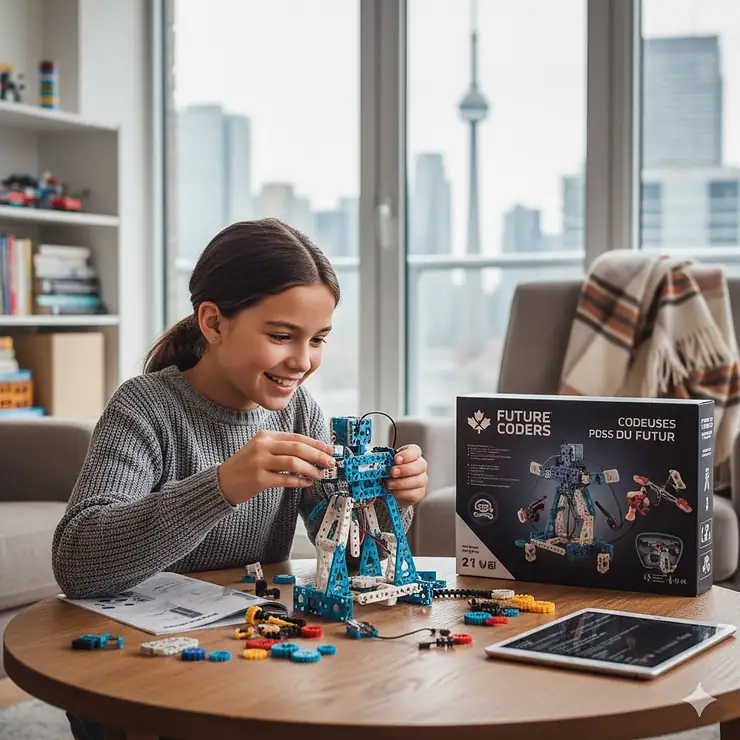
Picture this: your daughter confidently explaining how circuits work, building her own robot, or conducting chemistry experiments in your kitchen. That’s the power of the right stem toys for girls.

Here’s something that might surprise you. According to Statistics Canada, only 35% of Canadians aged 25-64 with STEM bachelor’s degrees are women, and even fewer—just 21%—actually work in STEM fields. This gender gap in STEM isn’t about ability. Research shows girls perform just as well as boys in math and science during early education. The real issue? Lack of early exposure, fewer role models, and societal stereotypes that suggest science is “for boys.”
That’s where stem toys for girls become game-changers. They’re not just playthings—they’re tools that build confidence, spark curiosity, and prove that engineering, coding, and chemistry are for everyone. Whether you’re shopping for your daughter, niece, or granddaughter, the right STEM toy can plant seeds of interest that bloom into lifelong passions.
In this comprehensive guide, I’ll walk you through the top 7 stem toys for girls available on Amazon.ca in 2026, complete with Canadian pricing, real customer feedback, and expert insights on choosing toys that genuinely inspire. Let’s bridge that gender gap, one awesome toy at a time.
Quick Comparison Table: Top Stem Toys for Girls
| Product | Age Range | Price (CAD) | Best For | Rating |
|---|---|---|---|---|
| Makeblock mBot Coding Robot | 8-12 years | $59-79 | Coding & robotics basics | 4.5/5 ⭐ |
| Snap Circuits Jr. SC-100 | 8+ years | $79.99 | Electronics & circuits | 4.6/5 ⭐ |
| National Geographic Chemistry Set | 8-12 years | $35-45 | Science experiments | 4.4/5 ⭐ |
| GoldieBlox Construction Sets | 4-9 years | $30-40 | Engineering principles | 4.3/5 ⭐ |
| LEGO Classic Creative Brick Box | 4+ years | $36.99 | Creative building | 4.7/5 ⭐ |
| Yellow Scope Chemistry Kit | 8-12 years | $45-60 | Female-focused science | 4.5/5 ⭐ |
| ThinkFun Gravity Maze | 8-12 years | $34.99 | Logic & engineering | 4.6/5 ⭐ |
💬 Just one click – help others make better buying decisions too!😊
Top 7 Stem Toys for Girls: Expert Analysis
1. Makeblock mBot Coding Robot Kit
If you want to introduce your daughter to coding without overwhelming her, the Makeblock mBot is brilliant. This little robot teaches Scratch and Arduino programming through hands-on building and coding exercises.
Key Specifications:
- Age recommendation: 8-12 years
- Programming languages: Scratch 3.0, Arduino
- Assembly time: Approximately 15 minutes
- Battery: 4 AA batteries (not included)
Price: $59-79 CAD on Amazon.ca
Canadian Customer Feedback: Parents in Ontario and BC particularly love how quickly kids can get started. “My 9-year-old daughter assembled it herself and was coding within an hour,” shared a Toronto reviewer. The bilingual app support is a bonus for French-Canadian families.
✅ Pros:
- Beginner-friendly with visual block coding
- Compatible with LEGO pieces for customization
- Free apps and extensive online tutorials
❌ Cons:
- Batteries not included
- Advanced features require more guidance
Shipping Note: Free shipping across Canada with Prime, typically arrives within 2-3 business days in urban areas.

2. Snap Circuits Jr. SC-100 Electronics Kit
The Snap Circuits Jr. transforms abstract concepts like electricity and circuits into tangible, hands-on learning. With over 100 projects, this kit keeps curious minds engaged for months.
Key Specifications:
- Projects: 100+ different circuits
- Components: 30+ colour-coded snap pieces
- Skills developed: Problem-solving, following instructions, electrical engineering basics
Price: $79.99 CAD on Amazon.ca
Canadian Customer Feedback: A Vancouver parent raved about how this toy “made electricity click” for her daughter. Canadian teachers frequently use this in elementary STEM programs because it’s safe, engaging, and requires no soldering.
✅ Pros:
- Award-winning (TOTY, STEM.org approved)
- Clear, illustrated instruction manual
- Can upgrade to larger kits (SC-300, SC-500)
❌ Cons:
- Requires 2 AA batteries (not included)
- Small pieces need careful storage
This kit earned 4.6 stars from over 1,900 Canadian customers who appreciate its educational value and durability.
3. National Geographic Chemistry Set
Science experiments at home? Yes, please! This National Geographic kit delivers 20 chemistry experiments that make learning about reactions, acids, bases, and crystals absolutely thrilling.
Key Specifications:
- Experiments: 20 guided activities
- Additional experiments: 10 using household items
- Lab equipment: Test tubes, beakers, pH strips, safety goggles
Price: $35-45 CAD on Amazon.ca
Canadian Customer Feedback: Montreal parents love how this follows Health Canada safety standards. The experiments range from creating glowing worms to colour-changing reactions. One reviewer noted, “Finally, a science kit that doesn’t feel dumbed down for girls.”
✅ Pros:
- Supports National Geographic’s educational mission
- Quality lab equipment included
- Comprehensive learning guide
❌ Cons:
- Some experiments require household supplies
- Adult supervision recommended
Perfect for budding chemists who love hands-on exploration!
4. GoldieBlox Engineering Construction Sets
GoldieBlox literally changed the game when they created engineering toys specifically designed to appeal to girls. These construction sets combine storytelling with building challenges.
Key Specifications:
- Age range: 4-9 years
- Pieces: Varies by set (typically 50-100+)
- Learning focus: Simple machines, engineering principles, problem-solving
Price: $30-40 CAD on Amazon.ca
Canadian Customer Feedback: Calgary parents appreciate how these kits feature a female protagonist named Goldie who solves problems through engineering. “My 6-year-old daughter now says she wants to be an engineer,” shared one proud parent.
✅ Pros:
- Story-driven building challenges
- Develops spatial reasoning
- Female role model at the centre
❌ Cons:
- Younger children may need help initially
- Some sets have fewer pieces than expected
Note: GoldieBlox announced they’re bringing back construction toys in 2026 for their 15th anniversary—watch for reimagined versions!
5. LEGO Classic Creative Brick Box (Medium/Large)
Sometimes, the best stem toys for girls are the timeless ones. The LEGO Classic series provides unlimited creative possibilities without prescriptive instructions.
Key Specifications:
- Pieces: 484-790 pieces depending on box size
- Includes: Wheels, windows, doors, eyes, and classic bricks
- Storage: Convenient plastic storage box included
Price: $36.99-60 CAD on Amazon.ca
Canadian Customer Feedback: Parents across Canada praise LEGO’s durability and open-ended play. “My daughters have built everything from robots to entire cities,” noted a Saskatchewan reviewer. The storage box is particularly appreciated during long Canadian winters when indoor play dominates.
✅ Pros:
- Develops spatial awareness and engineering thinking
- Compatible with all LEGO sets
- Extremely durable and reusable
❌ Cons:
- Can be expensive for larger sets
- Small pieces pose choking hazard for young siblings
LEGO consistently earns 4.7+ stars and remains a favourite among Canadian families for good reason.
6. Yellow Scope Chemistry Kit (Beakers & Bubbles)
Created by female scientists specifically for girls, Yellow Scope kits make chemistry accessible and exciting. This is one of the few science brands designed from the ground up with girls as the primary audience.
Key Specifications:
- Experiments: 12-15 chemistry activities
- Equipment: Real lab beakers, test tubes, pipettes
- Focus: Acids, bases, pH testing, chemical reactions
Price: $45-60 CAD (availability varies on Amazon.ca)
Canadian Customer Feedback: Though less common in Canada than the US, parents who find Yellow Scope products rave about them. “Finally, a science kit that doesn’t assume girls only want to make lip gloss,” said an Ottawa mother.
✅ Pros:
- Created by female scientists for girls
- Real lab equipment, not toys
- Engaging, girl-friendly presentation
❌ Cons:
- Sometimes harder to find in Canada
- Slightly higher price point
Worth seeking out if you want science toys that explicitly welcome and encourage girls.
7. ThinkFun Gravity Maze Logic Game
The ThinkFun Gravity Maze brilliantly disguises engineering and physics lessons as a marble maze game. This logic game challenges spatial reasoning and teaches principles of gravity and momentum.
Key Specifications:
- Challenges: 60 challenges from beginner to expert
- Skills: Spatial reasoning, planning, problem-solving
- Components: Towers, marbles, challenge cards
Price: $34.99 CAD on Amazon.ca
Canadian Customer Feedback: Edmonton parents report this game has incredible replay value. “My daughter spent an entire snow day working through challenges,” one reviewer shared. Teachers use it for gifted programs across Canadian provinces.
✅ Pros:
- Self-paced learning with increasing difficulty
- Builds critical thinking skills
- Compact and portable
❌ Cons:
- Marbles could be lost easily
- Some advanced challenges quite difficult
With a 4.6-star rating and multiple educational awards, this is a sneaky-smart way to teach engineering concepts.
Understanding the Gender Gap in STEM: Canadian Context
The gender disparity in STEM fields isn’t just a statistic—it has real-world implications for girls’ futures and Canada’s economy. According to the Canadian government, only 35% of STEM bachelor’s degree holders aged 25-64 are women, and just 21% of women with STEM degrees actually work in STEM fields.
Why Does This Matter?
Economic Impact: STEM careers typically offer higher salaries. The McKinsey Global Institute estimates that advancing gender equality could contribute up to $150 billion to Canada’s GDP by 2026. When girls miss out on STEM opportunities, they also miss out on lucrative career paths.
Innovation Gap: Diverse teams create better solutions. Research shows that closing the gender gap in STEM education would positively impact employment and economic growth, with the European Institute for Gender Equality predicting significant employment increases when more women enter STEM fields.
It Starts Early: The research is clear—interest in STEM needs to be cultivated during childhood. Girls who engage with science and engineering toys between ages 4-12 are significantly more likely to pursue STEM subjects in high school and beyond.
The Role Model Factor
Studies demonstrate that female role models are crucial for recruiting AND retaining women in STEM fields. When girls see women scientists, engineers, and coders, they can envision themselves in those roles. This is why representation matters—and why engineering toys for girls that feature female characters (like GoldieBlox) can be so powerful.
Canadian initiatives like the Chairs for Women in Science and Engineering (CWSE) and Choose Science programs work to improve women’s representation in STEM, but change also happens at home, one toy at a time.

How to Choose the Best Stem Toys for Girls
1. Match Toys to Her Interests First
The best STEM toy is one she’ll actually play with. Does she love animals? Look for biology kits or robotics that involve animal designs. Into art? Try engineering toys that create visual effects or coding games that generate patterns.
2. Consider Her Current Skill Level
Start where she is, not where you wish she were. A brilliant chemistry set won’t inspire if it’s too advanced. Conversely, toys that are too simple will bore her. Check age recommendations as guidelines, but also consider her individual development.
3. Look for Open-Ended Play Possibilities
The most valuable STEM toys grow with your child. LEGO bricks, coding robots with expandable features, and circuit kits that can be upgraded offer extended play value and deeper learning over time.
4. Ensure Canadian Availability and Support
Check that products are readily available on Amazon.ca with reasonable shipping to your province. Look for products that comply with Canadian safety standards and offer French-language support if relevant to your family.
5. Read Real Canadian Reviews
Pay attention to feedback from other Canadian parents about shipping times, product quality, and whether the toy lived up to expectations. Look for reviews mentioning specific provinces or cities to gauge local experiences.
6. Balance Challenge with Achievability
STEM toys should challenge girls just enough to be engaging without being frustrating. The “Goldilocks zone” of difficulty keeps kids motivated. Look for toys with progressive difficulty levels.
7. Don’t Fall for Pink-Washing
Some companies simply make existing toys pink and call them “for girls.” Real engineering toys for girls focus on genuine STEM learning, not just colour schemes. While there’s nothing wrong with pink (some girls love it!), substance matters more than aesthetics.
Benefits of STEM Toys for Girls Beyond Science
Building Confidence and Resilience
When girls successfully build a robot or complete a circuit, they prove to themselves they CAN do hard things. This confidence transfers to other challenging subjects and life situations.
Developing Problem-Solving Skills
Coding games for girls teach computational thinking—breaking big problems into smaller, manageable steps. This logical approach helps with everything from math homework to navigating social situations.
Encouraging Collaborative Learning
Many STEM toys work brilliantly as family activities. Building circuits together or solving engineering challenges as a team creates bonding opportunities while modelling that learning is a collaborative, supportive process.
Fostering Growth Mindset
STEM toys naturally involve trial and error. When the circuit doesn’t work the first time or the code has a bug, girls learn that mistakes are part of learning—not signs of failure. This growth mindset is invaluable.
Creating Career Awareness
Early exposure to STEM concepts helps girls understand what scientists, engineers, and programmers actually do. This awareness expands their vision of possible future careers beyond traditional stereotypes.
Science Kits for Female Scientists: Inspiring the Next Generation
The phrase “female scientists” shouldn’t be remarkable—but representation still matters. Here’s why science kits that acknowledge and celebrate women in STEM make a difference:
Historical Context
For too long, science textbooks and toys featured only male scientists. According to Wikipedia’s extensive documentation on Women in STEM, historically women’s contributions to science were often ignored or attributed to male colleagues. When girls only see male scientists, they unconsciously absorb the message that science isn’t for them.
Modern Role Models Matter
Today’s girls need to see contemporary female scientists, not just Marie Curie (though she’s amazing!). From Jennifer Doudna’s CRISPR research to Canadian astronauts like Julie Payette, female role models science proves that women are leading cutting-edge discoveries.
Breaking Stereotypes
Science kits female scientists can use should showcase diverse women—different races, abilities, and backgrounds. When girls see scientists who look like them or their mothers, they understand STEM is truly for everyone.
Coding Games for Girls: Making Programming Accessible
Coding isn’t just for computer nerds—it’s becoming a fundamental literacy skill like reading and writing. Here’s how coding games for girls make programming approachable:
Visual Programming First
Tools like Scratch (used in the Makeblock mBot) use colourful blocks instead of intimidating text-based code. Girls can see immediate results from their programming efforts, which maintains engagement and builds understanding.
Game-Based Learning
When coding feels like playing a game rather than doing schoolwork, girls stay motivated. Many coding robots incorporate fun challenges—navigating mazes, avoiding obstacles, or creating light shows—that teach programming concepts through play.
Progressive Complexity
The best coding toys start simple and gradually introduce more complex concepts. Girls can master basic sequencing before moving to loops, conditionals, and variables—just like learning to walk before running.
Real-World Applications
Help girls understand how coding connects to things they care about. Explain how apps are built, how robots work in hospitals, or how animation in movies requires programming. Making it relevant makes it interesting.

Inclusive STEM Education: Starting at Home
Creating an inclusive STEM education environment doesn’t require expensive equipment or teaching credentials—just intention and consistency.
Language Matters
Avoid saying things like “math is hard” or “I was never good at science.” Girls pick up on adult anxieties about STEM subjects. Instead, model curiosity: “I don’t know—let’s figure it out together!”
Normalize Failure and Iteration
When her circuit doesn’t work or her code has bugs, respond with enthusiasm about the learning opportunity. “Interesting! What do you think went wrong? What could we try differently?” This reframes mistakes as valuable data.
Expose Her to Diverse STEM Careers
Point out women engineers, programmers, and scientists in everyday life. Watch documentaries featuring female scientists. Visit science centres and museums. The more varied STEM careers she sees, the broader her sense of possibility.
Challenge Gender Stereotypes Directly
If someone suggests science is “for boys,” address it immediately. “Actually, girls and boys are equally good at science. Everyone can be a scientist!” Make your home a space where those stereotypes don’t fly.
Celebrate Effort, Not Just Results
Praise the work she puts in, not just successful outcomes. “You worked really hard solving that engineering challenge” builds resilience better than “You’re so smart!”
Comparing STEM Toys vs. Traditional Toys
| Aspect | STEM Toys | Traditional Toys |
|---|---|---|
| Learning Focus | Explicit STEM concepts, problem-solving | Imaginative play, social skills |
| Complexity | Progressive challenges, open-ended | Often single-purpose or simple |
| Longevity | High replay value, grows with child | May be outgrown quickly |
| Skill Development | Critical thinking, logic, engineering | Creativity, storytelling, nurturing |
| Price Range | $30-150+ CAD | $10-100+ CAD |
| Gender Marketing | Increasingly gender-neutral | Often heavily gendered |
The Verdict? Both have value! The best toy collection includes STEM toys alongside dolls, art supplies, and outdoor equipment. Well-rounded play experiences create well-rounded kids.
Budget-Friendly STEM Options for Canadian Families
Not every family can invest $100+ in STEM toys, and that’s okay! Here are ways to provide STEM experiences on a budget:
Under $50 CAD Options
- Building block sets ($30-40): Generic brands offer great value
- Science experiment books ($20-30): Use household items for experiments
- Logic puzzles and games ($25-35): ThinkFun and similar brands
- Craft-based engineering kits ($30-45): Build structures with everyday materials
Free or Low-Cost Alternatives
✅ Library Programs: Many Canadian libraries offer free STEM workshops and lending libraries for science kits
✅ Online Coding Platforms: Scratch, Code.org, and Khan Academy Kids are completely free
✅ YouTube Channels: Crash Course Kids, SciShow Kids, and Emily’s Wonder Lab offer excellent science content
✅ DIY Projects: Pinterest and YouTube are full of STEM projects using household items—vinegar volcanoes, DIY slime, homemade circuits
✅ Community Programs: Boys & Girls Clubs, community centres, and schools often run affordable or free STEM programs
Common Mistakes When Buying Stem Toys for Girls
Mistake #1: Choosing Based on What YOU Find Interesting
Your daughter’s interests might differ wildly from yours. A parent who loves coding might buy robot kits when their daughter prefers biology. Watch her play, listen to her questions, and follow HER curiosity.
Mistake #2: Buying Toys That Are Too Advanced
Nothing kills interest faster than frustration. If a toy is meant for ages 10-12 and your daughter is 8, wait a year or two. Age recommendations exist for good reasons.
Mistake #3: Not Considering Time Investment
Some STEM kits require significant adult involvement. If you don’t have time to sit and help, choose more independent options. Rushed, stressful experiences with STEM toys can backfire.
Mistake #4: Assuming Pink = Girl-Friendly
Marketing teams know pink packaging attracts parents shopping for girls, but colour doesn’t determine quality or engagement. Evaluate toys based on their actual STEM content and learning potential.
Mistake #5: Buying One Toy and Expecting Magic
STEM interest develops through repeated exposure, not a single toy. Create an environment rich with science books, engineering challenges, and math games. Variety matters.
How Canadian Schools Support Girls in STEM
Across Canada, educators recognize the importance of encouraging girls in STEM from early ages. Here’s what’s happening in classrooms:
Provincial Initiatives
Different provinces approach STEM education uniquely. British Columbia’s curriculum emphasizes hands-on science from kindergarten. Ontario’s renewed math strategy includes specific gender-equity components. Quebec’s science programs increasingly highlight female scientists and engineers.
After-School Programs
Organizations like Actua operate science camps across Canada specifically designed to engage girls. Many schools partner with these organizations to offer subsidized or free STEM enrichment activities.
Teacher Training
Canadian teachers increasingly receive professional development on addressing gender biases in STEM instruction. Research shows even well-meaning teachers sometimes unconsciously call on boys more during science lessons or provide girls less wait time to answer challenging questions.
Classroom Materials
Modern Canadian classrooms feature more diverse science books, posters showing female scientists, and curriculum materials that explicitly address women’s contributions to STEM fields.
✨ Don’t Miss These Exclusive Deals!
🔍 Take your daughter’s STEM learning to the next level with these carefully selected products available in Canada. Click on any highlighted item to check current pricing and availability on Amazon.ca. These tools will help you create authentic learning experiences your family will love!
FAQ
❓ What age should I introduce stem toys for girls?
❓ Are stem toys for girls different from stem toys for boys?
❓ How much should I spend on stem toys for girls in Canada?
❓ Where can I buy authentic stem toys for girls in Canada?
❓ How do I know if a STEM toy is actually educational?
Conclusion: Building Canada’s Future Scientists, One Toy at a Time
Here’s what I want you to remember: stem toys for girls aren’t just about creating future engineers and scientists (though that’s fantastic). They’re about giving your daughter tools to think critically, solve problems creatively, and approach challenges with confidence.
Every time she successfully builds a circuit, debugs a code sequence, or completes a chemistry experiment, she’s proving to herself that she CAN do hard things. That confidence ripples outward into every aspect of her life—academics, sports, relationships, and future career choices.
The statistics show Canada needs more women in STEM. According to Statistics Canada, only 66% of women who start undergraduate STEM degrees persist to completion, compared to 72% of men. But that gap starts closing when girls develop STEM confidence early through hands-on play and learning.
You don’t need to spend hundreds of dollars or turn your home into a laboratory. Start with one quality STEM toy that matches your daughter’s current interests. Maybe it’s the Makeblock mBot if she’s curious about robots, or the Snap Circuits Jr. if she loves figuring out how things work. Perhaps the National Geographic Chemistry Set if she’s fascinated by mixing and reactions.
The key is starting NOW. Those neural pathways that support mathematical thinking, spatial reasoning, and logical problem-solving develop rapidly during childhood. The STEM foundation you build today creates possibilities for tomorrow.
So browse through our top picks, read those Canadian customer reviews, and choose something that makes you think, “Yes, she’ll love this.” Because somewhere in Canada right now, a girl is building her first robot, conducting her first chemistry experiment, or writing her first lines of code. She might just change the world—and it starts with the right toy.
Here’s to raising curious, confident, capable girls who know that science, technology, engineering, and mathematics are absolutely, unquestionably FOR THEM. 🚀👩🔬💻
Recommended for You
- 7 Best Arduino Starter Kit for Kids Canada 2026
- 7 Best French Learning Toys for Kids Canada 2026
- 7 Best Montessori Toys Canada 2026: Transform Learning Naturally
Disclaimer: This article contains affiliate links to Amazon.ca. If you purchase products through these links, we may earn a small commission at no additional cost to you.
✨ Found this helpful? Share it with your friends! 💬🤗
