
In This Article
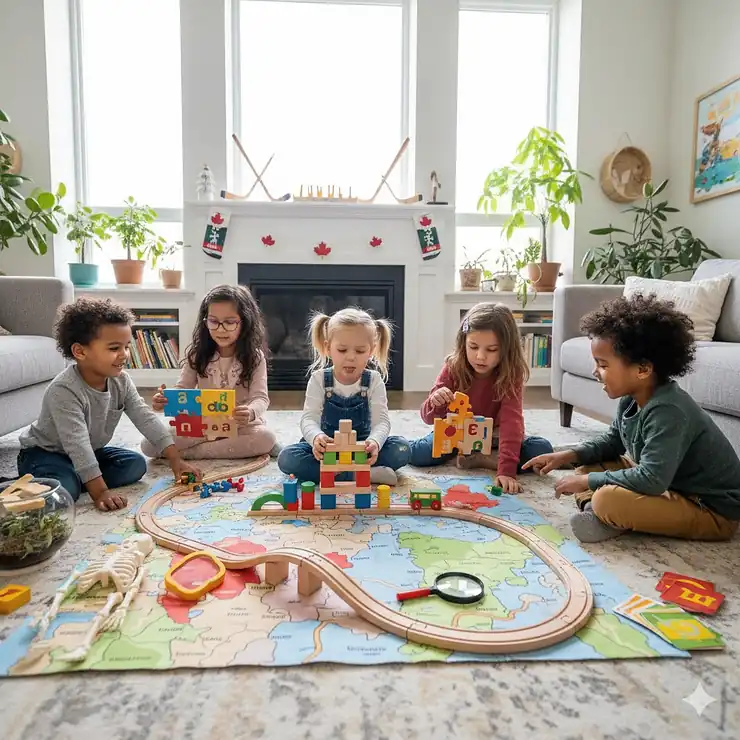
The glow of tablets and smartphones has become all too familiar in Canadian households, but there’s a growing movement among parents seeking healthier alternatives. According to the Canadian Paediatric Society, children under two should have no screen time, while those aged 2-5 should limit it to one hour daily. Yet many Canadian families struggle to meet these guidelines.
Here’s what makes this critical: research shows that early screen exposure can affect language development, sleep patterns, and even social skills. But the solution isn’t about restriction—it’s about replacement with engaging, hands-on alternatives.
Screen-free educational toys offer something digital devices simply can’t: tactile learning experiences that activate multiple brain regions simultaneously. When a child manipulates wooden blocks or solves a physical puzzle, they’re building neural pathways through real-world interaction. The National Training Laboratories found that children retain 75% of what they learn through hands-on practice, compared to just 5% from passive screen viewing.
Canadian parents are discovering that the right educational toys can captivate children just as effectively as screens, while fostering creativity, problem-solving, and fine motor skills. Whether you’re in Vancouver, Toronto, or anywhere across Canada, this guide will help you find quality options available through Amazon.ca with fast Canadian shipping.
Quick Comparison: Top Screen-Free Educational Toys Available in Canada
| Product | Age Range | Price (CAD) | Key Feature | Best For |
|---|---|---|---|---|
| Tokidos PlayCubes | 3-5 years | $149-$189 | Interactive screen-free gaming | Early STEM skills |
| Montessori Wooden Stacking Set | 1-3 years | $35-$55 | Natural materials | Sensory development |
| Magnetic Pattern Blocks | 4-8 years | $40-$65 | 130-piece STEM set | Creative building |
| Grimm’s Rainbow Stacker | 12M+ | $75-$95 | Open-ended play | Imagination & creativity |
| Code-a-Pillar | 3-6 years | $55-$75 | Unplugged coding | Logic & sequencing |
| Melissa & Doug Pattern Blocks | 3+ years | $25-$40 | Budget-friendly | Shape recognition |
| HABA Discovery Blocks | 18M+ | $80-$120 | Sound & texture variety | Multi-sensory learning |
💬 Just one click – help others make better buying decisions too!😊
Top 7 Screen-Free Educational Toys: Expert Analysis
1. Tokidos PlayCubes – School Ready Bundle
The Tokidos PlayCubes represent a revolutionary approach to screen-free digital learning, blending physical play with educational technology minus the screen. This interactive system includes rechargeable cubes that respond to PlayCards, creating a gaming experience without any visual display.
Key Specifications:
- Ages 3-5 years
- Built-in rechargeable battery (6+ hours playtime)
- Includes 3 interactive PlayCards
- Develops math, language, and problem-solving skills
Price: $149-$189 CAD on Amazon.ca
Canadian parents report that children stay engaged for remarkably long periods, with the tactile nature providing a satisfying alternative to tablets. The system teaches foundational skills through play, making it particularly valuable for preschool preparation.
✅ Pros:
- Completely screen-free despite being electronic
- Rechargeable system eliminates battery waste
- Grows with child through expandable PlayCard library
❌ Cons:
- Higher initial investment
- Requires charging management
Canadian Availability: Ships across Canada through Amazon.ca with Prime delivery in major cities.

2. KMTJT Montessori Wooden Educational Toy Set
This comprehensive Montessori wooden set brings traditional hands-on learning principles into modern Canadian homes. Featuring 30 pieces including fruit blocks, carrots, worms, and a five-sided sorting cart, it delivers exceptional value for developmental play.
Key Specifications:
- Ages 1-3 years
- 30 wooden pieces with non-toxic water-based paint
- Multiple activity types: shape sorting, colour matching, harvest play
- Large particles designed for safety
Price: $35-$55 CAD
Canadian buyers consistently praise the quality of materials and the variety of activities within one set. The wooden construction withstands enthusiastic toddler play while the multiple game options prevent boredom.
✅ Pros:
- Comprehensive activity variety in single set
- Sustainable wooden construction
- Excellent value for money
❌ Cons:
- Smaller pieces require supervision for youngest users
- Wood requires gentle cleaning (no soaking)
3. ISMETACU Magnetic Wooden Pattern Blocks
With 130 magnetic geometric pieces, the ISMETACU Pattern Blocks transform STEM learning into creative play. Strong magnets keep pieces secure while children explore mathematical concepts through building animals, objects, and abstract designs.
Key Specifications:
- Ages 4-8 years
- 130 colorful magnetic wooden pieces
- Multiple design cards included
- STEM-focused learning approach
Price: $40-$65 CAD
Canadian educators and parents appreciate how this set bridges creative play with mathematical thinking. Children naturally explore geometry, symmetry, and spatial relationships while believing they’re simply having fun.
✅ Pros:
- Exceptional piece count for the price
- Magnets reduce frustration during building
- Grows with child’s skill development
❌ Cons:
- Magnets not suitable for children who mouth toys
- Smaller pieces pose choking hazard for toddlers
4. Grimm’s Rainbow Wooden Stacker
The iconic Grimm’s Rainbow has become a staple in Canadian Montessori homes for good reason. This simple yet profound toy consists of 12 wooden arches in graduated sizes and rainbow colours, inspiring limitless open-ended play.
Key Specifications:
- Ages 12 months and up
- 12 wooden arches
- Non-toxic, water-based stain
- Handcrafted quality
Price: $75-$95 CAD
From simple stacking for toddlers to complex architectural creations for older children, the Grimm’s Rainbow adapts to developmental stages. Canadian families report years of continuous use across multiple children.
✅ Pros:
- Truly open-ended play value
- Heirloom quality construction
- Beautiful aesthetic appeals to adults too
❌ Cons:
- Premium price point
- May seem simple compared to complex toys
5. Fisher-Price Think & Learn Code-a-Pillar
For unplugged coding activities, the Code-a-Pillar introduces programming concepts through physical play. Eight easy-to-connect segments move the motorized caterpillar according to the sequence children create, teaching cause-and-effect and basic logic.
Key Specifications:
- Ages 3-6 years
- 8 programmable segments
- Motorized head
- Teaches sequencing and problem-solving
Price: $55-$75 CAD
Canadian parents appreciate how this toy demystifies coding without screens. Children arrange segments to create paths, developing computational thinking skills that transfer to digital coding later.
✅ Pros:
- Introduces coding concepts tangibly
- Immediate visual feedback
- Durable construction for active play
❌ Cons:
- Requires open floor space
- Battery-operated (not rechargeable)
6. Melissa & Doug Wooden Pattern Blocks and Boards
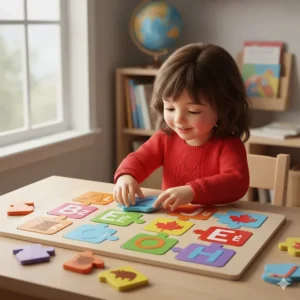
The Melissa & Doug Pattern Blocks offer budget-friendly entry into educational play. With 120 wooden pieces and five double-sided boards, children practice shape recognition, pattern completion, and early geometry.
Key Specifications:
- Ages 3+ years
- 120 wooden blocks in multiple shapes
- 10 pattern designs (5 double-sided boards)
- Sturdy wooden storage box
Price: $25-$40 CAD
This set represents exceptional value for Canadian families watching budgets. The classic design has withstood decades of educational play, and the pieces remain compatible with other Melissa & Doug geometry sets.
✅ Pros:
- Extremely affordable
- Proven educational value
- Expandable with additional sets
❌ Cons:
- Basic compared to magnetic alternatives
- Pieces can slide around during play
7. HABA Discovery Blocks – Sound Building Set
HABA Discovery Blocks add sensory dimensions to building play with blocks that chime, rattle, and create sounds. Made in Germany to exacting safety standards, these blocks engage auditory learning alongside spatial skills.
Key Specifications:
- Ages 18 months and up
- Various sound-making blocks
- Beech wood construction
- Water-based, non-toxic finish
Price: $80-$120 CAD
Canadian parents value HABA’s commitment to safety and quality. The sound elements captivate young builders while teaching cause-and-effect, and the different textures provide valuable sensory input.
✅ Pros:
- Multi-sensory learning experience
- Premium German manufacturing
- Safe for youngest builders
❌ Cons:
- Premium pricing
- Sound elements may annoy some parents
✨ Don’t Miss These Exclusive Deals!
🔍 Take your child’s learning to the next level with these carefully selected products available in Canada. Click on any highlighted item to check current pricing and availability on Amazon.ca. These tools will help you create authentic developmental experiences your family will love!
Understanding Screen-Free Educational Toys: More Than Just Play
Screen-free educational toys encompass any plaything that promotes learning without digital displays. Unlike apps or video games, these toys require physical manipulation, encouraging children to engage their bodies alongside their minds.
The power lies in tactile feedback—when children stack blocks, they feel weight and balance; when they sort shapes, their fingers learn geometric properties through touch. This multi-sensory engagement creates stronger neural connections than passive screen viewing ever could.
Research from educators and child development specialists consistently demonstrates that hands-on learning activates multiple brain regions simultaneously. The right hemisphere processes visual and spatial information while the left tackles logic and sequencing, creating comprehensive cognitive development.
For Canadian families, screen-free toys also address practical concerns beyond development. They require no charging (except for specific electronic-free options like Tokidos), create no blue light sleep disruption, and facilitate real-world social interaction when children play together.

The Science Behind Screen-Free Learning Success
Modern neuroscience reveals why traditional stem toys outperform digital alternatives for young learners. When children engage in hands-on learning, they activate what researchers call “embodied cognition”—the brain’s integration of physical movement with thinking processes.
Studies tracked through the National Training Laboratories demonstrate that retention rates soar with active participation. Children remember approximately 75% of content learned through practice, compared to only 10% from reading and 5% from lectures. This explains why a child building with blocks comprehends spatial relationships more deeply than one watching block-building videos.
The Canadian Paediatric Society emphasizes these findings in their updated 2026 guidelines. While they’ve moved away from rigid time limits for older children, they maintain strict recommendations for early childhood: no screens before age two, minimal thereafter. Their reasoning centres on how screens displace activities crucial for development—exactly the activities provided by no electronics learning games.
Canadian researchers have also observed concerning trends in children with excessive screen exposure. Language delays, attention difficulties, and reduced imaginative play all correlate with high screen time. Conversely, children who engage regularly with physical educational toys demonstrate stronger fine motor skills, better problem-solving abilities, and more creative thinking.
Dr. Michelle Ponti, chair of the Canadian Paediatric Society’s Digital Health Task Force, notes that screens themselves aren’t inherently harmful—but they displace critical developmental activities. Screen-free educational toys restore these opportunities in engaging formats children naturally enjoy.
How to Reduce Screen Time Naturally With Educational Alternatives
Start With Observation
Before purchasing toys, watch how your child currently plays. Do they enjoy building? Sorting? Creating? Match educational toys to existing interests rather than forcing new activities.
Create Inviting Play Spaces
Canadian parents successfully reduce screen time by making physical toys more accessible than devices. Dedicate low shelves or baskets to rotated toy selections, keeping options fresh without overwhelming children.
Model Screen-Free Engagement
Children imitate what they see. When parents choose books over phones during downtime, children naturally follow. Make your own screen-free activities visible and appealing.
Establish Screen-Free Zones and Times
Many Canadian families designate bedrooms and dining areas as screen-free spaces. Others implement “no-screen mornings” where educational toys fill time before school. Consistency matters more than perfection.
Involve Children in Selection
Take children to toy stores (Mastermind Toys and Indigo across Canada carry excellent selections) or browse Amazon.ca together. When children help choose educational toys, they invest more engagement in playing with them.
Age-Appropriate Screen-Free Toy Selection Guide for Canadian Parents
Infants (0-12 Months)
Focus on sensory exploration through high-contrast patterns, varied textures, and simple cause-and-effect toys. Wooden rattles, fabric books, and stacking rings provide appropriate challenges. Ensure all pieces exceed choking hazard sizes (larger than 44mm diameter).
Toddlers (1-3 Years)
This stage craves repetition and mastery. Simple puzzles, basic sorting toys, and stacking blocks allow toddlers to practice skills repeatedly. Canadian families appreciate that Montessori-style toys particularly suit this developmental window, offering self-correcting challenges.
Preschoolers (3-5 Years)
Imaginative play explodes during preschool years. Traditional stem toys like building sets, pretend play kitchens, and art supplies fuel creativity. This age also handles early coding toys like Code-a-Pillar, which introduce logical thinking through physical sequencing.
Early Elementary (5-8 Years)
Older children handle complex building systems, strategy games, and detailed craft projects. Advanced magnetic tiles, robotics kits (screen-free versions), and science experiment sets engage growing minds. Many Canadian families integrate these with outdoor exploration activities.
Comparing Screen-Free vs. Digital Educational Tools: What Canadian Research Shows
| Factor | Screen-Free Toys | Digital Educational Apps |
|---|---|---|
| Attention Span | Builds sustained focus | Encourages rapid switching |
| Motor Development | Strengthens fine & gross motor | Limited physical engagement |
| Creativity | Open-ended possibilities | Predetermined outcomes |
| Social Play | Facilitates sharing & cooperation | Often solitary experience |
| Sleep Impact | No blue light concerns | Can disrupt melatonin production |
| Cost Over Time | One-time purchase | Subscription fees common |
| Durability | Years of use, multiple children | Requires device updates |
| Canadian Availability | Readily shipped across provinces | Geographic restrictions possible |
Canadian health professionals increasingly recommend a “digital detox kids” approach, especially for children under five. This doesn’t mean eliminating technology entirely—it means prioritizing physical play during crucial developmental windows.
The key difference lies in agency. With educational toys, children control the pace, direction, and outcome of play. Screens, even educational ones, present predetermined sequences that children merely react to. This fundamental distinction shapes how learning consolidates in developing brains.

Storage and Organization Tips for Canadian Homes
Use Clear Bins With Labels
Canadian families swear by IKEA’s TROFAST system or similar clear storage. When children see toys, they remember to play with them. Label bins with pictures for pre-readers.
Rotate Toy Selection
Keep 70% of toys stored away, rotating weekly. This prevents overwhelm while keeping toys feeling “new.” Many Canadian parents report this single strategy dramatically increases engagement time.
Create Dedicated Learning Zones
Designate areas for different play types: a building corner with blocks, an art station with supplies, a reading nook with books. Zoned spaces encourage sustained focus.
Involve Children in Cleanup
Use cleanup songs or games to make tidying fun. Canadian educator-recommended approaches include “toy races” (who can put away blocks fastest?) or singing cleanup songs together.
Supporting Canadian Early Learning Through Screen-Free Play
Canada’s early childhood education framework emphasizes play-based learning, aligning perfectly with screen-free educational approaches. Provincial curricula from British Columbia to Newfoundland recognize hands-on exploration as fundamental to development.
Many Canadian preschools and daycares maintain screen-free environments, demonstrating commitment to tactile learning. Parents can extend these principles at home, creating continuity between school and family life.
Organizations like the Canadian Child Care Federation provide resources for parents seeking screen-free activities. Their free downloadable activity guides offer ideas requiring minimal materials—crucial for families managing winter months when outdoor play faces limitations.
Canadian public libraries also offer excellent support. Many branches host toy lending libraries where families borrow educational toys free, testing options before purchasing. Story times and craft programs provide structured screen-free engagement while building community connections.
For French-speaking Canadian families, resources through organizations like the Association québécoise des CPE offer bilingual activity ideas and developmental guidance aligned with screen-free principles.
Addressing Common Challenges Canadian Parents Face
“My Child Only Wants Screens”
This situation develops gradually and reverses gradually too. Start with 10-minute screen-free blocks using highly engaging toys. Gradually extend time as children rediscover physical play’s appeal. Expect resistance initially—habit changes require patience.
“Educational Toys Are Expensive”
While premium options exist, excellent budget choices abound. Melissa & Doug products, thrift stores, and toy libraries provide affordable access. Many Canadian families also organize toy swaps with neighbours, rotating resources without constant purchasing.
“I Don’t Have Space for Toys”
Vertical storage maximizes small Canadian homes and apartments. Wall-mounted shelves, over-door organizers, and under-bed storage bins create toy spaces in compact quarters. The rotation system mentioned earlier also reduces active toy volume.
“How Do I Handle Multiple Ages?”
Choose open-ended toys like blocks, art supplies, and loose parts (buttons, fabric scraps, natural materials) that engage various skill levels simultaneously. Older children often enjoy “teaching” younger siblings, creating natural collaborative play.
The Role of Outdoor Play in Screen-Free Learning
Canadian winters challenge outdoor play, but children need nature exposure year-round. Research from the University of British Columbia demonstrates that outdoor time significantly reduces screen dependency while boosting physical health and emotional regulation.
Screen-free learning extends beyond indoor toys. Collecting leaves, building snow structures, observing insects, and climbing trees provide rich educational experiences. ParticipACTION, Canada’s leading voice on physical activity, emphasizes that outdoor play contributes equally to cognitive development as structured educational toys.
Consider dedicating a portion of toy budgets to outdoor gear: quality winter clothing, magnifying glasses, field guides, and nature exploration kits. These investments pay dividends in reduced screen time and improved overall wellbeing.
Many Canadian communities offer outdoor education programs through parks departments or conservation authorities. These often run year-round, teaching children to appreciate screen-free activities in natural settings.
Building a Balanced Toy Collection: Canadian Expert Recommendations
Foundation Pieces (60% of Collection)
- Building blocks (wooden or magnetic)
- Art supplies (crayons, paper, paint, play dough)
- Puzzles (variety of complexity levels)
- Books (Canadian authors like Robert Munsch offer relatable content)
Special Interest Items (25% of Collection)
- STEM toys matching child’s interests
- Pretend play items (kitchen, tools, dolls)
- Musical instruments
- Sports equipment
Seasonal/Rotational (15% of Collection)
- Holiday-specific items
- New-interest explorations
- Borrowed library toys
- Gifts awaiting introduction
This distribution ensures children always have familiar favourites while accommodating new interests. Canadian occupational therapists recommend this balance for supporting comprehensive development without overwhelming children or spaces.
FAQ: Screen-Free Educational Toys in Canada
❓ What age should children start using screen-free educational toys?
❓ How much do quality screen-free educational toys cost in Canada?
❓ Can screen-free toys really compete with tablets for engagement?
❓ Are Montessori toys worth the higher cost for Canadian families?
❓ Where can I find unplugged coding activities for young children in Canada?
Conclusion: Creating Screen-Free Success in Your Canadian Home
The movement toward screen-free educational toys reflects Canadian parents’ growing awareness that early childhood development thrives on tangible experiences. While screens offer convenience, they can’t replicate the comprehensive learning that occurs when children manipulate physical objects, solve three-dimensional problems, and engage in open-ended creative play.
This guide has explored seven exceptional options available to Canadian families through Amazon.ca, ranging from budget-friendly Melissa & Doug classics to innovative systems like Tokidos PlayCubes. Each serves the crucial purpose of capturing children’s attention while building genuine skills—from fine motor development to early STEM concepts and logical thinking.
Remember that transitioning away from screens requires patience and consistency. Start small, perhaps replacing one screen period daily with engaging hands-on activities. Create inviting play spaces stocked with rotated toy selections. Most importantly, model the behaviour you hope to cultivate—when children see adults choosing books, crafts, or outdoor time over constant screen engagement, they naturally follow.
Canadian families have tremendous resources supporting this journey: toy libraries, nature programs, screen-free preschools, and community centres offering hands-on activities. Organizations like the Canadian Paediatric Society provide evidence-based guidance, while local parent groups offer practical support and encouragement.
The investment in quality educational toys pays dividends far beyond childhood. Children who develop strong hands-on learning foundations approach life with confidence, creativity, and problem-solving skills that serve them indefinitely. In choosing screen-free options today, you’re giving your child tools for lifelong success.
Recommended for You
- 7 Best Ontario Curriculum Learning Toys for Canadian Kids (2026)
- 7 Best Homeschool STEM Materials Canada 2026
- 7 Best Kids Microscope Canada 2026
Disclaimer: This article contains affiliate links to Amazon.ca. If you purchase products through these links, we may earn a small commission at no additional cost to you.
✨ Found this helpful? Share it with your friends! 💬🤗
