
In This Article
Remember when family time meant something more than everyone staring at different screens? I certainly do, and I’m watching Canadian families rediscover the magic of gathering around a table for an evening of laughter, friendly competition, and genuine connection.
The landscape of board games for families has evolved dramatically. What started as simple roll-and-move games has blossomed into an industry filled with innovative mechanics, stunning artwork, and experiences that genuinely bring people together. With winter months stretching long across Canada, there’s never been a better time to invest in quality family entertainment that doesn’t require electricity or WiFi.
Research from the National Center for Biotechnology Information demonstrates that board games significantly improve children’s cognitive development, visuospatial memory, and mathematical skills (https://pmc.ncbi.nlm.nih.gov/articles/PMC11274538/). Canadian families are catching on—sales of modern board games have surged 35% since 2023, with many discovering that cooperative games for kids teach teamwork while strategy games age 6+ challenge growing minds.
Whether you’re searching for party games for children during those long Canadian winters or educational board games that make learning fun, this guide covers everything you need. I’ve spent months researching what’s actually available on Amazon.ca, checking Canadian pricing, and reading feedback from families coast to coast.
Quick Comparison Table: Top Board Games at a Glance
| Game Name | Best For | Players | Age | Play Time | Price Range (CAD) |
|---|---|---|---|---|---|
| Ticket to Ride | Strategy & Geography | 2-5 | 8+ | 30-60 min | $38-$68 |
| CATAN | Resource Management | 3-4 | 10+ | 60-90 min | $31-$60 |
| Azul | Pattern Building | 2-4 | 8+ | 30-45 min | $30-$45 |
| Outfoxed! | Cooperative Deduction | 2-4 | 5+ | 20 min | $17-$30 |
| Blokus | Spatial Thinking | 2-4 | 7+ | 20 min | $25-$40 |
| Monopoly | Classic Property | 2-6 | 8+ | 60-120 min | $22-$45 |
| Guess Who? | Deductive Reasoning | 2 | 6+ | 15 min | $18-$28 |
💬 Just one click – help others make better buying decisions too! 😊
Top 7 Board Games for Families: Expert Analysis 🏆
1. Ticket to Ride – The Gateway Strategy Game
If I had to pick one game that has introduced more families to modern board gaming than any other, it would be Ticket to Ride. This cross-country train adventure transforms North American geography into an engaging competition that even grandparents enjoy.
Key Specifications:
- Players: 2-5
- Recommended age: 8 years and up
- Average playtime: 30-60 minutes
- Current Canadian price: $37.95-$68 CAD on Amazon.ca
The gameplay strikes that perfect balance between accessible and engaging. Players collect coloured train cards to claim railway routes connecting cities across the map. Longer routes earn more points, but there’s delicious tension when opponents might claim the route you need first.
Canadian families particularly appreciate the geography lesson hidden inside the fun. Kids naturally learn city locations and develop strategic thinking about route efficiency. The bilingual editions available in Canada make it perfect for francophone households too.
Pros:
✅ Easy to teach in under 10 minutes
✅ Engaging for ages 8 to 80
✅ High-quality components and beautiful board
Cons:
❌ Can feel competitive for very young or sensitive players
❌ Requires table space
Customer feedback from Canadian buyers consistently rates this 4.7 out of 5 stars, with families noting it’s become their go-to for weekend game nights. Many mention purchasing expansions after mastering the base game.
2. CATAN – Build Your Settlement Empire
CATAN revolutionized board gaming when it launched, and it remains one of the best strategy games age 6+ (though officially recommended for 10+) that teaches resource management and negotiation skills your kids will use for life.
Key Specifications:
- Players: 3-4 (expandable to 5-6)
- Recommended age: 10 years and up
- Average playtime: 60-90 minutes
- Current Canadian price: $31-$60 CAD on Amazon.ca
Players compete to build settlements, cities, and roads on the island of Catan by gathering and trading resources like wood, brick, wheat, ore, and sheep. The modular board means every game creates a different landscape, keeping family game night ideas fresh for years.
What makes CATAN exceptional for families is the negotiation element. Kids learn that sometimes cooperation benefits everyone, but they also discover when to drive a hard bargain. The 6th Edition features improved components and clearer rulebooks, making it easier for Canadian families to dive in.
Pros:
✅ Teaches resource management and planning
✅ High replayability with modular board
✅ Encourages negotiation and social skills
Cons:
❌ Longer playtime may challenge younger attention spans
❌ Dice rolling can feel unfair to some players
With over 38,000 ratings averaging 4.7 stars on Amazon.ca, CATAN has proven itself a staple in Canadian households. Parents report their teenagers requesting “just one more game” well past bedtime.
3. Azul – Stunning Tile-Laying Artistry
Award-winning and absolutely gorgeous, Azul brings the beauty of Portuguese tile work to your Canadian dining table. This 2018 Spiel des Jahres winner proves that educational board games can be both intellectually stimulating and visually stunning.
Key Specifications:
- Players: 2-4
- Recommended age: 8 years and up
- Average playtime: 30-45 minutes
- Current Canadian price: $30-$45 CAD on Amazon.ca
Players take turns drafting coloured tiles from a central factory display, then arranging them on their player board to create beautiful patterns. The tactile satisfaction of handling the resin tiles combined with strategic depth makes this one of those rare games where every family member finds something to love.
The bilingual Canadian edition includes both English and French instructions. The game scales beautifully from two players to four, making it perfect whether it’s just you and your spouse after the kids are asleep, or a full family gathering during the holidays.
Pros:
✅ Beautiful components that feel premium
✅ Quick to learn, challenging to master
✅ Works brilliantly with 2-4 players
Cons:
❌ Tiles can be small for very young children
❌ Some find it less interactive than other games
Canadian customers rave about the quality, with many mentioning they purchased additional Azul versions (Summer Pavilion, Stained Glass of Sintra) after falling in love with the original.
4. Outfoxed! – Cooperative Mystery Solving
Looking for cooperative games for kids that actually hold their attention? Outfoxed! delivers a Clue-style whodunit designed specifically for younger players, teaching deductive reasoning without the frustration of competitive elimination.
Key Specifications:
- Players: 2-4
- Recommended age: 5 years and up
- Average playtime: 20 minutes
- Current Canadian price: $17-$30 CAD on Amazon.ca
Mrs. Plumpert’s pot pie has been stolen, and players work together to gather clues using a special evidence scanner to identify which fox committed the crime. The cooperative nature means everyone wins or loses together, eliminating the tears that sometimes come with competitive games.
This is one of those gems that punches above its weight. The evidence scanner adds a tactile element kids love, while the deductive reasoning develops critical thinking skills. Canadian parents particularly appreciate that it’s genuinely engaging even for adults joining their 5-year-olds.
Pros:
✅ Cooperative gameplay reduces conflict
✅ Teaches logical thinking and deduction
✅ Quick playtime perfect for short attention spans
Cons:
❌ Limited replayability compared to more complex games
❌ Younger children may need adult guidance initially
With consistent 5-star reviews from Canadian buyers, Outfoxed! frequently appears in family game night ideas lists. Many mention it’s their go-to for introducing board gaming to preschoolers.
5. Blokus – Colourful Strategic Spatial Challenge
Blokus proves that sometimes the simplest concepts create the deepest gameplay. This award winning kids game uses just one rule—each piece you place must touch another piece of your colour, but only at the corners—yet it creates surprisingly complex spatial puzzles.
Key Specifications:
- Players: 2-4
- Recommended age: 7 years and up
- Average playtime: 20 minutes
- Current Canadian price: $25-$40 CAD on Amazon.ca
The game includes 84 pieces in four colours (21 pieces per player), each in different polyomino shapes. Players take turns placing their pieces on the board, trying to block opponents while preserving their own placement opportunities. It’s chess-like in its strategic depth but far more approachable.
Canadian occupational therapists often recommend Blokus for developing spatial reasoning and planning skills. The colour-blind accessible pieces feature different symbols for each colour, demonstrating thoughtful inclusive design.
Pros:
✅ One simple rule makes teaching effortless
✅ Deep strategy emerges from simple mechanics ✅ Colour-blind accessible design
Cons:
❌ Can feel abstract for players who prefer thematic games
❌ Analysis paralysis can slow down competitive players
Available with free shipping across Canada through Amazon.ca, Blokus regularly appears in schools and therapy practices alongside family living rooms.
6. Monopoly – The Timeless Property Trading Classic
Love it or hate it, Monopoly remains one of the most recognized board games for families worldwide. The 2026 editions available on Amazon.ca feature improved tokens and streamlined rules that address some traditional pain points.
Key Specifications:
- Players: 2-6
- Recommended age: 8 years and up
- Average playtime: 60-120 minutes
- Current Canadian price: $22-$45 CAD on Amazon.ca
Players buy, sell, and trade properties while developing them with houses and hotels. The goal is simple: bankrupt your opponents through shrewd real estate dealings. Canadian editions often feature familiar landmarks, making geography lessons part of the entertainment.
Modern variants include speed dice and official shortened rules that respect busy family schedules. The game teaches basic economics, negotiation, and money management—skills that remain valuable in 2026’s digital economy.
Pros:
✅ Universally recognized and understood
✅ Teaches money management and negotiation
✅ Numerous themed versions available
Cons:
❌ Games can run very long
❌ Player elimination can be frustrating
Despite its critics, Monopoly maintains strong sales across Canada, with families reporting that house rules and time limits make it more enjoyable than memories of endless childhood games suggest.
7. Guess Who? – Classic Deductive Reasoning Fun
Sometimes the party games for children that work best are the ones that have stood the test of time. Guess Who? has entertained families for decades with its simple yet engaging gameplay perfect for developing logical thinking.
Key Specifications:
- Players: 2
- Recommended age: 6 years and up
- Average playtime: 15 minutes
- Current Canadian price: $18-$28 CAD on Amazon.ca
Each player chooses a mystery character, then asks yes-or-no questions to narrow down possibilities and identify their opponent’s character. The 2026 edition includes updated character artwork while maintaining the flip-down board that makes the game so satisfying.
The bilingual English/French version ships across Canada makes it ideal for households developing language skills. The quick playtime means kids can play multiple rounds, and the two-player format works perfectly when you want one-on-one time with a child.
Pros:
✅ Develops question-formation and deductive skills
✅ Quick rounds keep engagement high
✅ Perfect for one-on-one parent-child time
Cons:
❌ Limited to two players
❌ Can become repetitive with the same character pool
Canadian parents appreciate that Guess Who? travels easily and requires no batteries or apps—just two people and a willingness to think logically about facial features and accessories.
Understanding Different Types of Family Board Games 🎯
The world of board games for families extends far beyond roll-and-move simplicity. Understanding different categories helps you choose games that match your family’s interests and developmental goals.
Cooperative Games: Working Together Toward Victory
Cooperative games for kids represent one of the fastest-growing segments in family gaming. Instead of competing against each other, players work as a team against the game itself. Research published in the journal Scandinavian Journal of Psychology found that cooperative board games can increase prosocial behaviours in preschoolers (https://pmc.ncbi.nlm.nih.gov/articles/PMC8248432/).
Games like Outfoxed!, Forbidden Island, and Pandemic teach children that collaboration often achieves more than competition. Canadian families with children of varying ages particularly appreciate how cooperative games let older siblings help younger ones without the frustration of holding back to “let them win.”
Strategy Games: Building Critical Thinking Skills
Strategy games age 6+ challenge players to plan ahead, manage resources, and adapt to changing circumstances. According to Wikipedia’s comprehensive history of board games (https://en.wikipedia.org/wiki/Board_game), strategy games have existed for millennia, with archaeological evidence dating back over 4,500 years to ancient Mesopotamia.
Modern strategy games like CATAN and Ticket to Ride teach children to think several moves ahead, evaluate probability, and make decisions with imperfect information—skills that translate directly to academic success and life planning.
Party Games: Social Fun for Larger Groups
Party games for children emphasize social interaction, laughter, and creating memorable moments over pure strategy. These games typically accommodate larger player counts and feature simpler rules that let new players jump in mid-game.
Canadian families hosting birthday parties or holiday gatherings find that party games break the ice and create shared experiences. Many modern party games incorporate Canadian humour and references, making them more relatable than their American counterparts.
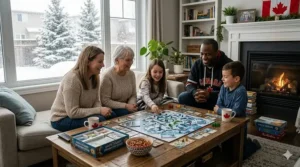
Educational Games: Learning Disguised as Fun
Educational board games integrate curriculum concepts into gameplay so seamlessly that children don’t realize they’re learning. Scholastic educational experts emphasize that board games develop early learning skills including colour recognition, counting, pattern matching, and following rules (https://www.scholastic.com/parents/kids-activities-and-printables/activities-for-kids/arts-and-craft-ideas/benefits-board-games.html).
From arithmetic practice in Sum Swamp to geography lessons in Ticket to Ride, these games supplement school learning while families enjoy quality time together.
How to Choose Board Games for Families in Canada 🍁
Selecting the right board games for families requires considering several factors unique to Canadian households. Here’s what to evaluate before clicking “add to cart” on Amazon.ca.
Consider Your Children’s Ages and Abilities
Age recommendations on boxes provide starting points, but your children’s actual development matters more. A bright 7-year-old might handle games rated 8+ while a struggling 9-year-old might benefit from games rated younger. Canadian parents should consider that children developing in two languages might need extra time to process written components.
Evaluate Player Count Flexibility
Canadian families come in all sizes, and your household size might change when cousins visit or teenagers invite friends over. Games that scale well across player counts offer better value. Check whether the game plays equally well at minimum and maximum player counts, as some games shine at specific numbers.
Match Playtime to Attention Spans
A 90-minute game might suit a rainy Sunday afternoon but frustrate overtired children on a Tuesday evening. Canadian families juggling hockey practice, violin lessons, and homework appreciate games with natural breaking points or variants that shorten playtime without sacrificing enjoyment.
Consider Storage and Setup Requirements
Canadian homes vary tremendously in size, and apartment dwellers in Vancouver or Toronto might struggle to store games with massive boards or hundreds of components. Consider whether you have dedicated game storage space and whether setup time fits your schedule.
Read Canadian Customer Reviews
Amazon.ca reviews from fellow Canadians provide insights about shipping times, component quality, and whether bilingual versions include proper French translations rather than awkward machine translations. Pay attention to comments about Canadian pricing and whether games go on sale during key shopping periods.
Think About Long-Term Value
Award winning kids games often cost more upfront but provide years of entertainment. Calculate the cost per play rather than just the sticker price. A $50 game played 100 times costs 50 cents per play, while a $15 game played twice costs $7.50 per play.
Benefits of Regular Family Game Nights 🌟
Beyond the obvious fun, establishing regular family game nights delivers measurable benefits backed by scientific research. Here’s what happens when Canadian families commit to weekly game sessions.
Cognitive Development Accelerates
A comprehensive study in Learning, Culture and Social Interaction demonstrated that board game interventions significantly improved children’s updating abilities and academic skills compared to regular classroom activities (https://pmc.ncbi.nlm.nih.gov/articles/PMC11274538/). Children who played board games regularly showed enhanced visuospatial memory, working memory, and mathematical reasoning.
Canadian educators report that students who play strategy games at home demonstrate better problem-solving abilities in science and math classes. The spatial reasoning developed through games like Blokus translates directly to geometry comprehension.
Emotional Intelligence Grows Stronger
Learning to win gracefully and lose with dignity represents crucial life skills that board games teach naturally. Children discover that luck sometimes trumps strategy, that comebacks happen even when you’re losing badly, and that today’s opponent becomes tomorrow’s teammate in cooperative games for kids.
Canadian psychologists observe that families who play games together report stronger emotional bonds and better conflict resolution skills. The safe, structured environment of board games lets children practice managing disappointment and celebrating others’ successes.
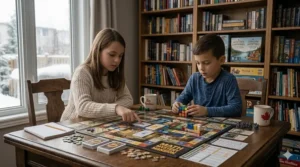
Screen Time Decreases Naturally
Rather than battling over device limits, family game night ideas provide compelling alternatives to digital entertainment. When children genuinely look forward to game night, tablets and consoles lose some of their magnetic pull.
Health Canada guidelines recommend limiting recreational screen time, and board games offer engaging substitutes that build rather than diminish family connections. Many Canadian families report that establishing game night traditions made enforcing screen limits significantly easier.
Communication Skills Improve Meaningfully
Modern board games require constant communication—explaining strategies, negotiating trades, discussing cooperative moves. Children naturally expand their vocabulary, practice articulating complex ideas, and learn to listen actively to others’ perspectives.
For bilingual Canadian households, board games create low-pressure opportunities to practice both English and French. Many families report their children’s language confidence growing through regular game-playing sessions.
Family Bonds Deepen Authentically
In our hyperconnected yet often disconnected world, board games create sacred space where phones sit face-down and family members actually see each other. The shared experiences, inside jokes, and memorable moments create family culture that children carry into adulthood.
Canadian families separated by work schedules, extracurricular commitments, and digital distractions report that game night has become their most treasured weekly tradition—the one event everyone protects on their calendar.
Popular Board Game Mechanics Explained 🔧
Understanding common game mechanics helps you identify what your family will enjoy most. Here’s a breakdown of popular systems you’ll encounter while browsing Amazon.ca.
Dice Rolling (Luck-Based Outcomes)
Games using dice introduce randomness that levels the playing field between children and adults. While strategy matters, lucky rolls can let a 6-year-old triumph over their engineer parent. Outfoxed! uses pictorial dice that young children understand without reading numbers.
Card Drafting (Strategic Selection)
Players choose cards from a common pool or their hand, creating engines or collecting sets. This mechanic rewards planning and adaptability. Games like 7 Wonders Junior showcase this system at family-friendly complexity.
Tile Placement (Spatial Reasoning)
Players place tiles to build boards, complete patterns, or claim territories. Azul exemplifies elegant tile placement, where each decision ripples through subsequent turns. This mechanic particularly appeals to visual-spatial thinkers.
Resource Management (Economic Strategy)
Players gather, trade, and spend resources to achieve goals. CATAN pioneered accessible resource management for families, teaching economic principles through wool, grain, and ore trading rather than abstract concepts.
Cooperative Teamwork (Shared Challenge)
Everyone wins or loses together against the game system. This mechanic eliminates the competitive tension that troubles some families while teaching collaboration and shared decision-making. Canadian families with highly competitive children often find cooperative games restore peace to game night.
Age-Appropriate Game Recommendations by Development Stage 👶👧🧒
Canadian families benefit from understanding which board games for families suit different developmental stages. Here’s guidance for matching games to your children’s growing capabilities.
Preschool (Ages 3-5): Foundation Building
At this stage, focus on games teaching colours, counting, turn-taking, and following simple rules. Cooperative games for kids work especially well as preschoolers struggle with losing gracefully. Look for games with chunky pieces safe for mouthing, short playtimes under 15 minutes, and minimal reading requirements.
Early Elementary (Ages 6-8): Expanding Horizons
Children this age handle more complex rules, basic strategy, and can usually manage disappointment when losing. Strategy games age 6+ introduce planning ahead, pattern recognition, and consequence prediction. Reading abilities expand, though pictorial components still help.
Upper Elementary (Ages 9-11): Strategic Thinking
Older elementary students appreciate genuine strategy, can handle 45-60 minute games, and often enjoy slight complexity. They’re ready for resource management, spatial puzzles, and games requiring multi-step planning. Many can play adult-level games with slight modifications.
Teens (Ages 12+): Full Complexity
Teenagers can handle everything from quick party games for children (when hosting younger siblings) to heavyweight strategy requiring 2+ hours. They often become the most passionate game collectors in families, researching new releases and teaching games to parents.
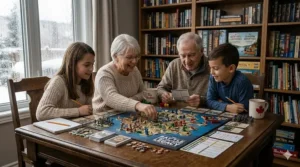
Creating Successful Game Night Traditions in Canadian Homes 🏡
Establishing family game night ideas that actually stick requires more than just buying games. Here’s how to build traditions that last throughout your children’s formative years.
Choose a Consistent Time and Protect It Fiercely
Whether it’s Friday evenings, Sunday afternoons, or the first Tuesday of each month, consistency matters more than frequency. Canadian families report that marking game night on the family calendar with the same priority as hockey practice ensures it happens.
Let Children Choose Games (Within Reason)
Rotate who selects the evening’s entertainment. When children feel ownership over game night, they invest more energy in making it successful. Keep a rotation chart on the refrigerator so everyone knows when their choosing turn arrives.
Prepare Snacks That Don’t Damage Components
Popcorn and board games mix poorly, but apple slices, cheese cubes, and pretzel sticks in individual bowls work beautifully. Many Canadian families establish game night treat traditions—special cookies, hot chocolate, or whatever makes the evening feel celebratory.
Adjust Rules to Maximize Fun
House rules aren’t cheating; they’re customizing games to fit your family. Shorten Monopoly by starting with extra money, make CATAN cooperative by facing shared challenges, or give younger players head starts in racing games. The goal is family bonding, not tournament-legal play.
Celebrate Milestones and Inside Jokes
Notice when someone achieves something noteworthy, even if they don’t win. Create silly traditions around specific game moments. These shared experiences become family mythology—the time Dad bankrupted himself through bad property deals or when 8-year-old Sophie pulled off an incredible comeback.
Where to Buy Board Games in Canada (Best Deals & Selection) 💰
Canadian families have multiple options for purchasing board games for families, each with distinct advantages worth considering.
Amazon.ca: Convenience Meets Selection
Amazon.ca offers the broadest selection of board games for families with competitive pricing, especially for Prime members. Free shipping thresholds make it easy to bundle purchases, and customer reviews from fellow Canadians provide valuable insights. Many games qualify for same-day or next-day delivery in major urban centres like Toronto, Montreal, Vancouver, and Calgary.
Watch for Prime Day, Black Friday, and Boxing Day sales when award winning kids games often drop 30-50% off regular prices. Subscribe to price tracking tools to catch deals on wish-list items.
Local Game Stores: Expert Guidance and Community
Independent game stores across Canada from 401 Games in Toronto to Strategies in Vancouver offer something Amazon can’t—knowledgeable staff who demonstrate games and provide personalized recommendations. Many host family game nights where you can try before buying.
Supporting local retailers keeps Canadian gaming communities vibrant and ensures you have places to play beyond your dining room table. Prices typically run 10-20% higher than Amazon, but the expertise and demo libraries often justify the premium.
Chapters/Indigo: Mainstream Selection
Canada’s largest bookstore chain stocks popular board games for families with the advantage of in-store browsing. Their selection focuses on mainstream titles and bestsellers rather than hobby games. Watch for Plum Rewards member discounts and holiday sales.
Costco: Bulk Savings on Popular Titles
Costco periodically stocks board games at significant discounts, though selection varies by location and season. When they carry award winning kids games, prices often beat all competitors. The catch: selection is limited and inventory doesn’t replenish once sold out.
Board Game Cafés: Try Before You Buy
Cities across Canada boast board game cafés where you pay an hourly fee to play from their libraries. This lets families test cooperative games for kids, strategy games age 6+, and party games for children before investing. Many cafés sell the games they stock, sometimes with play-credit discounts.
Top Board Games Comparison: Features and Value Analysis 📊
| Feature | Ticket to Ride | CATAN | Azul | Outfoxed! | Blokus |
|---|---|---|---|---|---|
| Learning Curve | Easy | Moderate | Easy | Very Easy | Easy |
| Replay Value | High | Very High | High | Moderate | Very High |
| Component Quality | Excellent | Good | Excellent | Good | Good |
| Age Range Appeal | 8-Adult | 10-Adult | 8-Adult | 5-10 | 7-Adult |
| Setup Time | 5 min | 10 min | 2 min | 5 min | 1 min |
| Language Dependence | Minimal | Minimal | None | Low | None |
| Canadian Value | Excellent | Excellent | Good | Outstanding | Good |
Common Mistakes When Buying Board Games (And How to Avoid Them) ⚠️
Canadian families waste hundreds of dollars annually on board games that never get played. Here’s how to avoid the most common purchasing pitfalls.
Buying Games Too Advanced for Current Ages
That amazing strategy game rated 12+ will gather dust if your oldest child is 9. Children grow into games quickly enough—buy for where they are now, not where they’ll be in two years. The exception: If you’ll play adult-only sessions until children mature enough to join.
Ignoring Actual Player Count
A 2-4 player game works poorly in a family of six. Conversely, buying a 4-8 player party game when you’re a family of three means it only emerges during rare large gatherings. Match player counts to your typical gaming situations, not best-case scenarios.
Overlooking Setup and Teardown Time
Games requiring 20 minutes of setup plus 15 minutes of component sorting after play rarely hit the table on school nights. Consider total time commitment, not just playtime. Games with quick setup get played far more frequently.
Focusing Solely on Awards Rather Than Preferences
Award winning kids games earn recognition for good reasons, but awards reflect judges’ preferences, not necessarily your family’s tastes. A Spiel des Jahres winner emphasizing abstract strategy might disappoint children craving thematic adventure.
Neglecting Expansion Compatibility
Some of the best board games for families support expansions that extend replayability for years. Before purchasing, check whether your budget stretches to essential expansions or whether the base game provides satisfying complete experience.
Storage and Organization Tips for Growing Game Collections 📦
As your family catches the board gaming bug, organization becomes crucial. Canadian families in smaller living spaces need creative solutions.
Invest in Proper Shelving Early
IKEA’s Kallax units have become the unofficial standard for board game storage, with square compartments fitting most boxes perfectly. Measure your available space and plan vertical storage to maximize floor space in Canadian homes where square footage comes at a premium.
Use Labeled Photo Storage for Components
Small pieces, cards, and tokens store beautifully in photo storage boxes available at dollar stores. Label clearly with game name and component type. This prevents the dreaded “we’re missing pieces” discovery mid-game.
Create a Family Gaming Library System
Establish rules about game handling: replace lids properly, store in designated spots, report damage immediately. Teach children that family game night ideas succeed only when everyone respects shared resources.
Rotate Games Seasonally
Keep 8-10 games readily accessible while storing others in closets or basements. Rotating every few months makes older games feel fresh again and prevents overwhelming choice paralysis when selecting evening entertainment.
Digitize Rule Books
Many publishers offer PDF rulebooks. Download these to tablets or phones for quick reference during play, saving wear on physical manuals. This particularly helps with games in English when you’re teaching in French or vice versa.
Frequently Asked Questions About Board Games for Families ❓
What are the best cooperative games for kids available in Canada?
✅ Top cooperative games for kids on Amazon.ca include Outfoxed! ($17-$30 CAD) for ages 5+, offering mystery-solving fun; Forbidden Island ($20-$35 CAD) for ages 10+, teaching resource management; and Ghost Fightin’ Treasure Hunters ($25-$40 CAD) for ages 8+, combining cooperation with spooky excitement. These games teach teamwork while eliminating competitive tension that troubles some families…
How much should I budget for family board games in Canada?
✅ Quality board games for families typically range from $20-$70 CAD on Amazon.ca. Budget-friendly options like Guess Who? and Outfoxed! cost $17-$30 CAD, mid-range strategy games like CATAN and Azul run $30-$60 CAD, and premium titles like deluxe Ticket to Ride editions reach $60-$70 CAD. Most families find excellent entertainment value at $30-$45 CAD per game…
What age is appropriate to start playing strategy games with kids?
✅ Children typically handle basic strategy games around age 6-7, though development varies individually. Strategy games age 6+ like Ticket to Ride Junior and Catan Junior simplify mechanics while building critical thinking. By age 8-10, most children graduate to full versions of games like CATAN and Azul. Canadian families report success starting earlier with cooperative games where adults provide subtle guidance…
Are educational board games actually effective for learning?
✅ Research from multiple studies confirms educational board games significantly improve mathematical skills, memory, and cognitive development in children. The National Center for Biotechnology Information found children who played board games in classrooms showed enhanced visuospatial memory and number operations. Games disguise learning as entertainment, making skill development feel natural rather than forced…
How do I get teenagers interested in family game night?
✅ Teenagers respond to more complex strategy, social deduction games, and titles offering meaningful choices. Let teens select games sometimes, invite their friends to join, and avoid overly childish themes. Many Canadian families report success with party games for children that scale to include teens, cooperative games requiring teamwork, and competitive titles where teenagers can demonstrate competence. Consider their gaming interests when selecting new additions…
Conclusion: Building Memories One Game at a Time 🎲
The best board games for families aren’t determined by award seals, BoardGameGeek ratings, or prices—they’re the ones that bring your specific family together, create laughter, teach lessons, and forge memories that outlast childhood. Whether you’re drawn to cooperative games for kids that teach teamwork, strategy games age 6+ that challenge growing minds, party games for children that energize gatherings, or educational board games that make learning irresistible, there’s never been a better time to explore modern family gaming.
Canadian families benefit from excellent access through Amazon.ca, with competitive pricing, reliable shipping across all provinces and territories, and bilingual options for households developing both official languages. The games profiled here represent tested excellence—titles that thousands of Canadian families return to week after week, creating traditions that children will remember decades later.
Start with one game that matches your family’s current interests and abilities. Commit to one game night weekly. Protect that time as fiercely as school concerts and hockey practices. Watch as something magical unfolds: faces illuminated not by screens but by genuine engagement, siblings cooperating instead of bickering, children developing skills they’ll carry through life, and families building bonds that strengthen with every shuffled deck and rolled die.
The award winning kids games highlighted here offer proven starting points, but your perfect family game might be something entirely different. Trust your instincts, read Canadian customer reviews, and don’t be afraid to try games outside your comfort zone. Some of my family’s most beloved board games for families started as impulse purchases that we almost didn’t make.
Winter evenings stretch long across Canada, but they need not feel endless. With the right games, cold months transform into cozy opportunities for connection. Your future self—and your adult children reminiscing about family game nights—will thank you for starting now.
Recommended for You 🌟
- 7 Best Wooden Puzzles for Toddlers Canada 2026
- 7 Best Magna-Tiles Sets Canada 2026
- 7 Best Art Supplies for Kids Canada 2026
Disclaimer: This article contains affiliate links to Amazon.ca. If you purchase products through these links, we may earn a small commission at no additional cost to you.
✨ Found this helpful? Share it with your friends! 💬🤗
