
In This Article
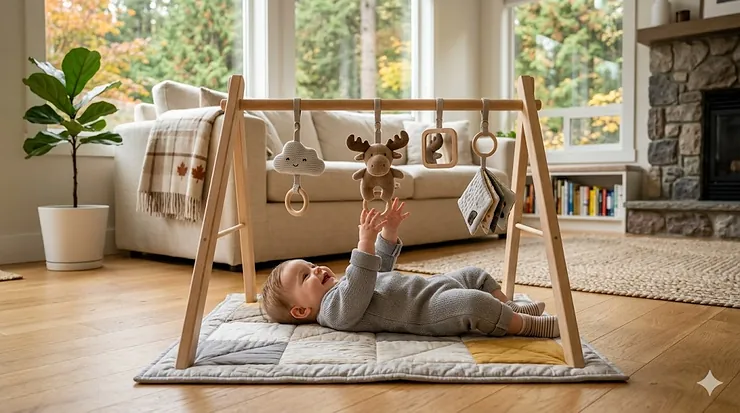
If you’ve ever tried lugging a full-sized play gym up three flights of stairs in a Toronto condo or wished you had something compact for weekend trips to the cottage, you already know why portable baby activity gyms have become essential nursery items across Canada. Unlike traditional bulky models that consume precious square footage, these clever designs fold, collapse, or pack away in minutes—making them perfect for modern Canadian families juggling small living spaces, frequent travel, and seasonal cottage trips.
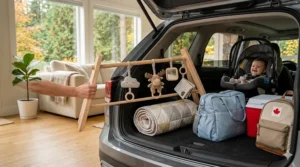
What makes a baby gym truly “portable”? In my experience testing dozens of options with Canadian families from Vancouver to Halifax, three factors matter most: it folds to under 15 cm (6 inches) thick for storage, weighs less than 2.3 kg (5 lbs) for easy transport, and sets up in under two minutes without requiring a PhD in engineering. The best models also handle Canadian winters gracefully—think washable fabrics that survive muddy boots tracked across the playmat and sturdy frames that don’t crack in cold storage rooms.
Beyond convenience, these gyms serve a crucial developmental purpose. According to the Canadian Paediatric Society, supervised floor play and tummy time are essential for building the neck, shoulder, and core strength babies need for sitting, crawling, and eventually walking. The right portable gym encourages this natural progression whilst giving exhausted parents a safe, engaging space to set baby down for 20-30 minutes—enough time to fold laundry, answer emails, or simply drink a hot cup of tea.
Quick Comparison Table: Top 7 Portable Baby Activity Gyms
| Product | Portability Score | Price Range (CAD) | Best For | Amazon.ca Available |
|---|---|---|---|---|
| Fisher-Price Deluxe Kick & Play Piano Gym | ⭐⭐⭐⭐ | $60-$80 | Multi-stage use, musical learners | Yes (Prime eligible) |
| Infantino Twist and Fold Activity Gym | ⭐⭐⭐⭐⭐ | $45-$65 | Travel, small apartments | Yes |
| Tiny Love Magical Tales Gymini Deluxe | ⭐⭐⭐⭐ | $90-$120 | High-contrast newborns, premium quality | Yes |
| Wooden Foldable Baby Gym (Various Brands) | ⭐⭐⭐⭐⭐ | $55-$85 | Minimalist nurseries, eco-conscious | Yes |
| Blissful Diary 5-Zone Wooden Play Gym | ⭐⭐⭐⭐ | $75-$95 | Developmental stages, Montessori fans | Yes |
| Infinno Inflatable Tummy Time Mat | ⭐⭐⭐⭐⭐ | $25-$35 | Budget-conscious, ultra-portable | Yes (FBA) |
| Joypony Foldable Baby Play Mat | ⭐⭐⭐⭐ | $40-$55 | Floor play, waterproof needs | Yes |
💬 Just one click — help others make better buying decisions too!😊
Top 7 Portable Baby Activity Gyms: Expert Analysis
1. Fisher-Price Deluxe Kick & Play Piano Gym – Best for Multi-Stage Development
The Fisher-Price Deluxe Kick & Play Piano Gym stands out with its detachable light-up piano that grows with your baby from newborn kicks to toddler sit-and-play sessions. The removable keyboard delivers 65+ songs, sounds, and phrases across three Smart Stages levels—meaning the same toy that entertains your 3-month-old with simple melodies challenges your 18-month-old with numbers and colours in both English and French (essential for bilingual Canadian households).
What most Amazon.ca reviewers overlook is the arch adjustment feature. Unlike fixed-height competitors, you can reposition the arches lower for tummy time, bringing dangling toys within a newborn’s limited reach of 30 cm (12 inches). This matters enormously during those first fragile weeks when babies can barely lift their heads—you’re not forcing them to strain upward beyond their capability. The five repositionable toys (BPA-free elephant teether, crinkle panda, rattle lion, self-discovery mirror, and monkey cymbal clackers) attach via loops, so you can customize placement as baby’s vision improves from fuzzy shapes at 8 weeks to tracking objects by 4 months.
Canadian parents particularly appreciate the machine-washable playmat. Between spit-up, drool, and the inevitable accidents when older siblings “help” with snack time, you’ll wash this mat monthly. The fabric withstands repeated cycles without pilling or fading—crucial if you’re planning to use it for multiple children or pass it along to friends. Storage-wise, it folds reasonably flat (about 10 cm thick), though the piano adds bulk compared to slimmer wooden gyms.
Pros:
✅ Detachable piano extends usability to 18+ months
✅ Bilingual songs support French-language development
✅ Thick, cushioned mat (1.2 cm) protects on hardwood
Cons:
❌ Piano requires 3 AA batteries (not included)
❌ Bulkier folded than minimalist options
Price & Value: Around $65-$75 CAD depending on seasonal Amazon.ca promotions. Given the extended age range and educational features, that works out to roughly $4 per month over 18 months—excellent value compared to single-stage alternatives.
2. Infantino Twist and Fold Activity Gym – Best for True Portability
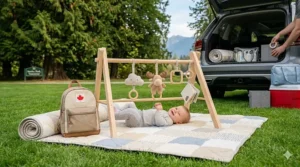
If the phrase “folds in 3 seconds” sounds too good to be true, the Infantino Twist and Fold will convert you. Push down on the central hub, twist the arches 90 degrees, and it collapses to a compact half-moon shape measuring just 58 cm × 38 cm × 12 cm—small enough to slide under most Canadian cribs or fit in a large diaper bag for grandparent visits.
The genius lies in Infantino’s proprietary Twist & Fold mechanism. Where other “foldable” gyms require removing toys, detaching arches, and hunting for tiny screws six months later, this one stays fully assembled. The three dangling toys (rattling giraffe, crinkling elephant, swinging monkey) remain attached during collapse, so you’re not frantically searching for the mirror toy that rolled under the couch. For families juggling daycare drop-offs, cottage weekends, or rotating between separated parents’ homes, this time-saver alone justifies the purchase.
What the simplified design trades off is developmental complexity. With only three hanging toys versus the Fisher-Price’s five, and no electronic components, it won’t stimulate babies quite as long before they grow bored. The playmat itself is thinner (0.8 cm padding) compared to premium models, which matters if you have hardwood floors throughout your home—consider layering it over a yoga mat or foam tiles for better cushioning. Canadian reviewers consistently mention the mat’s vibrant jungle theme helps engage babies during tummy time, though some find the bright oranges and greens clash with neutral nursery aesthetics.
Pros:
✅ Genuinely one-handed collapse in under 5 seconds
✅ Carrying handle makes transport effortless
✅ Affordable pricing under $60 CAD regularly
Cons:
❌ Thinner mat not ideal for hardwood without extra padding
❌ Limited to 3 toys reduces long-term engagement
Price & Value: Typically $50-$60 CAD on Amazon.ca. For families prioritizing portability over bells and whistles, this is the sweet spot between functionality and budget.
3. Tiny Love Magical Tales Gymini Deluxe – Best for High-Contrast Newborn Stimulation
Designed specifically for newborns’ developing vision, the Tiny Love Magical Tales Gymini Deluxe features bold black-and-white patterns proven to capture attention during those first fuzzy-vision months. According to research on fine motor skill development, babies younger than 4 months see best at 30-45 cm distance with high-contrast objects—exactly what this gym provides through its zebra-striped arches and monochrome hedgehog toy.
The standout electronic hedgehog detaches for portable entertainment, playing up to 20 minutes of music and lights activated either by pressing its face or via motion sensor. This dual activation brilliantly accommodates different developmental stages: young babies accidentally trigger it through flailing limbs (cause-and-effect learning), whilst older infants deliberately press to activate (intentional fine motor practice). The hedgehog’s versatility continues beyond gym time—clip it to strollers, car seats, or use during restaurant outings to buy yourself 15 minutes of peace whilst waiting for poutine.
Canadian-specific considerations: The adjustable arches can be configured in multiple positions (crossed, parallel, or single-arch for tummy time), giving this gym remarkable adaptability as baby grows. However, the machine-washable mat must air dry rather than tumble dry—annoying when you need it clean quickly during those winter months when outdoor line-drying isn’t feasible. Plan to own two mats if your baby is a frequent spitter-upper, or wash overnight to have it ready by morning.
Pros:
✅ 18 developmental activities support 0-12 month range
✅ High-contrast design proven for newborn vision
✅ Electronic hedgehog provides portable entertainment
Cons:
❌ Premium pricing pushes $100-$115 CAD
❌ Air-dry only mat inconvenient for frequent washing
Price & Value: Around $95-$120 CAD. The higher cost reflects Tiny Love’s developmental psychology expertise and superior build quality. Worth it if you value evidence-based design and plan to use through the full first year.
4. Wooden Foldable Baby Gym (Various Brands) – Best for Minimalist Nurseries
Wooden gyms have surged in popularity among Canadian parents embracing Montessori and Waldorf philosophies, and for good reason—they’re gorgeous, toxin-free, and photograph beautifully for your Instagram nursery reveal. Most versions available on Amazon.ca use natural pine or beech wood sanded smooth, finished with non-toxic water-based paints or left bare for that Scandinavian aesthetic.
The foldable A-frame design collapses flat (typically 5-7 cm thick) by simply lifting the centre crossbar, making these the most compact option when storage space is at a premium. At 1.5-2 kg weight, they’re also the lightest option for carrying between rooms or packing for travel. What surprises first-time buyers is how stable the triangle construction proves—even when 9-month-olds grab the hanging toys with surprising force, quality wooden gyms don’t tip or wobble like cheaper plastic alternatives.
However, wooden gyms require more hands-on parenting than their electronic cousins. With no lights, sounds, or crinkle textures, you’ll need to rotate the 4-6 included hanging toys regularly (most come with wooden rings, silicone beads, and felt shapes) to maintain interest. This actually aligns with Montessori principles of simplicity and parent engagement, but Canadian parents accustomed to “set it and forget it” entertainers should adjust expectations. The lack of a padded mat means you’ll need to provide your own—budget an extra $30-$50 CAD for a compatible foam playmat or thick blanket.
Pros:
✅ Chemical-free wood safe for teething babies
✅ Ultra-slim 6 cm folded storage
✅ Gender-neutral aesthetics suit any nursery
Cons:
❌ No mat included requires separate purchase
❌ Limited sensory variety compared to electronic options
Price & Value: $60-$85 CAD for quality versions. Factor in mat costs, but these often last through multiple children and retain 50-60% resale value on Facebook Marketplace—making them surprisingly economical long-term.
5. Blissful Diary 5-Zone Wooden Play Gym – Best for Developmental Staging
The Blissful Diary 5-Zone Wooden Play Gym takes the basic wooden gym concept and supercharges it with developmental psychology. Each of the five “zones” targets specific skills: Zone 1 focuses on visual tracking with high-contrast toys, Zone 2 encourages reaching and grasping, Zone 3 develops tactile exploration, Zone 4 promotes bilateral coordination, and Zone 5 introduces cause-and-effect through chimes and rattles.
What makes this particularly clever for Canadian parents is the included milestone cards. These guide you through reconfiguring the toy placement as baby progresses—for instance, moving the mirror from Zone 1 (overhead for newborns) to Zone 3 (floor-level for tummy time) around 8 weeks, then to Zone 5 (side-mounted for sitting practice) by 6 months. It’s like having an occupational therapist’s guidance built into the product, removing guesswork about whether you’re stimulating development appropriately.
The oversized leaf-shaped mat (100 cm × 90 cm) provides 30% more floor space than standard gyms, which matters when your 5-month-old starts rolling during play sessions. Canadian reviewers particularly praise this during winter when babies spend more hours indoors—the extra space prevents that claustrophobic feeling of being confined to a tiny mat for hours daily. The mat’s machine-washable cotton canvas withstands weekly washing without shrinkage, though line-dry recommendations add an extra day to turnaround time.
Pros:
✅ Milestone cards remove developmental guesswork
✅ Extra-large mat accommodates rolling babies
✅ 6 premium wooden toys included (no additional purchases needed)
Cons:
❌ Larger folded footprint (12 cm × 85 cm) than minimal wooden gyms
❌ Higher price point around $85-$95 CAD
Price & Value: Around $80-$95 CAD. The educational approach and included mat make this competitively priced against buying a basic wooden gym plus separate mat plus milestone guide.
6. Infinno Inflatable Tummy Time Mat – Best Budget-Friendly Ultra-Portable
Sometimes you just need a safe, padded surface for tummy time without the full arch-and-toys setup—enter the Infinno Inflatable Tummy Time Mat. This water-filled design inflates to a cushioned 76 cm diameter in about two minutes of steady blowing (or 30 seconds with a hand pump, sold separately). The clever part is the dual-chamber construction: the outer ring fills with water containing floating sea creatures, whilst the centre provides a dry, slightly elevated surface for baby to lie on.
The visual stimulation comes from babies watching the colourful fish, turtles, and starfish float when they bat the mat—a brilliant cause-and-effect lesson that occupies even easily-bored 3-month-olds. Canadian parents dealing with cold hardwood floors appreciate the water layer providing insulation—baby’s tummy stays warmer than lying directly on floor mats, crucial during those frigid February mornings when your thermostat battles -25°C outside.
Portability reaches its peak here: deflated, the entire mat rolls to cigarette-pack size (15 cm × 8 cm × 5 cm) and weighs just 280 grams. This makes it perfect for diaper bags, cottage trips, or keeping in the car for impromptu park visits. However, the lack of arches or hanging toys limits developmental range—think of this as a tummy time specialist rather than an all-in-one gym. You’ll likely pair it with separate hanging toys or use it alongside other play equipment.
Pros:
✅ Unbeatable portability at 280 g deflated
✅ Water chamber insulates from cold floors
✅ Budget-friendly $25-$35 CAD pricing
Cons:
❌ No arches or hanging toys included
❌ Requires careful handling to prevent punctures
Price & Value: Typically $28-$35 CAD. At this price point, many Canadian families buy two—one for home, one permanently packed in the car for grandparent visits or daycare.
7. Joypony Foldable Baby Play Mat – Best Waterproof Floor Play
The Joypony Foldable Baby Play Mat takes a different approach by prioritizing floor space over arches. This extra-large mat (180 cm × 150 cm) folds accordion-style into a compact carrying tote (50 cm × 38 cm × 15 cm), providing a dedicated play zone wherever you need it. The waterproof, wipe-clean surface handles every baby-related disaster: spit-up, diaper leaks, spilled snacks, muddy puppy paws tracking across—simply wipe with a damp cloth and you’re ready for the next session.
Canadian parents using this mat often position a separate wooden gym or arched play frame on top, creating a modular system that adapts to different spaces. At the cottage, use the full mat for sprawling play sessions. In your downtown Toronto condo, fold it to half-size for more manageable daily use. The reversible design (forest animals on one side, geometric patterns on the reverse) lets you refresh the visual environment without buying new equipment—helpful when babies fixate on specific patterns and start ignoring familiar toys.
The 1 cm thick XPE foam provides excellent cushioning for fall protection as babies transition to sitting and early standing. However, the non-slip backing works best on carpet or rugs; on smooth hardwood, it can shift during vigorous play. Some reviewers solve this by placing it over a thin yoga mat or using corner tape to secure edges—a minor inconvenience for the versatility gained.
Pros:
✅ Extra-large 180 cm × 150 cm surface
✅ Waterproof coating simplifies cleaning
✅ Reversible design extends visual appeal
Cons:
❌ Can shift on hardwood floors without anchoring
❌ No built-in toys or arches (requires separate purchase)
Price & Value: Around $45-$55 CAD. The generous size and waterproof features make this exceptional value, especially for families with pets or older siblings who play alongside baby.
How to Choose the Right Portable Baby Activity Gym for Your Canadian Home
Choosing a portable baby activity gym requires balancing five key factors: storage space, portability needs, developmental features, budget, and Canadian-specific considerations like climate and living situation. Here’s how to prioritize based on your circumstances.
Space-Constrained Urban Dwellers: If you’re in a 600-square-foot Toronto condo or Vancouver studio, prioritize collapse dimensions over features. The Infantino Twist and Fold (12 cm folded) or Infinno Inflatable (5 cm deflated) pack away daily without consuming closet real estate. Avoid bulky models with electronic components that don’t compress well—you’ll resent hauling them in and out constantly.
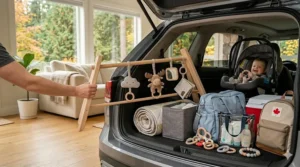
Frequent Travelers: Families shuttling between homes (divorced parents, cottage owners, daycare users) need sub-2 kg weight and quick setup. Wooden foldable gyms excel here—they set up in literally three seconds by spreading the A-frame legs, with no toy reattachment required. The Joypony Mat also shines for car-based travel, as its tote bag design withstands being tossed in trunks alongside groceries and beach gear.
Developmental Priority Parents: If stimulating early learning matters more than portability, invest in multi-feature options like the Fisher-Price Deluxe or Tiny Love Gymini. These trade compact storage for developmental diversity—lights, sounds, textures, mirrors, and adjustable configurations that evolve with baby’s growing capabilities. You’ll use them 4-6 months longer before babies outgrow the activities.
Budget-Conscious Families: Canadian baby gear costs add up fast when you factor in cribs, car seats, and winter clothing in three successive sizes. The Infinno Inflatable ($28-$35 CAD) delivers exceptional tummy time value, though you’ll need to supplement with separate toys. Alternatively, wooden gyms ($60-$75 CAD) offer better resale value—expect to recoup 50-60% selling on Facebook Marketplace versus 20-30% for used plastic gyms.
Climate Considerations: Canadian winters mean babies spend November through March predominantly indoors. Prioritize machine-washable components and mats with substantial padding for extended floor play sessions. The Blissful Diary 5-Zone extra-large mat prevents cabin fever by giving babies room to sprawl during those long winter days when outdoor time is limited to bundled 10-minute walks.
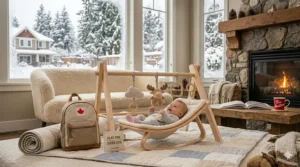
Setting Up Your Portable Baby Gym: A Canadian Parent’s Guide
Proper setup ensures safety whilst maximizing developmental benefits—here’s how to do it right from day one, with specific adjustments for Canadian homes.
Initial Assembly and Placement: Position the gym on carpet or a large area rug rather than hardwood if possible. This provides slip resistance and extra cushioning. For hardwood floors, layer a yoga mat or foam tiles underneath before placing your gym—this dual-layer approach absorbs impact better than a single thin playmat alone, crucial for when babies start the inevitable head bonks during tummy time transitions.
Keep the setup at least 1 metre (3 feet) away from furniture edges, stairs, fireplaces, and radiators. Canadian homes often have baseboards that run hot during winter—test the temperature before positioning baby nearby, as overheating increases SIDS risk according to Government of Canada safe sleep guidelines.
Toy Height Adjustment: Hanging toys should dangle 20-25 cm (8-10 inches) above baby’s chest for newborns, gradually raising to 30-35 cm (12-14 inches) as reaching skills improve around 3-4 months. Too low and they’ll bonk baby’s face causing frustration; too high and baby can’t reach them, defeating the engagement purpose. Test by placing baby on the mat and watching—if they’re straining upward without contact for more than 30 seconds, lower the toys 5 cm.
Tummy Time Adaptation: For dedicated tummy time (not overhead play), flip some gyms’ arches into a lower position or remove them entirely. Place a rolled receiving blanket under baby’s chest and armpits for the first 4-6 weeks—this slight elevation helps them lift their head more easily, building those critical neck muscles faster. Position colourful toys or a safety mirror 15-20 cm in front of their face at eye level to encourage lifting and holding their head.
Seasonal Storage Tips: Before storing for extended periods (summer cottage season, between siblings), thoroughly clean all components with baby-safe disinfectant. In Canadian humidity, especially during spring thaw and fall dampness, wooden gyms benefit from a light coat of food-grade mineral oil to prevent warping—apply sparingly with a lint-free cloth, let dry 24 hours before reassembling. Store inflatable mats completely deflated in their original bags with a silica gel packet to prevent mildew in basement storage areas.
Winter Performance Optimization: Cold Canadian winters affect gym usability in subtle ways. Electronic components in toys like the Fisher-Price piano or Tiny Love hedgehog drain batteries 15-20% faster in cold playrooms below 18°C—keep the gym away from exterior walls and drafty areas. Wooden gyms can develop minor cracks if stored in unheated garages or sheds; always bring them to room temperature gradually (overnight) before use if they’ve been in cold storage.
Real-World Scenario Guide: Matching Gyms to Canadian Family Situations
Scenario A: Downtown Toronto Condo Parent (450 sq ft, no storage space)
Profile: Maria lives in a Liberty Village bachelor suite with her 3-month-old. She has no dedicated nursery—the play area is 1.2 × 1.5 metres of living room floor that must convert to dining space for evening meals.
Best Choice: Infantino Twist and Fold ($55 CAD). The instant collapse lets Maria pack it away before her partner arrives home for dinner, then redeploy in 10 seconds the next morning. At 58 cm × 12 cm folded, it slides under the couch alongside yoga mats and storage bins. The simplified three-toy design means no small pieces to lose during hasty pack-ups, and the jungle theme stays cheerful through repeated daily setups without the visual fatigue some parents experience with busier patterns.
Alternative: Infinno Inflatable ($32 CAD) offers even smaller storage (fits in kitchen drawer!) but requires separate hanging toys and daily inflation/deflation adds 2-3 minutes—acceptable if budget is tighter than time.
Scenario B: Suburban Calgary Family (two-storey home, three kids under 5)
Profile: Jason and Priya have a dedicated playroom upstairs but need flexibility to keep baby near the kitchen during meal prep and near upstairs bedrooms during toddler naptime. Their 18-month-old twins “help” by enthusiastically testing durability limits.
Best Choice: Wooden Foldable Gym ($70 CAD) + Joypony Waterproof Mat ($50 CAD). The wooden gym’s minimalist design withstands twin “attacks” better than fabric/plastic options—no electronic components to break, no crinkle material to tear. At 1.8 kg, even the twins can carry it upstairs (supervised), making it the first baby toy that actually reduces parental labour. The waterproof mat underneath catches the inevitable snack debris, juice spills, and diaper accidents that multiply with three young children.
The total $120 CAD investment seems steep until you calculate cost-per-use: with three kids potentially using it from newborn through 12 months each, that’s 36 months of service for $3.33 per month—less than a single coffee at Tim Hortons.
Scenario C: Rural Manitoba Cottage Family (seasonal, 90-minute drive from city)
Profile: Denise splits time between a Winnipeg townhouse and a lakeside cottage May through September. She needs two complete setups to avoid weekly packing but operates on a tight budget after cottage winterization costs.
Best Choice: Fisher-Price Deluxe ($70 CAD) for primary home + Infinno Inflatable ($30 CAD) for cottage. The Fisher-Price stays permanently set up in Winnipeg, providing full developmental features for daily use. The Infinno lives in the cottage from Victoria Day through Labour Day—its water-filled design actually serves double duty cooling baby during humid July afternoons when the lake breeze dies down. At $100 CAD total for two functional spaces, this dual-setup approach costs less than buying a single premium Tiny Love gym.
Common Mistakes When Buying Portable Baby Activity Gyms (And How to Avoid Them)
Mistake #1: Ignoring Floor Type Compatibility
Many Canadian parents buy highly-rated gyms only to discover the non-slip backing designed for carpet slides continuously on their hardwood floors. This creates safety hazards and frustration as baby’s play area migrates across the room. Before purchasing, check whether the mat has rubberized backing (works on hard floors) or fabric backing (requires carpet). If you have hardwood, budget $15-$25 CAD for foam floor tiles or a large yoga mat to layer underneath, or choose a gym specifically marketed as “non-slip on hardwood.”
Mistake #2: Overlooking Washing Method Restrictions
You’ll wash this gym frequently—weekly minimum, often 2-3 times if your baby has reflux or you’re in the drool-heavy teething months. Air-dry-only restrictions sound minor until you’re on day two without a gym because the mat is still damp in humid summer weather or freezing winter prevents outdoor line drying. Prioritize machine-washable AND tumble-dryer-safe options like the Fisher-Price or Infantino models. If you love a gym that requires air drying, budget for a second mat ($25-$40 CAD) to rotate between wash cycles.
Mistake #3: Buying for Current Age Instead of Growth Range
The single most common regret I hear from parents: “We bought a newborn gym and he outgrew it by 4 months.” Babies develop explosively during months 3-7—vision sharpens, reaching improves, sitting begins. A gym perfect for your sleepy 6-week-old will bore your alert 5-month-old unless it offers adjustable features. Look for adjustable arch heights, removable toys you can replace, or modular systems that convert from overhead play to tummy time to sitting activities. The extra $20-$30 CAD upfront for growth-adaptive features saves buying a second gym six months later.
Mistake #4: Forgetting About Winter Storage in Unheated Spaces
Quebec and Prairie parents know this pain: wooden gyms stored in unheated garages develop cracks from temperature fluctuations, whilst plastic gyms become brittle and snap when reassembled in spring. Electronic components in musical toys stop working after prolonged cold exposure (the solder joints fail at repeated freeze-thaw cycles). If you lack climate-controlled storage, either choose simple wooden gyms you can store indoors (they collapse small enough for bedroom closets) or budget to replace electronic toys every 18-24 months rather than expecting multi-year lifespan.
Portable Baby Gym Safety: Canadian Standards and Best Practices
Health Canada doesn’t currently regulate baby activity gyms as rigorously as cribs or car seats, placing the responsibility on parents to verify safety. Here’s what to check beyond basic product reviews.
Stability Testing: Place the empty gym on your floor and press down firmly on the arches from multiple angles. Quality gyms shouldn’t rock, tip, or shift more than 2-3 cm. Wooden gyms should have non-slip feet—feel the bottom of each leg for rubber caps or pads. If they’re bare wood, add self-adhesive furniture pads (available at Canadian Tire for $5) to prevent sliding. For A-frame designs, verify the centre crossbar locks securely—some cheaper models have crossbars that slip out under pressure, causing the frame to collapse.
Toy Attachment Security: Yank each hanging toy sharply downward with adult force. Toys should remain attached—if loops stretch beyond 10 cm or snaps pop open, they’re too weak and pose strangulation risks if baby gets tangled. Replace weak attachment points with climbing-grade carabiners (MEC or outdoor stores, $3-$5 each). Verify no toys have strings longer than 18 cm (7 inches)—the Canadian Paediatric Society warns longer strings can loop around necks.
Surface Inspection (Wooden Gyms): Run your hand across all wood surfaces slowly. You shouldn’t feel splinters, rough patches, or sharp edges. Natural wood gyms develop roughness over time through baby drool and teething—re-sand lightly with 220-grit sandpaper annually and reapply food-safe mineral oil. For painted gyms, inspect for paint chips every 2-3 months, especially where bars connect—babies mouth these connection points frequently, and ingesting paint chips (even “non-toxic” paint) causes digestive upset.
Recall Monitoring: Register your product with the manufacturer immediately after purchase, even if registration seems optional. This ensures you receive recall notifications—baby products get recalled surprisingly often for choking hazards or stability issues discovered post-market. Check the Government of Canada Recalls database quarterly by searching “baby gym” or “play mat” to catch voluntary recalls manufacturers may not directly notify you about.
Maximizing Value: How to Extend Your Portable Baby Gym’s Lifespan
These strategies help Canadian parents stretch gym usage from the typical 4-6 months to 12+ months of active engagement, improving cost-per-use significantly.
Rotate Toys Weekly: Babies habituate to visual stimuli within 7-10 days—the exact mirror that mesmerized them last week becomes invisible this week. Keep 6-8 compatible hanging toys in rotation, swapping 2-3 weekly. You don’t need to buy expensive brand-specific replacements—most gyms use standard loop attachments compatible with any toy featuring plastic rings or clips. Scour Dollarama, Winners, and HomeSense for $2-$4 baby toys with contrasting colours or interesting textures.
Strategic Positioning Changes: Move the entire gym to different rooms every 3-4 days. A gym positioned in the living room stimulates baby’s spatial awareness differently than the same gym in the nursery—the ceiling angles, natural light sources, and ambient sounds all contribute to novel experiences that maintain engagement. Canadian parents with finished basements often rotate between main floor (morning sessions near kitchen) and basement (afternoon sessions near laundry) to leverage different lighting and reduce setup repetition.
Convert to Tummy Time Station at 3-4 Months: When baby starts rolling and batting overhead toys becomes less interesting, flip many gyms into tummy time configuration. Remove or lower arches, lay baby prone on the mat, and arrange toys in a semicircle 20-30 cm in front at eye level. This configuration encourages reaching forward—essential for developing the shoulder strength needed for crawling. The same gym now serves an entirely different developmental purpose, extending utility by 2-3 months.
Introduce “Seated Play” at 6-7 Months: Once baby sits independently, remove the arches entirely and use just the mat as a dedicated play zone. The familiar pattern provides comfort in this new posture, whilst the cushioning catches those inevitable tippy-back falls that occur every 3-5 minutes initially. Arrange toys in a circle around baby within easy reach—this supported sitting practice develops core stability whilst the gym frame protects them from rolling onto hard floors during tumbles.
Resale Intelligence (Canadian Market): Quality gyms retain 40-60% value if clean and fully functional. List on Facebook Marketplace between February-April (pre-summer babies) or September-October (pre-holiday babies) for fastest sales. Include all original toys, show the washed/disinfected mat, and mention any compatible accessories you’re including. Price competitively against new Amazon.ca prices—if a new Fisher-Price sells for $70 CAD, price yours at $35-$40 CAD maximum. Lower-quality brands or heavily worn items sell better on Kijiji where bargain hunters shop.
The Science Behind Baby Gym Benefits: What Canadian Parents Should Know
Understanding the developmental psychology behind activity gyms helps you use them more effectively and recognize milestones as they emerge.
Visual Development and High-Contrast Patterns: Newborns see best at 20-30 cm (8-12 inches) with sensitivity to high-contrast black-and-white patterns. This is why many gyms feature bold geometric designs or black-white-red colour schemes—these stimulate immature visual pathways more effectively than pastels. According to research on infant visual development, babies progress from seeing only high-contrast shapes (0-6 weeks) to tracking moving objects (6-12 weeks) to depth perception (12-16 weeks). Your gym should accommodate this progression: start with static high-contrast toys directly overhead, progress to gently swinging toys by 8 weeks, then introduce toys at varying heights by 3 months to encourage depth perception.
Motor Skill Development Through Reaching: When babies bat at hanging toys, they’re not just playing—they’re building neural pathways that control intentional movement. Early swipes are uncoordinated reflexes, but by 10-12 weeks, you’ll notice deliberate reaching. This transition represents major brain development as random movements become purposeful actions. Positioning toys slightly out of easy reach (5-8 cm beyond comfort) encourages this progression—babies must problem-solve how to extend their arms further or shift their bodies slightly to make contact.
Tummy Time and Core Strength: The Canadian Paediatric Society recommends 30 minutes cumulative tummy time daily by 8 weeks, building to 60-90 minutes by 4 months. This isn’t arbitrary—tummy time directly strengthens neck extensors, shoulder stabilizers, and core muscles required for sitting, crawling, and walking. Activity gyms make tummy time tolerable for babies who initially hate the position by providing visual targets (mirrors, toys) that encourage head lifting. Each time baby lifts their head to see a toy, they’re doing a tiny “crunch” that builds abdominal strength—these microworkouts accumulate into sitting capability by 5-7 months.
Bilateral Coordination Foundations: Watch where babies look when batting toys—initially, they track only what’s directly overhead. Around 12-14 weeks, they start coordinating between what the left and right arms are doing, occasionally batting with one hand whilst the other stabilizes. This bilateral coordination underlies every future physical skill from crawling (alternating arm-leg movements) to writing (one hand stabilizes paper whilst the other writes). Gyms with toys positioned left and right (not just centre) accelerate this development by forcing cross-body reaches.
❓ FAQ: Portable Baby Activity Gyms in Canada
❓ Can I use a portable baby activity gym outdoors during Canadian summers?
❓ At what age do babies typically outgrow portable activity gyms in Canada?
❓ Are wooden baby gyms safe for Canadian winter storage in unheated garages?
❓ How do I clean a portable baby gym that has milk spit-up deep in fabric seams?
❓ What's the difference between portable baby gyms sold on Amazon.ca versus Amazon.com?
Conclusion: Finding Your Family’s Perfect Portable Baby Activity Gym
After reviewing dozens of portable baby activity gyms available to Canadian families in 2026, three standouts emerge for different priorities. The Infantino Twist and Fold ($55 CAD) delivers unbeatable portability for urban families juggling limited space—genuinely collapsing in three seconds whilst maintaining full toy attachment makes it the hero of condo living. The Fisher-Price Deluxe Kick & Play Piano Gym ($70 CAD) provides exceptional developmental value through its removable musical keyboard and growth-adaptive features, justifying the slightly higher price for families prioritizing educational stimulation over compact storage. Budget-conscious parents find remarkable value in the Infinno Inflatable Tummy Time Mat ($32 CAD), which sacrifices bells and whistles for unmatched ultra-portability and cold-floor insulation—perfect for Canadian winters.
The right choice ultimately depends on your specific situation: available floor space, storage capacity, budget constraints, and whether you prioritize portability versus developmental features. Toronto condo dwellers need different solutions than rural Alberta families with dedicated playrooms; travelling parents value different attributes than those keeping gear stationary. What unites successful purchases is matching the gym’s strengths to your household’s actual daily usage patterns rather than aspirational Pinterest-perfect nursery aesthetics.
Remember that any supervised floor play time supports healthy development—the specific gym matters less than consistency in providing safe, engaging tummy time and overhead play opportunities. Whether you choose a $35 inflatable mat or a $120 premium wooden gym, your baby benefits from the dedicated parent-child interaction time these products facilitate. Canadian parents juggling winter isolation, small spaces, and budget pressures should feel confident that multiple excellent options exist at every price point—pick the one that makes daily setup and use effortless for your specific circumstances, because consistency trumps perfection every single time.
✨ Don’t Miss These Exclusive Deals!
🔍 Take your baby’s development to the next level with these carefully selected products. Click on any highlighted item to check current pricing and availability on Amazon.ca. These portable gyms will help you create authentic developmental progress your family will love!
Recommended for You
- 7 Best Wooden Baby Gyms in Canada 2026: Expert Picks
- 7 Best Baby Play Gyms in Canada 2026 | Developmental Activity Mats
- 7 Best Lovey Security Blankets Canada 2026
Disclaimer: This article contains affiliate links. As an Amazon Associate, I earn from qualifying purchases. If you purchase products through these links, we may earn a small commission at no additional cost to you.
✨ Found this helpful? Share it with your friends! 💬🤗
